

Bedtime, and you are three minutes from being downstairs. Your six year old is already in bed. You ask whether she said her dua and she says yes, and that is the end of it, because you have no way of knowing which one she means, whether she got the words right, or whether she said anything at all.
That gap is not a discipline problem and it is not a memory problem. It is that nobody at home reads Arabic, so nobody at home can check. This page is a list of eight daily duas for kids, with the Arabic, a transliteration, the plain meaning, and the exact reference for every single one, so you can hand your child something you know is right even though you cannot read it yourself.
Why eight, and not thirty
You can find lists of thirty. A child cannot hold thirty, and neither can you, and a list that long turns into a project instead of a habit.
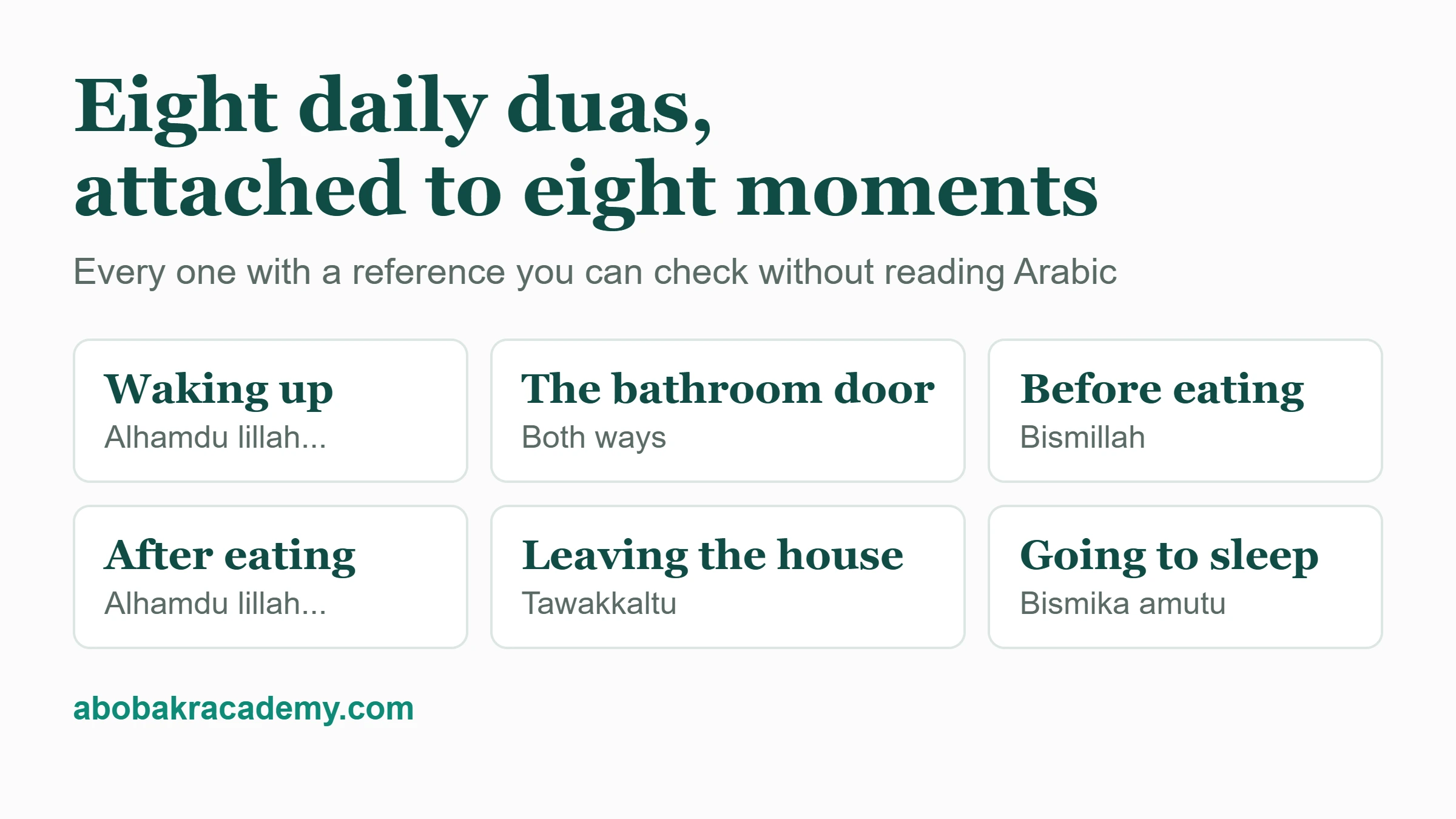
Eight works because eight is roughly the number of moments a child already has, every day, without anyone arranging them. She wakes up. She goes to the bathroom. She eats. She leaves the house. She eats again. She goes to bed. Those moments arrive on their own. The dua attaches to the moment, and the moment does the remembering.
Thirty duas need a schedule. Eight duas need a fridge door.
The eight, with references
Every line below was checked against the source before it went on this page. Where the wording comes from a hadith, the collection and number are given and link to the text on sunnah.com. Where it comes from the Qur’an, the verse links to quran.com. You are entitled to expect that of any dua sheet you print, and you can check every one of these in about a minute without knowing a word of Arabic, because the reference either resolves or it does not.
| When | Arabic | Say it like this | What it means | Reference |
|---|---|---|---|---|
| Waking up | الْحَمْدُ لِلَّهِ الَّذِي أَحْيَانَا بَعْدَ مَا أَمَاتَنَا وَإِلَيْهِ النُّشُورُ | Alhamdu lillahi alladhi ahyana ba’da ma amatana wa ilayhin-nushur | Praise be to Allah, who gave us life after He caused us to die, and to Him is the return. | Sahih al-Bukhari 6312 |
| Going into the bathroom | اللَّهُمَّ إِنِّي أَعُوذُ بِكَ مِنَ الْخُبُثِ وَالْخَبَائِثِ | Allahumma inni a’udhu bika minal-khubuthi wal-khaba’ith | O Allah, I seek refuge with You from all offensive and wicked things. | Sahih al-Bukhari 142 |
| Coming out again | غُفْرَانَكَ | Ghufranak | I ask You for Your forgiveness. | Sunan Abi Dawud 30, graded sahih |
| Before eating | بِسْمِ اللَّهِ | Bismillah | In the name of Allah. If she forgets and remembers halfway: Bismillahi awwalahu wa akhirah, in the name of Allah at its beginning and its end. | Sunan Abi Dawud 3767, graded sahih |
| After eating | الْحَمْدُ لِلَّهِ الَّذِي أَطْعَمَنِي هَذَا وَرَزَقَنِيهِ مِنْ غَيْرِ حَوْلٍ مِنِّي وَلَا قُوَّةٍ | Alhamdu lillahi alladhi at’amani hadha wa razaqanihi min ghayri hawlin minni wa la quwwah | Praise be to Allah, who fed me this and provided it for me, with no power or strength of my own. | Jami’ at-Tirmidhi 3458, graded hasan |
| Leaving the house | بِسْمِ اللَّهِ تَوَكَّلْتُ عَلَى اللَّهِ لَا حَوْلَ وَلَا قُوَّةَ إِلَّا بِاللَّهِ | Bismillah, tawakkaltu ‘ala Allah, la hawla wa la quwwata illa billah | In the name of Allah, I put my trust in Allah, there is no might and no power except with Allah. | Sunan Abi Dawud 5095, graded sahih |
| Sitting down to study | رَبِّ زِدْنِي عِلْمًا | Rabbi zidni ‘ilma | My Lord, increase me in knowledge. | Qur’an 20:114 |
| Going to sleep | اللَّهُمَّ بِاسْمِكَ أَمُوتُ وَأَحْيَا | Allahumma bismika amutu wa ahya | O Allah, in Your name I die and I live. | Sahih al-Bukhari 6314 |
Two of these are one word long. Three are a single short line. The longest one is the after-eating dua, and it is the one to leave until last.
Attach each one to a moment that already happens
The mistake is to teach all eight and then hope they surface. Teach one, attached to a moment, and do not add the next until the first one arrives without you asking.
A workable order, roughly one a week:
- Bismillah before eating. It happens three times a day, it is two syllables, and the whole family can say it out loud together, which does most of the teaching for you.
- Ghufranak. One word, and the bathroom door is a very reliable trigger.
- Going to sleep. You are already in the room. Say it with her rather than asking whether she said it.
- Waking up. Harder than it looks, because mornings are chaos. Tape it to the back of the bedroom door.
- Going into the bathroom. Now she has both halves of that door.
- Leaving the house. The school run says it for her until she says it herself.
- Rabbi zidni ‘ilma. Homework, Qur’an lesson, anything that counts as sitting down to learn.
- After eating. Longest, last, and by now she has weeks of proof behind her that she can do this.
If a week goes past and one has not stuck, stay on it. Nothing is lost by spending a fortnight on Ghufranak. Something is lost by moving to number five while numbers two and three have quietly stopped happening.
The transliteration will get three sounds wrong, and that is worth knowing
The middle column exists because you need something you can read. It will also teach your child a slightly wrong consonant in a few predictable places, and there is no version of English spelling that fixes this.
The two that matter here are the h in alhamdu and the gh in ghufranak. Neither is an English sound. The h is made further back in the throat than the one in “hello”, and the gh is closer to a French r than to anything in English. A child who learns them from the spelling will say them the English way, and will keep saying them the English way for years, because nobody at home can hear that anything is off. The same thing happens with the letters children mispronounce in Al-Fatiha, and for the same reason.
What to do about it is simple and it is not a purchase. Find one recitation of each dua, from a reciter or a teacher, and let her hear it before she reads it. Sound first, spelling second. The spelling is a reminder of a sound she already has, not the source of it.
How to tell it has actually landed, without reading a word
You cannot check her Arabic. You can check three things that do not need Arabic at all.
Does it arrive without a prompt? This is the only test that matters. A dua she says when you remind her is a dua you are saying. Sit through one meal without prompting anybody and see what happens.
Is it the same every time? You do not need to know what the words mean to notice that Tuesday’s version is longer than Monday’s. Drift means she is reconstructing it rather than remembering it, and that is the moment to go back to the recording.
Can she tell you what it is for? Ask her what she is saying when she comes out of the bathroom. “Asking Allah to forgive me” is a complete answer from a six year old. “I don’t know, it’s the bathroom one” means she has the sound and not the sense, which is a fine place to be for a week and a poor place to stay. The same distinction between fluent noise and real understanding shows up when you are trying to judge your child’s Qur’an progress.
The part you should not outsource, including to us
We teach Qur’an, Tajweed, Arabic and Islamic Studies, and we would be glad to teach your child. This is not the thing to buy lessons for.
Eight duas attached to eight moments is a parent’s job, it takes about ten seconds a day, and it does not need anyone who reads Arabic. Paying a tutor to run it would slow it down, because the tutor is not there when your daughter comes out of the bathroom and you are. What a teacher is actually useful for is the sound, and that is one lesson, not a course.
The place a teacher earns their fee is the next thing along, when she starts memorizing short surahs for her prayer and the words stop being three seconds long. And if the whole subject has already become a fight in your house, the duas are not where to start at all. Work out why she is refusing first.
Print it and put it where the moment happens
The table above prints. Print it twice, cut it into strips, and put each dua at the place it belongs rather than keeping all eight on one sheet in one room. The bathroom pair goes on the bathroom door. The two food ones go where you eat. The sleeping one goes by her bed.
A dua on the fridge that she walks past eight times a day will outperform an app she opens on Sunday. If you would rather not cut up a web page, the same eight duas are laid out as a printable card sheet. The rest of our sheets, all free and none of them behind an email form, are on the free printables page.
Questions parents ask
What age should a child start learning duas?
As soon as they can repeat a short phrase, which for most children is around three. Start with Bismillah before food, because the whole table is already saying it. There is no readiness test to pass here, unlike deciding when to start formal Qur’an lessons, where the answer depends much more on the individual child.
Does my child have to say the dua in Arabic?
The Arabic is what is being taught, and it is short enough that a young child manages it. Nothing stops her also saying what it means in English, and for a while the English is what makes it a real sentence rather than a noise. Both, and in that order, works well.
My child says the words but has no idea what they mean. Is that a problem?
Not at the start. Sound before sense is how almost every child gets there. It becomes a problem if it stays that way for a year, which is why the “what is it for” question above is worth asking every so often. Give her the meaning in one plain English sentence and let her repeat that too.
Where can I check a dua I found somewhere else?
Search the wording on sunnah.com for a hadith, or quran.com if it looks like a verse. A dua circulating without a reference is not automatically wrong, but you have no way to check it, and there is no shortage of properly referenced ones to use instead.
Should I use a duas app instead?
An app is a fine place to hear the sound, which is the one thing paper cannot do. It is a poor place to build a habit, because it needs somebody to decide to open it. Use the app for the audio and the paper for the moment.
Where to go from here
Get the first one going this week. One dua, one moment, everybody at the table saying it out loud, and no mention of the other seven.
If you would like someone to check the sounds, a teacher can hear in one sitting what a parent cannot hear at all, and can tell you which two or three to work on. That is what our free trial lesson is for, and if your answer after it is that you do not need lessons yet, we will tell you so. Get in touch and say which duas she is working on.