Surah An-Nas (الناس, “Mankind”) is the 114th and last surah of the Quran. It has six short verses, and in them Allah tells us to seek refuge in Him, the Lord, King and God of all people, from the whisperer who puts bad thoughts into people’s hearts and then slips away. Muslims recite it every morning and evening, before sleep and after the prayers, and it is one of the first surahs a child learns.
Below is the whole surah verse by verse with a recitation to play, the Arabic, a transliteration and the meaning, then every word on its own, the sounds a beginner gets wrong, when it is recited, a week’s plan for teaching it to a child, and a free printable with no sign-up.
Surah An-Nas in Arabic, with audio and meaning
Press the button beside a verse to hear it. The reciter is Sheikh Mahmoud Khalil al-Husary in his teaching recitation, al-Muallim: slow and clear, one verse at a time, recorded for people learning to recite. Under each verse is a line you can read to your child.
- قُلْ أَعُوذُ بِرَبِّ النَّاسِ
1 Qul aʿūdhu birabbin-nās
Say, "I seek refuge in the Lord of mankind,
For a child: Allah tells us to say this out loud. To seek refuge means to run to someone to be safe, the way you run to your mum or dad when you are scared. We run to Allah, who looks after every person.
- مَلِكِ النَّاسِ
2 Malikin-nās
The Sovereign of mankind,
For a child: Allah is the King of all people. Every king, queen and president is a person, and Allah is King over all of them.
- إِلَٰهِ النَّاسِ
3 Ilāhin-nās
The God of mankind,
For a child: Allah is the God of all people, the only One we worship.
- مِن شَرِّ الْوَسْوَاسِ الْخَنَّاسِ
4 Min sharril-waswāsil-khannās
From the evil of the retreating whisperer –
For a child: The whisperer is Shaytan. He whispers bad ideas, and when we remember Allah he pulls back and hides. That is what al-khannas means: the one who slips away.
- الَّذِي يُوَسْوِسُ فِي صُدُورِ النَّاسِ
5 Alladhī yuwaswisu fī ṣudūrin-nās
Who whispers [evil] into the breasts of mankind –
For a child: He whispers into people’s hearts: the little voice that says "do it, nobody will see".
- مِنَ الْجِنَّةِ وَالنَّاسِ
6 Minal-jinnati wan-nās
From among the jinn and mankind".
For a child: The whisperer can be one of the jinn, or a person. A friend who keeps pushing you to do something wrong is whispering too.
The transliteration helps you keep your place; take the sound from the recording. A line over a vowel (ā) means hold it longer, a dot under a letter (ṣ) marks a heavy sound English does not have, and ʿ is the letter ‘ayn. Each line stops the way a reciter stops at the end of a verse.
Surah An-Nas word by word
An-Nas has 20 words, and five of them are the same word, an-nās, “people” or “mankind”. A child who knows that one word already understands a quarter of the surah. Here is every word with its meaning.
| Verse | Arabic | Say | Meaning |
|---|---|---|---|
| 1 | قُلْ | qul | Say |
| أَعُوذُ | aʿūdhu | I seek refuge | |
| بِرَبِّ | birabbi | in (the) Lord | |
| النَّاسِ | an-nāsi | (of) mankind | |
| 2 | مَلِكِ | maliki | (The) King |
| النَّاسِ | an-nāsi | (of) mankind | |
| 3 | إِلَٰهِ | ilāhi | (The) God |
| النَّاسِ | an-nāsi | (of) mankind | |
| 4 | مِن | min | From |
| شَرِّ | sharri | (the) evil | |
| الْوَسْوَاسِ | al-waswāsi | (of) the whisperer | |
| الْخَنَّاسِ | al-khannāsi | the one who withdraws | |
| 5 | الَّذِي | alladhī | The one who |
| يُوَسْوِسُ | yuwaswisu | whispers | |
| فِي | fī | in | |
| صُدُورِ | ṣudūri | (the) breasts | |
| النَّاسِ | an-nāsi | (of) mankind | |
| 6 | مِنَ | mina | From |
| الْجِنَّةِ | al-jinnati | the jinn | |
| وَالنَّاسِ | wan-nāsi | and men |
The words are read here as they sound inside the verse. At the end of a verse the reciter stops, so the last vowel drops: an-nāsi becomes an-nās.
The sounds to listen for
If nobody at home reads Arabic, these are the places where a child’s An-Nas usually goes wrong. You do not need to know the rules to hear them. Play the verse, then listen for these in your child’s version.
- The doubled n in an-nās. The n is doubled and said through the nose for a moment, about two beats: an-nnnās, not a-nās. The same happens in al-khannās (verse 4) and al-jinnati (verse 6).
- The l you do not say. It is written al-nās, but the l merges into the n, so it is said an-nās. Children who learn from a book often say “al-nas”.
- The long ā at the end of every verse. Every verse ends on -nās, and the reciter holds that ā longer than an ordinary long vowel. Listen to how long al-Husary holds it and copy that.
- The hidden n in min sharri (verse 4). The n of min is not said clearly before sh. It is hidden in the nose and runs into the sh.
- Two kinds of s. Al-waswās and yuwaswisu use a light s, like the English s. Ṣudūr (verse 5) begins with a heavy ṣ, said with the tongue pressed low and the mouth rounder.
- Qul, not kul. The first sound is q, from the back of the throat, further back than an English k.
- Aʿūdhu. Two sounds English does not have: the ʿayn in the middle, and dh as in “this”, not z.
- Maliki here, māliki in Al-Fatiha. Verse 2 says مَلِكِ maliki, “King”, with a short a. Al-Fatiha says مَالِكِ māliki, with a long ā, in the Hafs reading printed in most mushafs. Children who know Al-Fatiha first often stretch the a here; the recording fixes it.
Our Tajweed rules guide explains each of these, with verses to hear.
When Muslims recite Surah An-Nas
An-Nas and Al-Falaq were revealed together, and the Prophet ﷺ said of them: “What wonderful verses have been sent down today” (Sahih Muslim 814a). Together they are called al-muʿawwidhatayn, the two surahs of seeking refuge. The hadith give these times to recite them:
- Morning and evening, three times each, with Al-Ikhlas: “three times in the morning and evening; they will serve you for every purpose” (Sunan Abi Dawud 5082, graded hasan by al-Albani).
- Before sleep. The Prophet ﷺ cupped his hands, blew into them after reciting Al-Ikhlas, Al-Falaq and An-Nas, and wiped over his body, starting with his head and face. “He used to do that three times.” (Sahih al-Bukhari 5017).
- After every prayer: he told ʿUqbah ibn ʿAmir to recite them “after every prayer” (Sunan Abi Dawud 1523, graded sahih by al-Albani).
- When ill. When he was sick, “he would recite Mu’awwidhat (Surat Al-Falaq and Surat An- Nas) and then blow his breath over his body” (Sahih al-Bukhari 5016).
The bedtime one is where most children learn it. Do it with them every night, hands cupped, three times, and the surah is learnt by ear before anyone has opened a book.
How to teach Surah An-Nas to a child in a week
A child of four or five can learn An-Nas in about a week at ten minutes a day, and an older child faster. The plan below needs no Arabic from you, only the play buttons above.
- Day 1: just listen. Play all six verses three times at bedtime. Do not ask your child to say anything yet.
- Day 2: verses 1 and 2. Play verse 1, let your child say it back, and repeat until it sounds like the recording. Then verse 2.
- Day 3: verses 3 and 4. Start with yesterday’s two. Verse 4 is the longest; split it in two (min sharril-waswās, then il-khannās) if you need to.
- Day 4: verse 5. Listen for the light s of yuwaswisu and the heavy ṣ of ṣudūr.
- Day 5: verse 6, then the whole surah from the start, with you saying the first word of each verse as a prompt.
- Day 6: the pause test. Stop your child after any verse and ask for the next one cold. If they cannot start it without the one before, go back to that verse.
- Day 7: make it theirs. Recite it together at bedtime with Al-Ikhlas and Al-Falaq, hands cupped, three times. From now on that is where it gets revised.
Our short surahs to memorize page puts An-Nas in order with the other eighteen short surahs, and the free short surahs tracker lets your child tick it off.
An-Nas and Al-Falaq: what is the difference?
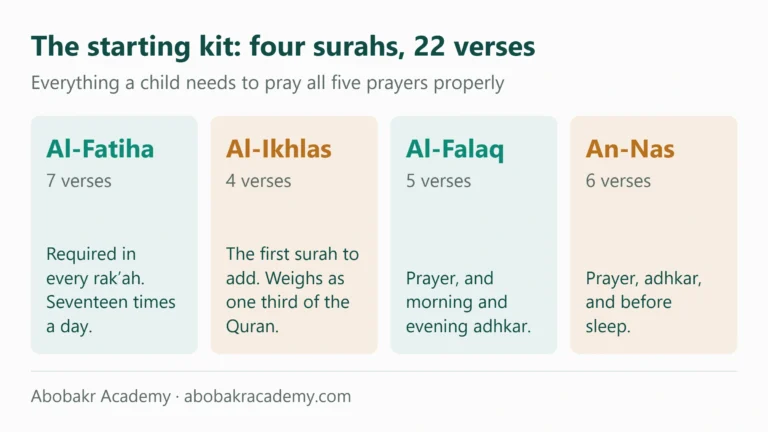
The two are learnt together and are easy to mix up. Al-Falaq asks for protection from harm that comes from outside; An-Nas asks for protection from the whisper that comes from inside. Commentators point out that Al-Falaq names Allah once and lists four harms, while An-Nas names Allah three ways and asks protection from one harm, because the whisper is the harder one to see.
| Al-Falaq (113) | An-Nas (114) | |
|---|---|---|
| Verses | 5 | 6 |
| Allah is named as | Lord of daybreak | Lord, King and God of mankind |
| Protection from | the evil of what He created, darkness, those who blow on knots, the envier | the whisperer, from the jinn and from people |
| Where the harm comes from | outside you | inside: thoughts put into the heart |
| First verse | Qul aʿūdhu birabbil-falaq | Qul aʿūdhu birabbin-nās |
Free Surah An-Nas chart and printable (PDF)
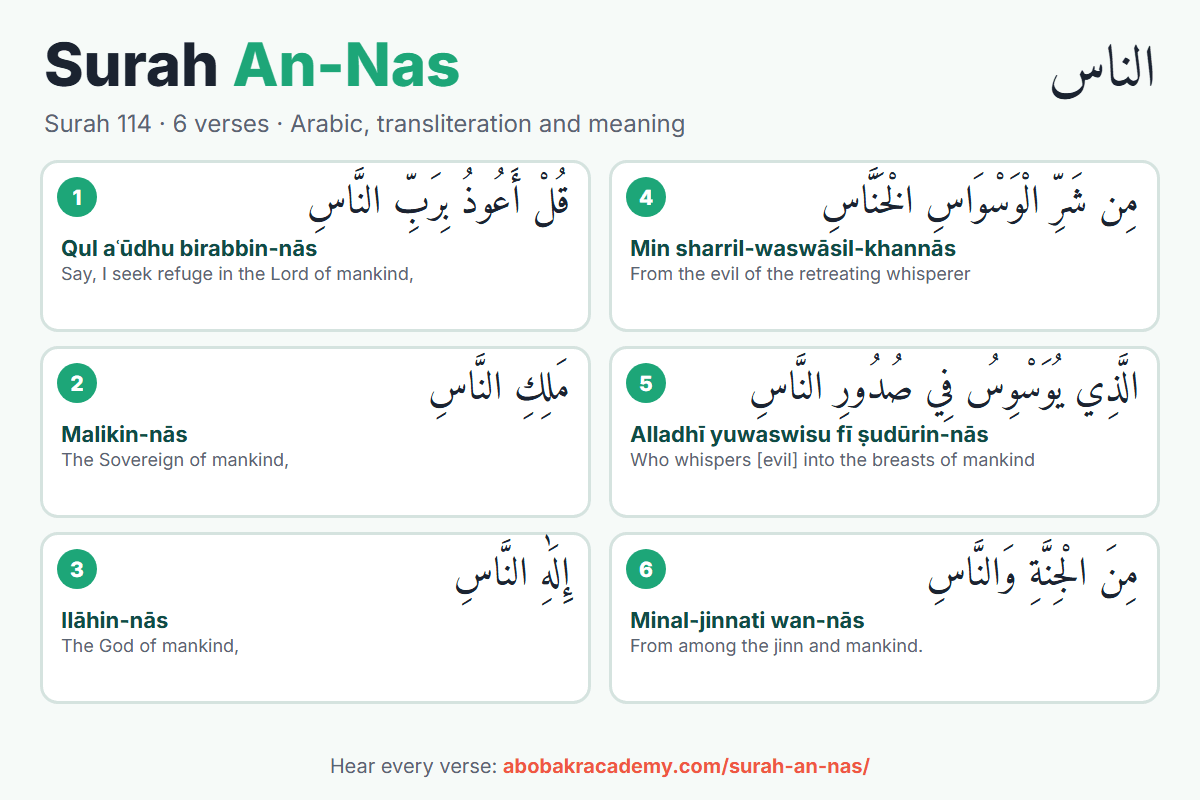
The chart has all six verses in Arabic with the transliteration and the meaning, for the fridge or the wall by your child’s bed. The Surah An-Nas printable (PDF, 2 pages) adds the word by word table, the sounds to listen for and the times to recite it. No email and no sign-up.

When nobody at home reads Arabic
This site is built for families where nobody at home reads Arabic, and An-Nas is one of the surahs such a family can teach well on its own, because it is learnt by ear and the recording does the reciting. Where a parent cannot help is in hearing small mistakes: a short ā, a missing doubled n, a k for a q. A teacher catches those in the first lesson, before they set. Our tutors teach the short surahs to children whose parents do not read Arabic, and explain everything in English. See online Quran classes for kids; the first lesson is free. If paid lessons are out of reach, we keep a list of the ways to learn the Quran online for free, sorted by whether a teacher listens.
Surah An-Nas: what people ask
What is the meaning of Surah An-Nas?
An-Nas means “mankind” or “people”. In the surah Allah tells the Prophet ﷺ, and every Muslim, to say: I seek refuge in the Lord of mankind, the King of mankind, the God of mankind, from the evil of the whisperer who slips away, who whispers into the hearts of people, whether he is from the jinn or from mankind.
What is the story behind Surah An-Nas?
Sahih Muslim records that An-Nas and Al-Falaq were revealed together and that the Prophet ﷺ called them verses whose like had never been seen. Many commentators connect them with the magic worked on the Prophet ﷺ by a man called Labid ibn al-Aʿsam, which is told in Sahih al-Bukhari 5763; that report does not itself name the two surahs, so treat the link as the commentators’ explanation.
What is Surah An-Nas for?
It is a prayer for protection. A Muslim recites it to ask Allah to keep them safe from the whispers of Shaytan and of people who push them towards wrong. It is recited in the morning and evening, before sleep, after the prayers and over someone who is ill.
How do you say Surah An-Nas?
Say it soo-rah an-NAAS, with the n doubled and the long aa held. The l of “al” is not said. Inside the verses, every verse ends on that same -nās.
Where is Surah An-Nas in the Quran?
It is the 114th surah, the very last page of the Quran, in the 30th juz (Juz ‘Amma). It comes straight after Al-Falaq, surah 113.
Why is “an-nas” repeated so many times?
The word comes five times in six verses. Allah is named as Lord, King and God of people, three relationships with every one of us, and the danger is whispers that reach people. The repetition also makes the surah easy for a child to remember: every verse ends on the same sound.
More to learn together
- Short surahs to memorize: all nineteen short surahs in order, verse by verse with audio.
- Daily duas for kids: the du’as a child learns first, from waking up to going to sleep.
- Islamic phrases: a’udhu billah and the other phrases a Muslim child hears every day.
- Salah steps for kids: where the short surahs are recited in the prayer.
- Free printables: more charts and worksheets for Muslim children.