

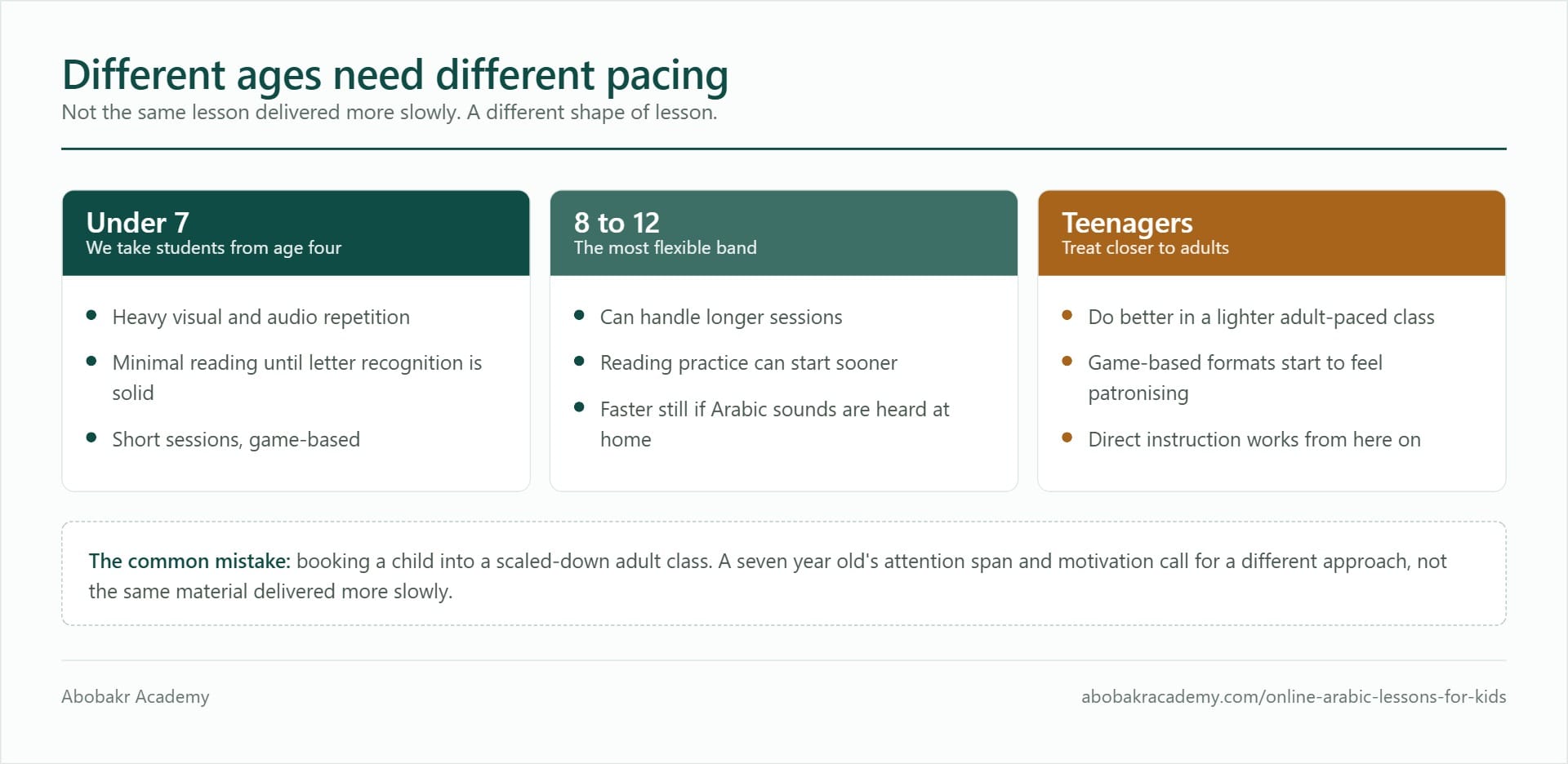
Teaching a child Arabic online works differently from teaching an adult, and the most common mistake is booking a child into a scaled-down version of an adult class. A seven year old’s attention span and motivation call for a different approach, not the same material delivered more slowly.
There is a second difference that most course pages skip. A large share of the children in these lessons are not absolute beginners. They have heard Arabic at home their whole lives. What they cannot do is produce it, and that changes where the lesson should start. If you are looking at Arabic for the household generally rather than for one child, the adult programme covers that ground.
When Your Child Understands Arabic but Answers in English
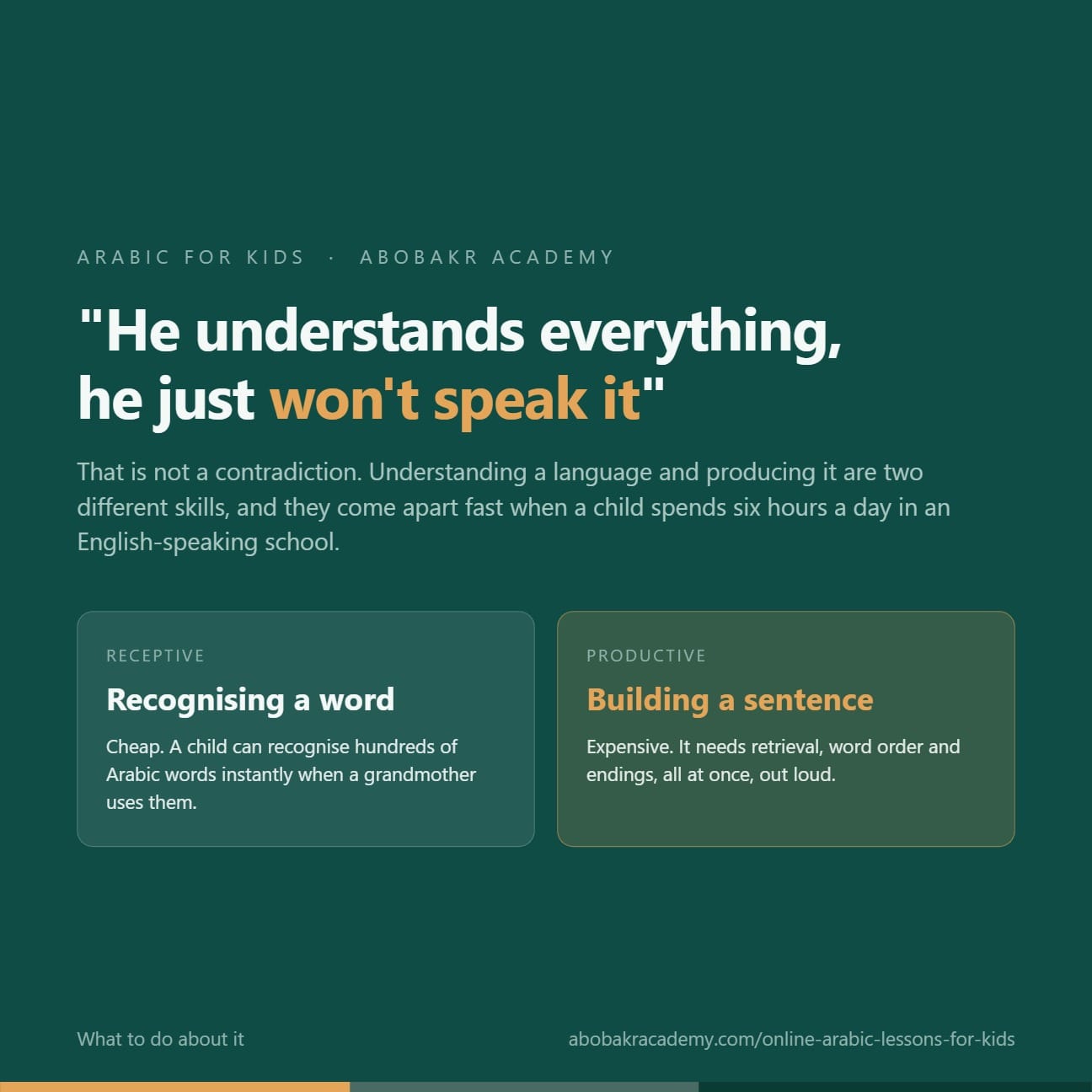
Ask a Muslim parent in Manchester or Michigan how much Arabic their eight year old has, and the answer is often contradictory: he understands everything, he just will not speak it. That is not a contradiction. Understanding a language and producing it are two different skills, and they come apart quickly when a child spends six hours a day in an English-speaking school.
The first is receptive, the second productive. A child can recognise hundreds of Arabic words instantly when a grandmother uses them and still be unable to build a sentence, because recognising a word costs far less effort than retrieving one.
This decides how the lesson should be run. A child with a receptive base does not need the same starting point as a true beginner. Drilling the alphabet from zero throws away what they already have and bores them, which is usually the week a parent hears that Arabic class is boring. What they need is production: being asked questions they have to answer aloud, being handed a sentence frame and made to fill it, being allowed to be wrong quickly and often.
The English-answer reflex does not break through explanation. It breaks through volume of speaking. In a lesson taught one to one, or in a small group of two or three, a child cannot sit behind a classmate, which is the main reason this format suits heritage learners better than a class of thirty. The free trial session is short, roughly fifteen to twenty minutes, and most of it is the tutor working out what the child already recognises before deciding where to begin.
Why Kids Need a Different Structure, Not Just a Slower One
Children generally learn best through repetition wrapped in something enjoyable: songs, short games, visual flashcards, and frequent small wins rather than long explanations. A thirty-minute session packed with short activities holds a child’s attention far better than the same thirty minutes spent on a single grammar point. Teachers working with young learners typically switch activities every five to seven minutes, something that would feel disjointed in an adult lesson but works well with a child.
What Your Child Actually Learns, in Order
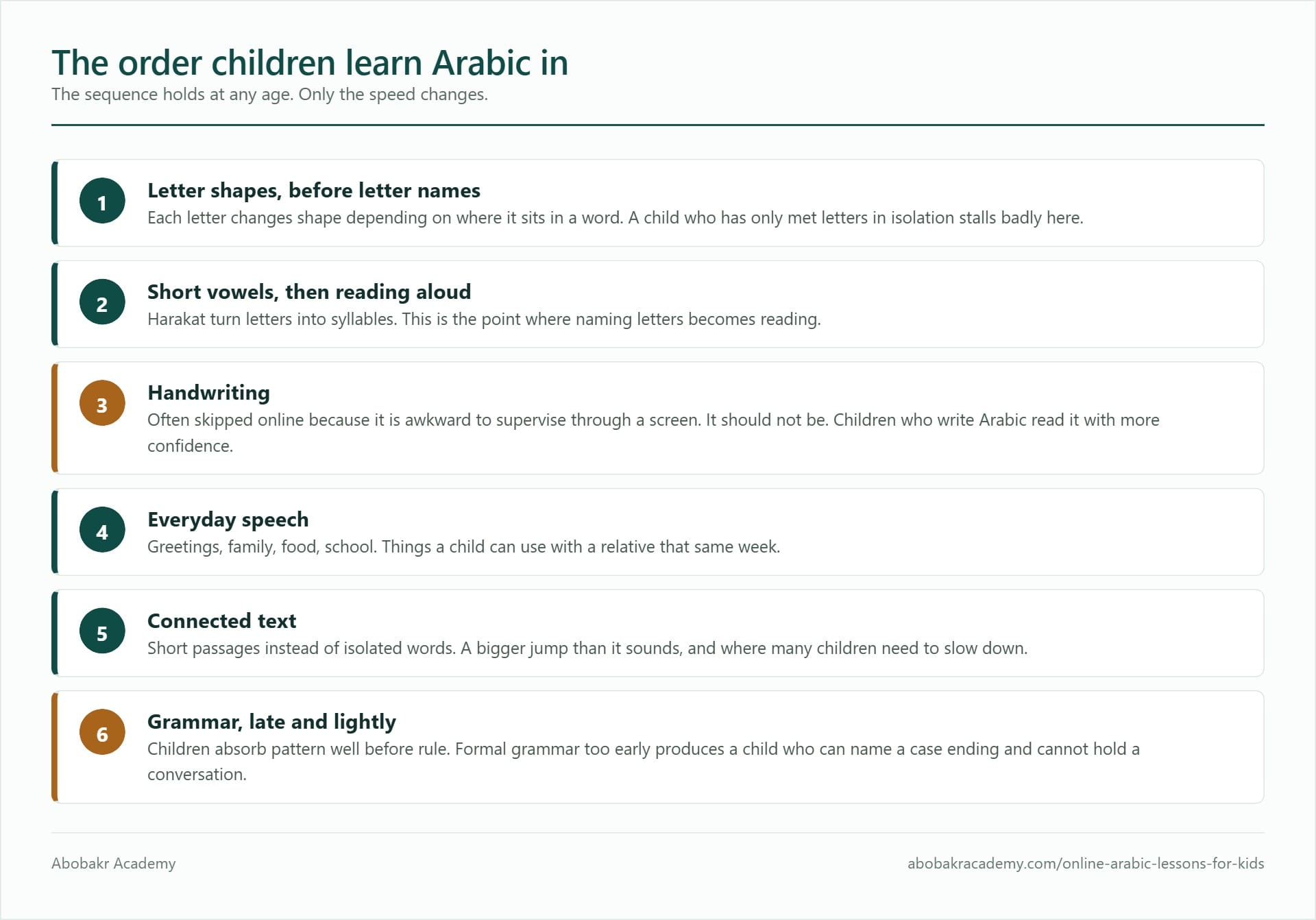
Parents usually want the sequence, not just an assurance that one exists. For children the order below holds at any age, though the speed varies enormously.
Letter shapes before letter names. Knowing the twenty-eight letters is the easy half. The harder half is that each one changes shape depending on where it sits in a word, and a child who has only met letters in isolation stalls badly here. It is worth staying on this until it is automatic. A wall chart helps here more than a book does; ours is free to download and print, and it shows every letter in all four positions.
Short vowels, then reading aloud. Harakat turn letters into syllables, and this is the point at which naming letters becomes reading. It tends to arrive faster for a child who has heard the language spoken at home.
Handwriting. Frequently skipped in online courses because it is awkward to supervise through a screen, and it should not be. Forming the letters by hand fixes their shapes in a way reading alone does not, and children who write Arabic read it with more confidence.
Everyday speech. Greetings, family, food, school, the things a child can use with a relative that same week. For heritage learners this is where recognition starts converting into speech.
Connected text. Short passages instead of isolated words. This is a bigger jump than it sounds and is where a lot of children need to slow down.
Grammar, late and lightly. Children absorb pattern well before rule. Formal grammar introduced too early produces a child who can name a case ending and cannot hold a conversation.
Different Ages Need Different Pacing
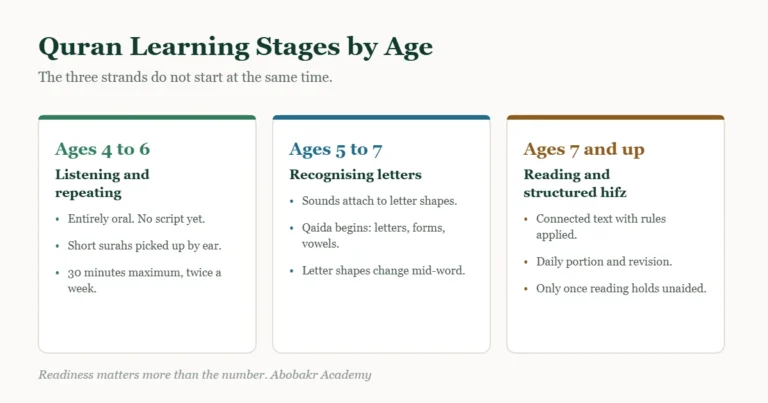
Children under seven generally need heavy visual and audio repetition with minimal reading before letter recognition is solid, and we take students from age four. Children between eight and twelve can usually handle longer sessions and reading practice sooner, especially with some exposure to Arabic sounds at home. Teenagers often do better in a lighter version of an adult-paced class than in a young-child format, since the game-based approach starts to feel patronising once a student is old enough for direct instruction.
When Home Arabic and Classroom Arabic Disagree
A child who speaks Egyptian or Levantine Arabic at home will eventually tell the tutor that a word is wrong. They are not being difficult. Written Arabic and spoken dialect genuinely differ in vocabulary and in the shape of ordinary sentences, and a child who has only ever heard one has no reason to expect the other.
How that moment is handled matters more than which variety is being taught. What works is naming the difference out loud rather than correcting the child: this is how it is written, that is how your family says it, both are Arabic. Children accept that easily. What they will not accept is being told that the way their mother speaks is a mistake, and a tutor who gets that wrong loses the child for weeks.
For most families the practical answer is standard Arabic as the backbone, since it is what books, formal writing and the Quran use, with the home dialect treated as an advantage rather than interference.
Will My Child Sit Through an Online Lesson?
This is the question most parents ask before booking, usually about a child who will not sit still for homework. The honest answer is that it depends far more on how the lesson is built than on the child.
What holds a young child on a screen is a short session, thirty minutes for younger children with no benefit in stretching it, a change of activity every few minutes, the same tutor every week so the child is not spending the first ten minutes warming up to a stranger, and being spoken to rather than presented at.
What loses them is long stretches of explanation, reading material pitched above their level, and any format where staying silent is an option.
If a session is landing badly, it is better to move it than push through. Lessons can be rescheduled with two hours notice, and a weekly subscription includes one cancellation a month, so a lesson that falls on a bad afternoon does not have to be a write-off.
For Families Focused on the Quran Specifically
Many parents booking Arabic for their children are working toward Quran reading rather than conversation, which shifts the emphasis. Correct pronunciation of the letters and their points of articulation matters early, because it is what later tajweed rests on, and vocabulary is drawn from the prayers and the short surahs rather than from everyday speech. Children on this path often start with the Qaida primer and move across to our Quran lessons for children once reading is steady.
What Parents Can Do Between Sessions
Ten minutes of casual review on most days beats one long practice at the weekend. Past that, the things that seem to help are small and unglamorous.
- Let them send voice notes to relatives. Speaking to a grandmother has real stakes attached, which a worksheet never will.
- Keep Arabic books within reach, including ones above their level. Familiarity with the script does some of the work before the reading does.
- Watch something short together in Arabic. It reinforces sound patterns without anyone calling it practice.
- Ask rather than test. “How do you say this?” invites an answer, while “what did you learn today?” reliably produces “nothing”.
- Praise effort ahead of accuracy at this age, and resist correcting every mistake as it happens.
- Protect the weekly slot. A lesson time that keeps moving quietly teaches a child that Arabic is the thing that gets cancelled.
Frequently Asked Questions
At what age can a child start learning Arabic online?
We take students from age four. At that age the lesson is almost entirely listening, repetition and play, with reading introduced once the child can sit through a short guided activity.
How long should a session be for a young child?
Thirty minutes is the usual length for younger children. Lessons run from thirty minutes up to two hours depending on age and what the student is working on, but most sit in the thirty to sixty minute range, and stretching a young child past that rarely improves retention.
My child understands Arabic but refuses to speak it. Is that fixable?
Usually, and faster than parents expect. The recognition is already there, so the work is production practice rather than starting over. Expect the shift to take weeks of being made to answer aloud, not a single breakthrough lesson.
My child is shy on camera. Is online still a good option?
Most children warm up within two or three sessions once they are used to the teacher, which is why keeping the same tutor matters. The free trial usually shows whether the format will suit them before you commit.
Should siblings of different ages share a class?
Generally not. A five year old and an eleven year old need different pacing and different material, so separate sessions work better. Families enrolling more than one child receive a ten percent sibling discount.
Do the lessons teach Modern Standard Arabic or dialect?
Standard Arabic is the backbone, since it is what reading, writing and the Quran require. Where a child already speaks a dialect at home, tutors work with it rather than against it.
Lesson length, frequency and cost are set together, and the current rates are on our pricing page. The first class is free, and it is the quickest way to find out where your child actually is rather than where a syllabus assumes they are. You can arrange one through our contact page.