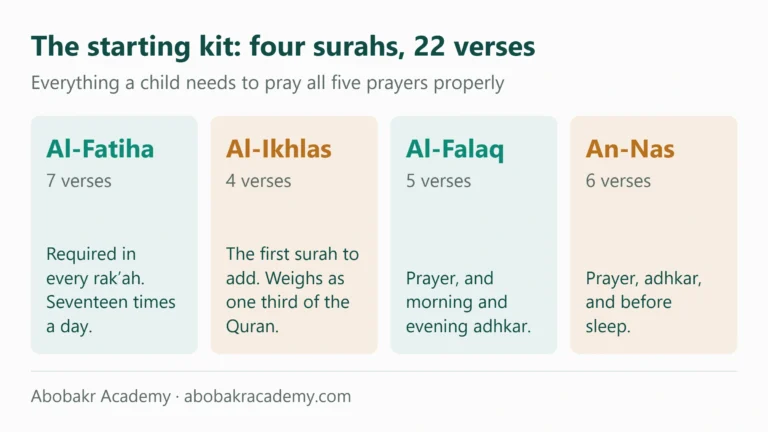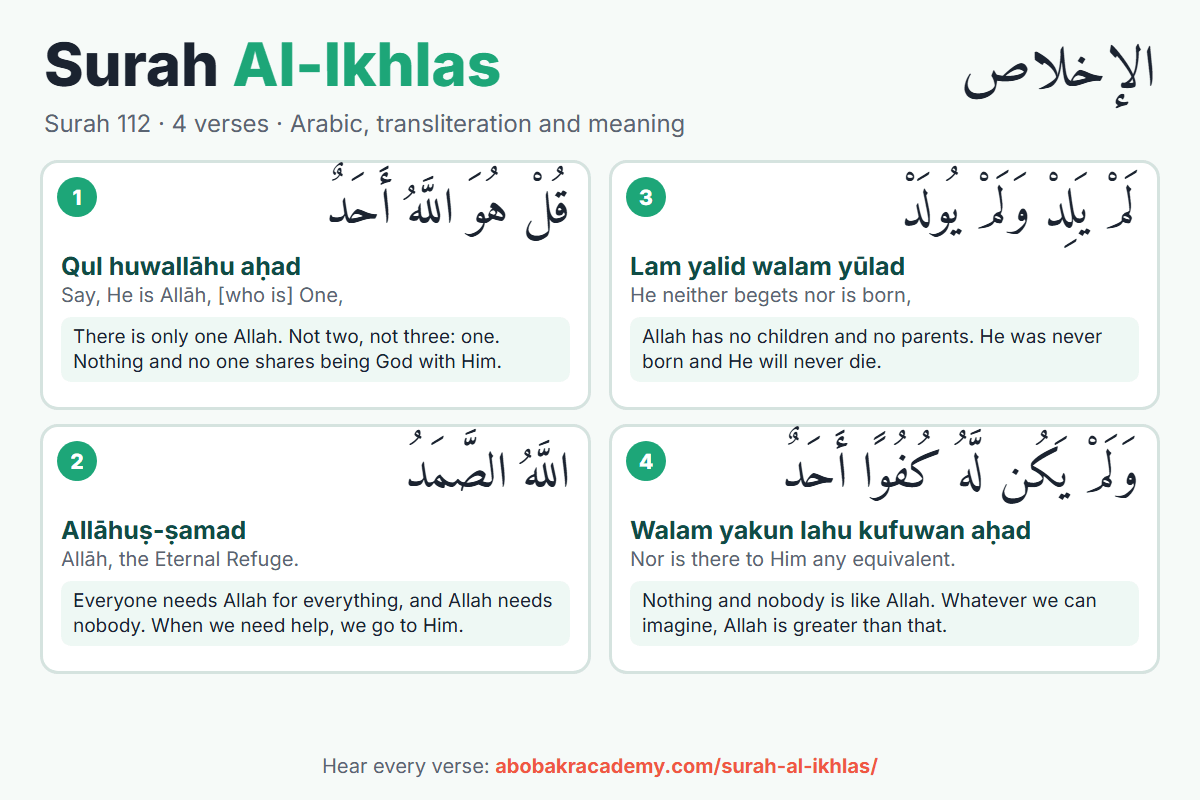
Surah Al-Ikhlas (الإخلاص, “Sincerity”) is the 112th surah of the Quran. It has four short verses, and they say who Allah is: One, the One everyone needs while He needs no one, with no child and no parent, and with nothing like Him. The Prophet ﷺ said it is equal to a third of the Quran. It is recited in prayer, every morning and evening, and before sleep, and it is usually the first surah a child learns after Al-Fatiha.
Below is the whole surah verse by verse with a recitation to play, the Arabic, a transliteration and the meaning, then every word on its own, the sounds a beginner gets wrong, what “a third of the Quran” means, a week’s plan for teaching it to a child, and a free printable with no sign-up.
Surah Al-Ikhlas in Arabic, with audio and meaning
Press the button beside a verse to hear it. The reciter is Sheikh Mahmoud Khalil al-Husary in his teaching recitation, al-Muallim: slow and clear, one verse at a time, recorded for people learning to recite. Under each verse is a line you can read to your child.
- قُلْ هُوَ اللَّهُ أَحَدٌ
1 Qul huwallāhu aḥad
Say, "He is Allāh, [who is] One,
For a child: There is only one Allah. Not two, not three: one. Nothing and no one shares being God with Him.
- اللَّهُ الصَّمَدُ
2 Allāhuṣ-ṣamad
Allāh, the Eternal Refuge.
For a child: Everyone needs Allah for everything, and Allah needs nobody. When we need help, we go to Him.
- لَمْ يَلِدْ وَلَمْ يُولَدْ
3 Lam yalid walam yūlad
He neither begets nor is born,
For a child: Allah has no children and no parents. He was never born and He will never die.
- وَلَمْ يَكُن لَّهُ كُفُوًا أَحَدٌ
4 Walam yakun lahu kufuwan aḥad
Nor is there to Him any equivalent."
For a child: Nothing and nobody is like Allah. Whatever we can imagine, Allah is greater than that.
The transliteration helps you keep your place; take the sound from the recording. A line over a vowel (ā) means hold it longer, a dot under a letter (ḥ, ṣ) marks a sound English does not have. Each line stops the way a reciter stops at the end of a verse.
Surah Al-Ikhlas word by word
Al-Ikhlas has only 15 words. Aḥad, “one”, comes twice, at the start and at the very end, so the surah opens and closes on the same idea. Here is every word with its meaning.
| Verse | Arabic | Say | Meaning |
|---|---|---|---|
| 1 | قُلْ | qul | Say |
| هُوَ | huwa | He | |
| اللَّهُ | allāhu | (is) Allah | |
| أَحَدٌ | aḥadun | the One | |
| 2 | اللَّهُ | allāhu | Allah |
| الصَّمَدُ | aṣ-ṣamadu | the Eternal, the Absolute | |
| 3 | لَمْ | lam | Not |
| يَلِدْ | yalid | He begets | |
| وَلَمْ | walam | and not | |
| يُولَدْ | yūlad | He is begotten | |
| 4 | وَلَمْ | walam | And not |
| يَكُن | yakun | is | |
| لَّهُ | lahu | for Him | |
| كُفُوًا | kufuwan | equivalent | |
| أَحَدٌ | aḥadun | any [one] |
The words are read here as they sound inside the verse. At the end of a verse the reciter stops, so the last vowel drops: aḥadun becomes aḥad.
The sounds to listen for
If nobody at home reads Arabic, these are the places where a child’s Al-Ikhlas usually goes wrong. You do not need to know the rules to hear them. Play the verse, then listen for these in your child’s version.
- The bounce on every final d. All four verses end on d: aḥad, aṣ-ṣamad, yūlad, aḥad. When the reciter stops on it, the d bounces with a small echo (qalqalah) instead of stopping dead.
- Qul and aḥad. Qul has q from the back of the throat, not k. Aḥad has ḥ, a breathy h like breathing on a cold window, not an English h.
- The heavy l of Allāh. In huwallāhu and at the start of verse 2 the l of Allāh is heavy, said with a full, round mouth, because the vowel before it is a.
- Aṣ-ṣamad. The l of “al” is not said; it merges into the ṣ, which is doubled and heavy, with the tongue pressed low.
- Yakun lahū. Written yakun lahu, said yakul-lahū: the n disappears into the l with no nasal sound, and the u of lahu is held for two counts because the next letter carries a vowel.
- Kufuwan aḥad. The n at the end of kufuwan is said clearly before the a of aḥad. It does not hide or merge.
Our Tajweed rules guide explains each of these, with verses to hear.
Why Al-Ikhlas is equal to a third of the Quran
A man heard someone reciting Al-Ikhlas over and over and told the Prophet ﷺ, as if he thought it was too little. The Prophet ﷺ said: “this Surah is equal to one-third of the Qur’an!” (Sahih al-Bukhari 5013). In another report he asked his companions, “Is any one of you incapable of reciting a third of the Qur’an in a night?”, and when they asked how, he named Al-Ikhlas (Sahih Muslim 811a).
Scholars explain the third by what the Quran contains: much of it is about who Allah is, much about what He commands, and much about what happened and what will happen. Al-Ikhlas is entirely the first of these. That is why it is so highly rewarded; it does not mean reading it replaces reading the rest of the Quran.
A companion who always ended his recitation in prayer with Al-Ikhlas explained that he loved it because it describes the Most Merciful, and the Prophet ﷺ said: “Tell him that Allah loves him.” (Sahih al-Bukhari 7375).
When Muslims recite Surah Al-Ikhlas
- Morning and evening, three times, with Al-Falaq and An-Nas: “three times in the morning and evening; they will serve you for every purpose” (Sunan Abi Dawud 5082, graded hasan by al-Albani).
- Before sleep. The Prophet ﷺ cupped his hands, blew into them after reciting Al-Ikhlas, Al-Falaq and An-Nas, and wiped over his body, starting with his head and face. “He used to do that three times.” (Sahih al-Bukhari 5017).
- In prayer. Being short, it is one of the surahs recited most often after Al-Fatiha.
At bedtime the three go in order: Al-Ikhlas, then Al-Falaq, then An-Nas, hands cupped, three times. Each has its own page here, verse by verse with the same recitation.
How to teach Surah Al-Ikhlas to a child in a week
Al-Ikhlas is short enough that many children of three or four learn it by hearing it at bedtime. Taught on purpose, ten minutes a day, a week is plenty. The plan below needs no Arabic from you, only the play buttons above.
- Day 1: just listen. Play all four verses three times at bedtime. Do not ask your child to say anything yet.
- Day 2: verse 1. Play it, let your child say it back, and repeat until it sounds like the recording, bounce at the end included.
- Day 3: verse 2. Two words. Start with verse 1 and add it.
- Day 4: verse 3. Lam yalid, walam yūlad: the two halves sound alike, so let your child hear the difference between yalid and yūlad.
- Day 5: verse 4, the longest, then the whole surah from the start.
- Day 6: the pause test. Stop your child after any verse and ask for the next one cold.
- Day 7: make it theirs. Recite it at bedtime before Al-Falaq and An-Nas, hands cupped, three times. From now on that is where it gets revised.
Our short surahs to memorize page puts Al-Ikhlas second, straight after Al-Fatiha, and the free short surahs tracker lets your child tick it off.
Free Surah Al-Ikhlas chart and printable (PDF)
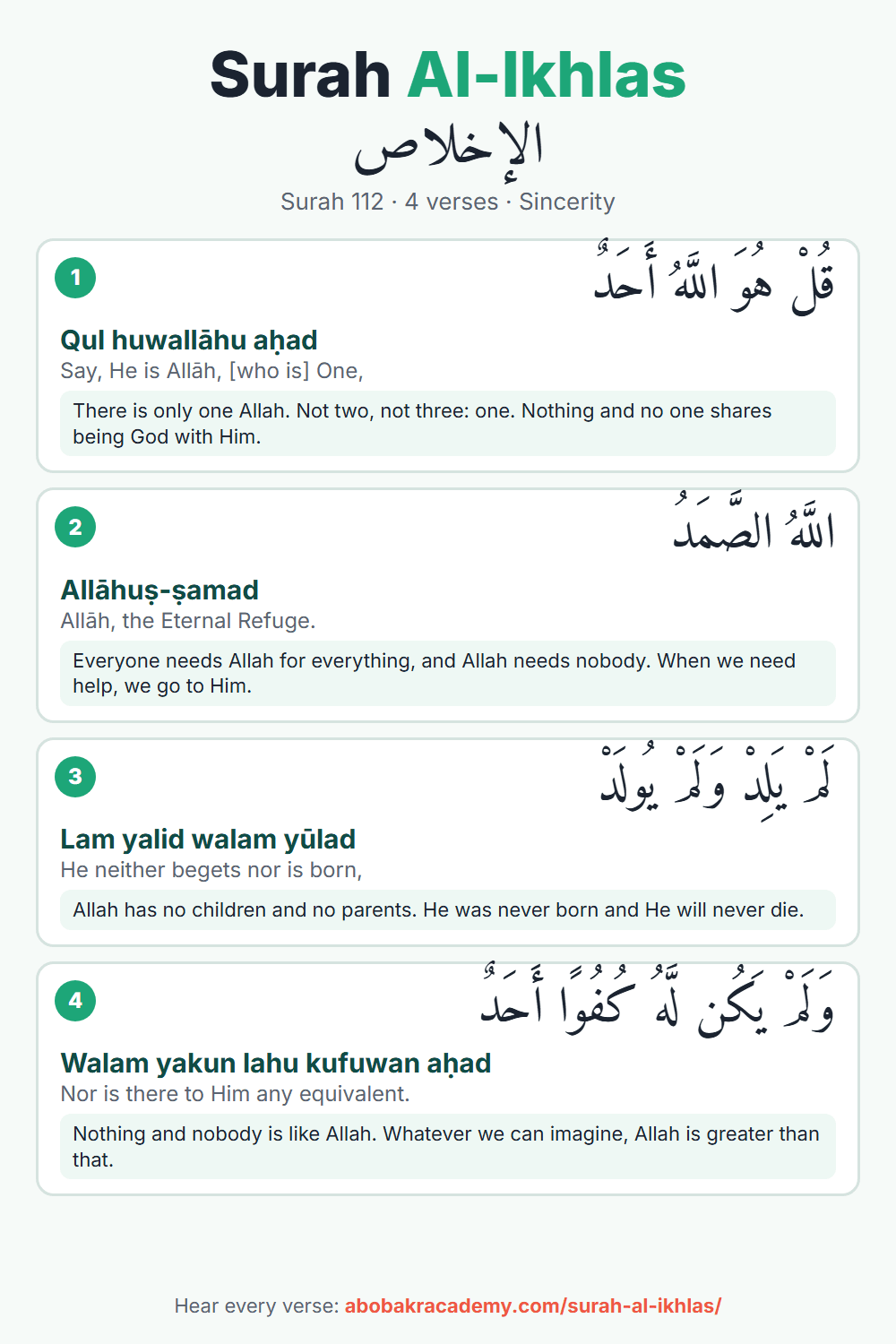
The chart has all four verses in Arabic with the transliteration and the meaning, for the fridge or the wall by your child’s bed. The Surah Al-Ikhlas printable (PDF, 2 pages) adds the word by word table, the sounds to listen for and the times to recite it. No email and no sign-up.
When nobody at home reads Arabic
This site is built for families where nobody at home reads Arabic, and Al-Ikhlas is the easiest surah for such a family to teach well, because it is short and learnt by ear. Where a parent cannot help is in hearing small mistakes: an h for a ḥ, a flat d, a light l in Allāh. A teacher catches those in the first lesson, before they set. Our tutors teach the short surahs to children whose parents do not read Arabic, and explain everything in English. See Quran classes for children; the first lesson is free.
Surah Al-Ikhlas: what people ask
Which surah is called a third of the Quran?
Al-Ikhlas, surah 112. The Prophet ﷺ said it is equal to a third of the Quran, in Sahih al-Bukhari 5013 and Sahih Muslim 811. Scholars explain that a third of the Quran describes who Allah is, and Al-Ikhlas is wholly about that.
What is three times Surah Ikhlas equal to?
Many people say three times equals the whole Quran. That is an inference from the hadith, which says one recitation equals a third; the hadith itself does not say three times. It is a great reward either way, and it does not take the place of reading the rest of the Quran.
What does ikhlas mean?
Ikhlas means sincerity or purity: making your worship for Allah alone. The word does not appear in the surah; the surah is given the name because it describes Allah purely, with nothing joined to Him.
What is Surah Ikhlas in English?
Say: He is Allah, the One. Allah, the Eternal Refuge. He neither begets nor is born, nor is there to Him any equivalent.
Why was Surah Al-Ikhlas revealed?
A report in Jami at-Tirmidhi 3364 says the idolaters asked the Prophet ﷺ to describe his Lord’s lineage and the surah was revealed in reply. Sunnah.com grades that report weak, so treat it as the commentators’ explanation rather than a certain account.
What is the best surah for kids to learn first?
Al-Fatiha, because every prayer needs it, then Al-Ikhlas, because it is four short verses that a child has usually heard many times already. Al-Falaq and An-Nas come next.
More to learn together
- Surah Al-Falaq and Surah An-Nas: the two surahs recited with Al-Ikhlas at bedtime.
- 99 names of Allah for kids: Al-Ahad and As-Samad are two of them.
- Short surahs to memorize: all nineteen short surahs in order, verse by verse with audio.
- Daily duas for kids: the du’as a child learns first, from waking up to going to sleep.
- Free printables: more charts and worksheets for Muslim children.