Noorani Qaida is the beginner’s primer most Quran teachers use to take a child or an adult from not knowing the Arabic letters to reading the Quran correctly. Most editions have 17 lessons (prints range from about 16 to 20), moving from single letters through vowels, long vowels, sukoon and shaddah to short verses. Children usually start around five and finish in six to twelve months; adults often take three to six.
It needs no spoken Arabic, so a parent who reads none can still follow along with the recordings of every stage below. What comes after it is set out in our step-by-step guide for Quran beginners.
What Is Noorani Qaida?
Noorani Qaida (القاعدة النورانية) is a beginner’s primer that teaches the reading of Quranic Arabic from absolute zero. It starts with the individual Arabic letters, then combines them step by step, letter shapes, vowel marks, joined forms, elongations, until the learner can read full verses of the Quran accurately. It was compiled by Sheikh Noor Muhammad Haqqani, a scholar from Ludhiana in India, around the turn of the twentieth century, and editions of it are now printed everywhere from Karachi to Cairo to London.
What makes the Qaida unusual is that it teaches reading and correct pronunciation at the same time. A child who finishes it properly doesn’t just recognize words. They already apply the basic rules of Tajweed without knowing the rule names, because every exercise was designed around them. That is why serious Quran programs, including our own Quran course for beginners, still build their first months around it rather than replacing it with something modern.
How the Lessons Are Structured
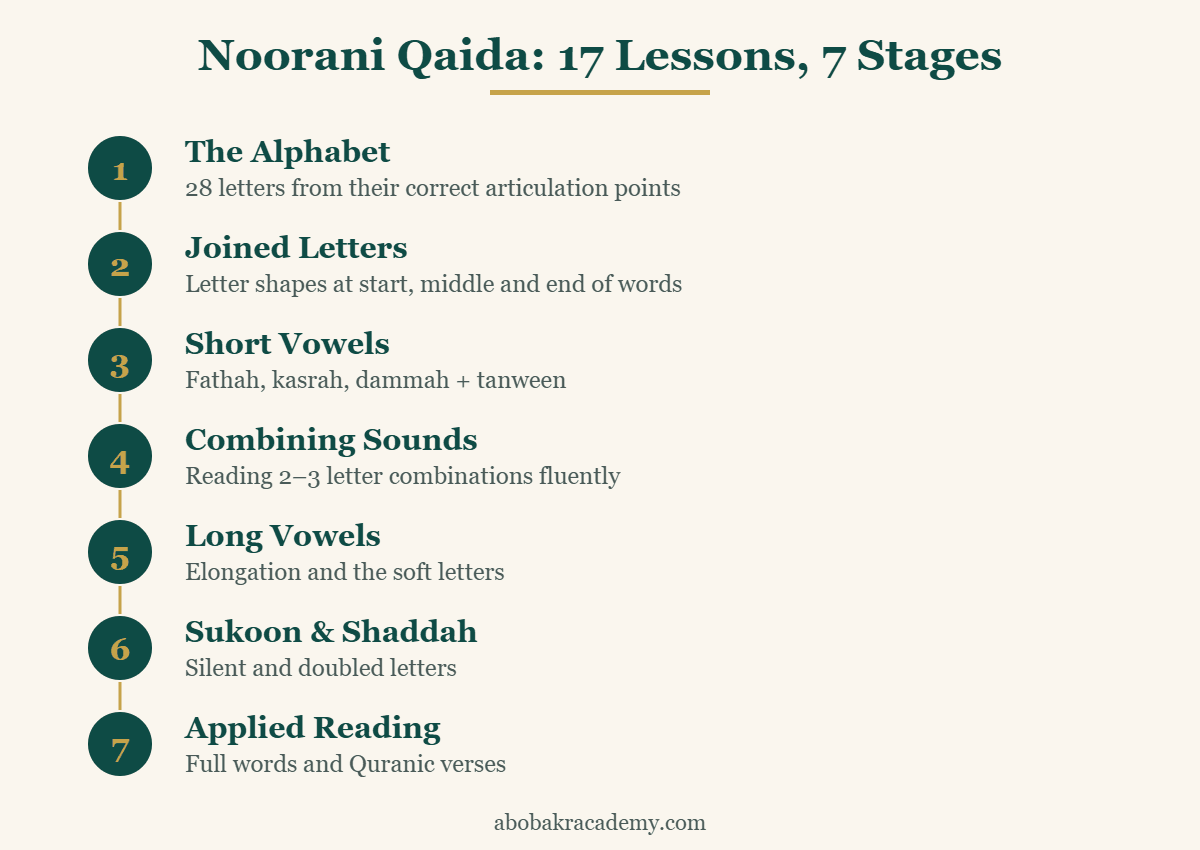
Most editions arrange the material into seventeen short lessons. Some prints split or merge them into anywhere from sixteen to twenty, but the progression is always the same:
- Lessons 1–2: The alphabet. The twenty-eight letters in their isolated forms, each pronounced from its correct articulation point (makhraj). Our free printable Arabic alphabet chart covers exactly this stage, with the joined forms the next lessons move on to. This is where a teacher matters most. Several Arabic sounds simply don’t exist in English.
- Lessons 3–4: Joined and compound letters. Arabic letters change shape depending on where they sit in a word; these lessons drill all the positions, plus special compounds like لا.
- Lessons 5–7: The short vowels. Fathah, kasrah and dammah, the three marks that turn silent letters into syllables, followed by tanween (the doubled end-vowels).
- Lessons 8–10: Combining sounds. Reading two- and three-letter combinations fluently, the stage where actual “reading” clicks for most learners.
- Lessons 11–13: Long vowels and softness. The elongating letters (huroof maddah) and the soft letters (huroof leen) that stretch sounds to two counts.
- Lessons 14–15: Sukoon and shaddah. Silent letters and doubled letters, the marks that give Quranic words their rhythm.
- Lessons 16–17: Applied reading. Full words and short verses from the Quran, read with the stretching and stopping rules learned earlier.
A primer puts reading before reciting, and reciting is what the tradition prizes: Sahih al-Bukhari 5027 records the Prophet, peace be upon him, saying that the best of you are those who learn the Quran and teach it. Nothing in the booklet is decorative. Each page drills exactly one new idea on top of everything before it, which is why skipping ahead almost always ends in re-learning later.
The seventeen lessons as a table, with what stalls each band
The same progression as the list above, in a form you can scan or copy into a lesson plan. The fourth column is the one nothing else on this subject publishes: the mistake that usually holds a learner at that band. Catching it early is most of what a primer is for.
| Lessons | What it covers | What they can do after it | What usually stalls them |
|---|---|---|---|
| 1 to 2 | The twenty eight letters in isolated form, each from its own makhraj | Name and sound every letter on its own | Borrowing an English sound for ح ع ص ط. This is where a teacher matters most. |
| 3 to 4 | Joined and compound forms, including لا | Recognise a letter anywhere in a word | Learning the isolated shape only, then freezing when the same letter appears joined. |
| 5 to 7 | Fathah, kasrah and dammah, then tanween | Turn letters into syllables and read them aloud | Naming the vowel instead of sounding it, so ba becomes ba fathah. |
| 8 to 10 | Two and three letter combinations | Read short combinations without stopping. Reading clicks here. | Rushing this band. It decides whether reading ever becomes automatic. |
| 11 to 13 | Long vowels, huroof maddah, and the soft letters, huroof leen | Hold a stretch for two counts, the same way every time | Stretching by feel, so the same word is two counts once and four the next. |
| 14 to 15 | Sukoon and shaddah | Read silent and doubled letters with the right rhythm | Passing over the shaddah, which reappears later as a missing ghunnah. |
| 16 to 17 | Full words and short verses from the Quran | Read a short surah applying the stretching and stopping rules | Arriving here before band four is automatic, which forces a re-learn. |
Hear Each Stage Read Aloud, in a Real Verse
The Qaida is a listen-and-repeat book, and a page of it cannot tell you what a letter sounds like. So here is one verse for each band of lessons, mostly from the surahs children learn first, in Sheikh Mahmoud Khalil al-Husary’s teaching recitation (al-Mu’allim), recorded slowly for learners to copy. Play it, pause, and have your child say it back. If nobody at home reads Arabic, this is how you check a sound without guessing.
Lessons 1 to 2: Single letters from their makhraj
الْحَمْدُ لِلَّهِ رَبِّ الْعَالَمِينَ
Al-ḥamdu lillāhi rabbil-ʿālamīn (Al-Fatihah 1:2): [All] praise is [due] to Allāh, Lord of the worlds.
Listen for the ḥ of al-ḥamdu and the ʿayn of al-ʿālamīn, two throat letters English has no sound for.
Lessons 3 to 4: Joined letters, and letters read by name
كهيعص
Kāf Hā Yā ʿAyn Ṣād (Maryam 19:1): Kāf, Hā, Yā, ʿAyn, Ṣād.
Listen for five letters written joined as one word but read by their names, the muqattaʿat many editions drill at this stage.
Lessons 5 to 7: Short vowels and tanween
وَلَمْ يَكُن لَّهُ كُفُوًا أَحَدٌ
Walam yakun lahu kufuwan aḥad (Al-Ikhlas 112:4): Nor is there to Him any equivalent.
Listen for kufuwan: the doubled ending (tanween) sounded as -an because the reciter does not stop on it.
Lessons 8 to 10: Reading short combinations
قُلْ هُوَ اللَّهُ أَحَدٌ
Qul huwallāhu aḥad (Al-Ikhlas 112:1): Say, “He is Allāh, [who is] One.”
Listen for four short words read straight through without a pause between letters.
Lessons 11 to 13: Long vowels (maddah) and soft letters (leen)
مَالِكِ يَوْمِ الدِّينِ
Māliki yawmid-dīn (Al-Fatihah 1:4): Sovereign of the Day of Recompense.
Listen for the two-count stretch on the ā of māliki, the longer stretch on dīn where the verse stops, and the soft aw of yawmi.
Lessons 14 to 15: Sukoon and shaddah
إِنَّا أَعْطَيْنَاكَ الْكَوْثَرَ
Innā aʿṭaynākal-kawthar (Al-Kawthar 108:1): Indeed, We have granted you, [O Muḥammad], al-Kawthar.
Listen for the doubled n of innā held with a nasal hum (ghunnah), and the ʿayn of aʿṭaynāka read with no vowel after it (sukoon).
Lessons 16 to 17: Applied reading
إِنَّ الْإِنسَانَ لَفِي خُسْرٍ
Innal-insāna lafī khusr (Al-‘Asr 103:2): Indeed, mankind is in loss.
Listen for a whole verse read with every rule from the bands above and a proper stop at the end.
Al-Fatihah, Al-Ikhlas, Al-Kawthar and Al-‘Asr are recited in full, verse by verse, on our page of short surahs to memorize.
Why This Method Still Works
The Qaida is phonics for Quranic Arabic. Instead of memorizing whole words by sight, which collapses the moment a learner meets an unfamiliar verse, it builds sound-by-sound decoding that works on any page of the Quran. Modern literacy research arrived at the same conclusion for English reading a century later: systematic phonics beats whole-word memorization. Sheikh Haqqani simply got there first.
The second reason is pronunciation. Because every exercise is read aloud to a teacher who corrects the articulation points immediately, mistakes never get the weeks of repetition they need to become habits. Learners who start with apps or YouTube alone often read quickly but carry a dozen fossilized pronunciation errors that take months to undo.
Print the lesson map and progress record
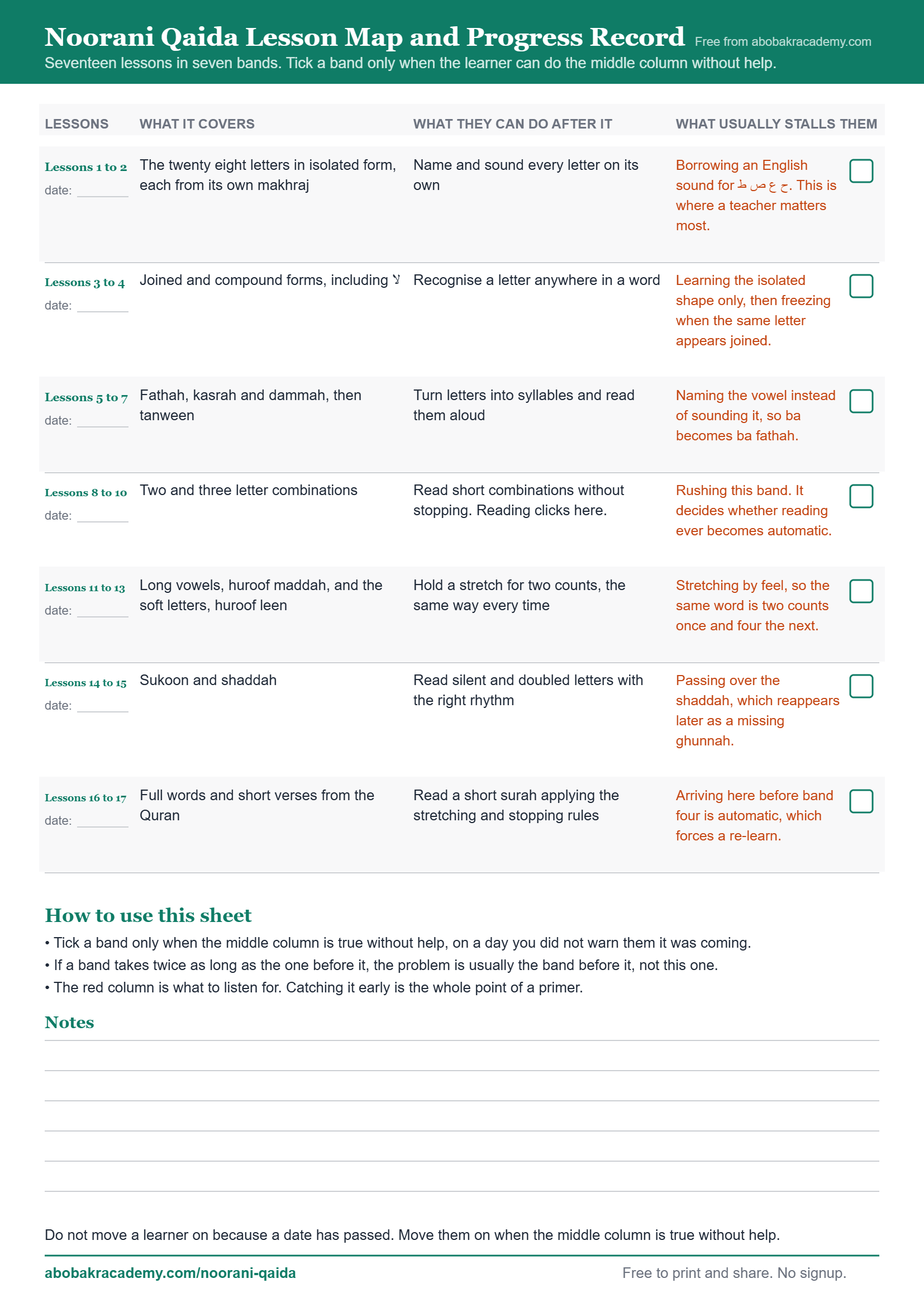
One sheet of A4 with all seven bands, a tick box and a date line for each, and room for notes. It is our own work rather than a copy of the Qaida itself, which is somebody else’s book. Free, no email, and you are welcome to print a class set. If you want a per lesson version, the Noorani Qaida progress tracker goes lesson by lesson.
- Lesson map and progress record, print ready A4 PDF
- The same sheet as a PNG image (for a phone, a tablet or a whiteboard)
How Long Does Noorani Qaida Take?
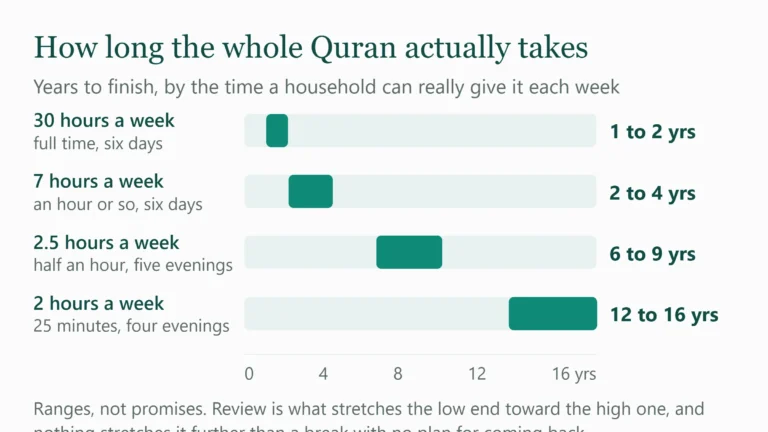
With two to three lessons per week, most students finish in this range:
- Children aged 5–8: six to twelve months. Younger children move slowly through the letters but rarely need to unlearn anything.
- Children aged 9–14: four to eight months, often faster because their attention span supports longer sessions.
- Adults: three to six months. Adults grasp the logic quickly; their real battle is pronunciation. Our tutors often spend two or three full sessions just on the throat letters with adult beginners, and that patience pays off for years.
Rushing is the classic mistake. A student who finishes in three months reading hesitantly has gained less than one who finishes in six reading smoothly. The Qaida is a foundation, and cracks in it show up in every later stage.
Noorani Qaida for Adults
Plenty of adults feel embarrassed opening a children’s primer. Don’t be. Every adult in our program held the same worry in week one and forgot it by week three. In our experience adults who commit to two sessions a week read their first full verse within a couple of months, and nobody will make you feel behind for starting late. If that’s you, our guide on learning to read the Quran as an adult covers everything that comes after the Qaida. For the time the later stages take, with one lesson a week or five, see our Tajweed timeline.
Learning Noorani Qaida Online: Teacher or App?
Apps and printed qaidas are useful for revision, but the Qaida was designed as a listen-and-repeat text. The teacher recites, the student mimics, the teacher corrects on the spot. That feedback loop is the method. Remove it and you keep the pages but lose the system. A live teacher also adjusts pace lesson by lesson, spending three sessions on the throat letters for one student and one session for another.
This is exactly how our Noorani Qaida classes for kids run: one-to-one video lessons with qualified tutors, including Al-Azhar trained teachers, scheduled around US, UK, Canadian and Australian time zones. Adults follow the same curriculum privately at their own pace.
What Comes After the Qaida?
Nazra comes next: reading straight from the Quran itself until it is fluent. Then Tajweed, then memorisation for those who want it. In order:
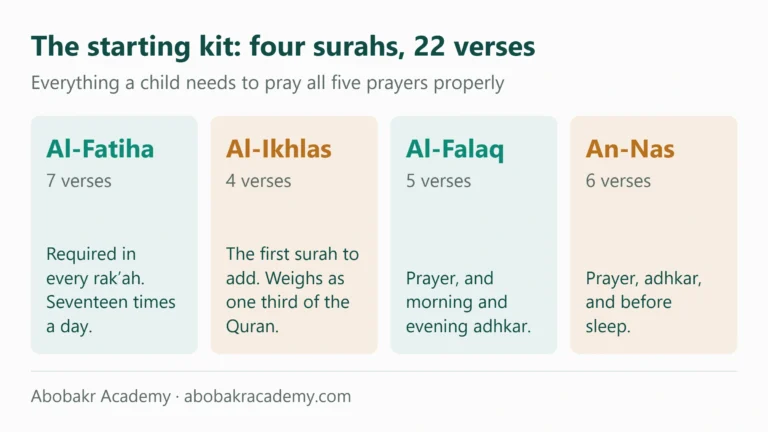
- Nazra (fluent reading). Start with the short surahs of the last juz, the ones children already hear in salah: Al-Ikhlas, Al-Falaq and An-Nas first, then longer pages, until any page can be read without stopping on a letter.
- Tajweed. Formal Tajweed study gives names to the rules the Qaida taught by ear, such as ghunnah and the stretches, and polishes them.
- Hifz, if you want it. Memorisation through a structured memorization program, which only works on reading that is already accurate.
Finishing the Qaida means you can decode and pronounce any Quranic text. Every stage after it leans on the habits it built.
What a Noorani Qaida Lesson Looks Like
A typical session runs twenty to thirty minutes for a young child and forty for an adult. That split is not arbitrary, and how long a session should run at each age is worth settling before you book a schedule. The teacher recites the target line, the student repeats it, and the teacher stops them the moment a letter slips. Then comes the part most people underestimate: the student reads the same line back several times without help, because recognition and recall are different skills. Lessons usually close with the teacher marking the exact line to practise before the next session, which is rarely more than half a page.
Our tutors keep a written note of which letters each student struggles with, so lesson eleven can revisit a shaky ص from lesson two rather than pretending it was mastered. Small habit, large difference over a year.
Teaching Noorani Qaida to Your Child at Home
Parents often want to support the lessons between sessions, and that support is genuinely valuable when it stays inside a few limits:
- Keep it short. Ten focused minutes a day beats an hour on Saturday, and children under eight rarely hold attention past fifteen minutes.
- Only revise material the teacher has already covered. Running ahead to the next lesson feels productive and usually installs a mistake that has to be dismantled later.
- Listen more than you correct. If you are not confident in your own pronunciation, play the teacher’s recitation and let your child copy that instead of you.
- Praise the sound, not the speed. A child who reads three letters correctly has done better than one who rushes a whole line.
- Expect plateaus. Nearly every student stalls somewhere in the joined letters. It passes.
If you would rather hand the structure to someone else entirely, our one-to-one Qaida classes for children handle the pacing, the correction and the record-keeping for you.
Mistakes That Slow Learners Down
Four problems account for most of the stalled progress our teachers see. Learners memorize the shape of a word instead of decoding its letters, which works until an unfamiliar verse appears. They practise silently, so nobody hears the errors accumulating. They treat the vowel marks as decoration rather than instructions. And they move to the next lesson because the calendar says so, not because the current one is secure.
The fix for all four is the same and it costs nothing: read aloud, slowly, to someone who can correct you.
Knowing When to Move to the Next Lesson
A reasonable test: the student can read the lesson’s exercises accurately, at a natural pace, without the teacher prompting, on two separate days. The second day matters. Reading it well once often reflects short-term memory of that session rather than genuine command of the material.
Noorani Qaida and Other Beginner Primers
The Qaida is not the only primer in circulation. The older Baghdadi Qaida is still used in parts of South Asia and Turkey, and various modern workbooks package similar material with colour illustrations. They differ mainly in sequence and presentation rather than substance, since all of them must teach the same alphabet and the same vowel system.
It stays the default in most Arabic-speaking institutions for one practical reason: its exercises are built directly from Quranic words, so students spend the whole book reading the language they are preparing to recite. Editions vary in layout, and inexpensive print copies are widely available, so it is worth asking your teacher which edition they teach from before buying one.
Who Can Start It, and Whether You Can Skip It
Is Noorani Qaida only for children?
Not at all. It was written for anyone starting from zero, and adults usually finish it faster than children do. The content is identical; only the pace and session length change.
Do I need to speak Arabic to learn Noorani Qaida?
You don’t need any. The Qaida teaches reading and pronunciation, not conversation or vocabulary. Most of our own students start it without a word of Arabic, and it was written with exactly that learner in mind.
Can I skip Noorani Qaida and learn directly from the Quran?
You can, but it is slower and error-prone. The Quran was not arranged as a teaching sequence; the Qaida was. Students who skip it usually plateau at hesitant reading and return to it anyway. It is worth telling a struggling child that the effort itself is counted: Sahih al-Bukhari 4937 records that the one who reads the Quran haltingly, finding it difficult, has two rewards. The standard the Qaida is building toward is the one set in Surah al-Muzzammil 73:4, to recite it measured and unhurried.
What is the difference between Noorani Qaida and Nazra?
The Qaida teaches you the mechanics of reading; nazra is the fluency practice that follows: reading directly from the Quran itself, page after page, until it becomes effortless.
How many lessons per week should a beginner take?
Two to three short lessons beat one long one. Fifteen to twenty minutes of daily repetition between lessons does more than a longer lesson.
What age can a child start Noorani Qaida?
Around five is the usual starting point, once a child can sit through a short lesson and repeat sounds accurately. Some four-year-olds manage it in very short sessions; others do better waiting until six. A child’s readiness counts for more than their age.
Ready to start? Book a free trial class and read your first Arabic letters with a qualified tutor this week. No payment details, no commitment.