
Free Printable Arabic Alphabet Chart
Most Arabic alphabet charts show 28 letters standing on their own. That is the version nearly every beginner meets first, and it is also why so many stall around week three: a letter inside a real word usually does not look like the letter on the chart.
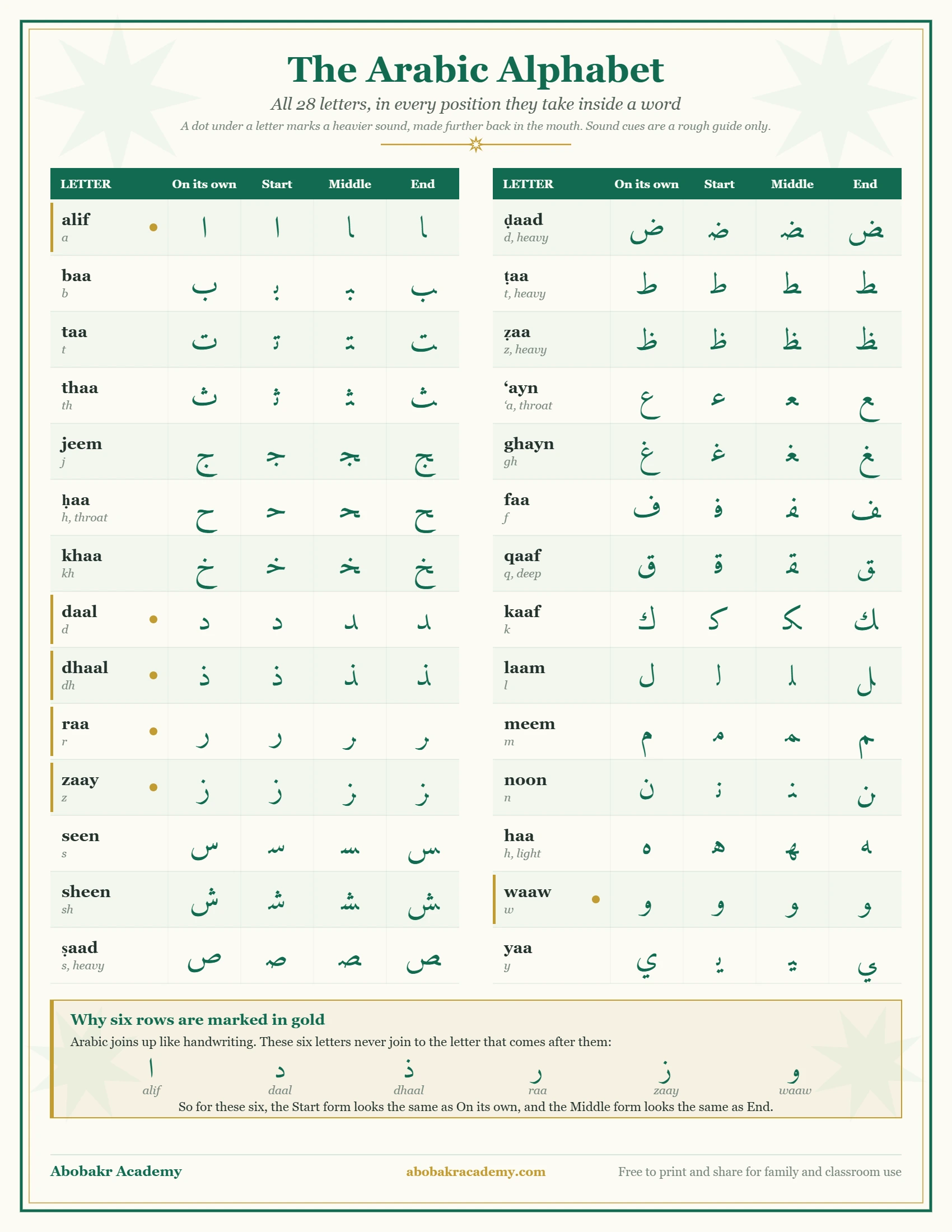
This one shows every letter in all four of the shapes it actually takes. It is free to download and print, for your own family or a classroom, with no sign-up. If you would rather have someone guide the process, we teach the same sequence live.
Download the chart (PDF) One page. Prints on A4 and US Letter.
Black-and-white version (PDF) Same chart, no colour fills. For classes and co-ops printing a stack of copies.
What this chart shows that a list of letters does not
Arabic joins up. A letter at the start of a word, in the middle, at the end, or standing alone can look different enough that a beginner does not recognise it as the same letter. Nobody warns you about this, because to anyone who reads Arabic it is too obvious to mention.
The practical result is a learner who can recite the alphabet perfectly and still cannot read a word, then concludes they are bad at Arabic. They are not. They learned one shape out of four. If that is where you are, our free 90 day reading plan sets out what to do in the twelve weeks after the chart, and the longer version of the same sequence is in our guide to teaching Arabic at home when you do not speak it.
Each row here gives you all four: on its own, at the start, in the middle, at the end. Reading across a row is the useful exercise. The letter that looks unrecognisable in the middle column is the one to spend an extra minute on.
Here is the chart above written out as text, because an image cannot be searched, copied, read aloud by a screen reader, or enlarged comfortably on a phone. Same twenty eight letters, same four positions. The six that never join to the letter after them are marked.
| Letter | Alone | Start of a word | Middle | End |
|---|---|---|---|---|
| alif does not join forward | ا | ا | ـا | ـا |
| baa | ب | بـ | ـبـ | ـب |
| taa | ت | تـ | ـتـ | ـت |
| thaa | ث | ثـ | ـثـ | ـث |
| jeem | ج | جـ | ـجـ | ـج |
| haa | ح | حـ | ـحـ | ـح |
| khaa | خ | خـ | ـخـ | ـخ |
| daal does not join forward | د | د | ـد | ـد |
| dhaal does not join forward | ذ | ذ | ـذ | ـذ |
| raa does not join forward | ر | ر | ـر | ـر |
| zayn does not join forward | ز | ز | ـز | ـز |
| seen | س | سـ | ـسـ | ـس |
| sheen | ش | شـ | ـشـ | ـش |
| saad | ص | صـ | ـصـ | ـص |
| daad | ض | ضـ | ـضـ | ـض |
| taa (heavy) | ط | طـ | ـطـ | ـط |
| dhaa (heavy) | ظ | ظـ | ـظـ | ـظ |
| ayn | ع | عـ | ـعـ | ـع |
| ghayn | غ | غـ | ـغـ | ـغ |
| faa | ف | فـ | ـفـ | ـف |
| qaaf | ق | قـ | ـقـ | ـق |
| kaaf | ك | كـ | ـكـ | ـك |
| laam | ل | لـ | ـلـ | ـل |
| meem | م | مـ | ـمـ | ـم |
| noon | ن | نـ | ـنـ | ـن |
| haa (light) | ه | هـ | ـهـ | ـه |
| waaw does not join forward | و | و | ـو | ـو |
| yaa | ي | يـ | ـيـ | ـي |
The six letters that never join to the letter after them
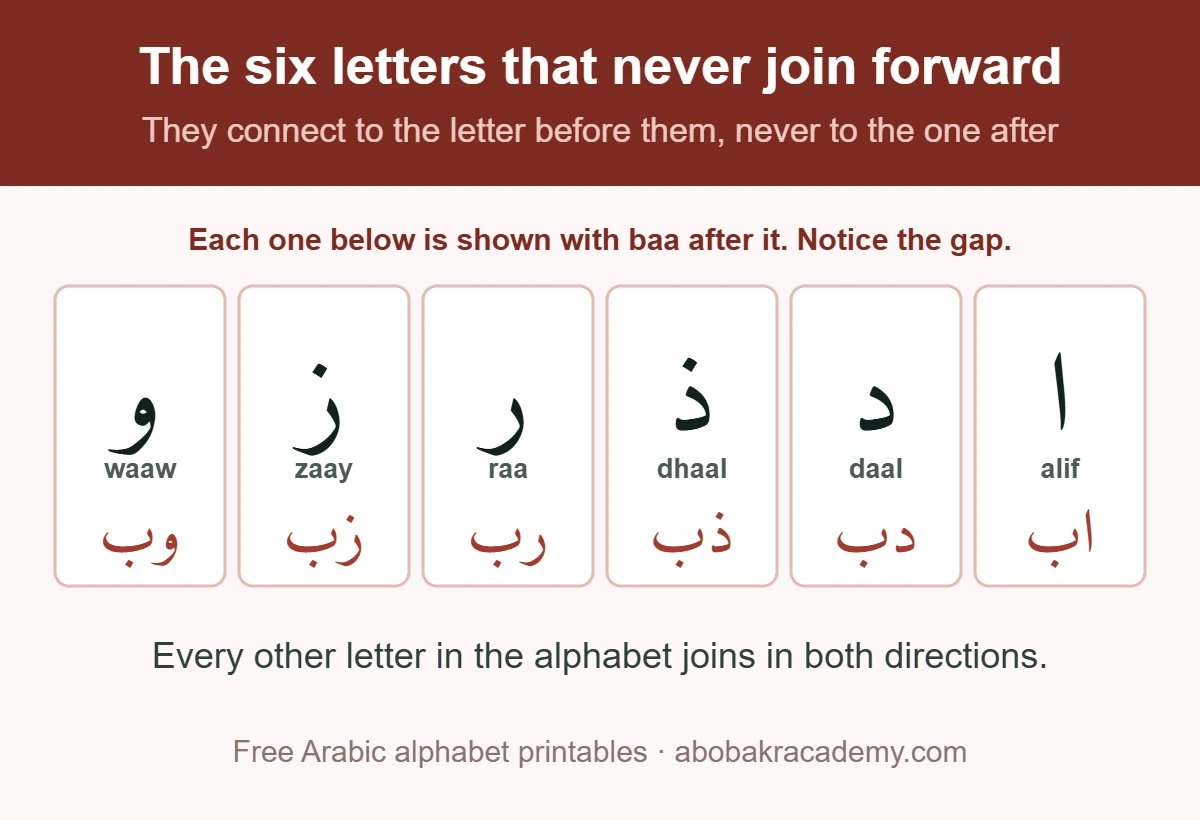
Six letters break the pattern: alif, daal, dhaal, raa, zaay and waaw. They accept a join from the letter before, but never pass one on to the letter that follows. They are marked in gold on the chart.
This is worth knowing early, because it explains something that otherwise looks like a printing error. For these six, the Start form is identical to the On its own form, and the Middle form is identical to the End form. Learners often assume the chart is wrong. It is not.
It also explains the gaps in written Arabic. A space inside what looks like one word is usually one of these six ending a segment, not the end of the word.
How to use it with a child who is just starting
Pin it somewhere the child passes, rather than somewhere they sit down to study. A chart used for thirty seconds a day beats one opened for twenty minutes on Sunday.
Work down the rows in order rather than jumping to the letters in their name, which is the usual temptation. The order is not arbitrary: letters sharing a shape sit together, so baa, taa and thaa differ only in dots, and learning them as a group is faster than meeting them weeks apart. Once a letter is recognised, attaching a word to it is what makes it stay, and our reference table of all 28 Arabic letters with a word for each gives one example word, in script and with transliteration, for every letter on this chart.
Cover the first column and see whether they can still name the letter from its middle form alone. That is the test that matters, and it is the one a chart on a wall makes easy. If you want that same test in a form a child can hold and shuffle, the Arabic alphabet flashcards put all four shapes on a card each.
If you are working through a Qaida with them, this pairs with it directly. Our guide to the Qaida covers the sequence most teachers follow after letter recognition.
Which Arabic letters have an English equivalent, and which do not?
Ten of the twenty eight do not. Most charts print an English letter beside every Arabic one, which implies a clean swap, and for much of the alphabet that is fair enough: baa really is b and meem really is m. But ten of these letters have no English sound at all, and a learner who is told otherwise learns a wrong sound first and then has to unlearn it.
The table below is the honest version. The third column gives the nearest English letter, which is what any transliteration will use. The fourth column says whether that is actually the same sound. If you want the pronunciation of each letter set out in full, the Arabic alphabet tracing worksheets carry a sound column for all twenty eight.
| Letter | Name | Nearest English letter | Is it the same sound? |
|---|---|---|---|
| ا | alif | a | Not a consonant at all. It is a long a, as in father |
| ب | baa | b | Yes, as in book |
| ت | taa | t | Yes, as in table |
| ث | thaa | th | Yes, as in think |
| ج | jeem | j | Yes, as in jam |
| ح | haa | none | No English equivalent. A hard h from deep in the throat |
| خ | khaa | kh | No English equivalent. The ch of Scottish loch |
| د | daal | d | Yes, as in door |
| ذ | dhaal | th | Yes, as in this |
| ر | raa | r | No. Tapped or rolled, not the English r |
| ز | zayn | z | Yes, as in zoo |
| س | seen | s | Yes, as in sun |
| ش | sheen | sh | Yes, as in ship |
| ص | saad | s | No. A heavy s, made further back in the mouth |
| ض | daad | d | No English equivalent. A heavy d, and the sound Arabic names itself after |
| ط | taa (heavy) | t | No. A heavy t, made further back |
| ظ | dhaa (heavy) | th | No. A heavy version of the th in this |
| ع | ayn | none | No English equivalent. Made in the throat, with no near miss |
| غ | ghayn | gh | No English equivalent. Closest to a French r |
| ف | faa | f | Yes, as in fish |
| ق | qaaf | q | No. Like k, but from the back of the throat |
| ك | kaaf | k | Yes, as in kite |
| ل | laam | l | Yes, as in lamp |
| م | meem | m | Yes, as in moon |
| ن | noon | n | Yes, as in nose |
| ه | haa (light) | h | Yes, as in house |
| و | waaw | w | Yes, as in was; also a long oo |
| ي | yaa | y | Yes, as in yes; also a long ee |
What the 28 letters leave out
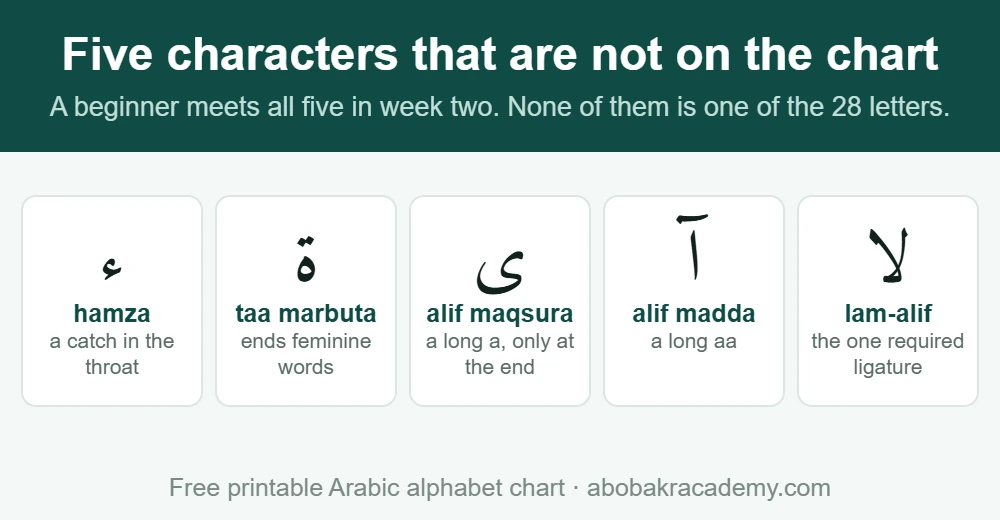
Every chart on this page stops at 28 letters, and so does nearly every chart you will find. That is the alphabet, but it is not the whole writing system, and the gap shows up in about week two. A child sounding out a real word runs into small marks above and below the letters, into a hamza that is not on any chart, and into a shape made of two letters joined into one. None of it is on the chart they have been staring at.
Here is the rest of it, in the order you are likely to meet it.
The short vowels are marks, not letters
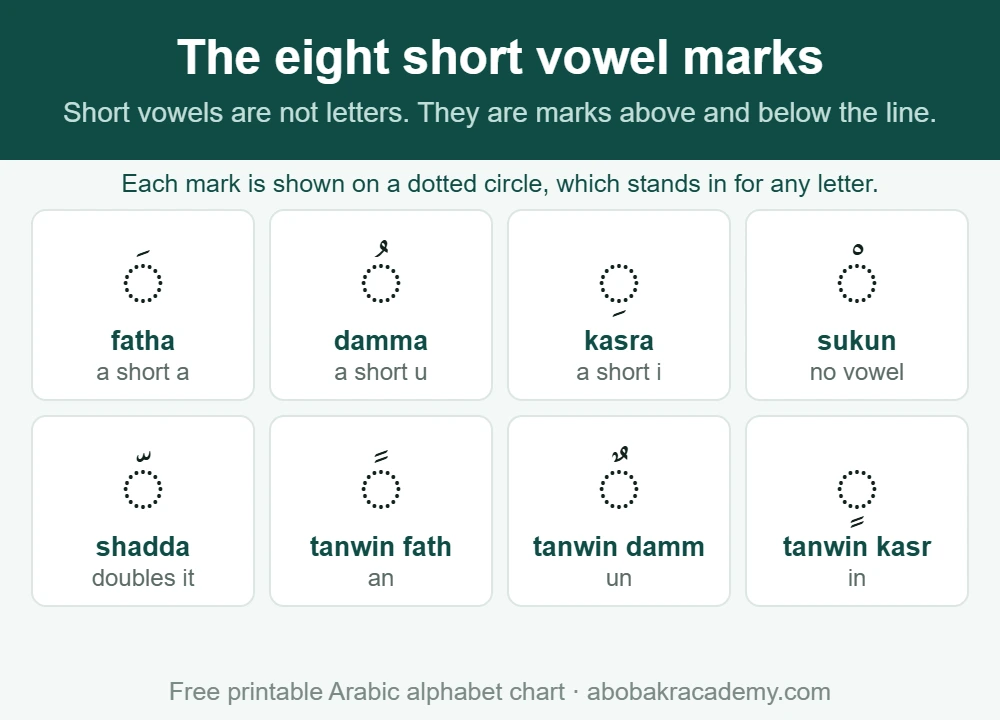
This is the single biggest surprise for an English-reading parent. Arabic writes the long vowels as letters and the short vowels as marks above and below the line, and in ordinary adult writing the marks are left off entirely. Children’s books, the Qur’an and teaching material keep them. That is why a word your child reads confidently in their workbook can look unreadable in a newspaper.
| Mark | Name | What it does | Sounds like | On baa |
|---|---|---|---|---|
| ◌َ | fatha | a short “a” | as in cat | بَ = ba |
| ◌ُ | damma | a short “u” | as in put | بُ = bu |
| ◌ِ | kasra | a short “i” | as in sit | بِ = bi |
| ◌ْ | sukun | no vowel | the letter closes the syllable | بْ = b |
| ◌ّ | shadda | doubles it | hold the consonant twice as long | بّ = bb |
| ◌ً | tanwin fath | “an” | an ending, mostly in formal Arabic | بًا = ban |
| ◌ٌ | tanwin damm | “un” | an ending, mostly in formal Arabic | بٌ = bun |
| ◌ٍ | tanwin kasr | “in” | an ending, mostly in formal Arabic | بٍ = bin |
Characters that are not on the alphabet chart
| Character | Name | What it is |
|---|---|---|
| ء | hamza | A catch in the throat, the sound in the middle of uh-oh. It rides on alif, waw or yaa, or sits on its own. |
| ة | taa marbuta | A “tied taa” that ends most feminine words. Read as a when you stop, as t when you carry on. |
| ى | alif maqsura | Looks like a yaa with no dots and sounds like a long a. It only ever ends a word. |
| آ | alif madda | A long aa. It is what you get when two alifs would otherwise collide. |
| لا | lam-alif | Not a letter. It is the one compulsory ligature in Arabic: lam and alif written as a single shape. |
Four letters borrowed for foreign sounds
These are not part of the 28. They are Arabic letters with extra dots, invented so that Persian, Urdu and borrowed words can be written in the same script. Your child will meet them on packaging and in names long before any lesson introduces them.
| Letter | Name | Sound | Where you see it |
|---|---|---|---|
| پ | peh | p | Persian and Urdu. In Arabic a p is usually written with baa. |
| چ | cheh | ch | Persian and Urdu. |
| ڤ | veh | v | Used for foreign names and loanwords. |
| گ | gaf | g | Persian and Urdu. Egyptians read jiim as a hard g instead. |
The character names used here follow the Unicode Standard’s Arabic code chart, and the transliteration follows the Library of Congress Arabic romanization table. We cite them because a parent who cannot read Arabic has no way to check us otherwise, and nobody else on this topic tells you where their spellings came from.
What a chart cannot do
It cannot teach pronunciation. Several of these letters have no English equivalent, and the difference between the light and heavy pairs is made in a part of the mouth most English speakers never use deliberately. Reading a transliteration will not get you there. Hearing it and being corrected will. That is the part a teacher covers in our online Arabic lessons for kids.
That is the honest limit of any printable. A chart fixes recognition. Pronunciation needs an ear on the other end. It will not teach the hand either: recognising a letter and writing it are two different skills, and the free Arabic alphabet tracing worksheets are the sheets for the second one.
A second free printable: the monthly Quran progress check
If your child is already in lessons and you do not read Arabic yourself, the harder question is not which letters they know but whether they are actually progressing. This sheet gives you a five-step check you can run once a month, plus a blank log to record it, so you are comparing evidence rather than your memory of how they sounded in March.
Download the progress check (PDF) One page. Includes a blank recording log.
The chart is one of eleven free sheets on this site. The rest, in the order a child needs them, are on the printables page.
The reasoning behind it, including the five things any parent can judge without knowing a word of Arabic, is set out in how to check your child’s Quran progress when you don’t read Arabic.
A third free printable: the Noorani Qaida progress tracker
If your child has moved past single letters and is working through the Qaida itself, there is a companion sheet for that stage. The Noorani Qaida progress tracker lists all sixteen lessons in the order teachers actually follow, and for each one it tells you what your child should sound like when the lesson has landed and what a problem sounds like. It is built on the same principle as this chart: everything on it works by ear, so you can follow the progress without reading a word of Arabic.
Downloading and printing it: what you get, and what it costs
Nothing, is what it costs. There is no sign-up, no email box and no watermark, and there never will be on any printable here. Both files are linked at the top of this page and both open straight from the link.
The colour PDF is one page. The six letters that never join forward are filled in gold so a child can spot them without being told. It prints correctly on A4 and on US Letter without rescaling, because the artwork sits inside the smaller of the two safe areas.
The black-and-white PDF is the same chart with the colour fills removed. It exists because a class or a co-op printing thirty copies should not be spending colour ink on decoration, and because a greyscale print of the colour version turns the gold letters into a muddy tone that reads as a smudge rather than a signal.
Two practical notes from parents who have used it. A chart on the wall at a child’s eye level gets looked at, and a chart in a folder does not. And if you laminate one copy, laminate the black-and-white one: the gold goes shiny under the film and the glare lands exactly on the letters you most want read.
Using these in a class or co-op
Both sheets are free to print and hand out for family, classroom, madrasah or homeschool use. You do not need to ask us. We would rather they were useful than protected. If you republish them online, a link back is appreciated and is the only thing we ask.
Printing, the font and the vowel marks
Is the chart really free?
Yes, and there is no email form in front of it. The download links above go straight to the PDF.
Will it print properly on A4?
Yes. The page is sized for US Letter with wide margins, so it scales onto A4 without losing anything at the edges. Print at 100% or let your printer fit to page.
Which font is the Arabic set in?
Amiri, an open-licensed naskh typeface. Naskh is the style most Qurans and most teaching materials use, so the letter shapes match what a learner will meet next.
Does the chart include the vowel marks?
No. It covers letter shapes only, which is the first stage. Harakat come after a learner can recognise letters in all positions, and mixing the two at once is a common reason beginners stall.
My child can name the letters but still cannot read. What now?
That is the normal gap, and it is almost always the positional forms plus joining. Work across the rows rather than down the first column, then move to two- and three-letter combinations. If it persists past a few weeks, it is worth having someone listen.
If you want a teacher to take it from here, we teach Arabic and Quran one to one or in small groups to families across the US, UK, Canada and Australia, and the first class is free. You can also see what is covered in the classes we offer free of charge.
There is a fourth as well: the Tajweed rules chart, which puts Noon Sakinah, Meem Sakinah, Qalqalah, Ghunnah and the Madd lengths on one page. It suits a child who is already reading and starting to work on how the words should sound.