Al-Fatiha comes round seventeen times a day. Two rak’ahs at Fajr, four at Dhuhr, four at Asr, three at Maghrib, four at Isha, and the same seven verses in every one of them.
That repetition is exactly why it’s worth listening to. Whatever your child is doing with those sounds, they’re doing it seventeen times a day and have been since they learned to pray. If a letter is being substituted, this is where the groove is deepest.
It’s also the one passage you can check without reading Arabic, because you already know how it goes. You’ve heard it thousands of times. Your ear knows more than you think.
What actually goes wrong
The usual explanation is that Arabic has sounds English doesn’t have. That’s true, but it hides the useful part.
Most of these letters have an English near-neighbour standing right beside them. Your child already owns that neighbour, reaches for it in both places, and produces one letter twice. They’re not failing at some exotic new sound. They’re flattening a pair into one.
One letter on this page has no neighbour at all, and that one behaves differently: instead of a substitution you get a gap.
That distinction is what makes this checkable. You’re not judging whether a sound is correct, which would need Arabic. You’re listening for whether two sounds are different from each other, which needs nothing but ears. Judging whether each sound is actually right is a teacher’s job, and it is exactly what a tutor listens for in our online Quran classes for kids.
How much this matters
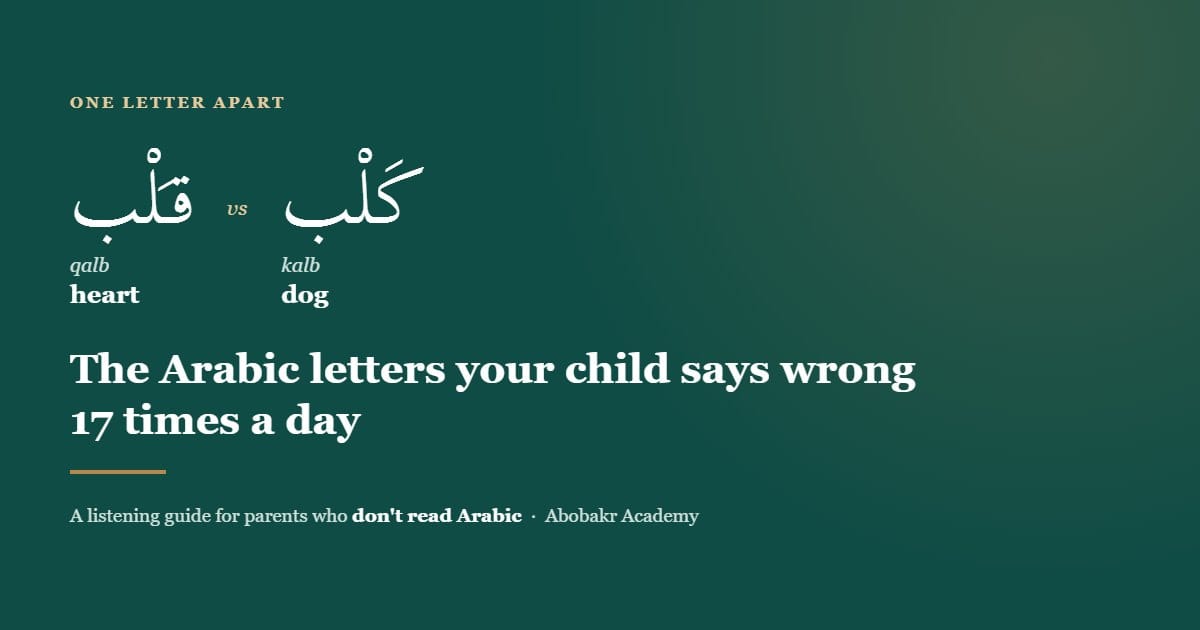
One pair genuinely swaps one word for another. قلب is qalb, heart. كلب is kalb, dog, and it’s one letter away. It’s the example most teachers reach for and it earns its place.
Don’t carry that too far, though. Most substitutions don’t produce a different word. They produce something that isn’t a word at all, which is a different sort of error.
Scholars do treat clear errors more seriously than hidden ones, and substituting one letter for another sits in the serious category. I’d rather say that plainly than hedge it. But the classical answer to the worry that follows is already there: the Prophet ﷺ said the one who recites the Qur’an proficiently is with the noble scribes, and the one who recites it and stumbles, finding it hard, has two rewards (Muslim 798, also Bukhari 4937 in slightly different wording). A child working at a sound is in the second group. That’s a good place to be, not a shameful one.
Qaf and kaf
Your English “k” is essentially kaf. There’s no English sound at all where qaf lives, so qaf gets swallowed by the neighbour next door. Both come from the back of the tongue against the roof of the mouth, not from the throat. Qaf sits further back and heavier, kaf slightly forward and lighter.
Where to hear it: مَالِكِ يَوْمِ الدِّينِ in verse four carries kaf. الصِّرَاطَ الْمُسْتَقِيمَ in verse six carries qaf.
The test: these two letters have clearly different names, so just ask. “Say qaf. Now say kaf.” Any child past the first Qaida lessons knows them. If you hear the same English “k” twice, you’ve found something worth passing on.
The two h sounds
Here the letter names won’t help you, because both ح and ه come out as some version of “ha” and that’s precisely why they collapse. So use words instead. You already know these two.
ه comes from the deepest part of the throat and it’s open, breath with nothing in its way. ح comes from the middle of the throat, the same breath squeezed until the air rasps through a tightened passage. They differ in where they’re made and in how hard the air has to work.
Where to hear it: الْحَمْدُ, the first word of verse two, opens on ح. اهْدِنَا, the first word of verse six, opens on ه.
The test: ask for those two words, one after the other. ه should sound easy, like fogging a mirror. ح should sound tighter and rougher, closer to the start of clearing your throat but without the scrape at the back. That scrape belongs to غ, another letter entirely. If both words start with the same soft English “h”, they’ve been flattened together.
Ayn, the one with no neighbour
Ayn (ع) is the letter with nothing standing beside it in English. Not a rough approximation, nothing. It’s voiced, made in the middle of the throat with a genuine constriction, and most English speakers need months to get near it.
Because there’s nothing to substitute, children don’t substitute. They skip. What you’re listening for is an absence.
Where to hear it: عَلَيْهِمْ, in the last verse, begins on ayn. It appears twice in that verse, so you get two goes at it. Verse five gives you two more, inside نَعْبُدُ and نَسْتَعِينُ.
The test: listen to the start of عليهم. There should be a real sound there, deliberate and slightly tight in the throat. If the word simply opens on a plain “a”, the way an English speaker would say “alay-him”, the ayn has been dropped.
Be patient with this one. It’s the hardest to hear on the list and the slowest to fix.
Sad and seen, side by side
This is the tidiest contrast in the surah, because both letters sit inside one phrase.
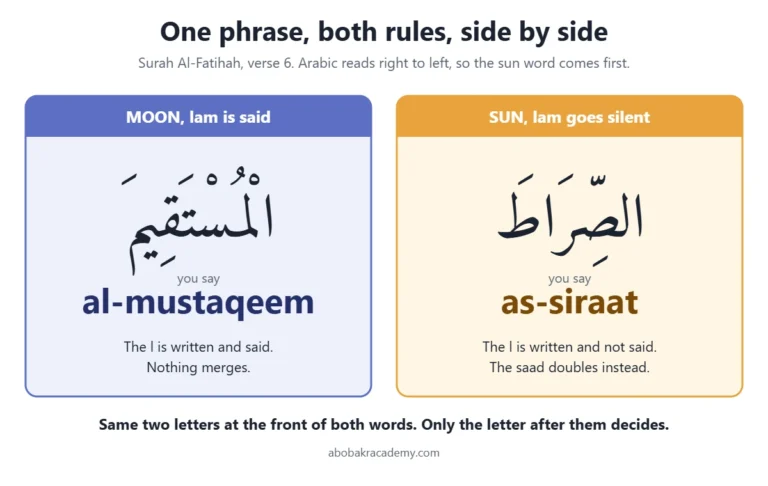
Seen (س) is a light “s”, near enough to the English one. Sad (ص) is its heavy counterpart, and English has no heavy “s”, so children reach for the light one twice.
Where to hear it: الصِّرَاطَ الْمُسْتَقِيمَ. The first word opens on sad. The second carries seen in the middle. Two words, adjacent, in the verse your child says seventeen times a day.
The test: don’t watch for the tongue tip moving, because it stays put for both. What changes is behind it: on sad the back of the tongue lifts and the sound gets fuller and rounder, as though there’s more room behind it. Say those two words in sequence and listen to the weight of each “s”. If they match, the pair has collapsed.
Dad and dal, with a warning
Dal (د) is close enough to an English “d”. Dad (ض) is the heavy one, and it’s distinctive enough that Arabic gets nicknamed لغة الضاد, the language of the dad, because classical scholars believed no other language had it.
Dad isn’t made with the tongue tip like dal. It comes from the side of the tongue pressing against the upper molars, and it’s heavier and held slightly longer.
Where to hear it: الضَّالِّينَ, the final word of the surah, is dad. الْحَمْدُ, at the start of verse two, ends on dal.
The test, and the caveat: ask for “dad” and “dal” as letter names, listening for the second to be heavier and a touch longer.
Now the caveat, because it matters. This is the hardest pair here for an English ear, and unlike qaf and kaf, both letters can land as a plain “d” even when your child is producing them correctly. If you can’t tell them apart, that isn’t a finding. It’s the expected result. Report it as “worth checking” rather than “something I heard”, or you’ll send a teacher hunting for a problem that was never there.
Doing this tonight
You don’t need a special session. After Maghrib, ask your child to recite Al-Fatiha once, slowly, out loud. Then five short checks, in the order they come.
Then put on a recitation of Al-Fatiha by a well-known reciter and listen to those same five places. It takes ninety seconds and it will recalibrate your ear better than any written description, this one included.
What you can’t do from the kitchen
You can detect these. You can’t fix them, and trying tends to backfire twice over. You end up modelling the wrong sound yourself, and your child learns that reciting within earshot invites correction, which is a quick way to stop them reciting within earshot. If you want something you can lead from the kitchen instead, the eight daily duas are a better use of the same ten seconds.
There’s a ceiling on what any of this shows you, too. A child can produce every letter perfectly in isolation and still misapply them in connected recitation, where the rules about how sounds meet each other take over. That layer needs a teacher listening properly.
So don’t interrupt to correct. Wait until they’ve finished. Then, rather than telling them they got it wrong, ask them to teach you: “show me how that one goes, I can never get it.” Children who have to demonstrate a sound slow down and produce it more carefully than they would under correction.
Then tell the teacher plainly what you heard. Teachers hear “he’s struggling” constantly and it tells them nothing. “Qaf and kaf sound identical when he says them” tells them exactly where to start.
Questions parents ask
At what age should these be right?
Ayn and the heavy letters take longer than the rest, and a five- or six-year-old still working at them is ordinary rather than behind. Direction of travel matters more than age. A sound that’s slowly improving is fine. One that’s sounded exactly like its pair for a year has settled, and settled substitutions need deliberate work to shift.
My child recites beautifully and fast. Doesn’t that mean it’s fine?
Not on its own. Fluency and accuracy aren’t the same thing, and speed hides substitutions rather than revealing them. Slow recitation is where you hear the letters.
What if the mistake came from the teacher?
It happens. If your child’s sounds match their teacher’s exactly and both differ from a well-known recitation, that’s worth raising politely. A teacher trained in recitation will welcome the question rather than take it badly.
Tracking progress, and the ghunnah to fix next
If your child is still working through the Qaida, these letters arrive in its earliest lessons, which is why substitutions settle so early. Our free Noorani Qaida progress tracker sets out what to listen for at every lesson, and you can print it.
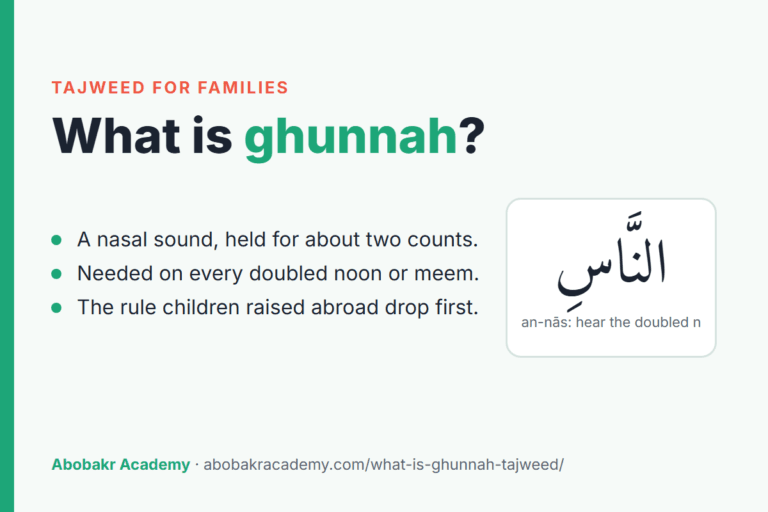
For the broader question of whether your child is progressing at all, checking your child’s Quran progress without reading Arabic covers what to watch month to month. And once these letters are secure, ghunnah is usually the next thing to go, with its own two-count test. If the letters are still being learned rather than corrected, the 90-day reading plan sets out what order they come in and what follows them.
If a substitution does turn out to be locked in, that isn’t a disaster and it isn’t your fault for missing it. Substitutions like these are ordinary, and they get fixed by a teacher listening. Not by a parent worrying at the kitchen door.