
Online Islamic Studies Academy: Aqeedah, Fiqh, Seerah and Akhlaq, Taught Live
Islamic Studies covers the ground that recitation alone never reaches: what a Muslim actually believes, how to pray and fast correctly, how the Prophet (peace be upon him) lived, and what any of it means for a fourteen-year-old in Leeds or a new revert in Toronto.
Every class here is live and one-to-one. Your child is never one face in a grid of twenty, and nobody is reading from a slide deck. The tutor knows what was covered last week, which point was misunderstood, and what needs revisiting before anything new is introduced. Many of our Islamic Studies teachers are Al-Azhar trained, and most hold an Ijazah in Quran alongside their formal study. You can see them by name on our About Us page.
The first class is free. No card details are needed to book it.

What Our Online Islamic Studies Classes Cover
Islamic Studies is not one subject. It is six related disciplines, and a good curriculum moves between them rather than teaching each in isolation. A lesson on the Prophet’s migration will touch history, character and law in the same forty minutes.
Aqeedah: Belief and Its Foundations
The starting point for every student, whatever their age. Tawheed and the oneness of Allah, belief in the angels, the revealed books, the messengers, the Last Day, and divine decree. For younger children this is taught through story and question rather than definition. For teenagers and adults it goes further, into the questions they are already being asked at school or at work and often cannot answer.
Fiqh: How Worship Is Actually Performed
Purification, the conditions and mechanics of salah, fasting, zakat calculation, and the rulings of Hajj and Umrah. This is the most immediately practical part of the syllabus. A student who has memorised three juz but is unsure whether their wudu broke has a gap worth closing. Where scholars differ, we say so and explain why, rather than presenting one view as the only one.
Seerah: The Life of the Prophet
Taught chronologically, from Makkah before revelation through to the farewell sermon. Seerah is the section children remember longest, because it is narrative rather than list. It also does quiet work that nothing else in the syllabus does: it turns an abstract figure into a person who was hungry, grieved, was rejected by his own city, and kept going.
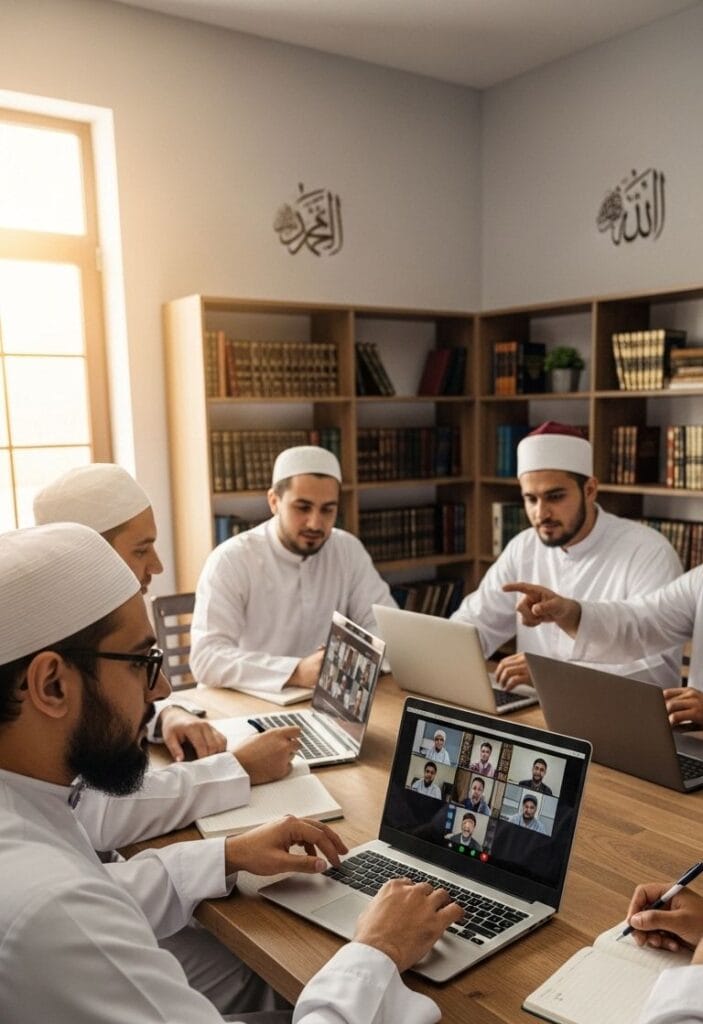

Tafsir: Understanding What You Recite
Verse-by-verse explanation, beginning with the short surahs a student already knows by heart. There is a particular moment worth waiting for, when a child who has recited Surah Al-Fil correctly for two years learns for the first time what happened to the elephants. Tafsir turns memorised sound into meaning, which is usually the point at which motivation stops being something parents have to supply.
Hadith: The Prophetic Narrations
Selected collections appropriate to level, with attention to the meaning and the application rather than chains of transmission at the early stages. Older students learn how authenticity is assessed and why the distinction between sahih, hasan and daif matters when someone forwards them a quote on WhatsApp. We also cover our dedicated Hadith course for students who want to go deeper.
Akhlaq: Character and Conduct
Honesty, patience, how to treat parents, neighbours and classmates, and what Islam requires of someone who is angry or has been wronged. Parents raise this more than any other topic in a first call. They want a child who prays, and they want a child who is decent, and they are right to treat the second as inseparable from the first.
Students who want Quran recitation and memorisation alongside this can combine Islamic Studies with our Quran classes, Tajweed programme or Hifz pathway. Understanding the language itself is covered in Arabic classes.
Islamic Studies for Children Growing Up Outside the Muslim World
A child in Cairo absorbs a great deal without being taught it. The adhan is audible from the street, Ramadan changes the rhythm of the whole city, and the questions they will face about their faith come later and more gently. A child in Manchester, Houston or Melbourne gets none of that for free.
That shapes how we teach. Our tutors teach from across the Arab world, but the syllabus is built around students who think in English and live somewhere the deen is a minority position. That means explaining rather than assuming, answering the awkward question rather than deferring it, and never making a student feel foolish for not knowing something they were never taught. It also means the whole class is delivered in clear English, with Arabic introduced deliberately rather than presumed.
Islamic Studies for Adults and Reverts
Roughly a third of our Islamic Studies students are adults. Some are reverts covering the fundamentals properly for the first time. Some grew up Muslim, learned to pray by copying a parent, and have carried a private uncertainty about whether they were doing it correctly for twenty years. Others simply want to read the Quran with understanding rather than sound.
Adult classes run at a different pace and with different assumptions. Nobody is going to be handed a children’s workbook. Questions that feel embarrassing in a mosque study circle are ordinary here, because there is one tutor and one student and no audience. Several of our adult students book their sessions at six in the morning before work, or late evening after the children are asleep, which our timezone coverage makes possible.
How the Classes Run
- Live video, one tutor and one student, no recordings substituting for teaching.
- Sessions are typically thirty minutes for younger children and forty-five to sixty for teenagers and adults.
- You choose the days and times. Our tutors cover US, UK, Canadian and Australian hours.
- Progress notes go to parents, so you are not guessing what was covered.
- Male and female tutors are available, and you can request a preference.
Who Teaches Islamic Studies Here
Every tutor on the Islamic Studies faculty holds formal qualification from Al-Azhar, and several have postgraduate study behind them. They are named individually, with their subjects, on our About Us page, which we would encourage you to read before booking. An academy that will not tell you who is teaching your child is one worth asking questions about.
If you would like to see the full range of programmes first, our course list covers everything we offer, and there is more detail on trying us at no cost on the free classes page.
Islamic Studies for Adults
Most adults who enrol here are not starting from nothing. They pray, they fast, they are raising children as Muslims. What they have never done is study any of it formally, and at some point that gap starts to matter, usually when a child asks a question or a situation at work needs a ruling they cannot find.
What adult classes look like
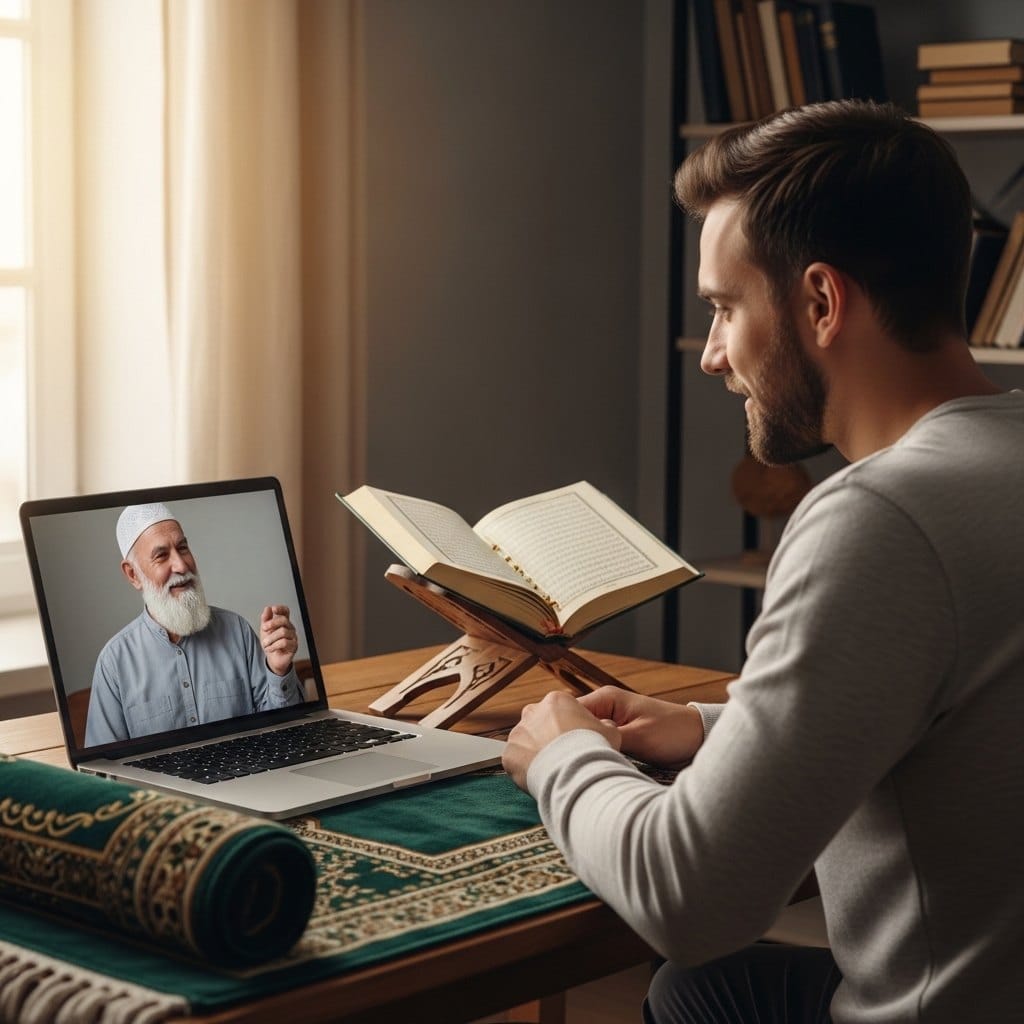
An adult lesson is a conversation rather than a recitation. The tutor sets out a position, you push back on the parts that do not sit right, and you leave with the reasoning instead of a rule to memorise. That is the main difference from how we teach children, who are building a foundation they will reason about years later.
Our online Islamic classes for adults run live, 30 to 60 minutes for most students. You can study one to one, or in a small group of two or three if you would rather learn alongside a spouse or a friend.
Where most adults choose to start
Children usually begin with aqeedah. Adults more often begin with fiqh, because it is immediately usable: the conditions that invalidate a prayer, how zakat is calculated on actual savings rather than in the abstract, what changes when you travel for work. Aqeedah tends to land better afterwards, because by then you are asking why the thing you already do is done that way.
Reverts are the exception and the order there is different. The free classes set out what a first term looks like when you are starting from the beginning.
The part nobody says out loud
The most common reason an adult puts this off is embarrassment. They feel they should already know, and they do not want to ask a basic question in front of people who might. One to one removes the audience. A student who has prayed for thirty years without ever studying the fiqh of it is completely ordinary here, and no tutor is surprised by it.
Fitting Islamic classes around work
Lessons are arranged directly with your tutor rather than slotted into fixed class times, which is what makes evenings and weekends workable. If something comes up, two hours of notice is enough to move a lesson, and a weekly subscription includes one cancellation a month. Where a tutor becomes unavailable for something unexpected, a replacement is arranged or a compensatory session added rather than the lesson being lost.
Many adults run this alongside recitation work. Our adult Quran classes page covers that side.
Online Islamic Studies: Common Questions
Does my child need to speak Arabic to start?
Not at all. The entire class runs in English, and Arabic terms are introduced gradually with explanation. Many of our students begin with no Arabic whatsoever and pick it up through the material rather than before it.
What age can a child begin Islamic Studies?
Around five or six works well for Seerah stories and basic Aqeedah taught conversationally. Fiqh in any structured sense tends to land better from about eight. We will tell you honestly during the trial if we think a child would be better waiting six months.
Which school of fiqh do you teach?
Our teaching follows the Al-Azhar tradition, which is grounded in the four recognised Sunni schools. Where a ruling differs between them we explain the difference rather than pretending one position is the only one. If you follow a particular madhhab and want that reflected, tell us when you book and we will match you accordingly.
Can adults take these classes, or is it children only?
Adults are very welcome and make up a substantial share of our Islamic Studies students, including reverts starting from the beginning. Adult sessions are paced and pitched differently from children’s classes.
How is this different from watching lectures online?
A recorded lecture cannot tell whether you understood it. A live tutor notices the pause before you answer, corrects the misconception you did not know you were carrying, and adjusts the next session accordingly. That feedback loop is the entire difference, and it is the reason structured study has always been done with a teacher.
What does it cost?
Price depends on the subject, the length of each lesson and how many lessons you take per week. More weekly sessions bring the hourly rate down, from $8.50 to $7.00, and families enrolling more than one child take 10% off. Full figures are on our pricing page. Book the free trial and we will give you an exact quote afterwards with no pressure attached.
Start With a Free Islamic Studies Class
Book a trial session and see how your child gets on with the tutor before committing to anything. No card details, no obligation, and if the match is not right we will suggest a different teacher rather than push you to continue.

Booking and Practical Questions
Find answers to the most frequently asked questions about studying Arabic online through an Online Arabic Academy.
How do I join the Online Islamic Studies Academy?
You can register for a free trial class at Abobakr Academy and start learning immediately.
Are the courses suitable for beginners?
Yes, we offer beginner-friendly programs for all ages.
Do you have courses for children?
Yes, we provide engaging Islamic studies programs for kids with interactive methods.
What online platform do you use?
We use reliable online platforms with live interaction for effective learning.
Our Islamic Studies teachers hold recognised qualifications, meet them.