
Every new student at Abobakr Academy gets a full class with a qualified tutor at no cost, and every student who completes a course receives a certificate at no cost. Those are two separate things, and this page explains both plainly so you know exactly what you are booking.
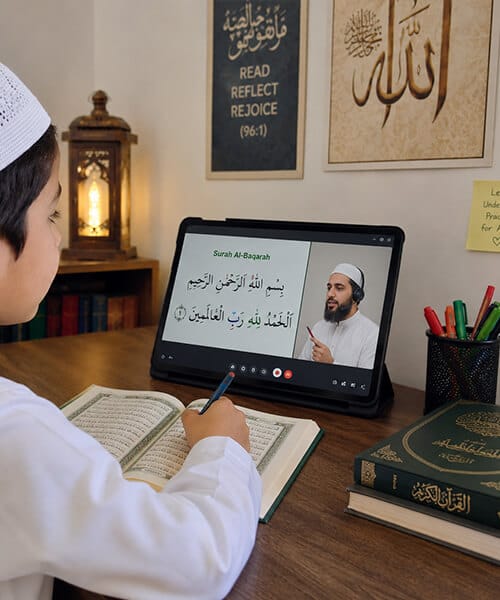
The trial is a real lesson, not a sales call. You are placed with a tutor, often Al-Azhar trained, in the subject you actually want to study, one to one, for the normal lesson length. They teach, they assess where you or your child currently stand, and afterwards you decide whether to continue. No card details are taken to book it, and nobody will chase you if you do not come back.
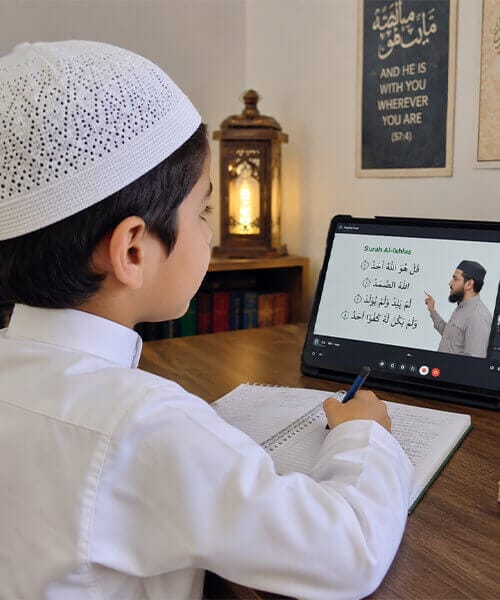
A lot of academies advertise free Islamic classes and mean a recorded video, a PDF, or a fifteen-minute consultation with someone from the sales team. We mean a live lesson with the teacher who would go on to teach you.
We would rather be direct about that than have you discover it three clicks later. An academy that hides the pricing model usually has a reason.
The free class can be taken in any of the subjects we teach. Most people start with whichever one they were already searching for.
From the Arabic letters upward for complete beginners, through to fluent recitation. If you have never read a word of Arabic, this is where you begin. See the full Quran classes programme.
The rules that govern correct pronunciation: makharij, the noon sakinah rules, madd, and the qalqalah letters. Suitable both for people starting out and for those who have recited for years and want their mistakes identified properly. More detail on the Tajweed programme.
Taught for non-native speakers, starting with the alphabet and moving through vocabulary and grammar towards reading the Quran with understanding rather than sound alone. Our Arabic classes cover both classical and practical usage.
Aqeedah, fiqh, seerah, tafsir, hadith and akhlaq. This is the part parents most often say was missing from their own upbringing. The full syllabus is on the Islamic Studies page.
Structured memorisation with revision schedules that hold up over years rather than weeks. Details on the Hifz pathway.
A good share of the families who book a free class are not looking for a single lesson. They want something to stand in for a weekend madrasah that is nowhere near them, or a structured strand to sit inside a homeschool timetable, or simply a teacher who is awake at the hour their child is ready to sit down.
That is a fair way to use the academy, and it works differently from a one-off trial.
Lessons are live and one to one, or a small group of two or three when siblings learn together. Nobody waits their turn to read and nobody hides at the back. For a child who has stalled in a group setting this is usually the thing that shifts, because the teacher hears every letter as it is said and corrects it there and then instead of three weeks later.
Families studying with us long term tend to keep two or three strands going at once: Quran reading with Tajweed as the spine, Arabic beside it, and Islamic Studies once or twice a week. Hifz is added when a student is ready for it rather than on a fixed schedule. Written progress notes follow each lesson, which is what makes the arrangement usable as a homeschool record rather than just a series of calls.
Teaching hours are arranged to suit families in the United States, the United Kingdom, Canada and Australia, so the timetable is built backwards from when your household is actually free rather than from when it suits us.
The trial class is free and the certificate of completion is free. Carrying on is not, and it would be dishonest to imply otherwise on a page about free classes. We have deliberately kept a price list off this page, because the real figure depends on how many lessons a week you want and across how many subjects, and a made up number here would only irritate you later. Ask when you book and you will get a straight answer before you commit to anything.
Families asking whether we can serve as a school usually want to know what a child actually studies year on year, so here is the honest shape of it. Younger children, roughly five to seven, spend most of their time on letter recognition and the short surahs at the end of the mushaf, with the basics of wudu and salah taught alongside. From about eight to eleven the weight shifts to connected reading, early memorisation and the fiqh a child needs to pray properly without being prompted. From twelve upward tajweed is taught as a discipline rather than in passing, and seerah, aqeedah and akhlaq become subjects in their own right rather than stories told in passing.
None of that is a fixed timetable. A ten-year-old who has never read Arabic starts at the letters like anyone else, and a seven-year-old who reads fluently moves on. The stage a child enters at is set in the first session, not by their age.
Homeschooling parents often need evidence of work covered, and it is worth being straight about what we are and are not. Abobakr Academy is not an accredited school and does not issue transcripts or grades that a state authority will recognise. What exists is a named tutor who teaches your child directly, a record of the lessons attended, and a certificate of completion at the end of a course.
For most families using us as the Islamic studies strand of a wider homeschool programme, that is enough, because the accreditation they need comes from whatever body oversees the rest of their curriculum. If you need formally accredited Islamic schooling, we are not that, and it is better to know now.
A fair share of people who book a free class are not continuing an education, they are beginning one. Reverts to Islam, adults who grew up in Muslim families without ever being taught, and parents who want to learn alongside their children all arrive with the same worry, which is that everyone else already knows the things they are about to ask.
The practical order for someone starting from zero is narrower than most reading lists suggest. Learn how to purify yourself and how to pray, because those are daily obligations and everything else can wait. Learn a handful of short surahs well enough to use them in salah. Learn the basics of what Muslims believe about Allah and His Messenger, peace be upon him. That is a first term, and it is genuinely enough.
Reading Arabic can run in parallel or come later. It is a separate skill from understanding your religion, and treating it as a prerequisite is what stops many adults from starting at all. A tutor working one to one will not assume a background you do not have, and nobody else is in the room to hear the questions.
Most families are booked in within twenty-four hours. Our tutors cover US, UK, Canadian and Australian hours, including early mornings and late evenings.
Fourteen families have written about their experience with us, most of them originally in Arabic and translated here. You can read all of them on the testimonials page.
Two different things get called a certificate in Islamic education, and they are not equivalent. Knowing the difference will save you from paying for the wrong one somewhere else.
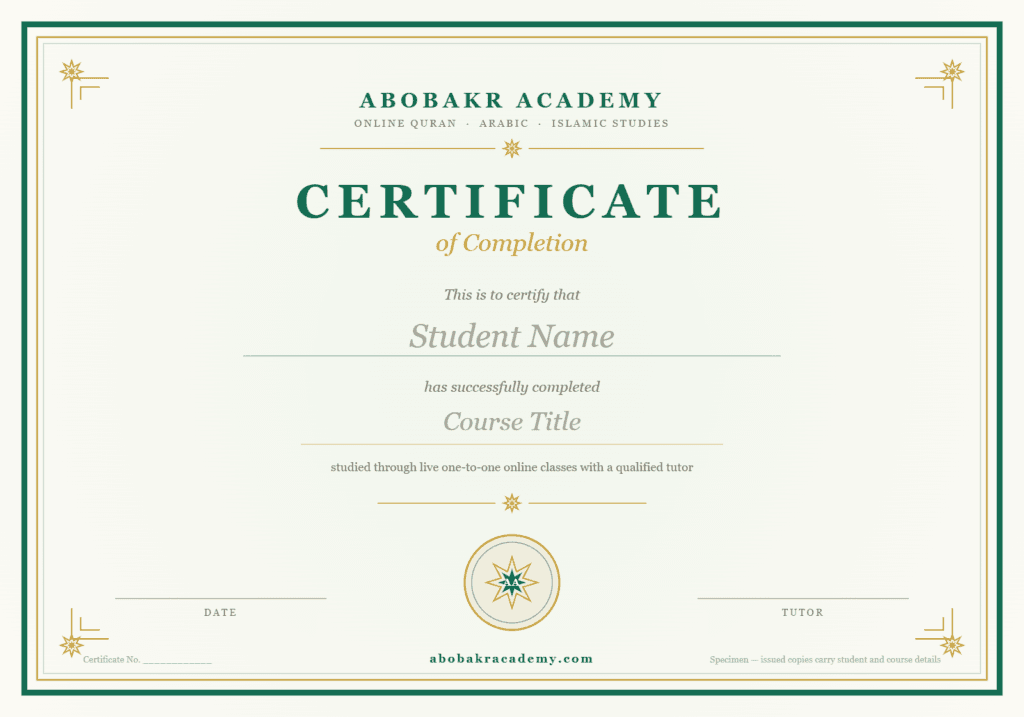
Issued when a student finishes a course with us. It records the student’s name, the course, the tutor who taught it and the period of study. Families use these for Islamic school applications, for homeschool records, and quite often simply because a nine-year-old who has been handed a certificate with their name on it will work harder for the next one. There is no charge for it.
A different order of thing entirely. An Ijazah is a formal authorisation to transmit Quran, granted only after a student recites the whole text to a teacher who themselves holds an unbroken chain of transmission going back to the Prophet (peace be upon him). It takes years, not months, and it cannot be bought or fast-tracked. Several of our tutors hold one, and students who want to pursue that route can do so with us, but we will be honest with you about the timescale before you commit.
We do not issue certificates for attendance. A student completes a course when the tutor judges that the material has been learned, which usually means demonstrating it: reciting the section correctly, applying the tajweed rules unprompted, or answering on the fiqh and aqeedah covered. A certificate that anyone gets for showing up is worth what you paid for it, which in most cases online is nothing.
They are issued by Abobakr Academy and carry the weight of our teachers’ teaching qualifications. They are not government-accredited academic credentials, and any provider telling you their online Islamic certificate carries formal academic accreditation is worth a second look. For Islamic school admissions, homeschool portfolios and personal record, they do the job. For a university transfer credit, they do not, and we will not pretend otherwise.
Requested often enough that we treat it as standard rather than special. Female tutors are available across every subject, and you can ask for one when you book the trial without needing to explain why.
Nobody here will assume you know what a rak’ah is. A good portion of our adult students came to Islam recently and want the fundamentals covered properly rather than picked up piecemeal from videos.
They have not. Adults learn to read Arabic faster than children in our experience, because they already understand what reading is and can practise without being told to. What they lack is usually confidence rather than capacity.
Younger children do shorter sessions, typically thirty minutes, with tutors who are used to holding a six-year-old’s attention over video. Progress notes come to you afterwards so you know what actually happened in the lesson.
Some employers, Islamic schools and further study programmes ask for documented evidence of study. Our certificates name the student, the course completed and the tutor, and are issued at no charge when a course finishes.
It is free. There is no unlock charge, no printing fee and no administrative cost. It is issued when you complete a course as a normal part of finishing.
No, and it would be misleading to suggest otherwise. The first class is free and certificates are free. Lessons after the trial are paid, because the tutors teaching them do this as their profession.
None at all. Give us a name, a subject and your availability. If you decide not to continue there is nothing to cancel.
Many of our tutors are Al-Azhar trained, and most hold an Ijazah in Quran. They are listed by name and subject on our About Us page, which is worth reading before you book anywhere, including here.
The free class covers one subject. If you are genuinely undecided between two, mention it when booking and we will suggest which to start with based on the student’s level rather than which is more expensive.
Tell us and we will move them to a different teacher. Fit between a child and a tutor matters more than most parents expect, and it is not a complaint we take badly.
For a lot of families it does, though the shape is different. A madrasah gives your child a room full of peers and a fixed Saturday morning. We give them a teacher to themselves at an hour you pick. Families who want both often keep the madrasah for the social side and use us for the reading and Tajweed that a large group cannot get to properly.
Yes, and a fair number of our families do exactly that. Written progress notes follow every lesson and the certificate of completion costs nothing, so there is a paper trail for a homeschool portfolio. Say at the outset that you are homeschooling and the tutor will pace the subject around the rest of your year rather than run to a timetable of their own.
Pick a subject, tell us when suits you, and we will arrange a live one-to-one lesson with a qualified tutor this week. You can also browse everything we teach on the courses page, or start with the beginners guide if you are not sure where you fit.