

Most people meet the Tajweed Quran rules as a list. Fourteen rules, or nine, or twelve depending on whose article you opened, each with an Arabic name and a definition. You read it, nod, and close the tab no better at reciting than you were before.
The list is not the problem. The problem is that a list has no order and no way of telling whether you are doing any of it correctly. This page fixes both. The rules are here, explained plainly, but they are arranged in the order teachers actually teach them, and every one comes with something you can listen for tonight.
What Tajweed actually is, and what it is not
Tajweed is the set of rules governing how the Quran is pronounced when recited aloud. It covers where each letter is formed in the mouth, how long vowels are held, when sounds merge into one another, and where a reader may stop. The word itself means to do something well.
Two things it is not. It is not a style of recitation, so the beautiful melodic reading you have heard is a separate skill layered on top. And it is not optional decoration: applying the rules is what keeps the recitation the same sound it was when it was revealed, and the more serious errors change meaning rather than merely sounding wrong.
You do not need to finish learning the rules before you start applying them. Almost nobody learns Tajweed as theory first. You learn a rule, you hunt for it on the page, and it becomes automatic somewhere between the twentieth and the hundredth time.
The order to learn the Tajweed Quran rules in
This is the part almost every guide leaves out, and it matters more than the definitions. Learned in the wrong order, the rules feel arbitrary. Learned in this order, each one rests on the last.
| Stage | What you learn | Why it comes here | Typical time |
|---|---|---|---|
| 1. Letters | Makharij, the articulation points. Where each of the 28 letters is formed. | Every later rule assumes you can already make the letter correctly. Fixing this later means unpicking a habit. | 2–6 months |
| 2. Vowels and length | Short vowels, then Madd, the elongations, counted in beats. | Length is the most audible thing in recitation and the easiest for a listener to check. | 1–3 months |
| 3. Ghunnah | The nasal sound, and the letters that carry it. | It sits inside several later rules. Learn it once here and Ikhfa, Idgham and Iqlab become variations rather than new material. | 2–4 weeks |
| 4. Noon and Meem Sakinah | The four cases of noon sakinah and tanween, then the three of meem sakinah. | The largest single block of rules, and the one that most changes how a page sounds. | 2–4 months |
| 5. Qalqalah and letter weight | Qalqalah, then Tafkhim and Tarqiq. | Refinements. Audible, but they do not change meaning, so they can wait. | 1–2 months |
| 6. Stopping | Waqf and Ibtida, where to pause and where to resume. | Needs enough fluency that you are reading phrases rather than words. | 1–2 months |
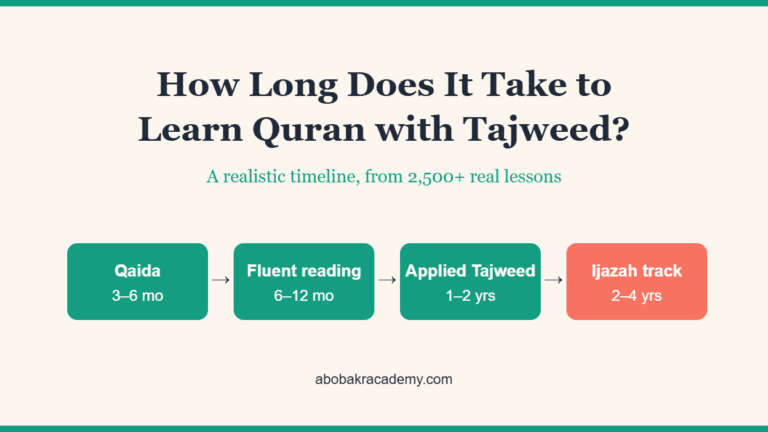
Two things surprise people about this table. The first is how much of it is stage 1: the letters take longer than everything else and are the part most self-taught readers skip. The second is that stopping comes last, even though it is the rule most visible on the page. Our guide to how long tajweed usually takes sets the same ground out against a full learning timeline.
The Tajweed Quran rules, one by one

Makharij, where each letter is formed
The 28 Arabic letters are produced at seventeen points spread across the throat, the tongue, the palate and the lips. Several pairs sit close enough together that an English-speaking mouth defaults to the wrong one: ق and ك, the two h sounds ح and ه, س and ص, د and ض. Getting these right is the whole of stage one, and it is why the letters children raised abroad say wrong is worth reading before anything else here.
Sifaat, what each letter does
Where makharij is the place, sifaat are the qualities: whether the sound is whispered or voiced, held or stopped, heavy or light. In practice you learn these through the letters rather than as a separate list, which is why they rarely appear as a lesson of their own.
Madd, holding the vowel
Madd is elongation, measured in beats called harakat. The natural madd runs two beats and appears constantly. The longer ones, four or six beats, are triggered by a hamzah or a sukoon following the vowel. The common fault is not getting these wrong individually but flattening all of them to roughly three beats once you speed up, so nothing is actually measured.
Ghunnah, the nasal sound
A sound made through the nose rather than the mouth, held about two beats. It belongs to ن and م, most obviously when they carry a shaddah, and it lives inside several of the rules below. A reader who has lost ghunnah is not missing one rule, they are missing a component of several at once, which is why the nasal sound children raised abroad drop first is worth catching early.
Noon Sakinah and Tanween, the four cases
When a noon carries no vowel, or a word ends in tanween, what happens next depends entirely on the letter that follows:
Meem Sakinah, the three cases
A silent meem follows the same logic with fewer branches. Before another م it merges with ghunnah. Before ب it is hidden, again with ghunnah. Before everything else it is simply pronounced clearly.
Qalqalah, the bounce
Five letters, ق ط ب ج د, carry a slight echo when they fall without a vowel. It is a bounce, not a vowel: the mouth releases the letter and stops. At the end of a verse the bounce is stronger than it is mid-word, which is the clearest single sign of a reader who has been taught rather than self-taught.
Tafkhim and Tarqiq, heavy and light
Some letters are pronounced with the back of the tongue raised, giving a fuller, heavier sound. Others stay light. ر and the lam of the word Allah change between the two depending on the vowels around them, and those two are where nearly all the difficulty sits.
Shaddah, the doubled letter
A shaddah means the letter is said twice, held rather than repeated. On ن or م it also brings the two-beat ghunnah, which is the easiest place in the whole Quran to hear whether a reader has the nasal sound at all.
Waqf and Ibtida, stopping and starting
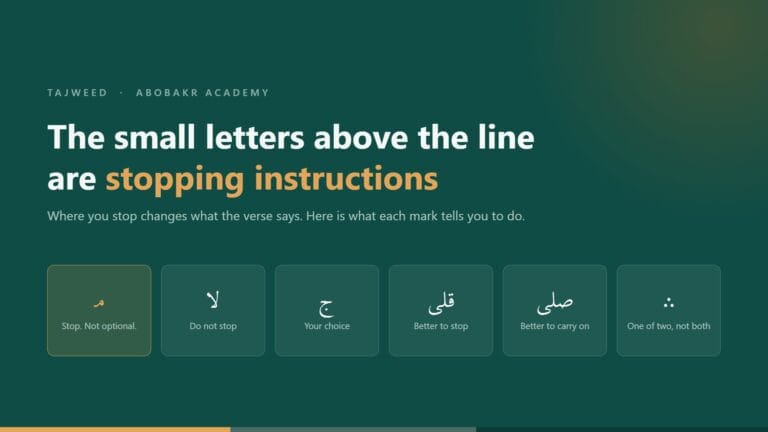
Where you stop changes what the verse says, and the small letters printed above the line are instructions telling you where stopping is compulsory, forbidden or a matter of choice. It is the one rule family with its own notation, and we have set it out in full in what the Quran stop signs mean, including what happens to the last word when you stop on it.
The rules of Raa
Almost every guide lists ر under heavy and light letters and moves on, but it carries its own small rule set and it is one of the commonest faults in Western students. Broadly, the ر is heavy when it carries a fathah or a dammah, and light when it carries a kasrah. Where it is silent, the vowel before it decides. There are exceptions, and a teacher will walk you through them, but the working rule catches most cases and is worth internalising early because the letter appears constantly.
Hamzat al-Wasl, the hamzah that disappears
The small alif at the start of many words is pronounced when you begin on it and silent when you arrive at it from the previous word. Reading al-hamdu at the start of a verse but sliding straight into it mid-sentence is this rule working correctly. Readers who learned from transliteration usually pronounce it every time, which makes recitation sound chopped into separate words rather than flowing.
Lahn, and which errors actually matter
Scholars split recitation errors into two grades, and the distinction is more useful to a learner than any individual rule.
This grading is also why the order in the table runs the way it does. Stage one prevents clear errors. Everything after it addresses hidden ones. A reader who has genuinely finished stage one is already reciting acceptably, even with plenty left to polish, and the same logic underpins applying the rules while you actually recite rather than studying them separately.
Sifaat in a little more detail
The attributes come in opposing pairs, and you only need a handful to explain most of what you hear. Whispered against voiced decides whether the vocal cords engage, which is what separates ت from د. Held against stopped decides whether the sound can be sustained. Heavy against light decides the tongue position. The rest are refinements that a tutor introduces as they become relevant to a letter you are struggling with, rather than as a list to memorise.
A test for each rule that works by ear
This is the part no other guide gives you, and it is the difference between knowing the rules and using them. None of these needs Arabic. Every one can be run by a parent listening to a child, or by an adult listening back to a recording of themselves.
If your child fails one of these, that is useful rather than discouraging. It tells the tutor exactly where to spend the next lesson, and it is a far better brief than “he needs to improve his Tajweed”.
Print the rules on one page
Reading rules on a screen and applying them at the Mushaf are different activities. We made a one-page chart so the rules can sit beside the book instead.
It covers the five families that account for most beginner errors: Noon Sakinah, Meem Sakinah, Qalqalah, Ghunnah and the Madd lengths. It is free, there is no signup and no email wall, and teachers and co-ops are welcome to print as many copies as they need. You can get it from our free printable Tajweed rules chart.
The mistakes that actually persist
Not the generic ones. These are the four that survive for years in students who have covered the rules thoroughly, because none of them shows up on a written test.

Ghunnah gets clipped under speed
The nasal sound is the first thing to go when a reader accelerates. It is held for a full two beats at slow pace and shortened to almost nothing at speed, and the reader rarely notices because the letters are still correct.
Madd lengths drift towards each other
A student who can cleanly separate a two-beat madd from a six-beat one at slow speed will often flatten all of them to about three once moving. Everything sounds vaguely long and nothing is measured.
Stops land wherever the breath runs out
Waqf is a meaning decision. Under speed it quietly becomes a lung decision, and the reader ends up stopping mid-phrase in places that blur or damage the sense of the verse.
Letters are formed at the wrong point
The ق that is really a ك, the ض that is really a د. These come from stage one and they are the hardest to fix later, because by then the mouth has rehearsed the wrong shape several thousand times.
All four are correction problems rather than knowledge problems. They need somebody listening, which is the honest reason a chart alone will not finish the job.
How long the Tajweed Quran rules take to learn
Adding up the table near the top gives roughly eight months to two years to cover the rules and have them running automatically, for someone who can already read Arabic script and practises a few times a week. Reciting a full narration with the precision required for an Ijazah is a different order of commitment, usually two to four years beyond that.
Three things move the number more than talent does: whether you can already read the script, whether anyone is correcting you, and how often you practise. Twenty minutes four times a week beats two hours once. We set the full picture out in our guide to how long it takes to learn Quran with Tajweed.
Learning with a teacher listening
Recorded courses teach rules well. They cannot hear you. Correction is the step that needs another person, and it is why this material has been passed on face to face rather than from a book for fourteen centuries.
In a one-to-one lesson the tutor stops you at the word rather than waiting for the end of the verse, because by then the error has been rehearsed four more times. Our tutors are Ijazah certified, many of them trained at Al-Azhar, which in practice means they were corrected the same way by their own teachers. If you would rather have somebody listening than a set of rules to study alone, our online tajweed lessons run one to one, and the first session is spent mostly listening to you read.
Questions about the Tajweed Quran rules
Do I have to learn Tajweed before I can read the Quran?
No, and waiting would be a mistake. You learn to read the letters first, then add the rules a family at a time while you are already reading. Almost nobody learns the theory in full before starting.
Is applying Tajweed obligatory?
Scholars distinguish between the rules whose neglect changes meaning or corrupts a letter, which must be observed, and the finer points of beautification, which are recommended. In practice a learner does not need to resolve that debate: the rules that matter most are also the ones taught first.
Which Tajweed rule should I learn first?
The articulation points of the letters, before any named rule at all. Every rule below stage one assumes you can already produce the letter correctly, and a letter learned wrong is far harder to fix than a rule learned late.
Can I learn Tajweed rules on my own?
You can learn what they are. You cannot reliably tell whether you are applying them, because the errors that persist are exactly the ones a reader cannot hear in their own voice. Charts, apps and articles get you a long way and then stop at the same place.
How many Tajweed rules are there?
Different guides count between nine and fourteen, which is why the lists never agree. The disagreement is about grouping rather than content. Learn the six families in the table above and you have covered what every one of those lists contains.
My child recites quickly and beautifully. Does that mean the Tajweed is right?
Not necessarily, and speed often hides the four faults above. Ask them to read the same page at half pace. Errors that are invisible at speed become obvious when there is time to hear them.
Where to start this week
Pick one rule, not six. Ghunnah is the usual choice because it is the most audible and it sits inside several other rules, so fixing it improves more than one thing at once. Run the nose test tonight, then police that single rule across one page a day for a week.
If reading itself is still shaky rather than the rules, start on our structured Quran reading track instead and come back to this page once the letters are steady.
If you would like a teacher listening while you do it, our tutors run a short trial lesson and will tell you plainly which stage of the table above you are actually at.