The five pillars of Islam are the five things every Muslim does: the shahada (saying what we believe), salah (praying five times a day), zakat (giving to people in need), sawm (fasting in Ramadan) and Hajj (visiting the Kaaba in Makkah, once in a lifetime for those who are able). The Prophet ﷺ described Islam as a building that stands on these five, which is why they are called pillars.
Below are the five with a picture and the Arabic for each, a button to hear every word, the Quran verse behind each pillar, what a child can do for each one, and a free printable poster, cards, worksheet and colouring page with no sign-up.
The five pillars of Islam in order
Here they are in the order most families teach them. Tap the button beside each Arabic word to hear it.
| Pillar | Arabic | What it is | How often |
|---|---|---|---|
| 1. Shahada Faith | شَهَادَة shahaadah | Saying the words that make a person Muslim, and meaning them. | Said every day; heard in every call to prayer |
| 2. Salah Prayer | صَلَاة salaah | Stopping five times a day to pray to Allah, facing the Kaaba in Makkah. | Five times every day |
| 3. Zakat Charity | زَكَاة zakaah | Sharing what we have, so that some of it goes from people who have more to people who have less. | Once a year |
| 4. Sawm Fasting | صَوْم sawm | Going without food and drink in the daytime in Ramadan, to learn patience and to remember people who are hungry. | Every day of Ramadan, once a year |
| 5. Hajj Pilgrimage | حَجّ hajj | A special trip to the Kaaba, the house Prophet Ibrahim built, at least once in a lifetime. | Once in a lifetime, if able |
The picture of a building comes from the Prophet ﷺ himself: بُنِيَ الإِسْلاَمُ عَلَى خَمْسٍ شَهَادَةِ أَنْ لاَ إِلَهَ إِلاَّ اللَّهُ وَأَنَّ مُحَمَّدًا رَسُولُ اللَّهِ، وَإِقَامِ الصَّلاَةِ، وَإِيتَاءِ الزَّكَاةِ، وَالْحَجِّ، وَصَوْمِ رَمَضَانَ, “Islam is built on five” (Sahih al-Bukhari 8). A building needs all of its pillars to stand, and that is the picture to give a child.
Each pillar, explained for kids
1. Shahada (faith)
What it is: Saying, and believing, that there is no god but Allah and that Muhammad is His messenger. For kids: Saying the words that make a person Muslim, and meaning them.
أَشْهَدُ أَنْ لاَ إِلَهَ إِلاَّ اللَّهُ
أَشْهَدُ أَنَّ مُحَمَّدًا رَسُولُ اللَّهِ
Ash-hadu an la ilaha illallah, ash-hadu anna Muhammadan rasulullah.
“I bear witness that there is no god but Allah, and I bear witness that Muhammad is the Messenger of Allah.”
As said in the call to prayer (Sunan Abi Dawud 499, graded hasan sahih by Al-Albani).
فَاعْلَمْ أَنَّهُ لَا إِلَٰهَ إِلَّا اللَّهُ “that there is no deity except Allāh” (Muhammad 47:19)
مُّحَمَّدٌ رَّسُولُ اللَّهِ “Muḥammad is the Messenger of Allāh” (Al-Fath 48:29)
2. Salah (prayer)
What it is: Praying five times every day and night: Fajr at dawn, Dhuhr after midday, Asr in the afternoon, Maghrib at sunset and Isha at night. For kids: Stopping five times a day to pray to Allah, facing the Kaaba in Makkah. The steps of the prayer for kids have a picture for each position.
وَأَقِيمُوا الصَّلَاةَ وَآتُوا الزَّكَاةَ “establish prayer and give zakāh” (Al-Baqarah 2:43)
3. Zakat (charity)
What it is: Giving a set share of the savings a family holds above a minimum amount, one fortieth (2.5%) for silver, to people in need. For kids: Sharing what we have, so that some of it goes from people who have more to people who have less.
وَأَقِيمُوا الصَّلَاةَ وَآتُوا الزَّكَاةَ “establish prayer and give zakāh” (Al-Baqarah 2:43)
4. Sawm (fasting)
What it is: Not eating or drinking from dawn until sunset, every day of the month of Ramadan. For kids: Going without food and drink in the daytime in Ramadan, to learn patience and to remember people who are hungry.
كُتِبَ عَلَيْكُمُ الصِّيَامُ “decreed upon you is fasting” (Al-Baqarah 2:183)
5. Hajj (pilgrimage)
What it is: Travelling to the Kaaba in Makkah, once in a lifetime, for every Muslim who is able to make the trip. For kids: A special trip to the Kaaba, the house Prophet Ibrahim built, at least once in a lifetime.
وَلِلَّهِ عَلَى النَّاسِ حِجُّ الْبَيْتِ مَنِ اسْتَطَاعَ إِلَيْهِ سَبِيلًا “pilgrimage to the House” (Ali ‘Imran 3:97)
Why fasting comes before Hajj
Most lists, including the one above, give the order shahada, salah, zakat, sawm, Hajj. That order has a story. When Ibn Umar was repeating the hadith, a man said it back to him with Hajj before fasting. Ibn Umar answered: no, fasting Ramadan and then Hajj, that is how I heard it from the Messenger of Allah (Sahih Muslim 16a). Other narrations, including the one in Sahih al-Bukhari, list Hajj first. The five pillars are the same in all of them.
What your child can do for each pillar
Young children are not expected to do all five the way adults do. Here is what each pillar can look like for them now.
| Pillar | What a child can do now | Source |
|---|---|---|
| Shahada | Learn the words and what they mean, and listen for them in the adhan. | Sunan Abi Dawud 499, graded hasan sahih by Al-Albani |
| Salah | Copy you at prayer time, learn wudu first, and start praying properly by seven. | Sunan Abi Dawud 495, graded hasan sahih by Al-Albani |
| Zakat | Zakat al-Fitr is paid for them at the end of Ramadan; they can drop the coins in the box. | Sahih al-Bukhari 1503 |
| Sawm | Practise with part of a day, the way the Companions’ children did, with a toy to help the time pass. | Sahih al-Bukhari 1960 |
| Hajj | Learn how Ibrahim and Ismail raised the foundations of the Kaaba (Al-Baqarah 2:127). A child’s Hajj counts, and the parent is rewarded too. | Sahih Muslim 1336a |
Before salah comes wudu. Our wudu steps for kids page has the ten steps with a picture for each.
Five pillars of Islam pictures
One card for each pillar, with its picture, its Arabic name and how often it is done. The cards are in the printable too: cut them out, mix them up, and ask your child to put them back in order.
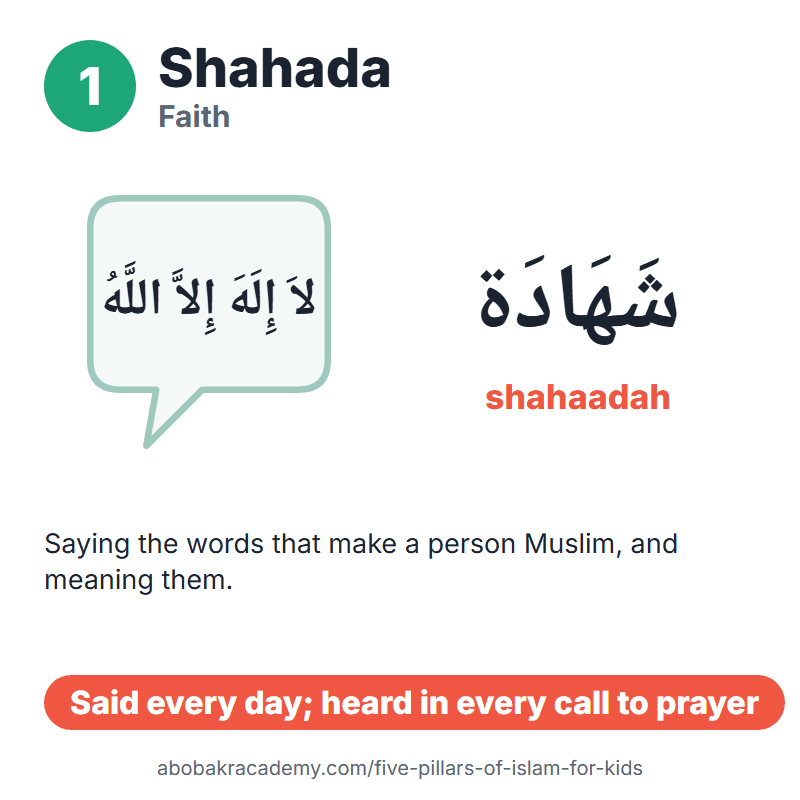


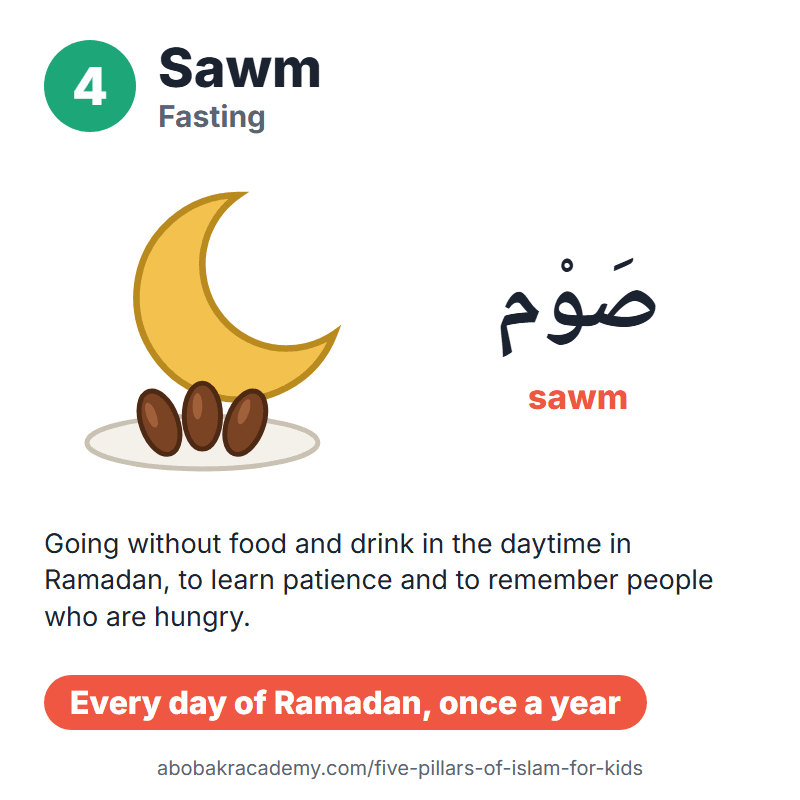
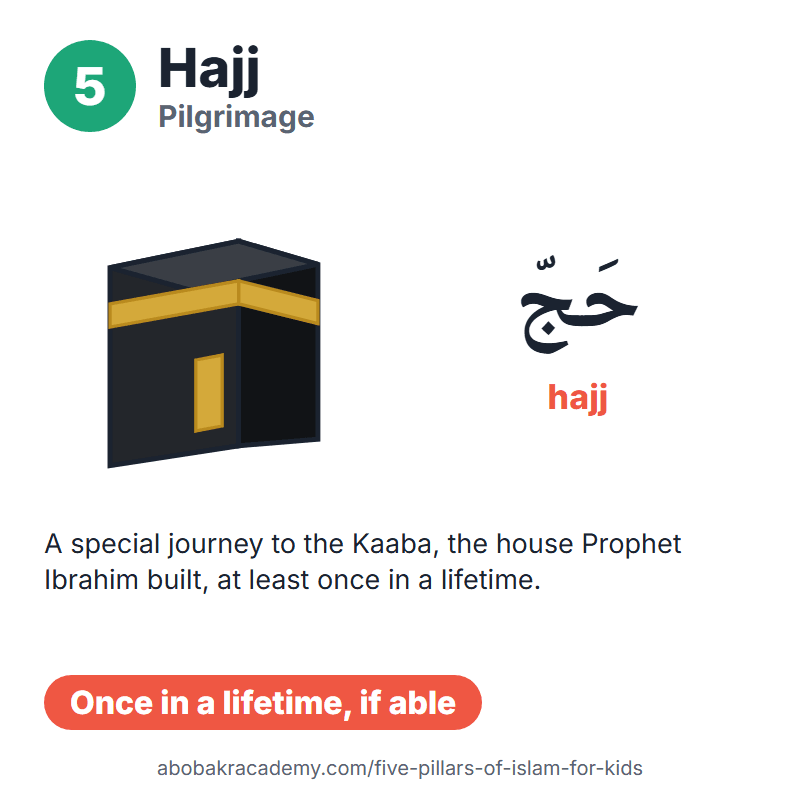
Free printable: five pillars of Islam for kids (PDF)
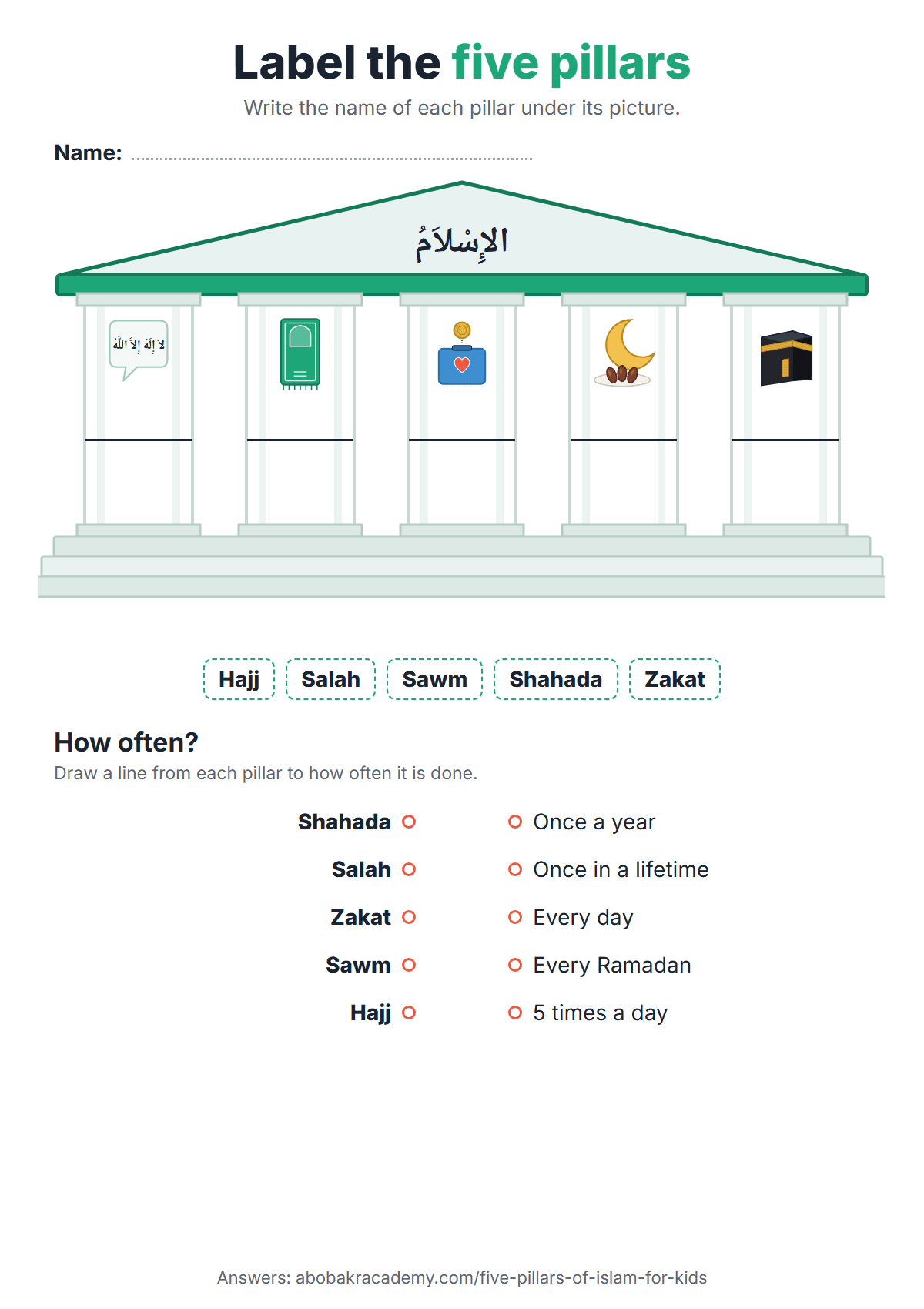
Download the five pillars printable (PDF, 4 pages). No email and no sign-up. It has:
- a poster of the five pillars with the Arabic and how often each is done;
- the five picture cards, to cut out and put in order;
- a worksheet: label the pillars, then match each one to how often it is done;
- a colouring page of the building and its five pillars.
Where each pillar comes from
For parents who want to check: the hadith this page relies on, each linked to its page on sunnah.com, with the grade where sunnah.com shows one. The verses are linked above, beside each pillar.
| Hadith | Grade on sunnah.com | What it shows |
|---|---|---|
| Sahih al-Bukhari 8 | in the Sahih | Islam is built on five: the shahada, prayer, zakat, Hajj and fasting Ramadan |
| Sahih Muslim 16a | in the Sahih | Ibn Umar corrected a man who put Hajj before fasting: fasting Ramadan comes first |
| Sunan Abi Dawud 499 | Hasan Sahih (Al-Albani) | The words of the shahada as they are said in the adhan |
| Sahih al-Bukhari 1395 | in the Sahih | Five prayers every day and night; zakat is taken from the rich and given to the poor |
| Sunan Abi Dawud 495 | Hasan Sahih (Al-Albani) | Children are taught to pray at seven |
| Sahih al-Bukhari 1454 | in the Sahih | Zakat on silver is one fortieth (2.5%) |
| Sahih al-Bukhari 1503 | in the Sahih | Zakat al-Fitr is paid for every Muslim, young and old |
| Sahih al-Bukhari 1960 | in the Sahih | The Companions had their children practise fasting, with wool toys to keep them busy |
| Sahih Muslim 1336a | in the Sahih | A child’s Hajj counts, and the parent is rewarded |
| Sahih Muslim 1337 | in the Sahih | Hajj is not required every year |
Teaching the five pillars when nobody at home reads Arabic
This site is built for families where nobody at home reads Arabic, and the five pillars need very little of it: five words and the shahada, each with a play button above. The rest is things your family already does, so point to them as they happen: the shahada in the call to prayer, salah at prayer times, the fast and Zakat al-Fitr in Ramadan, and the pictures of the pilgrims in Makkah in the month of Dhul Hijjah.
When your child is ready to read the Quran itself, our teachers start from the letters and explain everything in English. See Quran classes for kids; the first lesson is free.
The five pillars in order, and how children remember them
What are the 5 pillars of Islam in order?
Shahada (faith), salah (prayer), zakat (charity), sawm (fasting in Ramadan) and Hajj (pilgrimage to Makkah). Some narrations put Hajj before fasting; Ibn Umar insisted on fasting first (Sahih Muslim 16a).
How do you explain the five pillars to a child?
Use the Prophet’s own picture: Islam is a building that stands on five pillars (Sahih al-Bukhari 8). Then give each pillar one sentence: we say what we believe, we pray five times a day, we share with people in need, we fast in Ramadan, and we visit the Kaaba once in our life if we can.
How can kids remember the five pillars?
Count them on one hand and tie each one to a time you already know. The shahada is in every call to prayer, salah comes at the five prayer times, zakat once a year, sawm in the month of Ramadan, and Hajj in the month of Dhul Hijjah.
Do children have to do all five pillars?
Not in the way adults do. Children learn the shahada, are taught to pray by seven (Sunan Abi Dawud 495), have Zakat al-Fitr paid for them (Sahih al-Bukhari 1503), practise fasting (Sahih al-Bukhari 1960), and a child’s Hajj counts (Sahih Muslim 1336).
What does zakat mean for kids?
Zakat means giving part of what we have to people who have less. A family pays one fortieth, 2.5%, of the savings it holds above a minimum amount, once a year (Sahih al-Bukhari 1454).
Wudu, the Islamic months and Hajj, explained for kids
- Wudu steps for kids: the washing before salah, in ten steps with a picture for each.
- Islamic months for kids: Ramadan, the month of fasting, and Dhul Hijjah, the month of Hajj.
- Hajj step by step: the days of Hajj in order, for older children and adults.
- Free printables: more charts and worksheets for Muslim children.
- Online Quran classes for kids: from the first letter, with a free first lesson.