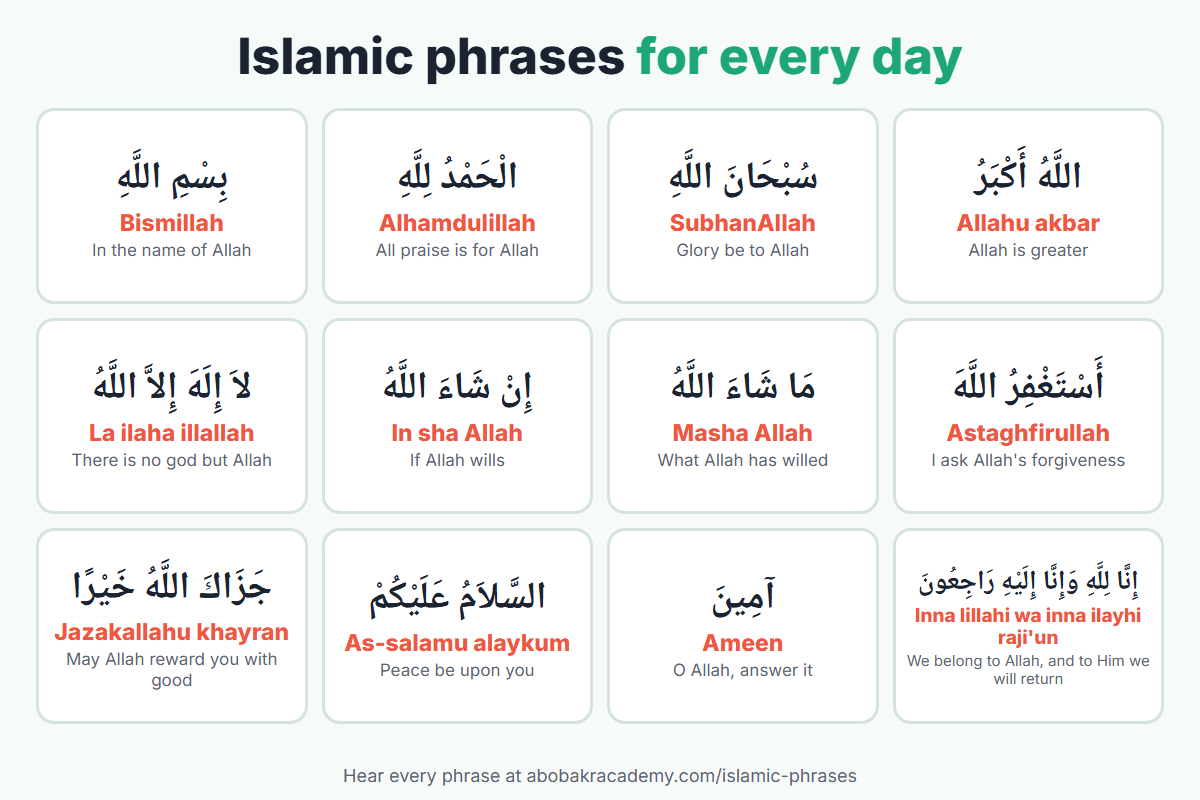
Islamic phrases are short Arabic sayings Muslims use all through the day. The ones you will hear most are bismillah (in the name of Allah) before starting something, alhamdulillah (all praise is for Allah) to give thanks, in sha Allah (if Allah wills) about the future, masha Allah (what Allah has willed) at something good, subhanAllah (glory be to Allah) at something amazing, astaghfirullah (I ask Allah’s forgiveness) after a mistake, and jazakallahu khayran (may Allah reward you with good) to say thank you. Shukran and the other ways to say thank you in Arabic have a page of their own, with the replies.
Below are 21 of them with the Arabic, a button to hear each one, what it means, when to say it, how to reply, and the verse or hadith it comes from. Then the phrases a child needs for each moment of the day, and free phrase cards and a printable with no sign-up.
Common Islamic phrases and their meanings
Tap the button beside the Arabic to hear it said slowly. Tap a phrase’s name to jump to how and when to use it.
| Phrase | Arabic | Meaning | When to say it |
|---|---|---|---|
| Bismillah | بِسْمِ اللَّهِ | In the name of Allah. | Before eating, drinking, getting dressed, leaving the house, and before starting anything that matters. |
| Bismillahir Rahmanir Rahim | بِسْمِ اللَّهِ الرَّحْمَٰنِ الرَّحِيمِ | In the name of Allah, the Entirely Merciful, the Especially Merciful. | Before reciting a surah of the Quran. |
| Alhamdulillah | الْحَمْدُ لِلَّهِ | All praise is for Allah. | After eating, after a sneeze, on good news, and in answer to "How are you?" It is thanks to Allah whether the news is good or not. |
| SubhanAllah | سُبْحَانَ اللَّهِ | Glory be to Allah: Allah is far above any fault. | When something amazes you, like a sunset, a baby’s hand or a huge storm; and 33 times after each prayer. |
| Allahu akbar | اللَّهُ أَكْبَرُ | Allah is greater: greater than anything you can think of. | To begin the prayer and at its movements, in the call to prayer, 33 times after each prayer, and at a moment of joy or awe. |
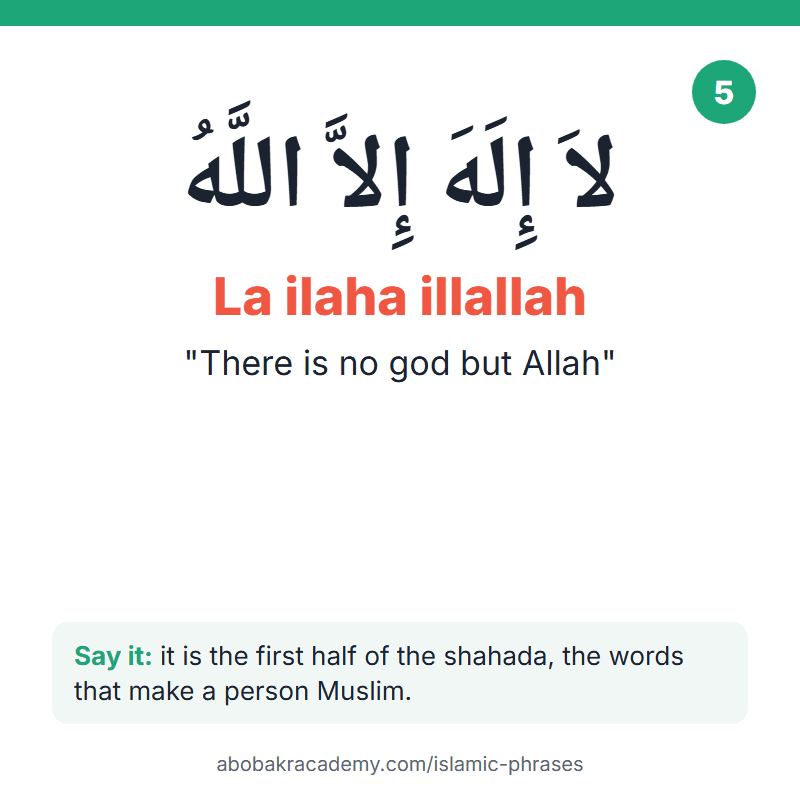
| La ilaha illallah | لاَ إِلَهَ إِلاَّ اللَّهُ | There is no god but Allah. | It is the first half of the shahada, the words that make a person Muslim. |
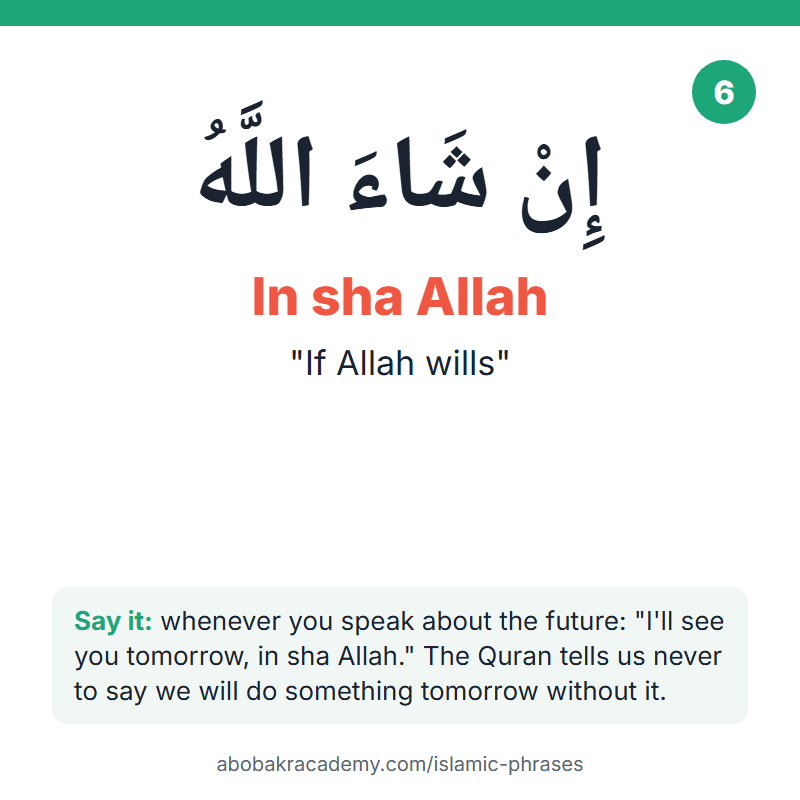
| In sha Allah (inshallah) | إِنْ شَاءَ اللَّهُ | If Allah wills. | Whenever you speak about the future: "I’ll see you tomorrow, in sha Allah." The Quran tells us never to say we will do something tomorrow without it. |
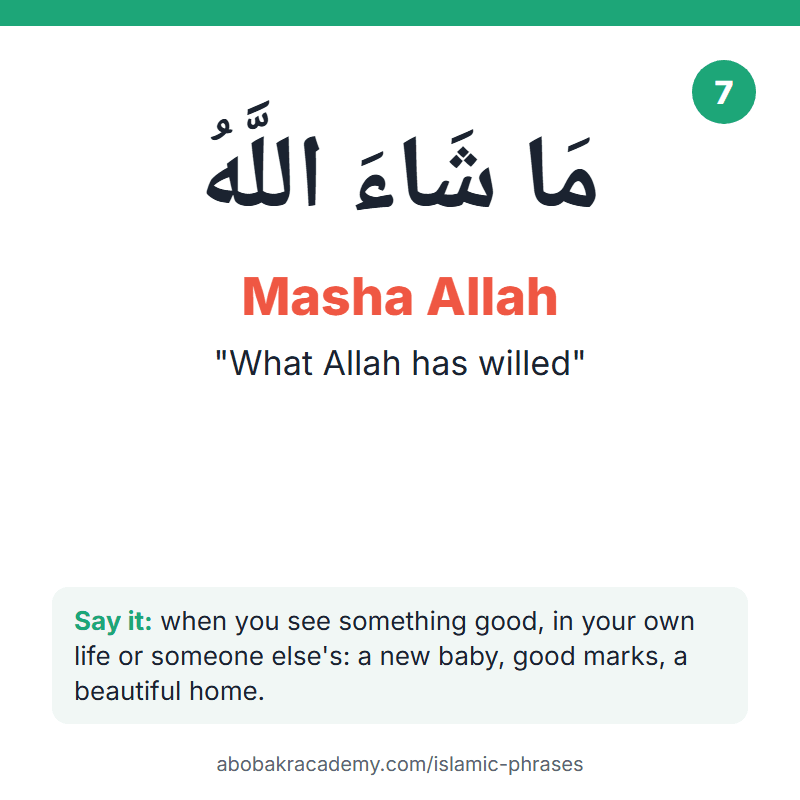
| Masha Allah (mashallah) | مَا شَاءَ اللَّهُ | What Allah has willed. | When you see something good, in your own life or someone else’s: a new baby, good marks, a beautiful home. |
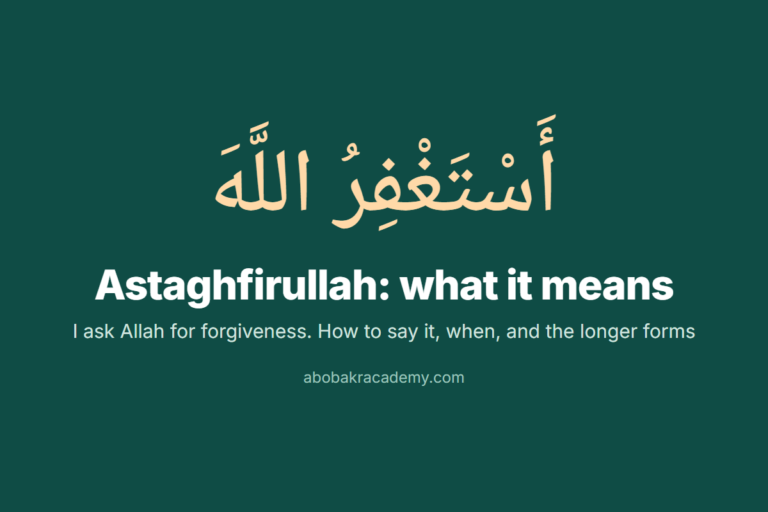
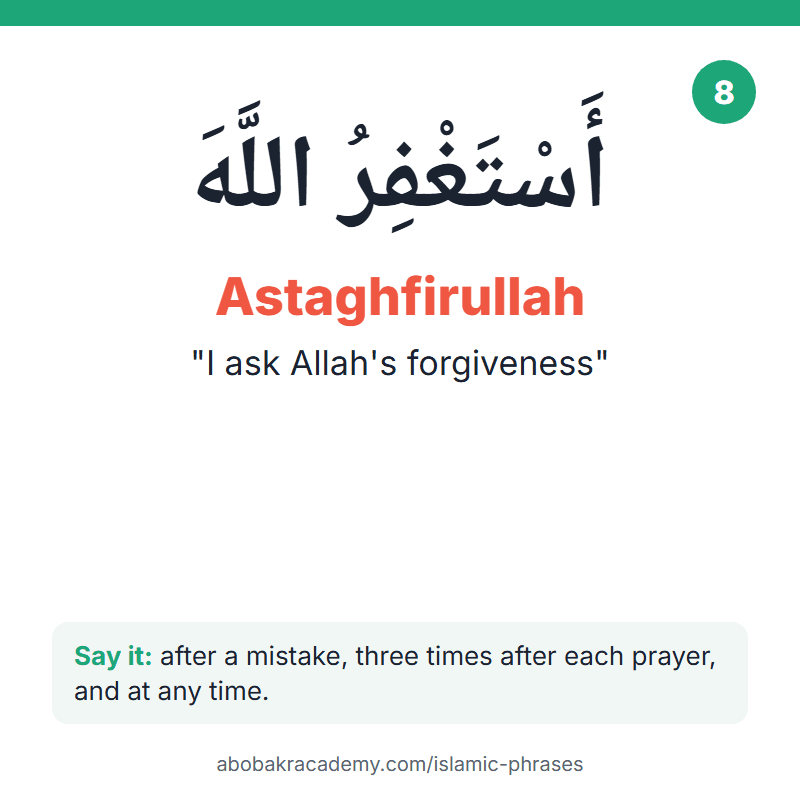
| Astaghfirullah | أَسْتَغْفِرُ اللَّهَ | I ask Allah’s forgiveness. | After a mistake, three times after each prayer, and at any time. |
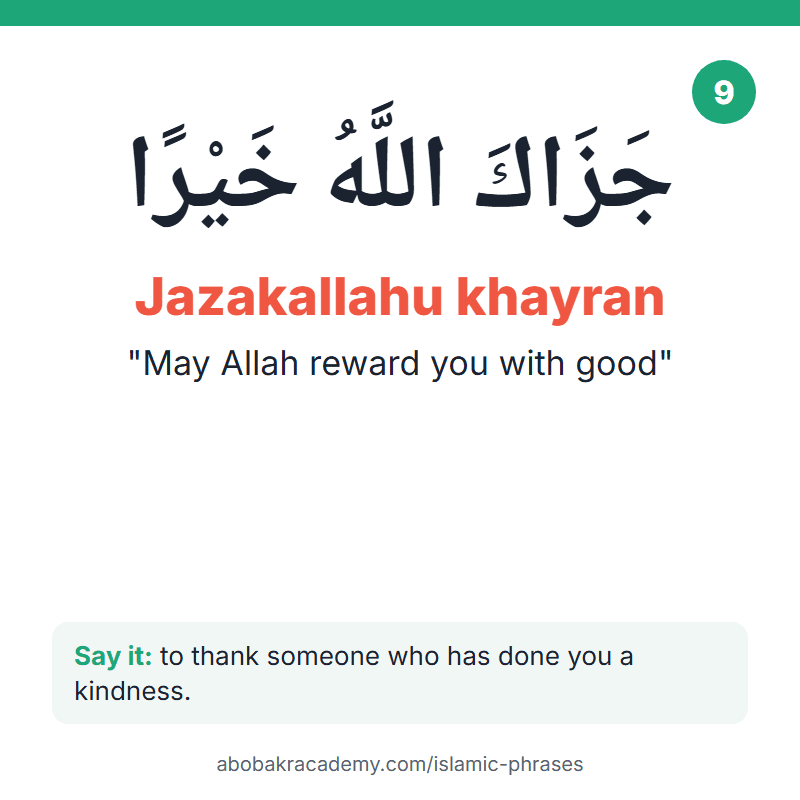
| Jazakallahu khayran | جَزَاكَ اللَّهُ خَيْرًا | May Allah reward you with good. | To thank someone who has done you a kindness. |
| Barakallahu lak (barakallahu fik) | بَارَكَ اللَّهُ لَكَ | May Allah bless you (in it). | On someone’s good news: a wedding, a new job, a new baby. |
| As-salamu alaykum | السَّلاَمُ عَلَيْكُمْ | Peace be upon you. | When you meet a Muslim or walk into a room, and when you leave. |
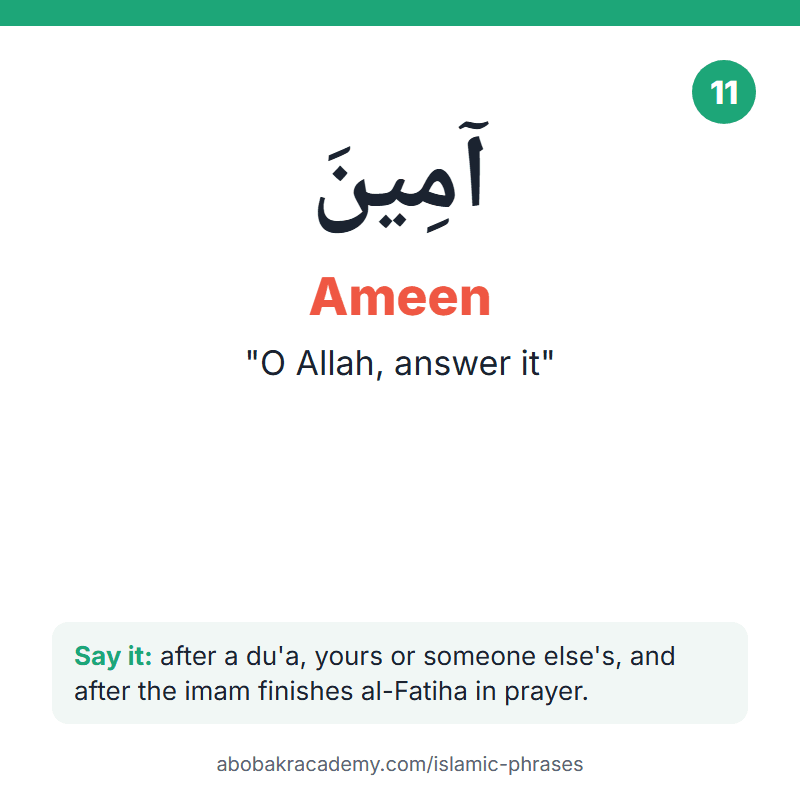
| Ameen | آمِينَ | O Allah, answer it. | After a du’a, yours or someone else’s, and after the imam finishes al-Fatiha in prayer. |
| La hawla wa la quwwata illa billah | لاَ حَوْلَ وَلاَ قُوَّةَ إِلاَّ بِاللَّهِ | There is no power and no strength except with Allah. | When something is too hard for you, when you are about to start a hard task, and when leaving the house. |
| A’udhu billahi min ash-shaytan ir-rajim | أَعُوذُ بِاللَّهِ مِنَ الشَّيْطَانِ الرَّجِيمِ | I seek refuge with Allah from Satan, the outcast. | When you feel angry, before reciting the Quran, and when a bad thought comes. |
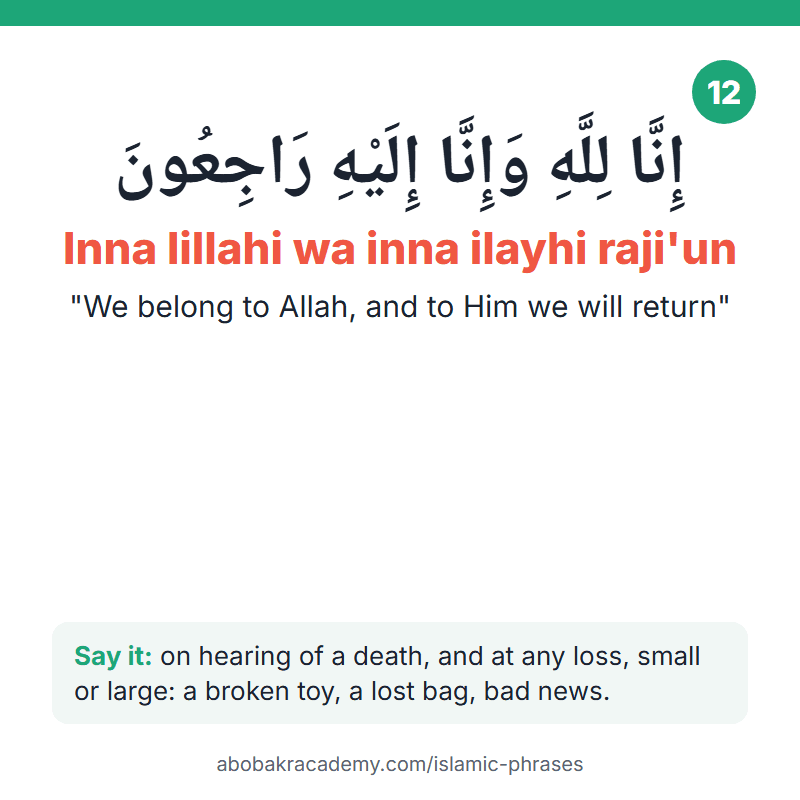
| Inna lillahi wa inna ilayhi raji’un | إِنَّا لِلَّهِ وَإِنَّا إِلَيْهِ رَاجِعُونَ | We belong to Allah, and to Him we will return. | On hearing of a death, and at any loss, small or large: a broken toy, a lost bag, bad news. |
| Hasbunallahu wa ni’mal wakil | حَسْبُنَا اللَّهُ وَنِعْمَ الْوَكِيلُ | Allah is enough for us, and He is the best to rely on. | When you are afraid or wronged. |
| Yarhamuk Allah | يَرْحَمُكَ اللَّهُ | May Allah have mercy on you. | When someone sneezes and says alhamdulillah. |
| SubhanAllahi wa bihamdihi | سُبْحَانَ اللَّهِ وَبِحَمْدِهِ | Glory be to Allah, and all praise is His. | As dhikr at any time. |
| Sallallahu alayhi wa sallam (ﷺ) | ﷺ | May Allah send blessings and peace upon him. | Whenever the Prophet Muhammad is named. |
| Subhanahu wa ta’ala (SWT) | سُبْحَانَهُ وَتَعَالَىٰ | Glorified and exalted is He. | After the name of Allah, in speech or writing. |
Each phrase: when to say it and how to reply
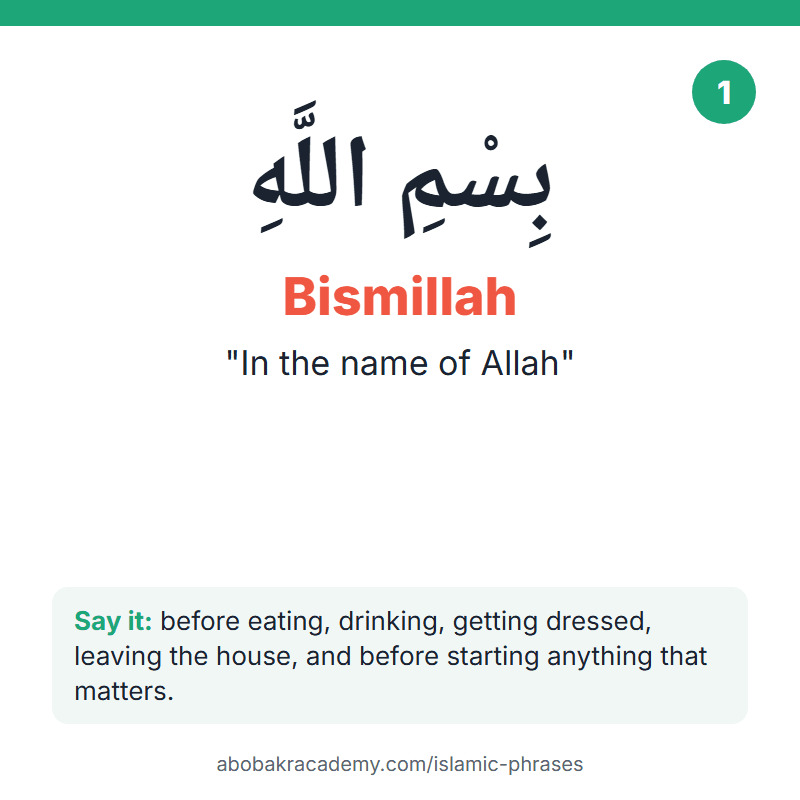
Bismillah
بِسْمِ اللَّهِ
Meaning: In the name of Allah. When to say it: Before eating, drinking, getting dressed, leaving the house, and before starting anything that matters.
Forgot to say it at the start of a meal? Say bismillahi fi awwalihi wa akhirihi, in the name of Allah at its beginning and its end.
Source: In the Quran as بِسْمِ اللَّهِ (Al-Fatihah 1:1); Jami` at-Tirmidhi 1858, graded sahih by Darussalam; Sahih al-Bukhari 5376.
Bismillahir Rahmanir Rahim
بِسْمِ اللَّهِ الرَّحْمَٰنِ الرَّحِيمِ
Meaning: In the name of Allah, the Entirely Merciful, the Especially Merciful. When to say it: Before reciting a surah of the Quran. It is the first verse of al-Fatiha, and it opens every surah but one (at-Tawbah).
This is a verse of the Quran, so we give a reciter’s recording rather than a machine voice: tap the verse link to hear it.
Source: The words of Al-Fatihah 1:1, “In the name of Allāh, the Entirely Merciful, the Especially Merciful”.
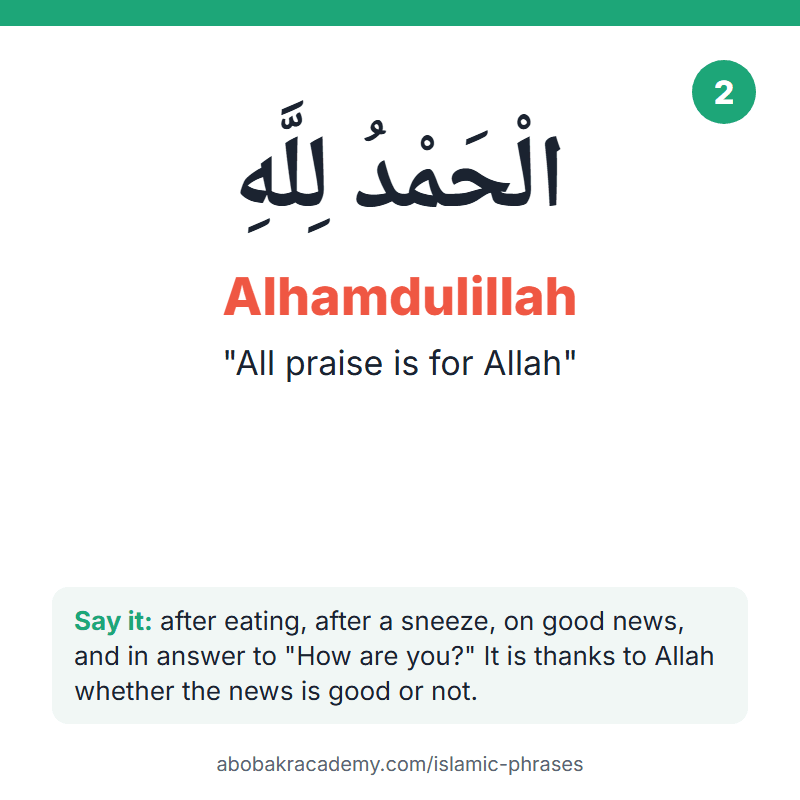
Alhamdulillah
الْحَمْدُ لِلَّهِ
Meaning: All praise is for Allah. When to say it: After eating, after a sneeze, on good news, and in answer to "How are you?" It is thanks to Allah whether the news is good or not.
Source: In the Quran as الْحَمْدُ لِلَّهِ (Al-Fatihah 1:2); Sahih al-Bukhari 6224; Sahih Muslim 597a.
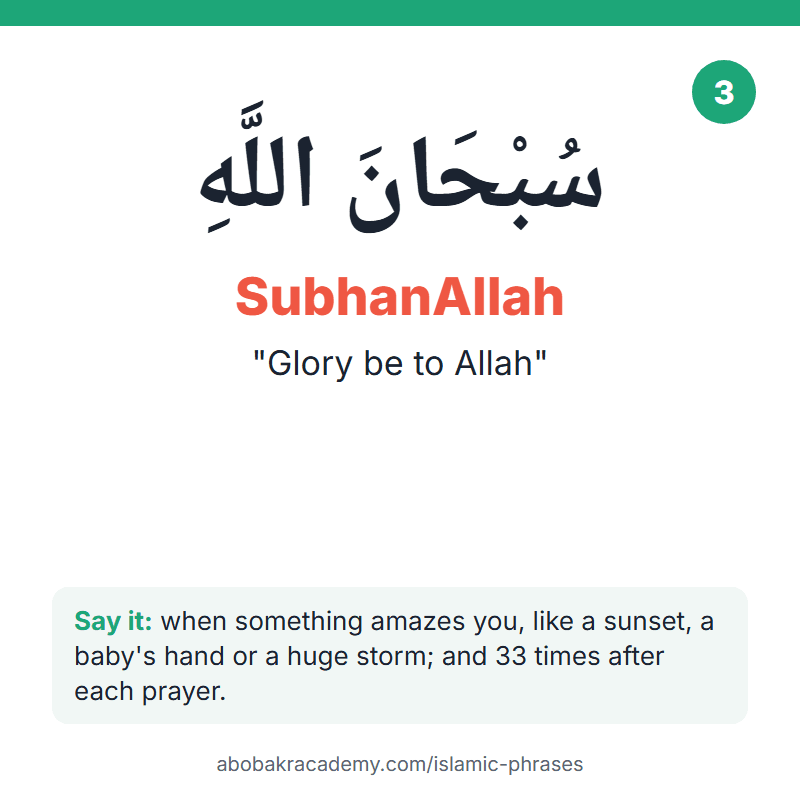
SubhanAllah
سُبْحَانَ اللَّهِ
Meaning: Glory be to Allah: Allah is far above any fault. When to say it: When something amazes you, like a sunset, a baby’s hand or a huge storm; and 33 times after each prayer.
Source: Sahih al-Bukhari 6406; Sahih Muslim 597a.
Allahu akbar
اللَّهُ أَكْبَرُ
Meaning: Allah is greater: greater than anything you can think of. When to say it: To begin the prayer and at its movements, in the call to prayer, 33 times after each prayer, and at a moment of joy or awe.
Source: Sunan Abi Dawud 499, graded hasan sahih by Al-Albani; Sahih Muslim 597a.
La ilaha illallah
لاَ إِلَهَ إِلاَّ اللَّهُ
Meaning: There is no god but Allah. When to say it: It is the first half of the shahada, the words that make a person Muslim. It is said in the call to prayer, and as dhikr at any time.
Source: In the Quran as لَا إِلَٰهَ إِلَّا اللَّهُ (Muhammad 47:19); Sunan Abi Dawud 499, graded hasan sahih by Al-Albani.
In sha Allah (inshallah)
إِنْ شَاءَ اللَّهُ
Meaning: If Allah wills. When to say it: Whenever you speak about the future: "I’ll see you tomorrow, in sha Allah." The Quran tells us never to say we will do something tomorrow without it.
How to reply: There is no fixed reply. People often say it back, or say ameen if it was a hope. The verse it comes from, its three words and how to write it in Arabic are on our page on what inshallah means.
Source: In the Quran as إِن شَاءَ اللَّهُ (Al-Fath 48:27); Al-Kahf 18:23: “And never say of anything, ‘Indeed, I will do that tomorrow,’” 18:24: “Except [when adding], ‘If Allāh wills.’”; Sunan Abi Dawud 499, graded hasan sahih by Al-Albani.
Masha Allah (mashallah)
مَا شَاءَ اللَّهُ
Meaning: What Allah has willed. When to say it: When you see something good, in your own life or someone else’s: a new baby, good marks, a beautiful home. It says the good came from Allah, not from us.
The Prophet ﷺ taught the wording: say "what Allah wills, then what so-and-so wills", never "what Allah and so-and-so will" as if they were equal.
Source: In the Quran as مَا شَاءَ اللَّهُ لَا قُوَّةَ إِلَّا بِاللَّهِ (Al-Kahf 18:39); Sunan Abi Dawud 4980, graded sahih by Al-Albani.
Astaghfirullah
أَسْتَغْفِرُ اللَّهَ
Meaning: I ask Allah’s forgiveness. When to say it: After a mistake, three times after each prayer, and at any time. Many people also say it on hearing something wrong or shocking. How to pronounce it, the verses behind it and its longer forms are on our page on what astaghfirullah means.
Source: Sahih Muslim 591; Sahih al-Bukhari 6306.
Jazakallahu khayran
جَزَاكَ اللَّهُ خَيْرًا
Meaning: May Allah reward you with good. When to say it: To thank someone who has done you a kindness. The Prophet ﷺ said that whoever says it has praised in full.
To one person or more: Jazaka to a man or boy, jazaki to a woman or girl, jazakum to more than one.
How to reply: Wa iyyak (and you) or wa antum fa jazakumullahu khayran (and you, may Allah reward you with good). Neither reply comes from a hadith; both are common.
Source: Jami` at-Tirmidhi 2035, graded hasan by Darussalam.
Barakallahu lak (barakallahu fik)
بَارَكَ اللَّهُ لَكَ
Meaning: May Allah bless you (in it). When to say it: On someone’s good news: a wedding, a new job, a new baby. The Prophet ﷺ said it to a companion who had just married.
To one person or more: Laka or fika to a man, laki or fiki to a woman, lakum or fikum to more than one.
How to reply: Wa fik barakallah (and may Allah bless you too) is a common reply.
Source: Sahih al-Bukhari 5155.
As-salamu alaykum
السَّلاَمُ عَلَيْكُمْ
Meaning: Peace be upon you. When to say it: When you meet a Muslim or walk into a room, and when you leave.
How to reply: السَّلاَمُ عَلَيْكَ وَرَحْمَةُ اللَّهِ As-salamu alayka wa rahmatullah (in everyday speech: wa alaykum as-salam wa rahmatullah): “Peace be upon you, and the mercy of Allah. When Adam first greeted the angels, they answered with more than he said.”
Our Arabic greetings page has the full greeting, the replies and every other greeting a child will hear.
Source: Sahih al-Bukhari 6227.
Ameen
آمِينَ
Meaning: O Allah, answer it. When to say it: After a du’a, yours or someone else’s, and after the imam finishes al-Fatiha in prayer.
Source: Sahih al-Bukhari 780.
La hawla wa la quwwata illa billah
لاَ حَوْلَ وَلاَ قُوَّةَ إِلاَّ بِاللَّهِ
Meaning: There is no power and no strength except with Allah. When to say it: When something is too hard for you, when you are about to start a hard task, and when leaving the house. The Prophet ﷺ called it a treasure of Paradise.
Source: Sahih al-Bukhari 6384; Sunan Abi Dawud 5095, graded sahih by Al-Albani.
A’udhu billahi min ash-shaytan ir-rajim
أَعُوذُ بِاللَّهِ مِنَ الشَّيْطَانِ الرَّجِيمِ
Meaning: I seek refuge with Allah from Satan, the outcast. When to say it: When you feel angry, before reciting the Quran, and when a bad thought comes. The Prophet ﷺ said it would take an angry man’s anger away.
Source: An-Nahl 16:98: “So when you recite the Qur’ān, [first] seek refuge in Allāh from Satan, the expelled [from His mercy]”; Sahih al-Bukhari 6115.
Inna lillahi wa inna ilayhi raji’un
إِنَّا لِلَّهِ وَإِنَّا إِلَيْهِ رَاجِعُونَ
Meaning: We belong to Allah, and to Him we will return. When to say it: On hearing of a death, and at any loss, small or large: a broken toy, a lost bag, bad news.
The Prophet ﷺ taught that a Muslim who says it at a loss and asks Allah for something better in its place is given better.
إِنَّا لِلَّهِ وَإِنَّا إِلَيْهِ رَاجِعُونَ اللَّهُمَّ أْجُرْنِي فِي مُصِيبَتِي وَأَخْلِفْ لِي خَيْرًا مِنْهَا
Inna lillahi wa inna ilayhi raji’un, Allahumma’jurni fi musibati wa akhlif li khayran minha: “We belong to Allah and to Him we will return. O Allah, reward me in my loss and give me something better in its place.”
Source: In the Quran as إِنَّا لِلَّهِ وَإِنَّا إِلَيْهِ رَاجِعُونَ (Al-Baqarah 2:156); Sahih Muslim 918a.
Hasbunallahu wa ni’mal wakil
حَسْبُنَا اللَّهُ وَنِعْمَ الْوَكِيلُ
Meaning: Allah is enough for us, and He is the best to rely on. When to say it: When you are afraid or wronged. Ibrahim said it when he was thrown into the fire, and the Prophet ﷺ said it when told an army had gathered against him.
These are the words of the verse, so we give a reciter’s recording rather than a machine voice: tap the verse link to hear it.
Source: The words of Ali ‘Imran 3:173, “Sufficient for us is Allāh, and [He is] the best Disposer of affairs”; Sahih al-Bukhari 4563.
Yarhamuk Allah
يَرْحَمُكَ اللَّهُ
Meaning: May Allah have mercy on you. When to say it: When someone sneezes and says alhamdulillah.
To one person or more: Yarhamuka to a man or boy, yarhamuki to a woman or girl.
How to reply: يَهْدِيكُمُ اللَّهُ وَيُصْلِحُ بَالَكُمْ Yahdikumullahu wa yuslihu balakum: “May Allah guide you and set your affairs right. The sneezer says this back.”
Source: Sahih al-Bukhari 6224.
SubhanAllahi wa bihamdihi
سُبْحَانَ اللَّهِ وَبِحَمْدِهِ
Meaning: Glory be to Allah, and all praise is His. When to say it: As dhikr at any time. The Prophet ﷺ said it and subhanAllahil azim are light on the tongue, heavy in the balance and loved by the Most Merciful.
Source: Sahih al-Bukhari 6406.
Sallallahu alayhi wa sallam (ﷺ)
ﷺ
Meaning: May Allah send blessings and peace upon him. When to say it: Whenever the Prophet Muhammad is named. In writing it is often shortened to the sign ﷺ, or to "pbuh" (peace be upon him) in English.
The Quran commands it, and the Prophet ﷺ said that whoever sends one blessing on him, Allah blesses ten times.
Source: Al-Ahzab 33:56: “O you who have believed, ask [Allāh to confer] blessing upon him and ask [Allāh to grant him] peace”; Sahih Muslim 408.
Subhanahu wa ta’ala (SWT)
سُبْحَانَهُ وَتَعَالَىٰ
Meaning: Glorified and exalted is He. When to say it: After the name of Allah, in speech or writing. In English it is often shortened to SWT.
Source: The words of Al-Isra 17:43, “Exalted is He and high above what they say”.
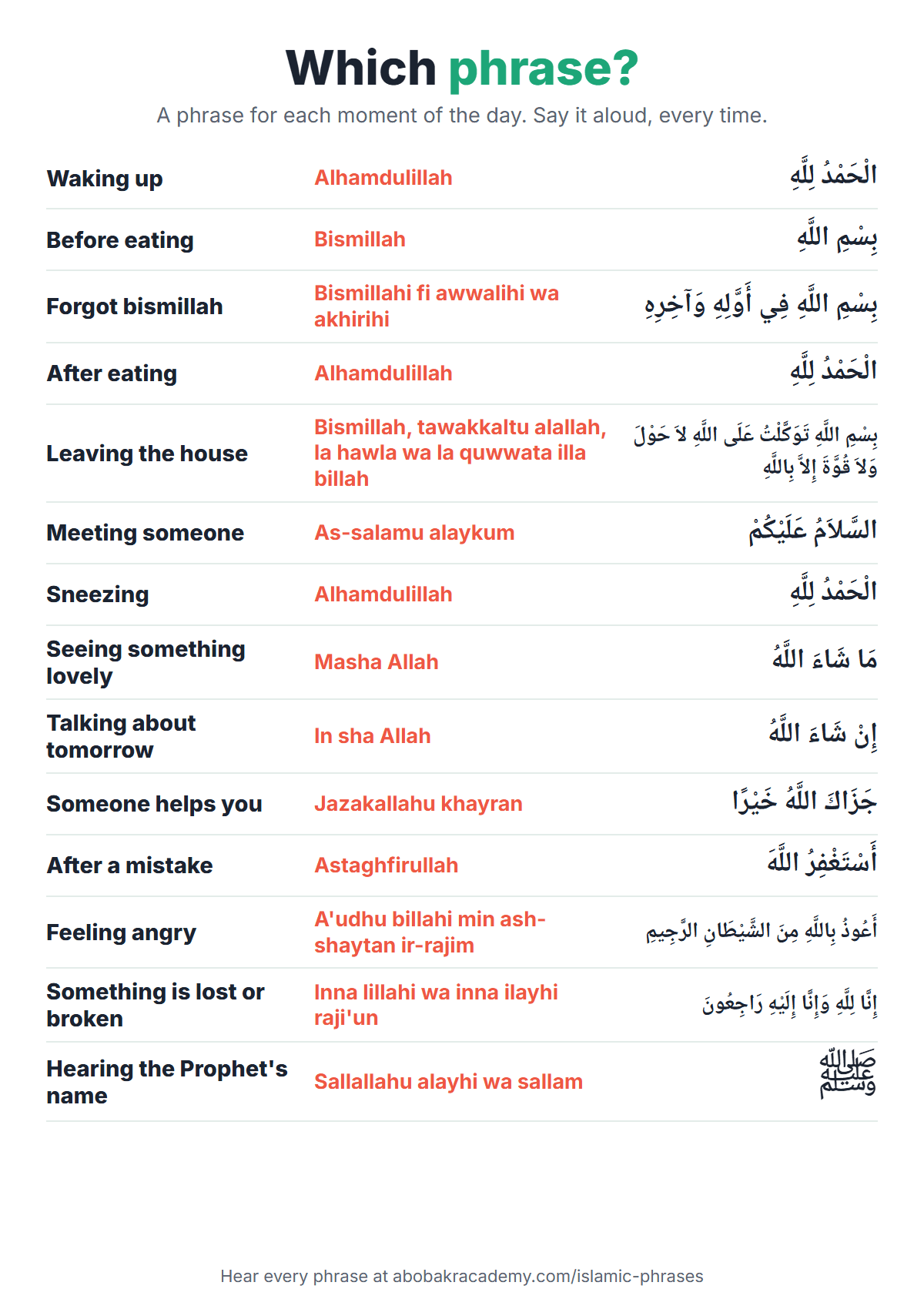
Islamic phrases for kids: one for each moment of the day
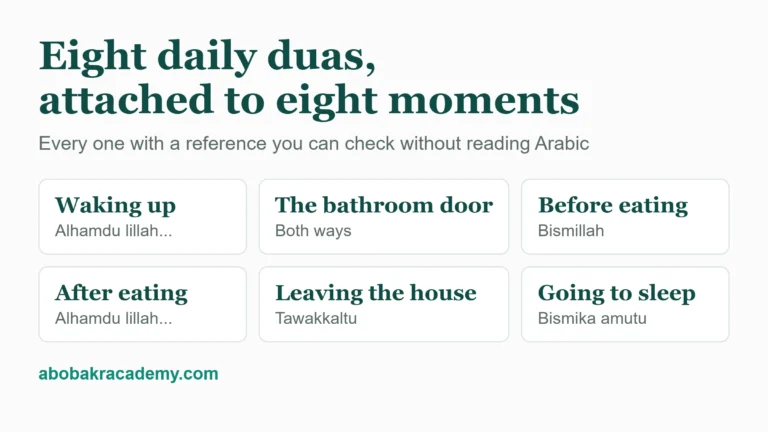
Children learn these phrases by hearing them at the same moment every day, long before they know what the words mean. Pick two or three moments that happen in your home every day, say the phrase aloud each time, and add another when those are easy. Here is a phrase for each moment.
| When | Say | Arabic |
|---|---|---|
| Waking up | Alhamdulillah The start of the waking du’a; the full du’a is on our daily duas page. | الْحَمْدُ لِلَّهِ |
| Before eating | Bismillah Say it aloud so your child hears it every meal. | بِسْمِ اللَّهِ |
| Forgot bismillah | Bismillahi fi awwalihi wa akhirihi In the name of Allah at its beginning and its end. | بِسْمِ اللَّهِ فِي أَوَّلِهِ وَآخِرِهِ |
| After eating | Alhamdulillah | الْحَمْدُ لِلَّهِ |
| Leaving the house | Bismillah, tawakkaltu alallah, la hawla wa la quwwata illa billah In the name of Allah, I rely on Allah, there is no power and no strength except with Allah. | بِسْمِ اللَّهِ تَوَكَّلْتُ عَلَى اللَّهِ لاَ حَوْلَ وَلاَ قُوَّةَ إِلاَّ بِاللَّهِ |
| Meeting someone | As-salamu alaykum Whoever greets first; the other replies with more. | السَّلاَمُ عَلَيْكُمْ |
| Sneezing | Alhamdulillah The listener says yarhamuk Allah; the sneezer answers yahdikumullahu wa yuslihu balakum. | الْحَمْدُ لِلَّهِ |
| Seeing something lovely | Masha Allah Or subhanAllah, if it amazes you. | مَا شَاءَ اللَّهُ |
| Talking about tomorrow | In sha Allah | إِنْ شَاءَ اللَّهُ |
| Someone helps you | Jazakallahu khayran | جَزَاكَ اللَّهُ خَيْرًا |
| After a mistake | Astaghfirullah | أَسْتَغْفِرُ اللَّهَ |
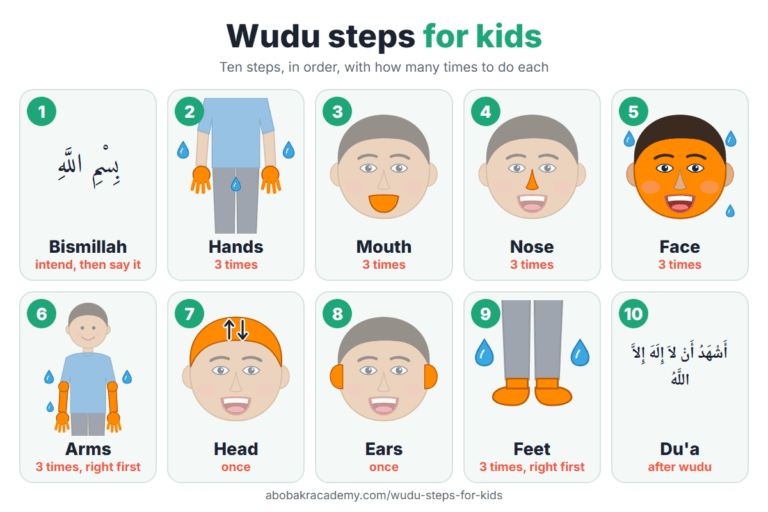
| Feeling angry | A’udhu billahi min ash-shaytan ir-rajim And sit down, or make wudu, if it does not pass. | أَعُوذُ بِاللَّهِ مِنَ الشَّيْطَانِ الرَّجِيمِ |
| Something is lost or broken | Inna lillahi wa inna ilayhi raji’un It teaches that everything is Allah’s to give and take. | إِنَّا لِلَّهِ وَإِنَّا إِلَيْهِ رَاجِعُونَ |
| Hearing the Prophet’s name | Sallallahu alayhi wa sallam | ﷺ |
For the longer du’as of the day, for waking up, sleeping, and entering and leaving the bathroom, see our daily duas for kids.
Inshallah, mashallah or subhanAllah: which one?
Is it inshallah or mashallah?
In sha Allah looks forward: “if Allah wills”, said about something that has not happened yet (“See you tomorrow, in sha Allah”). Masha Allah looks at what is already here: “what Allah has willed”, said when you see something good (“Your new baby, masha Allah!”). A simple rule for children: in sha Allah for tomorrow, masha Allah for today.
SubhanAllah or astaghfirullah?
SubhanAllah means Allah is far above any fault, so it is said in wonder: at a sunset, at a surprising fact. Astaghfirullah is asking forgiveness, so it belongs after a mistake. Many people also say astaghfirullah on hearing something wrong or shocking, which is fine, but a beautiful sight calls for subhanAllah or masha Allah, not astaghfirullah.
Can non-Muslims say inshallah?
Yes. These are Arabic words, and Arabic speakers of every faith say in sha Allah in daily speech. Nothing forbids anyone from saying it. For a Muslim it is also a small act of faith: the future belongs to Allah.
Sayyid al-istighfar: the best way to ask forgiveness
Astaghfirullah is the short form. The Prophet ﷺ called this du’a the best way of asking forgiveness, and said that whoever says it with certainty during the day and dies before evening is of the people of Paradise, and the same for the night (Sahih al-Bukhari 6306).
اللَّهُمَّ أَنْتَ رَبِّي، لاَ إِلَهَ إِلاَّ أَنْتَ، خَلَقْتَنِي وَأَنَا عَبْدُكَ، وَأَنَا عَلَى عَهْدِكَ وَوَعْدِكَ مَا اسْتَطَعْتُ، أَعُوذُ بِكَ مِنْ شَرِّ مَا صَنَعْتُ، أَبُوءُ لَكَ بِنِعْمَتِكَ عَلَىَّ وَأَبُوءُ لَكَ بِذَنْبِي، فَاغْفِرْ لِي، فَإِنَّهُ لاَ يَغْفِرُ الذُّنُوبَ إِلاَّ أَنْتَ
Say it like this: Allahumma anta rabbi, la ilaha illa ant, khalaqtani wa ana abduk, wa ana ala ahdika wa wa’dika mastata’t, a’udhu bika min sharri ma sana’t, abu’u laka bini’matika alayya, wa abu’u laka bidhanbi, faghfir li, fa innahu la yaghfirudh-dhunuba illa ant.
What it means: “O Allah, You are my Lord. There is no god but You. You created me and I am Your servant, and I keep Your covenant and promise as far as I can. I seek refuge in You from the harm of what I have done. I admit Your blessings on me, and I admit my sins, so forgive me, for no one forgives sins but You.”
Islamic phrase cards
Twelve cards with the phrases children hear most, each with the Arabic, how to say it, what it means and when to say it. They are in the printable too: stick one on the fridge each week, or on the door your child leaves by.


Free printable: Islamic phrases for kids (PDF)
Download the Islamic phrases printable (PDF, 4 pages). No email and no sign-up. It has:
- a chart of the twelve phrases children hear most, with the Arabic and the meaning;
- a table of all 21 phrases with when to say each one;
- the twelve phrase cards, to cut out;
- a “which phrase?” page: a phrase for each moment of the day, to put on the fridge.
Where each phrase comes from
For parents who want to check: every hadith this page uses, linked to its page on sunnah.com, with the grade where sunnah.com shows one. Sahih al-Bukhari and Sahih Muslim show no grade, because every hadith in them is held to be authentic. The verses are linked beside each phrase above. The Arabic of each phrase is copied from the hadith or verse it comes from, not typed.
| Hadith | Grade on sunnah.com | What it shows |
|---|---|---|
| Sahih al-Bukhari 5376 | in the Sahih | The Prophet told a boy eating with him to mention Allah’s name, eat with his right hand and eat from what is nearest |
| Sahih al-Bukhari 6224 | in the Sahih | Whoever sneezes says alhamdulillah; the one who hears says yarhamuk Allah; the sneezer answers yahdikumullah wa yuslihu balakum |
| Sahih Muslim 597a | in the Sahih | SubhanAllah, alhamdulillah and Allahu akbar thirty-three times each after every prayer |
| Sahih al-Bukhari 6406 | in the Sahih | Two phrases light on the tongue, heavy in the balance, loved by the Most Merciful |
| Sunan Abi Dawud 499 | Hasan Sahih (Al-Albani) | The words of the adhan, which open with Allahu akbar |
| Sahih Muslim 591 | in the Sahih | The Prophet asked forgiveness three times on finishing a prayer; al-Awza’i said the words are astaghfirullah, astaghfirullah |
| Jami` at-Tirmidhi 2035 | Hasan (Darussalam) | Whoever is done a kindness and says jazakallahu khayran has praised in full |
| Sahih al-Bukhari 5155 | in the Sahih | The Prophet said barakallahu lak to Abdur-Rahman ibn Awf on hearing he had married |
| Sahih al-Bukhari 6227 | in the Sahih | Adam greeted the angels with as-salamu alaykum and they replied adding wa rahmatullah |
| Sahih al-Bukhari 780 | in the Sahih | Say ameen when the imam says it; the Prophet used to say ameen |
| Sahih al-Bukhari 6384 | in the Sahih | La hawla wa la quwwata illa billah is one of the treasures of Paradise |
| Sahih al-Bukhari 6115 | in the Sahih | The Prophet said an angry man’s anger would leave him if he said a’udhu billahi min ash-shaytan ir-rajim |
| Sahih Muslim 408 | in the Sahih | Whoever sends one blessing on the Prophet, Allah blesses him ten times |
| Sahih al-Bukhari 6306 | in the Sahih | The best way of asking forgiveness (sayyid al-istighfar); whoever says it with certainty by day and dies before evening is of the people of Paradise, and the same by night |
| Sahih Muslim 918a | in the Sahih | A Muslim struck by a calamity who says inna lillahi wa inna ilayhi raji’un and asks Allah to reward him and replace it with better, is given better |
| Sahih al-Bukhari 4563 | in the Sahih | Ibn Abbas: Ibrahim said hasbunallahu wa ni’mal wakil when thrown into the fire, and Muhammad said it when told an army had gathered against them |
| Jami` at-Tirmidhi 1858 | Sahih (Darussalam) | When you eat, say bismillah; if you forget at the start, say bismillahi fi awwalihi wa akhirihi |
| Sunan Abi Dawud 5095 | Sahih (Al-Albani) | What to say on going out of the house |
| Sunan Abi Dawud 4980 | Sahih (Al-Albani) | Do not say ‘what Allah wills and so-and-so wills’; say ‘what Allah wills, then what so-and-so wills’ |
Teaching Islamic phrases when nobody at home reads Arabic
This site is built for families where nobody at home reads Arabic, and these phrases need none. They are learnt by ear: every one on this page has a play button, said slowly by a clear Arabic voice, and each takes a few seconds. Play one at the moment it belongs to (bismillah at the table, the sneeze reply when someone sneezes) and say it with your child. After a week of meals, bismillah is theirs. Where these phrases come from, the verses, the hadith and the life of the Prophet, is what our Islamic studies classes for children teach, in English.
Three phrases on this page are words of the Quran and have no machine voice, because a verse should be heard from a reciter: their verse links open a recitation on Quran.com. When your child is ready to read the Arabic itself, our teachers start from the letters and explain everything in English. See Arabic lessons for kids; the first lesson is free.
Replies, spellings and what SWT means
How do you respond to inshallah?
There is no fixed reply. If someone says they will do something in sha Allah, you can say it back, or say ameen if it is a hope (“You will pass, in sha Allah.” “Ameen.”).
How do you reply to jazakallah khair?
Common replies are wa iyyak (and you) and wa antum fa jazakumullahu khayran (and you, may Allah reward you with good). Neither comes from a hadith, so any kind reply is fine.
How do you spell inshallah?
In sha Allah writes the three Arabic words (in, sha, Allah) one by one; inshallah and insha’Allah run them together. All three are common in English and mean the same thing.
What does SWT mean after Allah?
SWT is short for subhanahu wa ta’ala, “glorified and exalted is He”, said or written after the name of Allah.
What does pbuh or ﷺ mean?
Both stand for sallallahu alayhi wa sallam, “may Allah send blessings and peace upon him”, said after the name of the Prophet Muhammad. Pbuh is the English “peace be upon him”; ﷺ is the Arabic phrase written as one sign.
Greetings, duas and more for your child
- Arabic greetings: the salam in full, the replies, and good morning, good night and the rest.
- Daily duas for kids: the eight du’as a child learns first, from waking up to going to sleep.
- The 99 names of Allah for kids: the names behind subhanAllah and Allahu akbar.
- Salah steps for kids: where Allahu akbar, subhanAllah and ameen come in the prayer.
- Free printables: more charts and worksheets for Muslim children.