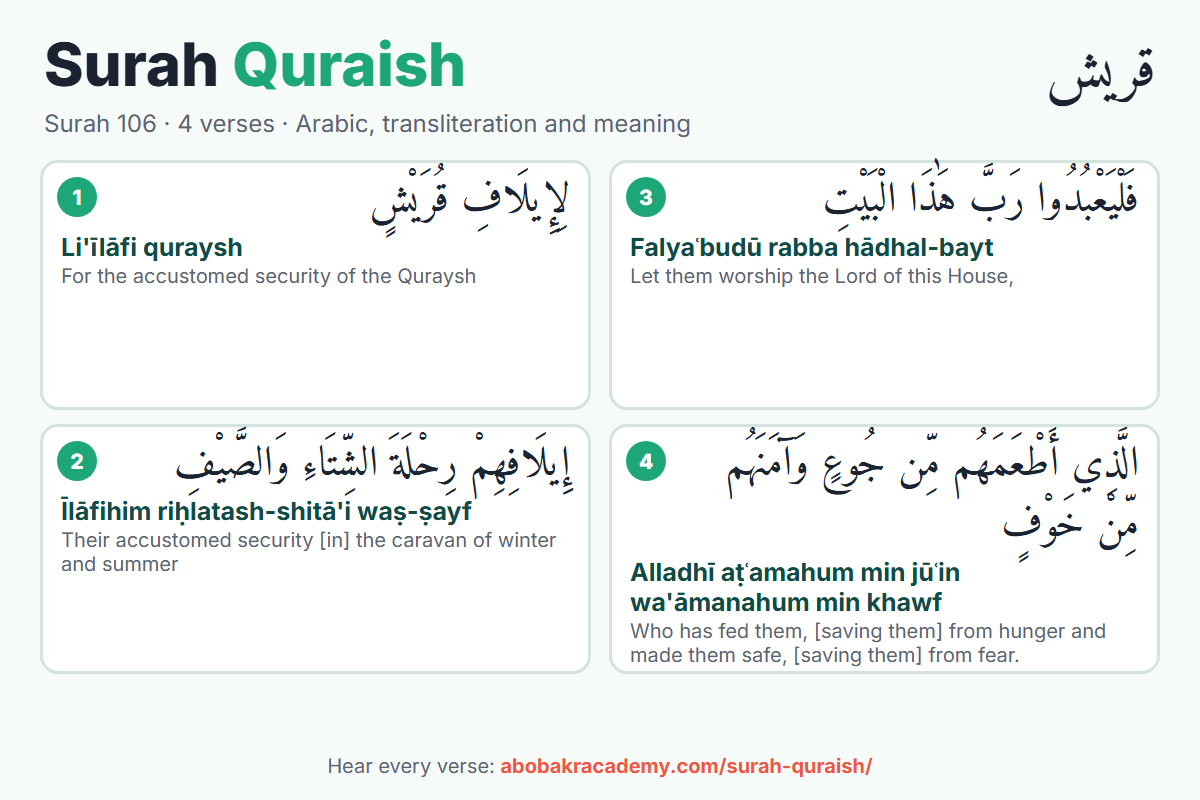
Surah Quraish (قريش, also spelled Quraysh) is the 106th surah of the Quran. It has four short verses, revealed in Makkah, about the Prophet’s own tribe: Allah kept the Quraysh safe beside the Kaaba, protected their trading caravans in winter and summer, fed them when they were hungry and made them safe when they were afraid, so they should worship the Lord of that House. It follows Surah Al-Fil, the story of the army of the elephant, and the two are read together in meaning.
Below is the whole surah verse by verse with a recitation to play, the Arabic, a transliteration and the meaning, then every word on its own, the story behind it told for a child, what is and is not true about its benefits, the sounds a beginner gets wrong, a week’s plan for teaching it, and a free printable with no sign-up.
Surah Quraish in Arabic, with audio and meaning
Press the button beside a verse to hear it. The reciter is Sheikh Mahmoud Khalil al-Husary in his teaching recitation, al-Muallim: slow and clear, one verse at a time, recorded for people learning to recite. Under each verse is a line you can read to your child.
- لِإِيلَافِ قُرَيْشٍ
1 Li’īlāfi quraysh
For the accustomed security of the Quraysh –
For a child: Quraysh was the Prophet’s own tribe, living in Makkah beside the Kaaba. Allah looked after them and kept them together.
- إِيلَافِهِمْ رِحْلَةَ الشِّتَاءِ وَالصَّيْفِ
2 Īlāfihim riḥlatash-shitā’i waṣ-ṣayf
Their accustomed security [in] the caravan of winter and summer –
For a child: Every winter their camels carried goods to Yemen, and every summer to Syria. Allah kept them safe on those long roads.
- فَلْيَعْبُدُوا رَبَّ هَٰذَا الْبَيْتِ
3 Falyaʿbudū rabba hādhal-bayt
Let them worship the Lord of this House,
For a child: So they should worship the Lord of this House, the Kaaba, and nobody else.
- الَّذِي أَطْعَمَهُم مِّن جُوعٍ وَآمَنَهُم مِّنْ خَوْفٍ
4 Alladhī aṭʿamahum min jūʿin wa’āmanahum min khawf
Who has fed them, [saving them] from hunger and made them safe, [saving them] from fear.
For a child: Allah gave them food when they were hungry and kept them safe when they were afraid. He does the same for us, so we thank Him.
The transliteration helps you keep your place; take the sound from the recording. A line over a vowel (ā) means hold it longer, a dot under a letter (ḥ, ṣ) marks a sound English does not have, and ‘ marks the throat letter ‘ayn. Each line stops the way a reciter stops at the end of a verse.
Surah Quraish word by word
Surah Quraish has 17 words. The first two verses both begin with īlāf, the safe, settled life Allah gave the tribe; the last verse names the two things it meant, food and safety. Here is every word with its meaning.
| Verse | Arabic | Say | Meaning |
|---|---|---|---|
| 1 | لِإِيلَافِ | li’īlāfi | For (the) familiarity |
| قُرَيْشٍ | qurayshin | (of the) Quraish | |
| 2 | إِيلَافِهِمْ | īlāfihim | Their familiarity |
| رِحْلَةَ | riḥlata | (with the) journey | |
| الشِّتَاءِ | ash-shitā’i | (of) winter | |
| وَالصَّيْفِ | waṣ-ṣayfi | and summer | |
| 3 | فَلْيَعْبُدُوا | falyaʿbudū | So let them worship |
| رَبَّ | rabba | (the) Lord | |
| هَٰذَا | hādhā | (of) this | |
| الْبَيْتِ | al-bayti | House | |
| 4 | الَّذِي | alladhī | The One Who |
| أَطْعَمَهُم | aṭʿamahum | feeds them | |
| مِّن | min | [from] | |
| جُوعٍ | jūʿin | (against) hunger | |
| وَآمَنَهُم | wa’āmanahum | and gives them security | |
| مِّنْ | min | from | |
| خَوْفٍ | khawfin | fear |
The words are read here as they sound inside the verse. At the end of a verse the reciter stops, so the last vowel drops: qurayshin becomes quraysh, and khawfin becomes khawf.
The story behind Surah Quraish, told for a child
Makkah sits in a dry valley where almost nothing grows. The Quraysh lived there beside the Kaaba, and they lived by trade. Ibn Kathir explains verse 2 as the trade the tribe gathered “during their journey in the winter to Yemen and in the summer to Ash-Sham” (Tafsir Ibn Kathir on 106:1). Other tribes respected them because they looked after Allah’s House, so their caravans travelled safely while raids were common on the roads around them.
The Prophet ﷺ was born into this tribe. He said that Allah chose the tribe of Kinana from the descendants of Isma’il, and that “he granted eminence to the Quraish amongst Kinana”, and from the Quraysh chose Banu Hashim, his own clan (Sahih Muslim 2276).
For a child, the surah comes down to one idea: Allah gave them food and safety, so they should thank Him by worshipping Him alone. Ask your child what Allah has given them today, starting with breakfast and a safe home, and the surah stops being about people long ago.
Surah Quraish and Surah Al-Fil: one story, two surahs
The surah just before it, Al-Fil (105), opens Alam tara kayfa faʿala rabbuka bi’aṣḥābil-fīl, “Have you not considered, [O Muḥammad], how your Lord dealt with the companions of the elephant?” It tells how an army with an elephant came to destroy the Kaaba and was destroyed instead. Surah Quraish carries the story on: because Allah protected the House, the tribe who lived beside it stayed safe and could keep travelling. Ibn Kathir notes that the two are linked in meaning, yet the Companions wrote “In the Name of Allah” between them. He quotes the scholar Ibn Jarir: “This is due to the consensus of the Muslims that they are two separate and independent Surahs.” (Tafsir Ibn Kathir on 106:1).
That makes them a good pair to teach together: Al-Fil is the story a child remembers, and Quraish is the thank-you that follows it. Both are on our short surahs to memorize page, verse by verse with the same recitation.
Benefits of Surah Quraish: what is true and what is not
Search for this surah and you will find it promised for weight loss, for marriage, for wealth and for safe travel. We searched the hadith collections on sunnah.com for the surah by name and found no hadith that gives Surah Quraish a special reward or ties it to any of those things. The claims usually come without a source, and when one is given it does not hold: a page that ranks for this surah cites Sahih Muslim 810 for a reward for reciting it, but that hadith is the Prophet ﷺ asking Ubayy, “do you know the verse from the Book of Allah which, according to you, is the greatest?”, and the answer is Ayat al-Kursi (Sahih Muslim 810). It does not mention Surah Quraish. The link to food probably comes from verse 4, which mentions hunger, but a verse that mentions hunger is not a promise about weight.
What is true is the reward that comes with reciting any part of the Quran, and the lesson the surah itself teaches: food and safety are gifts, and the right answer to a gift is gratitude. The Prophet ﷺ said the best of you are those who learn the Quran and teach it (Sahih al-Bukhari 5027), and teaching a child four verses about thankfulness is a good place to begin.
The sounds to listen for
If nobody at home reads Arabic, these are the places where a child’s Surah Quraish usually goes wrong. You do not need to know the rules to hear them. Play the verse, then listen for these in your child’s version.
- Quraysh. The q is said from the back of the throat, deeper than an English k.
- Ash-shitā’i. The l of “al” is not said; it merges into a doubled sh. Then the ā before the hamza is held longer than an ordinary stretch: listen to how long al-Husary keeps it.
- The ‘ayn. It comes three times: falyaʿbudū, aṭʿamahum and jūʿin. It is squeezed from the middle of the throat, not skipped.
- Hādhā. The dh is the th of “this”. Children often say haza or hada.
- Two kinds of min in verse 4. In min jū’ the n hides with a soft hum before the j. In min khawf the n is said clearly, because kh is a throat letter. The same word, two sounds, in one verse.
- Jū’in wa. The -in at the end of jū’in merges into the w that follows, with a hum: it sounds like jū’iw-wa.
- The soft endings. Bayt and khawf end verses on a soft ay and aw, which the reciter may stretch a little at the stop.
Our Tajweed rules guide explains each of these, with verses to hear.
How to teach Surah Quraish to a child in a week
Quraish has more unfamiliar sounds than Al-Ikhlas, so give it a full week at ten minutes a day. The plan below needs no Arabic from you, only the play buttons above.
- Day 1: the story. Tell the story of the elephant and the caravans in your own words, then play all four verses twice.
- Day 2: verse 1. Two words. Play it, let your child say it back, and listen for the deep q.
- Day 3: verse 2. The longest verse. Split it at riḥlata and join the halves once each is steady.
- Day 4: verse 3. Listen for the ‘ayn in falyaʿbudū and the dh in hādhā.
- Day 5: verse 4. Work on the two kinds of min, then recite the whole surah from the start.
- Day 6: the pause test. Stop your child after any verse and ask for the next one cold.
- Day 7: make it theirs. Let your child recite it in a prayer after Al-Fatiha, and ask what Allah fed them today.
The free short surahs tracker lets your child tick it off with the others.
Free Surah Quraish chart and printable (PDF)
The chart has all four verses in Arabic with the transliteration and the meaning, for the fridge or the wall by your child’s bed. The Surah Quraish printable (PDF, 2 pages) adds the word by word table and the sounds to listen for. No email and no sign-up.

When nobody at home reads Arabic
This site is built for families where nobody at home reads Arabic. Surah Quraish is short enough to learn by ear, but it carries three sounds English does not have, the q, the ‘ayn and the heavy ṣ of aṣ-ṣayf, and a parent who does not read Arabic cannot easily hear when a child gets them wrong. A teacher catches those in the first lesson, before they set. Our tutors teach the short surahs to children whose parents do not read Arabic, and explain everything in English. See Quran classes for children; the first lesson is free.
Surah Quraish: what people ask
Is Surah Quraish Makki or Madani?
Makki. It was revealed in Makkah, and it is about the people of Makkah and the Kaaba at its centre.
Is Surah Quraish for weight loss?
No. No hadith links Surah Quraish to weight loss, marriage or wealth; those claims circulate online without a source. Its verse about hunger is a reminder that Allah provides food, which is a reason for gratitude, not a diet.
Why was Surah Quraish revealed?
No single event is reported as its cause. Commentators read it as a reminder to the Quraysh: after Allah destroyed the army of the elephant and kept the Kaaba safe, the tribe enjoyed food, safe trade and respect, so they owed their worship to the Lord of the Kaaba alone.
What is Surah Quraish in English?
For the accustomed security of the Quraysh, their accustomed security in the caravan of winter and summer, let them worship the Lord of this House, who has fed them, saving them from hunger, and made them safe, saving them from fear.
What are the two journeys in Surah Quraish?
The tribe’s trading caravans: in winter south to Yemen, and in summer north to Ash-Sham, the lands around Syria. Ibn Kathir explains it this way in his commentary on the first verse.
Which surah comes before and after Surah Quraish?
Al-Fil (105) comes before it and tells the story of the elephant, which Quraish follows in meaning. Al-Ma’un (107) comes after it.
More to learn together
- Surah Al-Ikhlas, Surah Al-Falaq and Surah An-Nas: the three surahs recited at bedtime, each verse by verse.
- Short surahs to memorize: all nineteen short surahs in order, Al-Fil included, with audio.
- Salah steps for kids: where a short surah goes in the prayer.
- Daily duas for kids: including the du’a before eating, for the food verse 4 is about.
- Free printables: more charts and worksheets for Muslim children.