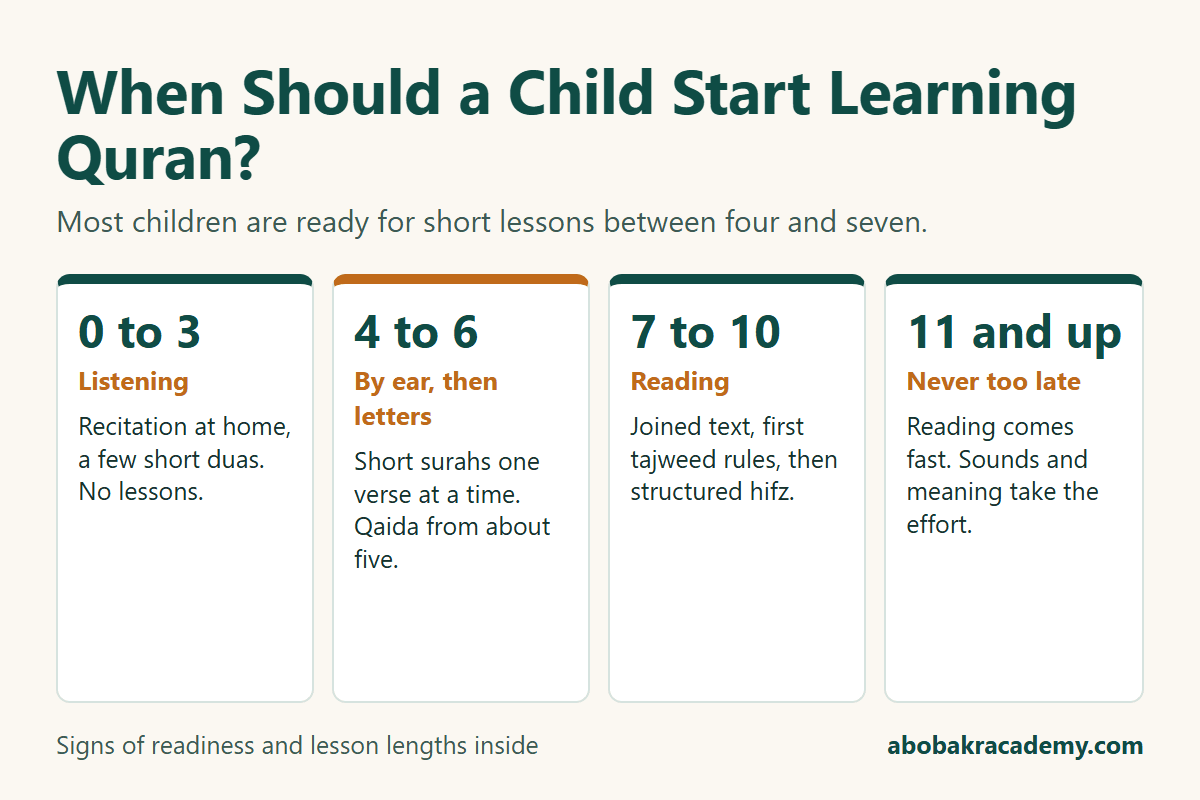
Most children are ready to start learning Quran in short, structured lessons somewhere between four and seven. Before that, listening is the lesson: recitation playing at home and a few short duas said together. Reading usually clicks between five and seven, and formal memorization works best once reading holds up on its own.
Two versions of the same question reach us all the time. One parent wants to know whether four is too early to start. Another wants to know whether eleven is too late, and usually puts the word “behind” somewhere in the message.
Both come from the same place. In a household where nobody grew up reading Arabic, there is no family benchmark to measure against. No older cousin who started at six, no memory of sitting with a grandmother and a wooden board. So a practical question about timing turns into a worry about whether you have already made a mistake.
You almost certainly have not. The answer gets more useful once you separate what a child can do at each stage from what they should be asked to do, which is how lessons for younger children are grouped in the first place.
Quran learning by age, at a glance
| Age | What your child works on | Lesson length |
|---|---|---|
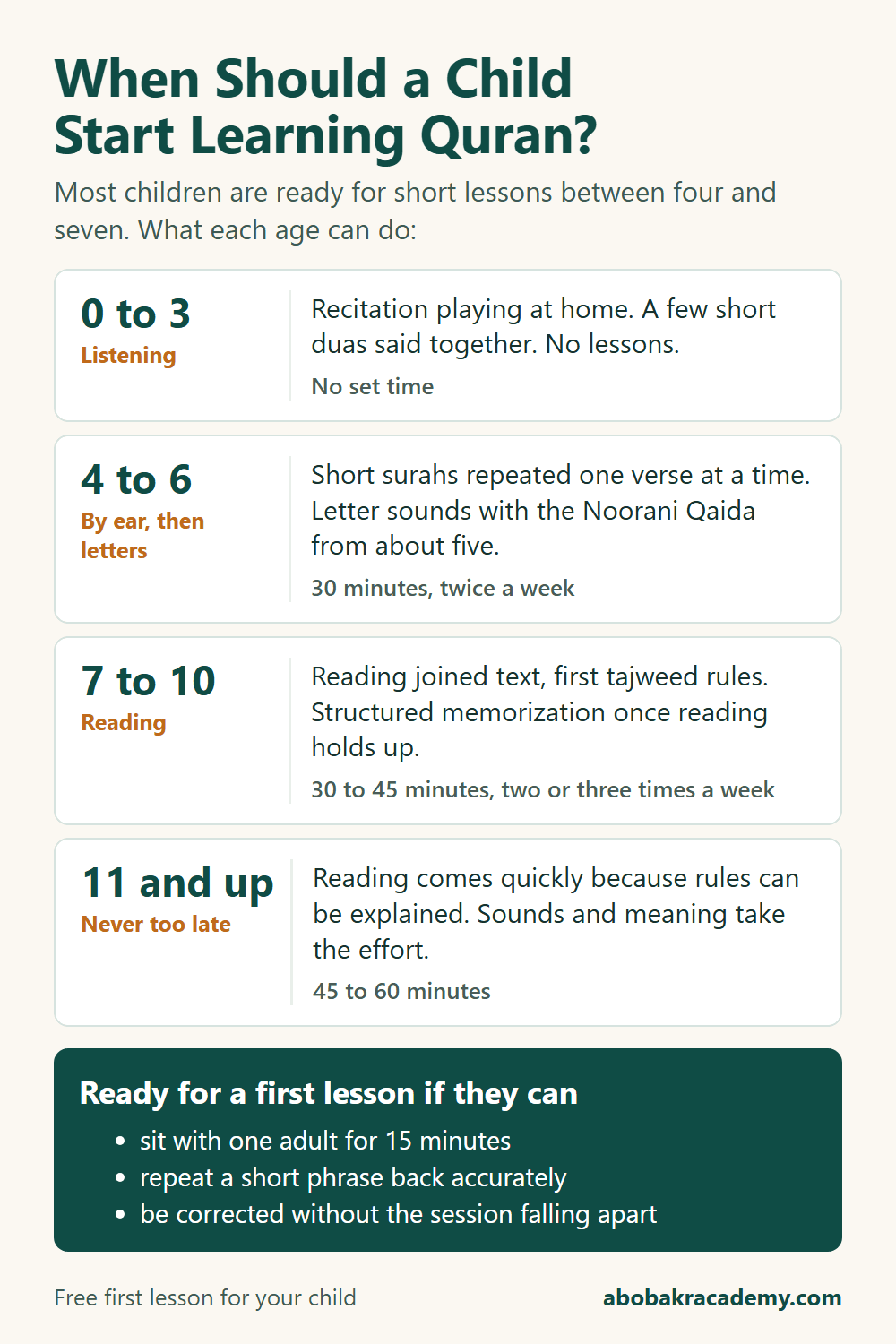
| Birth to 3 | Listening. Recitation in the house, a few short duas said together. No lessons. | None set |
| 4 to 6 | Short surahs by ear, one verse at a time, then letter sounds with the Qaida from about five. | 30 minutes, twice a week |
| 7 to 10 | Reading joined text, the first tajweed rules, and structured memorization once reading is steady. | 30 to 45 minutes, two or three times a week |
| 11 and up | Reading comes quickly because rules can be explained. Pronunciation and meaning take the effort. | 45 to 60 minutes |
There is no single best age to start Quran
Children can begin meaningful Quran learning from around four years old, and adults start from scratch every week. We teach students from age four upward, and a four-year-old’s lesson is a different activity from a nine-year-old’s, even though both are called a Quran lesson.
What changes with age is which of the three strands a child can work on:
- Listening and repeating. Possible from three or four, long before any reading.
- Recognising and sounding out letters. Usually workable from about five or six.
- Reading connected text with the rules applied. Typically seven and up.
A four-year-old who picks up three short surahs by ear has genuinely started. A nine-year-old who has never heard Arabic spoken aloud has also genuinely started, just through a different door.
What Islamic tradition says about starting age
Almost every article on this question reaches for the narration that children should be commanded to pray at seven, recorded in Sunan Abi Dawud 495. It is worth being precise about it, because it gets stretched further than it goes. The narration concerns salah, not Quran, and it names an age for holding a child to an obligation rather than an age for beginning instruction. Scholars have reasoned from it that seven is a sensible point for structured religious teaching more broadly. That is a considered extension, not a stated rule.
There is no fixed scriptural age for beginning Quran. What the tradition presses on instead is the parent’s responsibility to teach, and the wisdom of fitting the teaching to the child in front of you. This is why classical guidance on the question reads as principles rather than a number, and why an experienced teacher will ask about your child before answering it.
For a family in London or Toronto the practical upshot is what it has always been. Begin exposure early and informally, begin structure when the child can carry it, and keep the two apart in your own mind so you do not mistake one for the other.
What is the 7-7-7 rule for children in Islam?
It is a parenting saying usually credited to Ali ibn Abi Talib: play with your child for their first seven years, teach and discipline them for the next seven, and keep them close as a companion for the seven after that. It is quoted everywhere, but it is not found with a sound chain in the major hadith collections, so treat it as wisdom rather than a ruling.
As a rough map for Quran it fits the stages above surprisingly well. Under seven, keep it playful and by ear, and stop while your child still wants more. From seven, add structure and expect practice to happen. In the teens, talk with them about what they are reading instead of only checking that they read it.
What a four-year-old does in a Quran lesson
At this age the lesson is almost entirely oral, and it is short. A four-year-old hears a phrase, repeats it, and builds the sound of Arabic into their ear long before it is attached to a letter shape. Everyday Arabic greetings and their replies are an easy way to start that habit at home.
This is the part non-Arabic-speaking parents tend to undervalue, because it does not look like schoolwork. There is no book to check, no page to point at, nothing to photograph. But a child who has spent a year hearing correct pronunciation will later learn to read faster than a child who arrives at the alphabet cold.
Practically, a session at this age should run about thirty minutes at most, and often the useful part is the first fifteen. Two short sessions in a week beat one long one.
Ages five to seven, when reading usually clicks
This is the window where most children can start attaching sounds to letters. It lines up with learning to read in their school language, and that overlap helps more than it confuses. A child who already accepts that marks on a page carry sound will take the same idea in Arabic without much argument.
It is also where the primer nearly every child starts with earns its place. It moves through letters, then letter forms, then short vowels, then joining, in an order refined over a very long time. It is plain work, and it is the shortest route from nothing to reading.
One warning for this age. Arabic letters change shape depending on where they sit in a word, and children discover this at exactly the moment they thought they had finished the alphabet. If confidence drops around now, that is usually why, not a lack of ability. Keeping a printable letter chart on the wall that shows the forms side by side takes most of the surprise out of it.
Starting at eight or older, and why “behind” is the wrong frame
Older children have an advantage that gets overlooked: they can be told things. A ten-year-old can be given a rule, understand it, and apply it deliberately. A five-year-old has to absorb the same rule through repetition over months. Children who start later often move through the reading stage noticeably faster, even beginning with nothing.
What they lack is the ear. A child who has heard recitation since they were small has pronunciation built in. A child starting at ten has to be taught sounds that do not exist in English, consciously and one at a time. That is workable, but it needs a tutor who is genuinely listening and correcting rather than letting the page get turned.
The word “behind” only makes sense if there is a race. There is not one. A twelve-year-old starting now is starting now, and the only comparison worth making is against where they were last month.
How to tell if your child is ready to start Quran
Age is a rough stand-in for the things that decide whether lessons will work. Those are worth checking directly:
- Can they sit and attend to one adult for fifteen to twenty minutes?
- Can they repeat a short phrase back accurately after hearing it?
- Are they reading, or starting to read, in their first language?
- Can they be corrected without the session falling apart?
A child who manages the first two is ready for oral work whether they are four or seven. A child who manages all four is ready to begin reading. If none are true yet, waiting three months costs nothing.
What to do first if you cannot read Arabic yourself
You do not need to learn Arabic to support this, but you do need some way to tell whether anything is happening. Three things carry most of the weight.
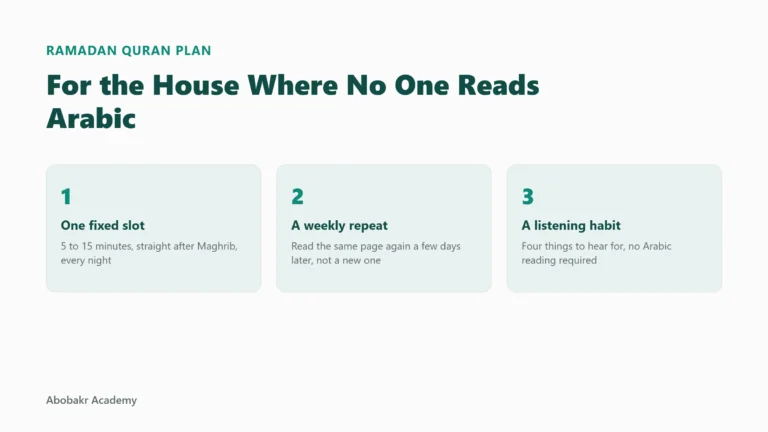
Play recitation in the house. Not as a lesson. Just on, in the background, while other things happen. It is the cheapest thing a non-Arabic-speaking family can do and it works at any age. The next cheapest is a set of printable dua cards, which gives a child something short to say out loud every day, long before any formal lesson starts.
Decide who owns practice. Fifteen minutes on non-lesson days does more than an hour on Sunday. Even if you cannot check accuracy, you can check that it happened.
Keep a written record. If you cannot assess recitation yourself, you need something to hand a tutor instead. A simple sheet showing what was covered and what was repeated turns the end of the month into a real conversation rather than a vague sense that it is going fine.
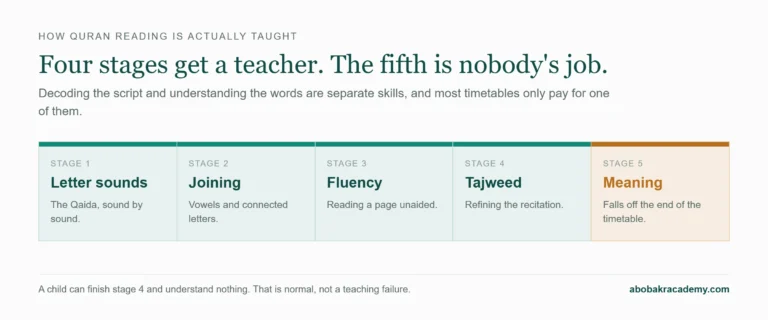
One thing that record will not capture, and that catches parents out around age nine or ten, is whether any of it means anything to the child yet. Fluent recitation with no comprehension is the normal order rather than a teaching failure, and what to do about it is a smaller job than most parents expect.
How long a lesson should run at each age
Our lessons range from thirty minutes to two hours, but the upper end of that is for older students and adults. For a young child, shorter and more frequent wins every time.
- Four to six: thirty minutes, twice a week.
- Seven to ten: thirty to forty-five minutes, two or three times a week.
- Eleven and up: forty-five to sixty minutes, depending on attention and goals.
A trial session is shorter, usually fifteen to thirty minutes, which is roughly the honest attention span of a young child. If they fade at twenty minutes, that is worth knowing before you commit to a schedule.
When should a child start memorizing Quran?
Reading and memorizing are different skills with different starting points, and treating them as one is the most common planning mistake we see. A child can memorize before they can read a single letter, because early hifz is entirely oral. Short surahs picked up by ear at four or five cost nothing and build the ear while they are at it.
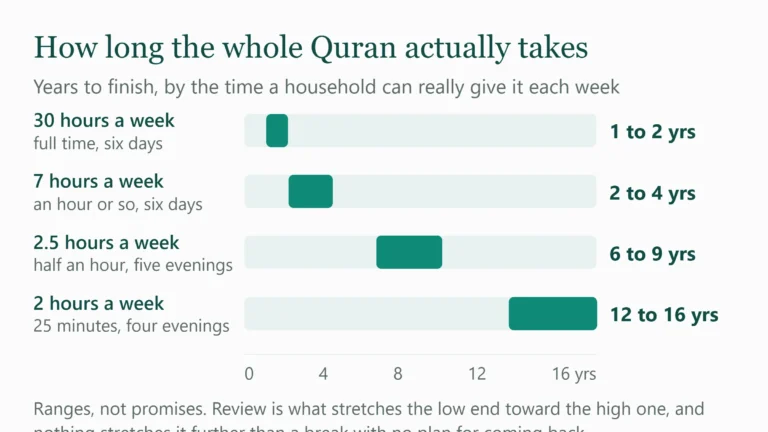
Structured memorization is a different matter. Committing to a daily portion, revising older material and being held to both usually works from around seven, and only once reading is fluent enough that the child can check themselves against the page. Beginning a formal memorization plan before reading is secure tends to produce a child who has memorized sound rather than text, and who cannot repair a mistake without an adult sitting next to them. Starting later than seven costs less than parents fear, too, because the clock on hifz is set by how much review the week can hold rather than by the age on the first day, and the year-by-year arithmetic makes that easier to see than any rule of thumb.
The order that works for most families: oral repetition from four, reading from five or six, structured hifz once reading holds up unaided.
Questions parents ask about starting age
Is four too young to start Quran?
No, as long as the lesson is oral and short. A four-year-old should be listening and repeating, not decoding letters.
How do you teach a 4-year-old Quran?
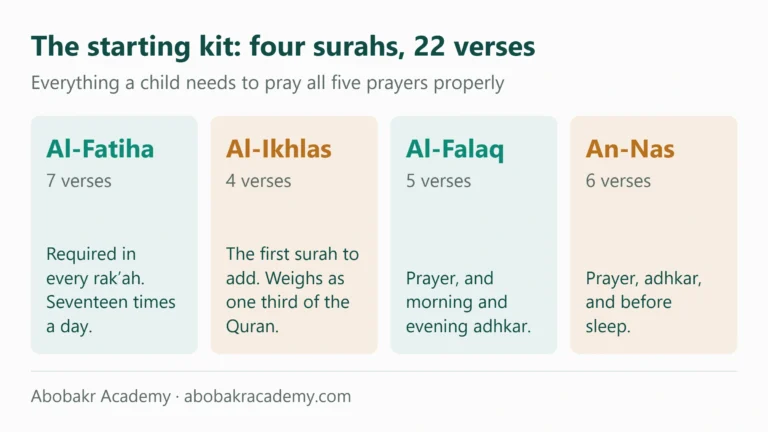
Mostly by ear. Pick one short surah, such as Al-Ikhlas (read it on Quran.com), play or recite it a few times a day, and have your child repeat one verse at a time until it comes back without help. Keep each sitting to ten or fifteen minutes, praise the effort rather than the result, and add the next verse only once the last one is steady. Letters can wait until five.
What can a 2-year-old learn about Islam?
Sounds and habits more than facts. Saying bismillah before eating, hearing a short surah at bedtime, a few words like Allah and salam, and watching you pray. Children this age copy what they see, so letting them see you pray teaches more than anything you tell them.
My child is twelve and has never read Arabic. Is it too late?
No. Older beginners usually clear the reading stage faster, because rules can be explained rather than absorbed. The real work is in pronunciation.
Should my child learn Arabic before starting Quran?
They are different skills and do not need to be sequenced. Reading Quran means decoding the script and pronouncing it correctly. Understanding the language is a separate study, and most children do the first for years before starting the second.
Who is the youngest person to memorize the Quran?
The best-known case is Mohammad Hossein Tabatabai of Iran, born in 1991, who had the whole Quran by heart at about five. Children like him are written about because they are rare. They are not a benchmark for your child, and a late start is not a lost race.
Can siblings of different ages learn together?
For oral memorization, sometimes. For reading, rarely, because they end up at different points in the primer and one child sits waiting. Separate short sessions work better, and there is a ten percent sibling discount when more than one child is enrolled.
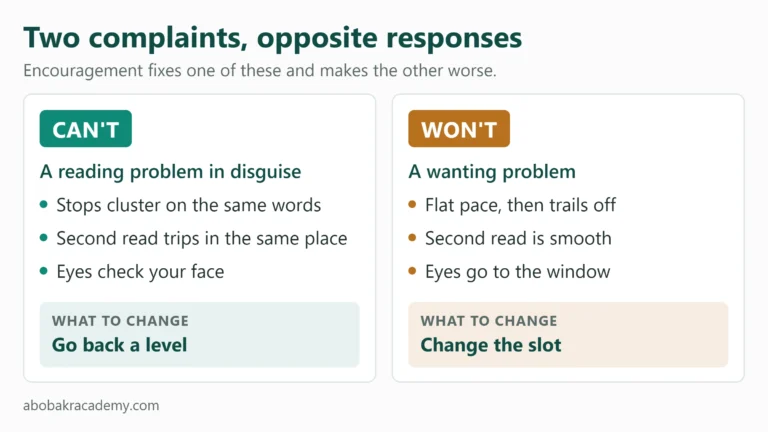
What if my child resists the lessons?
Check the length before anything else. Resistance at this age is far more often about duration than content. Cutting a session from forty-five minutes to thirty solves more than changing tutors does.
Choosing where to start, by age
If your child is four to six, begin with oral repetition and short sessions. If they are six or older and not yet reading Arabic, begin with the Qaida. If they are ten or older, expect reading to come quickly and pronunciation to take the effort.
Whatever their age, a first lesson tells you more than any amount of planning. You can see how the courses are structured, and that first session is deliberately short so you can watch how your child responds before deciding anything.