

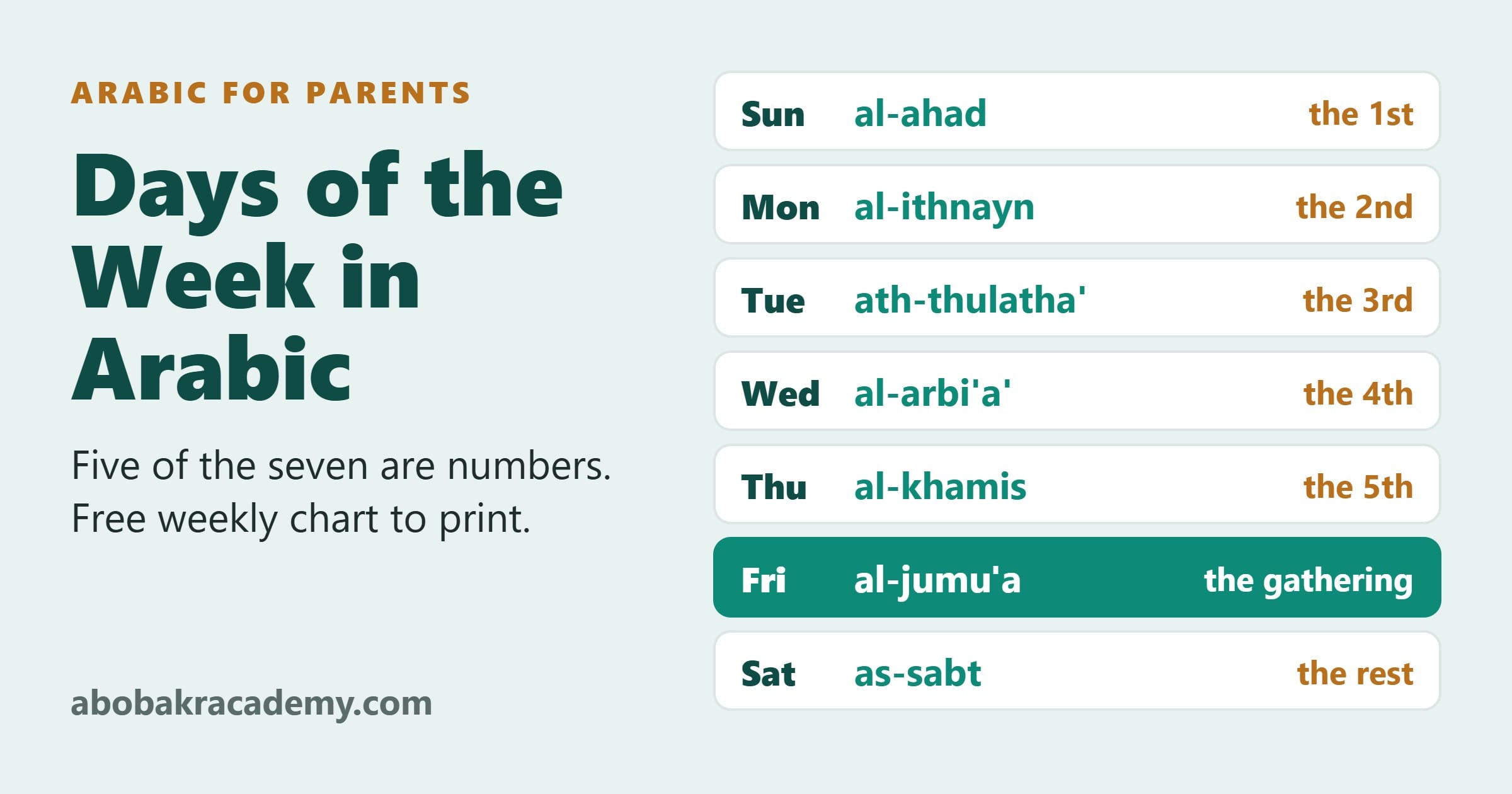
The days of the week in Arabic are الأَحَد (al-ahad, Sunday), الإِثْنَيْن (al-ithnayn, Monday), الثُّلَاثَاء (ath-thulatha’, Tuesday), الأَرْبِعَاء (al-arbi’a’, Wednesday), الخَمِيس (al-khamis, Thursday), الجُمُعَة (al-jumu’a, Friday) and السَّبْت (as-sabt, Saturday). Five of the seven are simply numbers, first to fifth, which makes this one of the easiest word sets in Arabic to learn.
The weekend-school newsletter says the class will learn the days in Arabic this month. Your daughter comes home, announces that Monday is “the second” and Tuesday is “the third”, and asks why. You don’t know. The honest answer is shorter than you’d think, and once you have it, you can teach the whole week in a few minutes a day.
Everything below assumes nobody at home reads Arabic. Each table keeps the Arabic and the pronunciation in separate columns, and further down there’s a weekly chart you can print and stick on the fridge.
What are the seven days of the week in Arabic?
| English | Arabic | Pronunciation | What the name means |
|---|---|---|---|
| Sunday | الأَحَد | al-ahad | “The first” (from wahid, one) |
| Monday | الإِثْنَيْن | al-ithnayn | “The second” (from ithnan, two) |
| Tuesday | الثُّلَاثَاء | ath-thulatha’ | “The third” (from thalatha, three) |
| Wednesday | الأَرْبِعَاء | al-arbi’a’ | “The fourth” (from arba’a, four) |
| Thursday | الخَمِيس | al-khamis | “The fifth” (from khamsa, five) |
| Friday | الجُمُعَة | al-jumu’a | “The gathering”, the day of congregational prayer |
| Saturday | السَّبْت | as-sabt | Related to the word for rest; the same root as “Sabbath” |
A quick word on the pronunciation column. The apostrophe marks either the throat sound ‘ayn (in arbi’a’ and jumu’a) or a small catch in the voice at the end of a word (the final ‘ in thulatha’). A child who ignores both will still be understood. Kh in khamis is the rasping sound in Scottish “loch”, and th is the soft “th” of “thin”, never the “th” of “this”.
Why does the Arabic week start on Sunday?
Because the names count from it. Sunday is day one, al-ahad, and the count runs up to Thursday, day five. Then the pattern stops, and the last two days have names of their own: Friday for the gathering and Saturday for rest.
That’s the whole trick for children. If your child can already count to five in Arabic, they know most of the week before they start, and our guide to Arabic numbers covers those five words with pronunciation. Say the number, then the day, side by side: ithnan, al-ithnayn. Thalatha, ath-thulatha’. The family resemblance is easy to hear even if you don’t know a word of Arabic.
One thing that trips up parents: in many Arab countries the working week doesn’t match the naming. In Saudi Arabia and Egypt, for example, the weekend falls on Friday and Saturday, so Sunday, “the first”, really is the first day back at work or school. A family in Manchester or Chicago lives the same seven names on a different rhythm, and that’s fine.
Why do Tuesday and Saturday sound different after “al”?
Every day name starts with al, “the”. Before most letters you hear the l clearly: al-ahad, al-khamis, al-jumu’a. Before a group of letters called the sun letters, the l disappears and the next sound doubles instead. That’s why Tuesday is ath-thulatha’, not “al-thulatha'”, and Saturday is as-sabt, not “al-sabt”.
You don’t need the rule to teach the days. Just teach the two names the way they’re written in the table, with the doubled sound, and your child’s teacher can explain the rule later when it comes up in Quran reading, where it matters a great deal. If you’d like to see it now, the same thing happens in the words ash-shams (the sun) and an-nur (the light).
What’s special about Friday?
Friday, al-jumu’a, is named for the gathering of the congregational prayer, and a whole surah of the Quran carries the same name. Its ninth verse tells believers that when the call to prayer is made on Friday, they should go to the remembrance of Allah and leave off their business (Surah al-Jumu’ah 62:9).
The Prophet (peace be upon him) called it “the best day on which the sun has risen”, the day on which Adam was created (Sahih Muslim 854a). For a child, that makes Friday the easiest day of the week to remember. It’s the one with a name that means something they already do.
You’ll also hear Friday greeted with jumu’a mubaraka, “a blessed Friday”. It sits nicely beside the other phrases in our guide to Arabic greetings and their replies.
Why do Muslims mention Monday and Thursday?
Because those are the two days the Prophet (peace be upon him) often fasted as a voluntary practice. He explained: “Deeds are presented on Monday and Thursday, and I love that my deeds be presented while I am fasting” (Jami’ at-Tirmidhi 747, graded hasan).
That gives a family two more anchors. Children who hear an older sibling or a parent say “I’m fasting today, it’s al-khamis” learn the word from real life rather than from a worksheet. Whether and when a child should fast is a question for your family and your imam, not for a vocabulary page, so we’ll leave it there.
How do you say “on Monday” or “every Friday” in Arabic?
This is where the list becomes usable. Arabic puts the word yawm, “day”, in front of the name when you mean “on” a particular day, and kull, “every”, in front of that when something repeats.
| English | Arabic | Pronunciation | How it’s built |
|---|---|---|---|
| On Monday | يَوْمَ الإِثْنَيْن | yawma l-ithnayn | yawm (day) plus the day name |
| Every Friday | كُلَّ يَوْمِ جُمُعَة | kulla yawmi jumu’a | kull (every) plus “day of Friday”, without al |
| Today | اليَوْم | al-yawm | Literally “the day” |
| Yesterday | أَمْس | ams | A word of its own |
| Tomorrow | غَدًا | ghadan | gh is a soft gargled g |
| The day after tomorrow | بَعْدَ غَدٍ | ba’da ghad | “After tomorrow” |
| Week | أُسْبُوع | usbu’ | From the root for seven |
| Next week | الأُسْبُوعُ القَادِم | al-usbu’ al-qadim | “The coming week” |
| Last week | الأُسْبُوعُ المَاضِي | al-usbu’ al-madi | “The past week” |
| Weekend | نِهَايَةُ الأُسْبُوع | nihayat al-usbu’ | “The end of the week” |
| What day is it today? | مَا اليَوْم؟ | ma l-yawm? | The one question worth asking every morning |
Notice usbu’, week. It comes from the same root as sab’a, seven. Arabic packs a small lesson into the word itself, and it’s a nice detail to point out to a child who likes patterns.
How do you teach the days of the week to a child who hears no Arabic at home?
Ask one question every morning, ma l-yawm?, “what day is it?”, and wait for the answer in Arabic. That’s it. Thirty seconds at breakfast, every day, for a month, will do more than a worksheet session on the weekend, because the answer changes daily and your child has to actually think.
You can check it without speaking any Arabic yourself. Keep the chart below on the fridge, look at the row for today, and listen for whether the answer matches the pronunciation column. If it does, move on. If your child says the number instead, arba’a instead of al-arbi’a’, that’s a good mistake: it means they’ve understood the pattern and only need the day form.
Here’s the trade-off. A song or an app will get the seven names into a child’s head faster than this, and there’s nothing wrong with using one. What a song won’t do is teach them which day it is. The morning question does, and that’s the part that makes the words stick. The same approach works for family words in Arabic, using the real relatives at your next family visit.
A weekly chart to print
Free, no email needed. One page.
| Day | Arabic | Pronunciation | Week 1 | Week 2 | Week 3 | Week 4 |
|---|---|---|---|---|---|---|
| Sunday | الأَحَد | al-ahad | ||||
| Monday | الإِثْنَيْن | al-ithnayn | ||||
| Tuesday | الثُّلَاثَاء | ath-thulatha’ | ||||
| Wednesday | الأَرْبِعَاء | al-arbi’a’ | ||||
| Thursday | الخَمِيس | al-khamis | ||||
| Friday | الجُمُعَة | al-jumu’a | ||||
| Saturday | السَّبْت | as-sabt |
Twenty-eight boxes is a month of mornings. When the chart is full, your child knows the week, and you’ll have watched it happen rather than wondering.
Common questions
What is Sunday in Arabic?
Sunday is al-ahad, الأَحَد, meaning “the first”. The Arabic week counts from Sunday, so Monday to Thursday are the second to the fifth.
What does Jumu’ah mean?
Al-jumu’a means “the gathering”. It’s the Arabic name for Friday, the day of the congregational prayer, and also the name of Surah 62 of the Quran.
Is Saturday the first day of the week in Arabic?
By its name, no. Sunday is al-ahad, “the first”, so the names count from Sunday. Some calendars in the Arab world are printed starting on Saturday because the weekend falls on Friday and Saturday there, which is where the confusion comes from.
How do you say “on Friday” in Arabic?
Say yawma l-jumu’a, “on the day of Friday”. The same pattern works for every day: yawma l-ahad, on Sunday, yawma s-sabt, on Saturday.
Are the day names the same in every Arabic dialect?
Nearly. The names are shared across the Arab world, with small sound changes in speech. In Egypt, for example, you’ll hear it-talat for Tuesday and il-itnen for Monday. The forms above are the standard ones and are understood everywhere.
Print the chart and start tomorrow morning. If your child is ready for more than a word list, you can book a free trial lesson with one of our teachers, who will tell you plainly whether a daily question at breakfast is all they need for now. For more to print, the Arabic alphabet chart is free too.