
Online Quran Memorization Course (Hifz) for Children and Adults
Our Quran memorization program is Hifz taught live over video, one to one, by a teacher who hears every line. Each lesson has three parts: new lines (sabaq), the pages from the last few weeks (sabaqi), and older portions on a rotation (manzil), with Tajweed corrected while the student recites.
Memorizing all 604 pages usually takes a child four to ten years and a full-time student 14 to 18 months, and you can also take Juz ‘Amma or a few chosen surahs on their own. The first lesson is free.
| Provider | Abobakr Academy, online |
|---|---|
| Course | Quran memorization (Hifz): Juz ‘Amma, chosen surahs, or the whole Quran |
| Who it is for | Children from age four, teenagers and adults, including families where nobody at home reads Arabic |
| Format | Live video lessons, one to one, or a small group if you ask |
| Teachers | Qualified tutors, many trained at Al-Azhar. Female tutors are available; ask for one when you book |
| Before you start | The student reads Arabic with the vowel marks. If not yet, we start with the Noorani Qaida and memorize short surahs by ear alongside it |
| Each lesson | New lines, recent pages and older portions, recited to the teacher, with Tajweed corrected as you go |
| Lesson length | 30 to 120 minutes; most families choose 30 or 60 |
| Price | 9.50 USD an hour, falling to 7.00 as monthly hours rise; monthly plans 34 to 84 USD; 10% off for siblings |
| Free trial | No charge for the first lesson, and nothing to sign up to afterwards |
| Parents | Welcome to sit in on any lesson. Lessons are not recorded unless you agree to it first |
Three ways to take the memorization course
Most students do not begin with the whole Quran, and they should not have to promise it on day one. The course runs in three tracks, and a student can move from one to the next without starting again.
| Track | Who it suits | What it covers | Typical length |
|---|---|---|---|
| Juz ‘Amma | First-time memorizers: children of five to nine, and adults starting out | The 30th juz, the 37 short surahs from an-Naba’ to an-Nas, the ones heard most in salah | Inside a year at 25 minutes, four times a week |
| Chosen surahs | Anyone with one goal in mind: a surah for the night, for Friday, or for prayer | Surahs such as al-Mulk, Ya-Sin, al-Kahf or al-Waqi’ah, one at a time | A few weeks to a few months each, by length |
| The whole Quran | Students who read fluently and can give memorization most days of the week | All 604 pages and 30 ajzaa, with a revision rotation that grows as they do | 14 months to 10 years, set by the pace below |
Children usually begin with the short surahs at the end of Juz ‘Amma and work backwards. Adults who want a plan for their first year should read how to start Hifz as a beginner before the trial lesson.
Choose a pace: intensive, standard or flexible
The standard Madani mushaf is 604 pages across thirty ajzaa, so a juz is a little over twenty pages. Every timeline below is that number divided by a realistic pace, and realistic means allowing for the weeks when nobody memorizes anything at all.
| Path | Pace | Typical student | Lessons a week | 604 pages takes |
|---|---|---|---|---|
| Intensive | Two pages a day | Full-time student, no school alongside | 6 | 14 to 18 months |
| Standard | One page a day | Committed teenager or adult | 5 to 6 | 2 to 3 years |
| Flexible | Half a page a day | Settled child, eight and up | 5 | 4 to 5 years |
| Flexible, first year | 3 to 4 lines a day | Child of six or seven | 4 to 5 | 8 to 10 years |
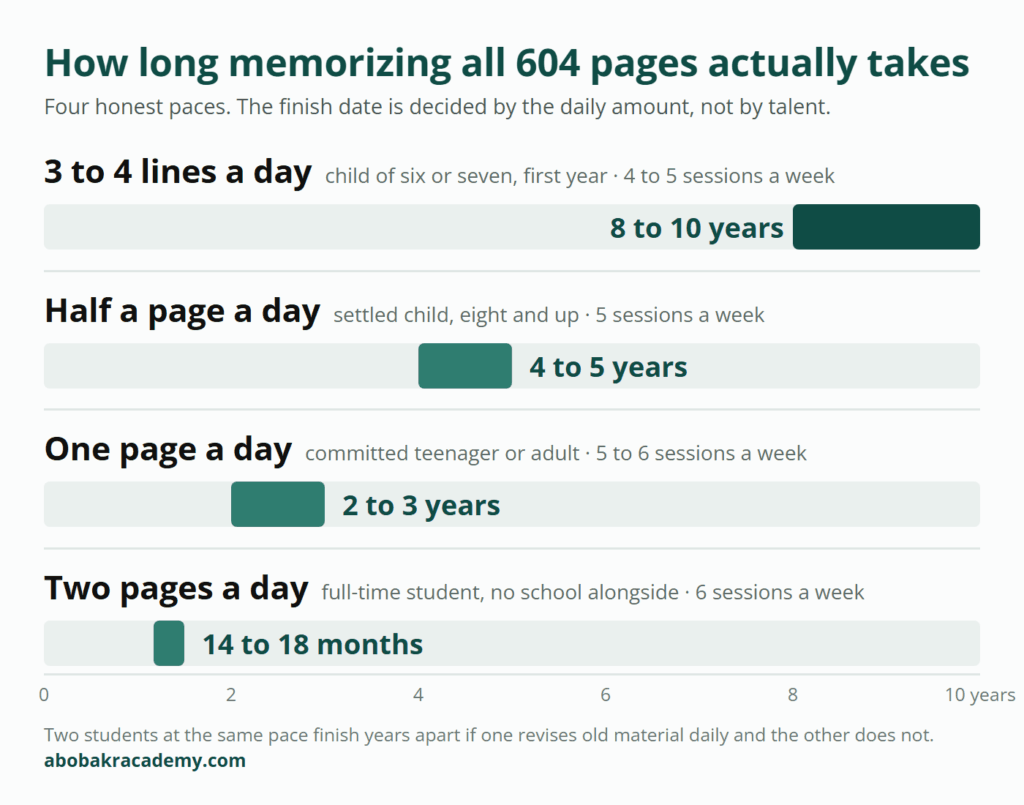
You may read elsewhere that an intensive path finishes in six to ten months. That means two or three pages every single day with no day missed, which a few students manage in a residential hifz school and almost nobody manages around school or work. We would rather quote you the figure you will reach.
The ranges are wide because the arithmetic assumes you miss days, and everybody misses days. Ramadan, illness, exams, travel and the two weeks after a house move all cost pages. Our Ramadan Quran reading plan for families who do not read Arabic at home keeps new material to a minimum during the month and leans on the weekly repeat described below.
Revision has arithmetic too, and it is the part nobody shows you. Once a student holds ten ajzaa, revising one juz a day means every portion comes back around every ten days. At twenty ajzaa that gap doubles, which is exactly when students who were doing well start losing early surahs. A program that does not plan for the growing revision load will stall somewhere around juz fifteen.
What happens in every lesson: sabaq, sabaqi and manzil
Ask three academies what their program is and you will get three brochures. The structure underneath is older than any of them, and it has three moving parts that run every single day.
| Part of the day | What it is | Share of the session |
|---|---|---|
| Sabaq the new material, sometimes called wajh jadid | What is being memorised today. For a child starting out this is often three or four lines, not a page. | The smallest part |
| Sabaqi the recent material | Roughly whatever was memorised in the last few weeks, recited back to check it has not slipped. | Several pages |
| Manzil the old material | The portion already considered finished, cycled through on a fixed rotation so it does not slip away. | The largest part |
The part that surprises most parents is the proportion. New material is the smallest piece of the day. A student memorizing four lines will usually recite several pages of older work in the same lesson, because a page that is not revised fades, even while it still feels as solid as the day it was learned.
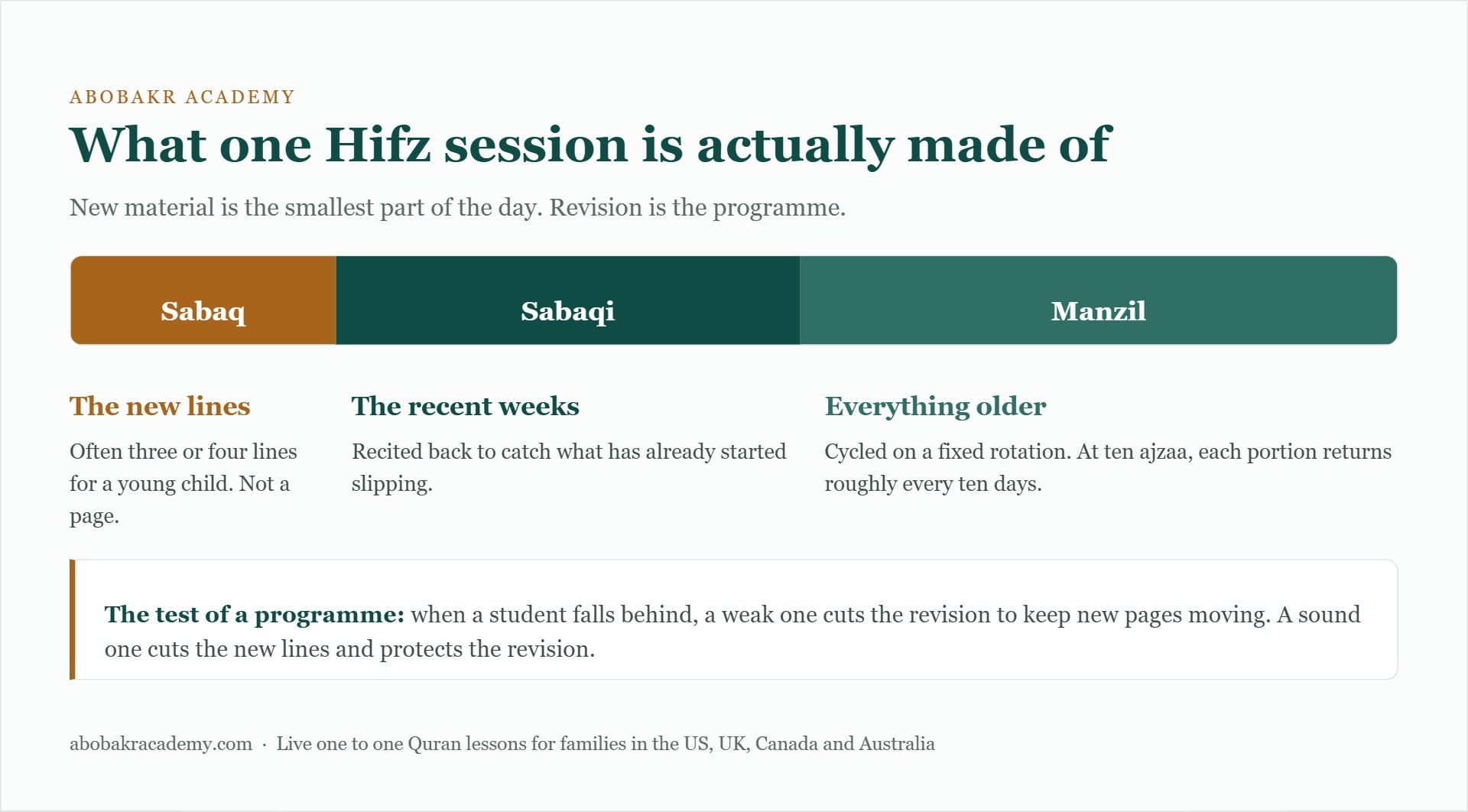
The test of any program is what happens to the revision when a student falls behind. A weak program cuts revision to keep the new pages moving, because new pages are what a parent notices. A sound one cuts the new material and protects the revision. If you ask nothing else on a trial lesson, ask that.
How long Hifz takes
Most academies will not answer this, and the reason is understandable: the true answer is a range, and a range sells badly against a promise. But the range is knowable. The Quran describes itself as made easy to remember, and what varies between students is how much of it they touch each day.
A child who starts at seven, keeps a half page a day through the school year, and slows over summers, finishes somewhere between thirteen and sixteen. An adult with a job who manages three sessions a week and a page each time is looking at four to six years. Someone doing a page a day with no interruptions can finish in two, and a small number of people do exactly that.
Talent moves the number less than two habits: whether the student recites to a teacher daily or twice a week, and whether old material is tested as often as new material is added, which is exactly what a written revision plan is for.
Two students at the same pace, one revising properly and one not, will be years apart by juz ten, and the one who skipped revision will be re-memorizing work they already paid for. To put in your own pace and see a finish date, use the calculator in our guide to how long it takes to memorize the Quran.
Memorizing when nobody at home reads Arabic
This is the situation most of the families we teach are in. Supporting a child in a language you cannot read has its own set of moves, and it changes what a parent can usefully do. You cannot check accuracy if you cannot read the script. You can check almost everything else, and the checks are all by ear.
Listen for hesitation at the same place twice. A child who stumbles at the same word on Monday and again on Thursday has not memorized that line, they have memorized the run-up to it. Tell the teacher exactly where it happens.
Ask for a portion from the middle, not the beginning. Say “start from the third line” or name a surah from last month. Memorization that only works from the opening word is chained, not stored, and chained memorization collapses in prayer.
Notice the speed. Fluent recitation of memorized material is even and unhurried. Racing is usually a student outrunning their own uncertainty, and it hides mistakes from an ear that cannot read along.
Count the revision, not the new pages. Ask your child what they revised today, not what they learned. If the answer is regularly “nothing”, the program has turned into a page counter.
Adults memorizing the Quran
Adults are told they have missed the window. It is the same objection that stops adults learning to read the Quran in the first place. It is not true, and the way it fails for adults is different from the way it fails for children, which is worth knowing before you start.
Adults memorize more slowly per session and retain better per unit of revision. A child will take a page in a morning and lose it in a fortnight without upkeep. An adult often needs three or four sittings for the same page and then holds it more stubbornly, particularly where they understand the meaning, because understanding gives the memory somewhere to attach.
The real obstacle for adults is rarely capacity. It is the consistency of a short daily slot against a week that keeps moving. Fifteen focused minutes every day beats two hours on a Sunday, and every experienced teacher will tell you the same thing.
Adults who begin with Juz ‘Amma, take four to six months over it, and revise it to the point of boredom before moving on, tend to still be memorizing three years later. Adults who begin at page one of al-Baqarah usually are not.
What goes wrong, and what it sounds like
Four failures account for most of the students who arrive here having stopped somewhere else.
The pace was set by a calendar. A fixed page-per-week schedule ignores that retention varies week to week. It produces a student who is technically on target and cannot recite juz three.
Tajweed was treated as a separate subject. Mistakes memorized are mistakes preserved. A missed ghunnah or a shortened madd, repeated for six months, becomes the version the student believes is correct, and unlearning it takes longer than learning it did.
Revision was optional. The single most common cause of a stalled Hifz. It shows up as a student who is fluent in what they did this month and vague about anything older.
Nobody tested from the middle. Recitation is checked from the start of the page every time, so nobody notices the memorization is sequential rather than solid until the student stands in prayer and cannot resume after an interruption.
Who teaches the memorization course
Hifz is taught here by two teachers who hold an Ijazah in the Quran, a licence to teach it given after reciting the whole Quran to a teacher with a connected chain. You are matched with one of them, and they stay with you from the first page. The rest of the faculty is on the about page.
Sister Nouran
Hifz, Tajweed, Qaida
Has memorised the whole Quran, with Ijazah in the Hafs and Shu’bah narrations, and is now studying the Ten Qira’at. More than ten years teaching children, teenagers and adults. Available to women and girls who want a female teacher.
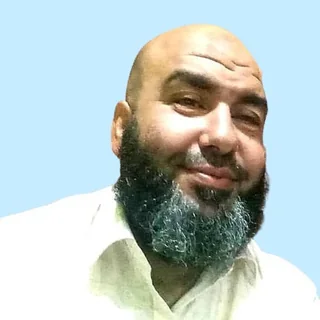
Ahmed Abdullah
Quran, Tajweed, Hifz
Ijazah in the Quran in the Hafs narration, with a connected chain. A graduate of Al-Azhar University, teaching Quran for more than ten years, in Arabic and English.
How to start the memorization course
- Book the free trial lesson. Tell us the student’s age, time zone, and whether you would like a female tutor.
- The teacher hears the student read and recite. From that, they suggest a track (Juz ‘Amma, chosen surahs or the whole Quran) and a pace you can keep. A student who cannot read yet starts with the Noorani Qaida.
- Pick your lesson times and a monthly plan. Plans are paid in advance, and a lesson can be moved with two hours’ notice, which matters when the plan depends on daily contact.
- Keep the revision going between lessons. The free revision planner and the short surahs tracker let a parent who reads no Arabic see what was revised and what is due.
Memorization is one of the five stages our online Quran classes teach, from the Noorani Qaida to understanding the meaning.
Questions parents and students ask
At what age should a child start Hifz?
Most children are ready for a full memorization plan at about seven, once they can read connected Arabic text with the vowel marks. From four or five, a child can memorize short surahs by ear with a teacher, and that is a good start. Our guide to what age to start the Quran goes through each age.
What is the best method for memorizing the Quran?
A small amount of new material each day, a lot of revision, and all of it recited to a teacher. That is the sabaq, sabaqi and manzil system above. Two habits help most: memorize from the same printed mushaf so the page layout becomes part of the memory, and practise starting from the middle of a page, not only the top.
How many pages a week should my child be memorizing?
For a settled child of eight or older, two to three pages a week is a sustainable rate that leaves room for revision. More than that is usually borrowed from the revision time and shows up as losses a few months later.
Can my child memorize without knowing Arabic?
Yes, and most of our students do. Memorization runs on sound rather than comprehension, which is why children who speak no Arabic can hold ajzaa fluently. Understanding is a separate track worth adding, but it is not a prerequisite.
How do I know the memorization is solid if I cannot read Arabic?
Use the four ear checks above. Ask for a portion from the middle, listen for repeated hesitation at the same word, watch the pace, and ask what was revised rather than what was learned.
Is it too late to start as an adult?
No. Expect fewer lines per session than a child and better retention per session. Start with Juz ‘Amma, take months over it rather than weeks, and protect a short daily slot rather than a long weekly one.
What happens if we fall behind?
The new material pauses and the revision continues. That is the correct response, and it is worth asking any academy you are considering how they handle it, because the answer tells you what the program is really optimising for.
Do you offer Ijazah?
Yes. Our Quran teachers hold an Ijazah in Hafs an Asim with a connected chain, and students who complete memorization to the required standard can work towards one.
Can I do Hifz online?
Yes. Memorization needs a teacher who hears you recite on most days and corrects you on the spot, and a live video lesson gives exactly that. What it cannot give is a class around you keeping you going, so a fixed daily slot matters even more online than in a masjid.
Can I become a hafiz by myself?
Some people memorize alone, but a mistake you cannot hear stays in, and a wrong vowel repeated for months becomes the version you believe. If you study on your own, recite to a teacher or a hafiz you trust at least once a week, above all for the revision.
What is the best app to help me memorize the Quran?
Apps are good for practice between lessons: listening to a reciter on repeat, hiding the text to test yourself, or having the app follow your recitation and flag a skipped word, which Tarteel is best known for. None of them hears a weak ghunnah or a shortened madd the way a teacher does, and none keeps your revision honest. Use one alongside a teacher, not instead of one.
Where can I find a free online Hifz course?
Some masjids run free online hifz circles, and our free Islamic classes page lists free courses from other academies, though most teach Islamic studies rather than memorization. Free courses rarely give daily one-to-one listening, which is the part memorization depends on. Our trial lesson costs nothing, and the free Quran revision planner works with any teacher.