

Many adults quietly carry the same wish: to open the Quran and read it directly in Arabic, without depending on transliteration or translations. If that is you, take heart. Adults sit down for their first lesson every single day at our academy, and many of them progress faster than children do, not because reading gets easier with age, but because an adult who has decided to learn shows up with intention. This guide walks you through the exact steps, from recognizing your first Arabic letter to reading full verses, along with a realistic weekly plan for a busy schedule. If you prefer guided support from day one, a teacher can follow this same path with you, step by step.
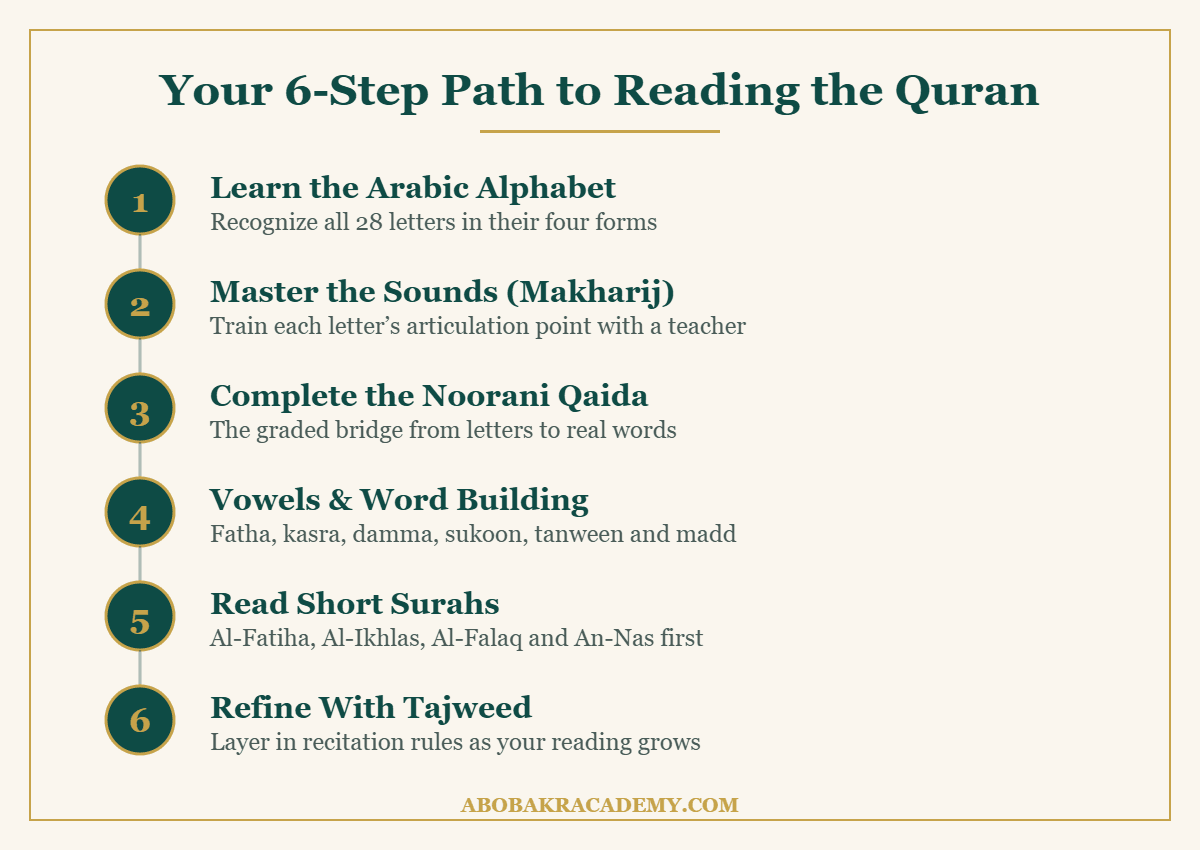
Step 1: Learn the Arabic Alphabet
Everything starts with the 28 letters of the Arabic alphabet. Your only goal at this stage is recognition: seeing a letter and knowing its name and shape. Arabic letters change form depending on where they sit in a word (beginning, middle, end, or standing alone), so spend time on the connected forms, not just the isolated ones. Most adults can comfortably recognize all letters in their four forms within two to three weeks of short daily practice. Flashcards, tracing, and reading letters aloud all help lock the shapes into memory.
Step 2: Master the Sounds (Makharij)
Arabic has several sounds that do not exist in English: letters like ح, ع, ص, and ض. Each letter has a precise articulation point in the mouth or throat, known as its makhraj. Getting these right early matters, because in Quranic Arabic a change in sound can change the meaning of a word. This is the step where self-study hits its limits: you cannot hear your own mistakes. Listening to a qualified teacher, repeating after them, and receiving correction is the fastest way to build accurate pronunciation from the start rather than un-learning bad habits later.
Step 3: Work Through the Noorani Qaida
The Noorani Qaida is a short foundational booklet used worldwide to teach Quran reading. It takes you from single letters to joined letters, then to short words, in a carefully graded sequence. Do not skip it or rush it. Adults sometimes feel the Qaida is “for children”. It is not. It is simply the most efficient bridge between knowing the alphabet and reading real Quranic text, and completing it properly usually takes six to ten weeks at a steady adult pace.
Step 4: Vowels, Sukoon, and Building Words
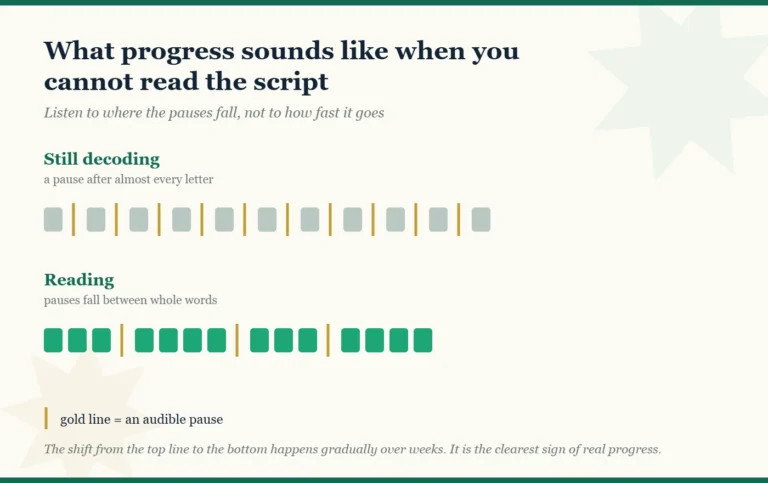
Next come the short vowels (fatha, kasra, damma), the sukoon, tanween, and elongation (madd). These small marks tell you exactly how each word is pronounced, which is why the Quran can be read accurately even by someone who does not yet understand Arabic. Practice blending letters with vowels slowly: قَ، قِ، قُ. Slow and correct always beats fast and sloppy. At this stage you are no longer memorizing shapes; you are genuinely decoding words, and progress starts to feel real.
Step 5: Read Your First Short Surahs
Once you can decode words, move to the short surahs at the end of the Quran. Surah Al-Fatiha, Al-Ikhlas, Al-Falaq, and An-Nas are the classic starting points. They are short, you likely already know how they sound from prayer, and that familiarity gives your reading a scaffold. Read each verse slowly with your finger under the text, then repeat it until it flows. Many learners at this stage also benefit from the broader roadmap in our guide to the starting course for new readers, which covers how to sequence your learning after the basics.
Step 6: Add Tajweed Gradually
Tajweed is the set of rules that governs precise Quranic recitation: where to prolong sounds, where letters merge, where the tongue rests. You do not need to master Tajweed before you start reading; you refine it as you go. Begin with the most common rules (the rules of noon sakinah, meem sakinah, and the madd lengths) and layer the rest over time. A structured programme introduces these rules in the right order with recitation practice, so theory and reading grow together.
A Realistic Weekly Plan for Busy Adults
Consistency beats intensity. A schedule that works for most working adults looks like this: two 30-minute lessons per week with a teacher, plus 15 minutes of self-practice on the remaining days. That is under three hours a week. The daily 15 minutes matters more than it looks. Reading is a motor skill, and short frequent repetition builds fluency far faster than one long weekend session. Attach your practice to an existing habit, such as right after Fajr or before sleeping, so it survives busy weeks.
Common Mistakes Adults Make
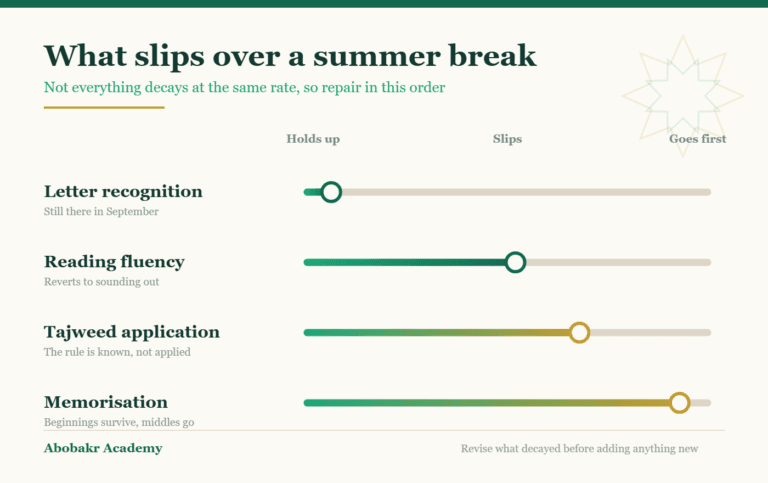
After years of teaching adult beginners, our teachers see the same three patterns slow people down. First, rushing past the Qaida to “get to the real Quran”, which leads to guessing instead of reading. Second, studying alone for months without feedback, so pronunciation errors harden into habits. Third, inconsistency: studying intensely for two weeks, stopping for a month, and restarting from near zero. The fix for all three is the same: a steady, modest routine with a teacher who corrects you in real time.
How Long Does It Take?
With two lessons a week and daily short practice, most adults go from zero to reading short surahs slowly in about three to four months, and to reading any page of the Quran (carefully, with occasional help) within six to twelve months. Your pace will vary with consistency more than with talent. Remember the beautiful principle from the hadith: the one who recites while struggling receives a double reward. Every difficult session counts.
Frequently Asked Questions
Am I too old to learn to read the Quran?
No. There is no age limit on learning. Adults regularly begin in their 30s, 40s, 50s, and beyond, and succeed with a steady routine. Maturity and motivation are genuine advantages.
Do I need to understand Arabic to read the Quran?
No. Reading (decoding the script with correct pronunciation) and understanding (knowing Arabic vocabulary and grammar) are separate skills. Most people learn to read first and study meaning later.
Can I learn to read the Quran on my own?
You can learn the alphabet and basic decoding on your own, but pronunciation and Tajweed need a teacher’s ear. A hybrid approach of self-practice plus regular guided lessons is the most reliable path.
What should I learn first: reading or memorization?
Reading first. Once you can read accurately, memorization becomes far easier and more correct, because you memorize from the page instead of only by ear.
How many lessons per week do I need?
Two lessons per week is the sweet spot for most adults: enough momentum to progress, light enough to sustain alongside work and family.
Start With a Free Trial
The hardest part is the first lesson. At Abobakr Academy, our qualified teachers, many of them trained at Al-Azhar, work with adult beginners every day, starting exactly where you are, even if that is the very first letter. You can begin with a free trial class, meet your teacher, and see the step-by-step method in action before committing to anything. If you would rather weigh up a few providers first, we have written about what credentials do and do not tell you when comparing tutors, and the questions worth asking before you pay.