

Sunday, ten to six. The lesson is at six. Your eight year old has developed a stomach ache, which is the same stomach ache he had last Sunday, and which will clear up at around ten past seven. You have had this argument four weeks running and you are starting to dread it more than he does.
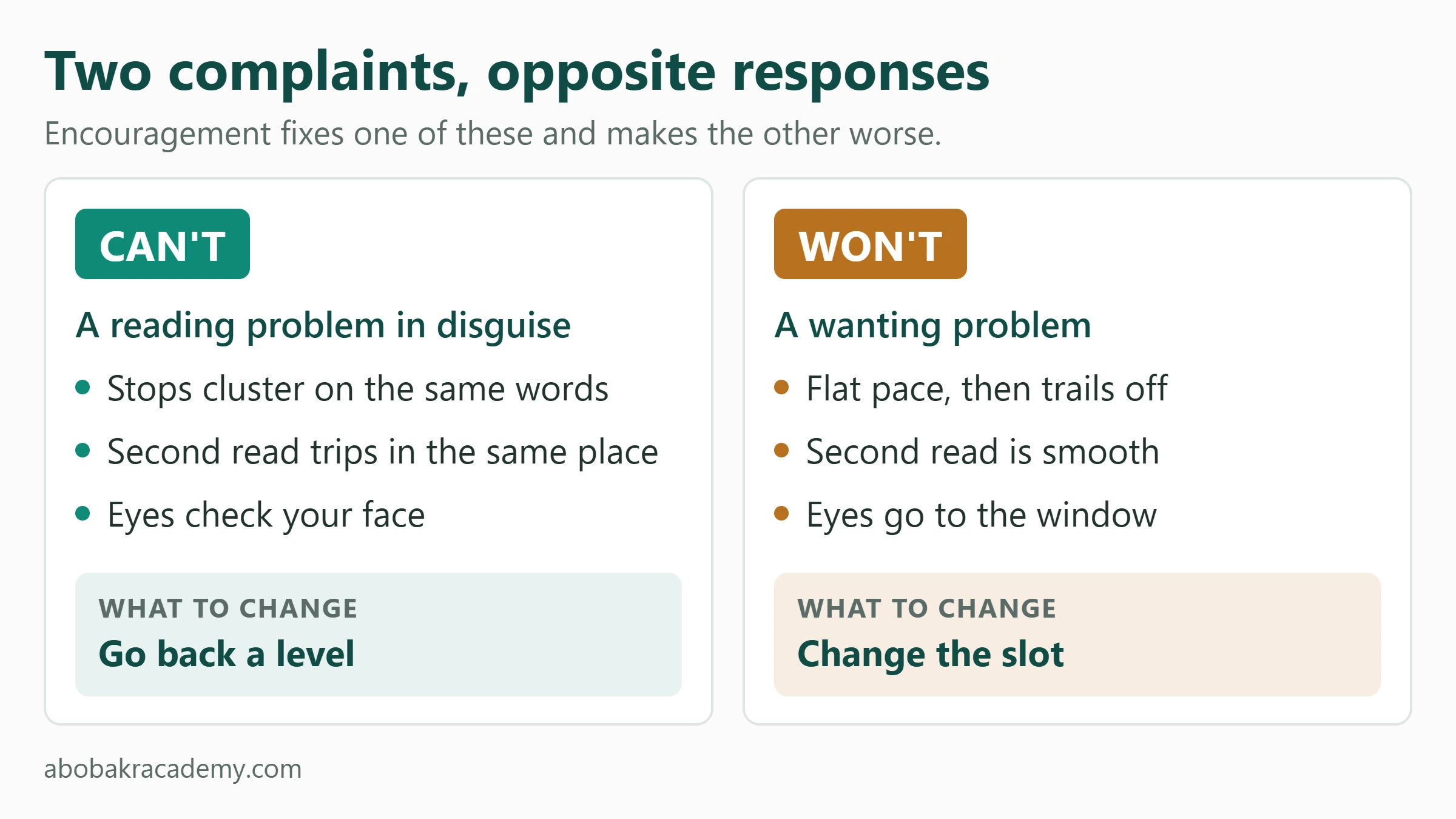
Almost everything written for parents in this situation treats it as a motivation problem. Sometimes it is. But a child who says he does not want to do Quran is usually making one of two quite different complaints, and they need opposite responses. He either will not, or he cannot. Encouragement fixes the first and makes the second worse.
Telling the two apart is most of the job. You can do it tonight, at your kitchen table, without reading a word of Arabic.
The two complaints hiding inside “I don’t want to”
“Won’t” is a wanting problem. The work is within reach and something else has gone wrong: the timing, the atmosphere, the teacher, or the fact that Quran has quietly become the only thing you ask him about. He could do the page. He does not want to sit down to it.
“Can’t” is a reading problem wearing a costume. The page in front of him is above what he can decode. Every line is a small public failure, and refusing is cheaper than failing. A child will almost never tell you this, partly because he may not have the words for it, and mostly because saying “I can’t read it” to a parent who also can’t read it feels like the end of the conversation rather than the start of one.
The reason this distinction matters more here than in maths or piano is that you cannot see the page the way you could see a worksheet of long division. A parent who reads Arabic glances over a shoulder and knows within ten seconds. You are working blind, so you need a different instrument.
The five minute check that tells you which one you have
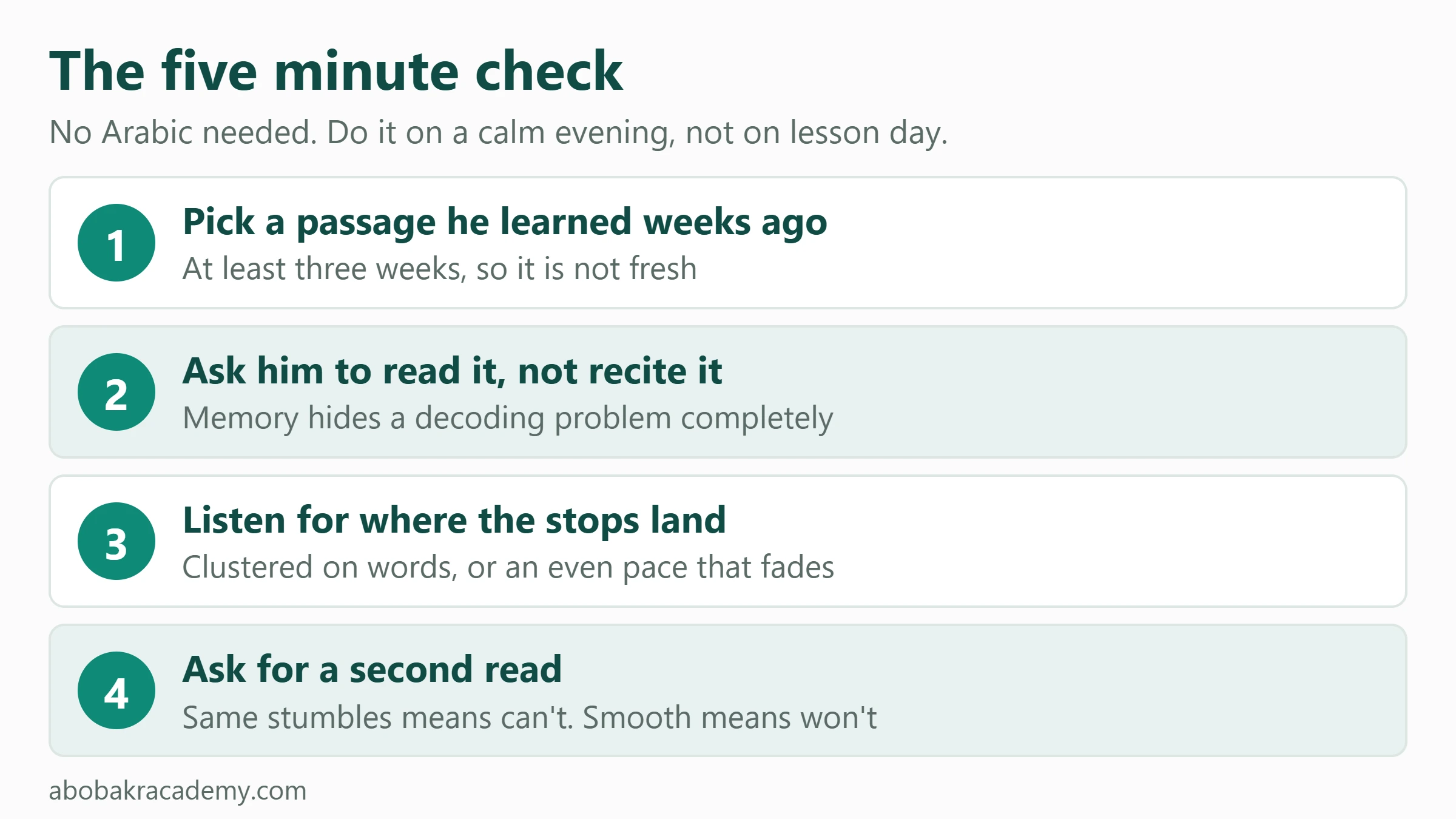
Do this on a calm evening, not on lesson day, and not straight after a row about it.
Pick a short passage he learned at least three weeks ago. Ask him to read it from the page, out loud, rather than recite it from memory. That distinction is the whole test, because memory hides a decoding problem completely. If he does not have a book to hand, open any short surah on a phone.
Then listen for three things, none of which need Arabic.
Where the hesitation lands. A child who cannot decode stops at particular words and sails through others. The stops cluster. A child who can decode but does not want to be there reads at a flat, even, slightly bored pace and then trails off.
Whether the same word trips him twice. Ask him to read the passage a second time. If he stumbles at the same place both times, that word is not yet decodable for him. If the second run is smooth, the first stumble was attention.
Where his eyes go. A child who is guessing looks up at you before or during each line, checking your face for whether he got it right. A child who is bored looks at the window, the clock, or his own hands.
Two rounds of that takes about five minutes and it will tell you more than a month of asking him what’s wrong. If the answer comes back “can’t”, the letters themselves are the place to start, and there are by-ear checks for the sounds children most often get wrong that work the same way, without you needing to read the script.
If it turns out to be can’t
Then the lesson is aimed above him and no amount of encouragement will close that gap. This is the good outcome, oddly, because it is the fixable one.
What usually happened is that he was moved on from letters to connected words before the letters were fully automatic. It looked like progress at the time. It often does. A five or six year old still working at the harder letters is ordinary rather than behind, and moving him up early to keep pace with a cousin or a class is the single most common way a confident beginner becomes a reluctant one.
The fix is not gentler encouragement. It is going back to the level where he is right about ninety percent of the time and building forward from there. That is a conversation with the teacher, not with the child, and it is a normal request rather than a complaint.
Expect the first clear shift in roughly two to three months of consistent weekly lessons once the level is right. Not two weeks. If you want something more structured than an impression, the monthly Quran progress check is a one-page procedure you can run yourself and file, so that in March you can compare against January rather than against your memory of January.
If it turns out to be won’t
Now motivation is the right frame, and the useful question is what specifically is being avoided. These are the five that account for most of it, and each one looks different at the table.
| What is actually wrong | What it looks like | What to change first |
|---|---|---|
| The slot is wrong | Fine on a Saturday morning, impossible at six on a weekday | Move the lesson before you judge the lesson |
| Shame in front of the teacher | Willing to read to you, silent or muttering on the call | Ask the teacher to spend two weeks below his level on purpose |
| Quran has become the only subject you ask about | Flinches when you say the word, fine once he starts | Stop asking daily. Ask on Fridays and mean it |
| Nothing visible has changed for months | Vague, listless, cannot tell you what he is working on | Get a named target out of the teacher for the next four weeks |
| He does not understand a single word | Older child, reads fluently, calls it pointless | Give the meaning of one short surah before the next lesson |
The first one is worth trying before any of the others because it costs nothing and it resolves a surprising share of cases. If a child who fights at five o’clock is willing at eight in the morning, the problem was never Quran. There is more on where the lesson actually fits in a school week, including why the after-school hour is worse than most parents expect.
The last one is the one parents most often miss, and it grows with age. A nine year old who can read the page perfectly and has no idea what any of it means will eventually ask why he is doing this, and “because it is the Quran” stops being a sufficient answer somewhere around then. That is not defiance. It is a reasonable question, and there is a real answer to it, which is that reading without understanding is a stage rather than a destination.
What to actually say to your child
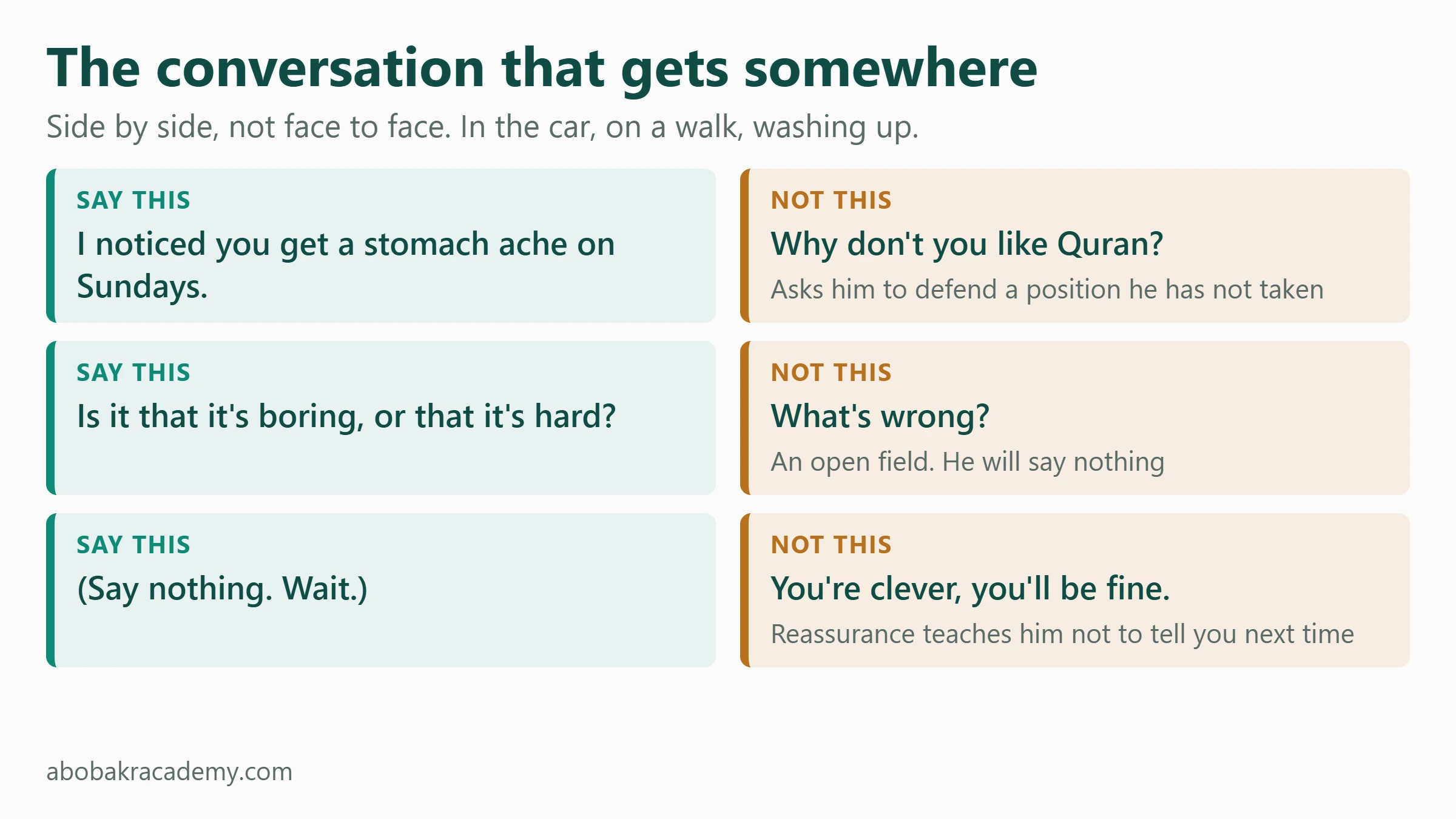
Most advice stops at “talk to your child”, which is true and useless. Here is the shape of a conversation that tends to get somewhere.
Do it side by side rather than face to face. In the car, on a walk, washing up. Face to face reads as an interview and he will give you interview answers.
Open with an observation, not a question. “I noticed you get a stomach ache on Sundays.” Then stop talking. The silence is doing the work and most parents fill it too early.
If nothing comes, offer him two doors rather than an open field. “Is it that it’s boring, or is it that it’s hard?” Children who will not volunteer a feeling will very often pick from a list, and those two options happen to be exactly the fork you are trying to resolve.
And then believe the answer. If he says it is hard, do not reassure him that he is clever. He has just told you something expensive and being told he is fine is how he learns not to bother telling you next time.
When stopping for a while is the right answer
This is the part the academies will not write, and it would be dishonest of us to leave it out because we are one.
If a child has been fighting this for months, if the lesson has become the worst hour of his week, and if the association between the Quran and being made to feel stupid is hardening, then continuing is not neutral. You are buying a page a week at the cost of how he feels about the book for the next twenty years. That is a bad trade and it is worth naming as one. If you do pause, keep one small thing running rather than nothing: eight short duas on one printable sheet take about ten seconds a day, carry no lesson and no correction, and mean the restart is not from zero.
A pause is not the same as quitting. Six or eight weeks with no formal lesson, with recitation still playing in the car and nothing asked of him, resets more than most parents expect. Children who come back to it after a break usually come back further along than the ones who were dragged through the break, because attitude compounds in both directions.
Two honest caveats. Pauses have a way of becoming permanent unless you write the restart date down when you start the pause. And this is where the practical question runs into a religious one about what parents are obliged to do, which is not ours to answer. Shaykh Irshaad Sedick’s answer on a son refusing to learn Quran is a good place to read the counsel, and your own imam knows your family and we do not. What we can tell you is what we see: forcing a resistant seven year old through a page a day produces readers who stop at eighteen, and we have never once seen it produce the thing the parent was actually hoping for.
What to say to the teacher, and when
Raise it early. Most parents wait until they are angry, and by then the conversation is about the teacher rather than about the child.
The sentence that works is specific and blameless: “He’s finding it hard to get to the lesson lately. Can we drop back to something he’s confident with for a couple of weeks and see if that helps?” A teacher who is paying attention will take that well and act on it. Vagueness in reply is the warning sign, more than any individual thing your child gets wrong.
Give any change a month before you judge it. If nothing has moved after a month of a properly easier level and a better time slot, the pairing is probably wrong, and a different tutor is a much smaller step than a different academy. There is a fuller set of questions that get a real answer out of a Quran teacher if you want to go into it properly.
What getting better actually looks like
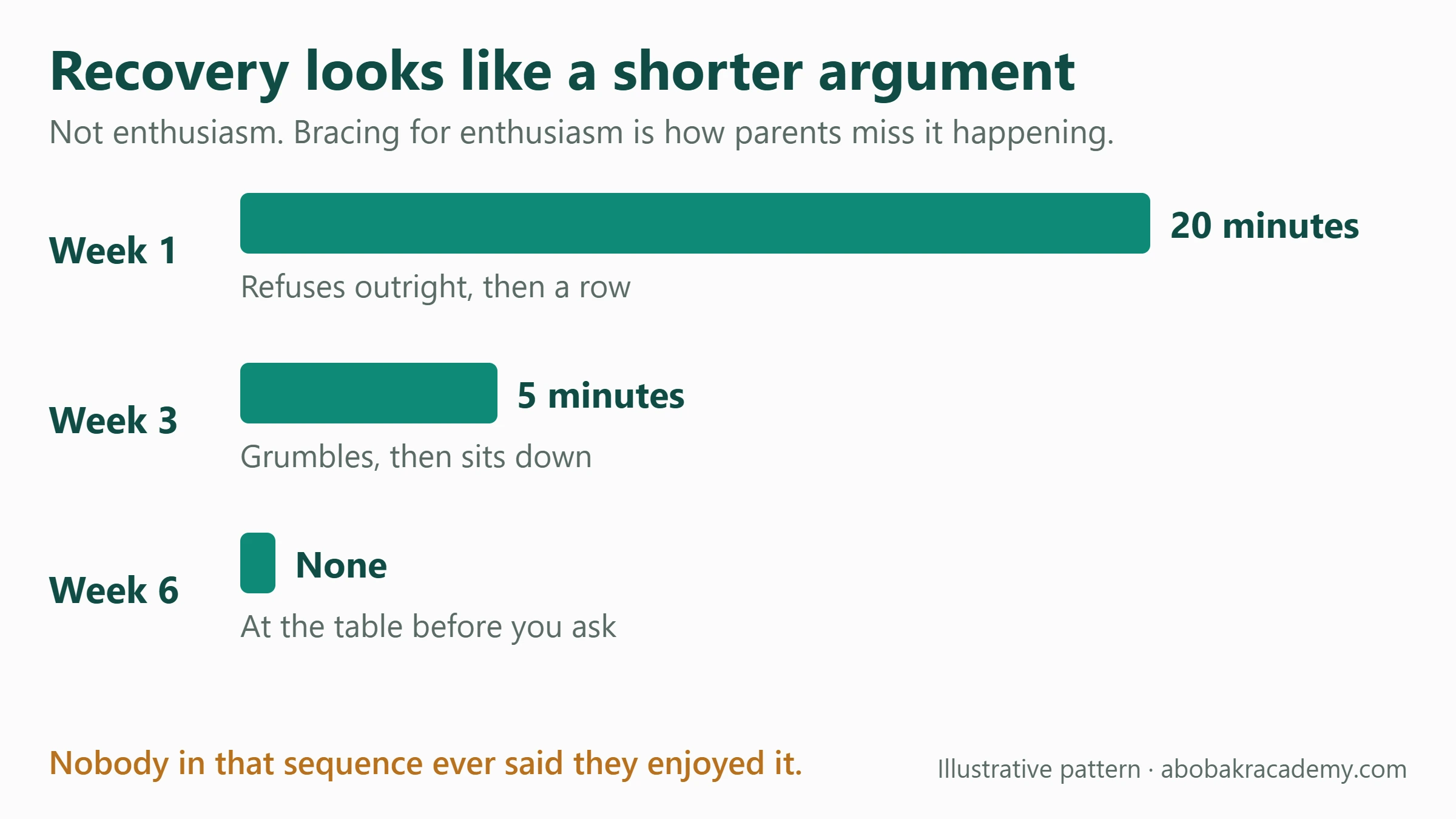
It does not look like enthusiasm. Bracing yourself for enthusiasm is how parents miss the recovery when it happens.
It looks like the argument getting shorter. Week one he refuses for twenty minutes. Week three he grumbles for five and sits down. Week six he is at the table before you have asked. Nobody in that sequence ever said they enjoyed it, and the thing you were worried about has nevertheless gone away.
Month to month you will hear very little difference in the reading itself. Across three or four months it is obvious. That gap between how slowly it improves and how quickly you would like it to is the reason to keep a written record rather than trusting the impression you have on any given Sunday.
Questions parents ask
Is it normal for a child to resist Quran lessons?
Yes, and it is close to universal at some point. Nearly every child who studies anything on a schedule for years will have a stretch of resisting it. What is not normal is resistance that lasts for months and gets worse rather than moving around, which usually means the level or the pairing is wrong rather than the child.
My child is happy to memorize but hates reading from the page. What does that mean?
Almost always that he cannot decode as well as his memorization suggests. Memorizing by ear from a teacher’s voice is a separate skill from reading the script, and a strong ear can mask a weak eye for a long time. Run the read-it-twice check above and you will usually find the stumbles cluster.
Should I use rewards or a sticker chart?
They work in the short term and they are fine for getting over a specific hump, such as the four weeks after a level change. They are a poor permanent arrangement, because the reward becomes the reason and you have to keep raising it. Use them to buy time while you fix the underlying thing, not instead of fixing it.
He says the lessons are boring. Is that a real reason?
Sometimes, and it is worth taking at face value once. A lesson where most of the talking is the teacher’s is boring and it is also not very effective. But “boring” is also the word children reach for when the real answer is “I can’t do it and I don’t want to say so”, which is why the read-it-twice check is more reliable than the word itself.
Would a different teacher fix this?
Occasionally, and it is a smaller and less disruptive change than parents assume. But change the level and the time slot first, because those are free, reversible, and account for more cases. If a month of both has moved nothing, then the pairing is the next thing to look at.
How long should I let a pause last?
Set the length before you start it rather than deciding as you go, and six to eight weeks is usually enough to break the association without losing the habit entirely. Keep listening going in the car during the pause, even if it is only the short surahs of Juz Amma on repeat. Put the restart date in your calendar on the day you begin, because open-ended pauses are the ones that quietly become permanent.
Where to go from here
Run the five minute check this week. It costs nothing and it decides everything that follows, because the response to “can’t” and the response to “won’t” pull in opposite directions and guessing wrong makes things worse rather than slower.
If it turns out the level is the problem and you would like someone to take it back to where he is solid, our tutors do that as a matter of course in one to one Quran lessons for children, and it is a normal request rather than an awkward one. You are welcome to tell us what is happening at home and we will tell you honestly whether we think lessons are the right next step, including when we think a break would serve him better.