

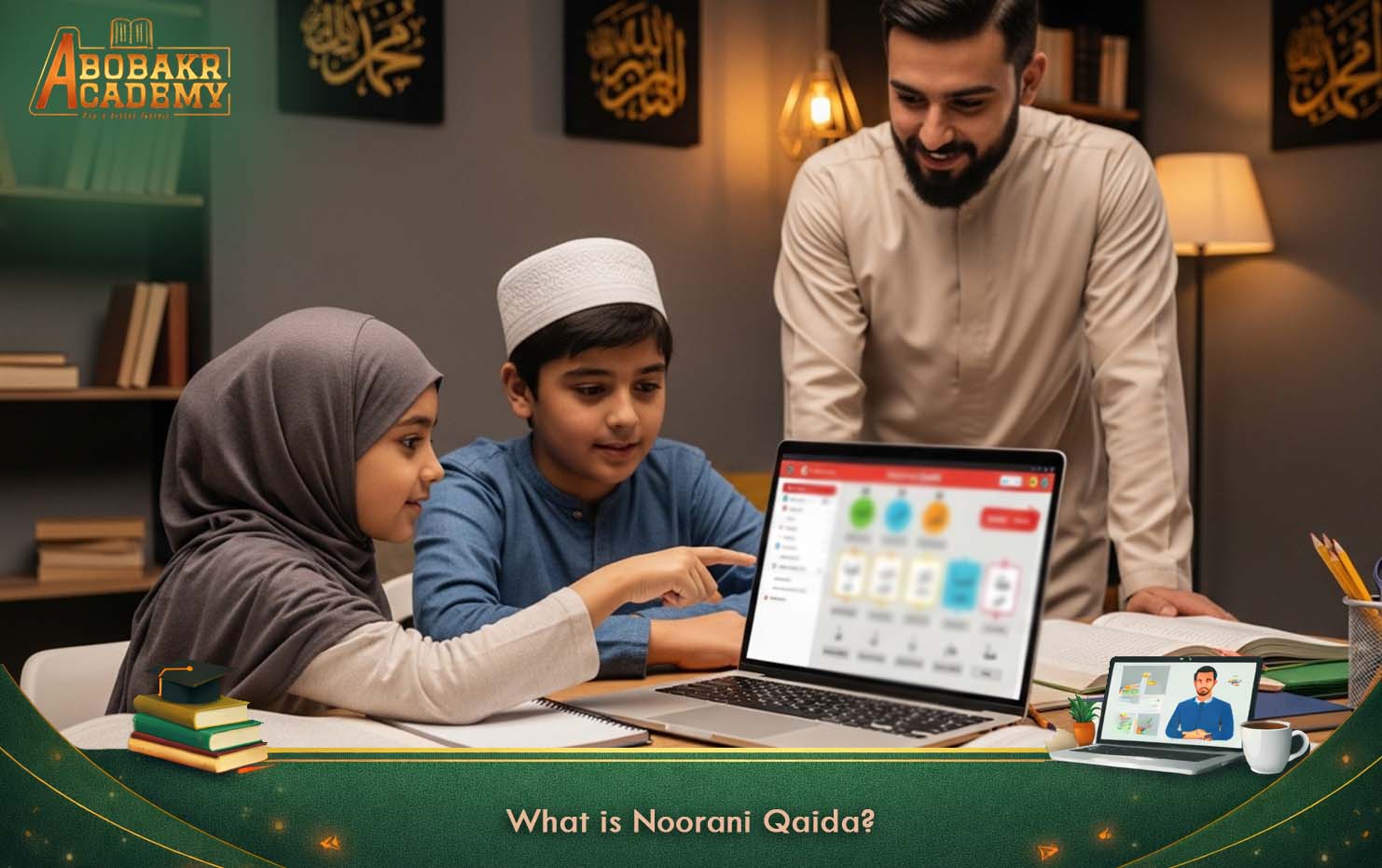
A Noorani Qaida lesson is short, spoken and repetitive. Your child opens the book at the line they reached last time, reads it aloud, and the tutor corrects whatever came out wrong. Then they read it again. The letters become automatic through that repetition rather than through explanation.
Abobakr Academy teaches the Qaida to children in live one-to-one classes over video call. Your child keeps the same tutor each week, at a time that fits around school, and the first class costs nothing. If that is where you are, our Qaida course is the usual next step.
If you want the background on the book itself, our complete guide to Noorani Qaida explains what the lessons contain and how long the whole book usually takes.
What Happens in a Noorani Qaida Class for Kids
Lessons follow the same shape every week, which is most of why young children cope with them. The tutor greets your child, asks them to read back the previous line, and only then moves forward. Nothing new is introduced until the last thing is secure.
Most of the class time goes on one specific difficulty. Children usually read isolated letters well within a few weeks, then stumble the moment two letters are joined and the shape changes. That join is where the repetition is spent.
- Recap of the previous lesson, read aloud by the child
- New letters or joins, modelled first by the tutor
- Correction of individual sounds, one at a time
- A short passage to practise before the next class
Choosing the Right Class Length for Your Child’s Age
Attention span decides this more than ability does.
Ages four to six. Thirty minutes is usually the ceiling, and even that works best when the tutor breaks it up. Two shorter classes a week suit this age better than one long one.
Ages seven to nine. Thirty minutes is comfortable and progress becomes visible faster, because children this age can practise on their own between lessons.
Ages ten and above. Longer classes are workable, and children at this age often move through the Qaida quickly once the alphabet is secure. Where a child should enter this sequence is a question of readiness as much as age.
Who Will Teach Your Child
Our Quran teachers are Al-Azhar trained, and several hold Ijazah, meaning their recitation has been certified through an unbroken chain of teachers. That matters for the Qaida specifically, because a child copies the sound their teacher makes. A mispronounced letter learned at five is difficult to correct at fifteen.
You can read the teachers’ names, subjects and qualifications on our About Us page. Families who would prefer a female teacher for their daughter should mention it when booking.
Booking Classes Around School Hours
We teach families in the United States, the United Kingdom, Canada and Australia. Our tutors keep late hours to cover North American evenings, so an after-school or weekend slot in your own time zone is almost always available.
A five o’clock lesson in London falls at seven in the evening in Cairo. North American slots run later still. Tell us the window that works around school and homework, and we will fit the tutor to it rather than the other way round.
Your Child’s First Class Is Free
The trial is a real lesson, not a sales call. The tutor finds out what your child already recognises, starts them at the right page, and afterwards tells you honestly whether they are ready for the Qaida or would do better waiting a few months.
Book through the form on this site or message us on WhatsApp. It helps to say your child’s age, your time zone, and whether they have seen Arabic letters before.
How You Will Know Your Child Is Progressing
The Qaida makes progress unusually easy to see, because it is ordered. Ask your child to read a page from three lessons ago. If it comes out fluently without prompting, the earlier material has settled and the pace is right. If it does not, the tutor slows down.
That check works beyond the Qaida too, and there are other signs a parent can read without knowing Arabic.
Tutors flag the letters a child keeps missing so the same sounds come round again in later lessons instead of being left behind.
One-to-One Classes Compared With Group Classes
Group classes are cheaper and work well for older children who already read. The Qaida is a poor fit for them. A child reading aloud in a group gets a fraction of the correction they need, and the mistakes that matter most are individual: one child cannot distinguish two similar letters, another rushes the vowels. One-to-one means every one of those gets addressed the week it appears.
What Comes After the Qaida
Finishing the Qaida means your child can decode Arabic script. The next step is applying the rules of recitation properly, which is covered in our Tajweed classes, and then reading from the Mushaf itself in our weekly lessons for children.
Questions Parents Ask Before Booking
What age can my child start Noorani Qaida classes?
Around five is the usual starting point, because the child needs to sit still and repeat a sound back accurately. Some four-year-olds manage it in short bursts. If your child is not ready, the tutor will tell you honestly after the trial rather than take a booking that will not work.
Does my child need to know Arabic first?
No. The Qaida assumes no Arabic at all. It teaches the letters and their sounds from the first page, which is why it works for children in English-speaking homes who have never seen the script before.
Can I sit in on the lessons?
Yes, and with younger children we encourage it for the first few weeks. Most parents find their child settles after three or four lessons and prefers to manage the call alone after that.
What happens if we miss a class?
Tell the tutor in advance and the slot is moved rather than lost. Regular attendance matters more than lesson length with the Qaida, since the sounds fade quickly when a child goes two weeks without reading aloud.
Will my daughter be taught by a female tutor?
She can be. Several of our Quran teachers are women, and families who prefer that arrangement should say so when booking the trial.
What equipment do we need?
A laptop, tablet or phone with a working microphone, and a copy of the Qaida. The tutor can share the pages on screen for the first lessons if your copy has not arrived yet.
Ready to start? Book a free trial class and see how your child gets on with a tutor before committing to anything. You can also browse our other online Quran classes.
While your child works through the Qaida, our free tracker for the sixteen Qaida lessons tells you what to listen for at each stage, even if you do not read Arabic yourself.