Your child already says at least two of the 99 names of Allah every day. Every time they say Bismillah ir-Rahmaan ir-Raheem before eating, they are saying Ar-Rahmaan and Ar-Raheem, the Most Merciful and the Always Merciful. They just may not know those words are names.
That is the easiest way into the whole list, and it is how this page is built. Below you will find all 99 names in Arabic with the vowel marks, a way to say each one, and a meaning a child can hold onto. Before the full list there are ten names to start with, chosen because your child will hear them in surahs they probably know already. Everything is free to print, with no sign-up.
The 99 names of Allah, called al-asmaa’ al-husnaa or “the most beautiful names”, are the names Muslims use to describe and call on Allah. A sound hadith promises Paradise to whoever learns them. For children, the best start is ten names they already hear in Bismillah, Surah Al-Ikhlas, Surah An-Nas and Ayat al-Kursi, learned one a week.
What are the 99 names of Allah?
They are names and descriptions of Allah: who He is and what He does. Some tell a child that Allah is kind (Ar-Rahmaan), some that He made everything (Al-Khaaliq), some that He hears every whisper (As-Samee’). Put together, they answer the question children ask sooner or later, which is “what is Allah like?”
The Quran tells us to use them: “And to Allah belong the best names, so invoke Him by them” (Surah Al-A’raf 7:180). The number comes from a hadith in both Sahih al-Bukhari and Sahih Muslim, in which the Prophet ﷺ said: “Allah has ninety-nine names, one hundred minus one, and whoever knows them will go to Paradise” (Sahih al-Bukhari 2736, and Sahih Muslim 2677).
Which names should a child learn first?
Start with the names your child already recites without knowing it. Eight of the ten below sit inside four short passages that most Muslim children learn early, so every time they recite, they are practising. The last two are the easiest to talk about at the dinner table.
| Name | Say it | Meaning | Where your child hears it |
|---|---|---|---|
| الرَّحْمَنُ | Ar-Rahmaan | The Most Merciful, kind to everyone | Bismillah, and Surah Al-Fatihah |
| الرَّحِيمُ | Ar-Raheem | The Always Merciful | Bismillah, and Surah Al-Fatihah |
| الْمَلِكُ | Al-Malik | The King of everything | Surah An-Nas: malikin-naas, King of mankind |
| الصَّمَدُ | As-Samad | The One everyone needs, who needs no one | Surah Al-Ikhlas: Allahus-samad |
| الْحَىُّ | Al-Hayy | The Ever-Living | Ayat al-Kursi: al-hayyul-qayyoom |
| الْقَيُّومُ | Al-Qayyoom | The One who keeps everything going | Ayat al-Kursi: al-hayyul-qayyoom |
| الْعَلِيُّ | Al-‘Aliyy | The Most High | The end of Ayat al-Kursi: wa huwal-'aliyyul-'azeem |
| الْعَظِيمُ | Al-‘Azeem | The Magnificent | The end of Ayat al-Kursi: wa huwal-'aliyyul-'azeem |
| الْخَالِقُ | Al-Khaaliq | The Creator | Everyday talk: who made the sky, the trees, and you? |
| الرَّزَّاقُ | Ar-Razzaaq | The Provider of food and everything we need | Before a meal: who gave us this food? |
Notice that Surah Al-Ikhlas opens with qul huwa Allahu ahad. The name Allah is itself the first of the 99, so that short surah gives your child two names in its first two lines. If your child is still learning these surahs, the short surahs to memorize first guide puts them in a sensible order.

How can you teach the names if you do not read Arabic?
You do not need to read the Arabic script to do this well. You need three things: the sound, the meaning, and a moment in the day to use them. The “say it” column in every table here is written so an English reader can say it out loud, and the meanings are short enough for a six-year-old to repeat.
Here is a routine that works in most homes:
- One name a week. Write it on a card and stick it on the fridge. Say it together whenever someone walks past.
- Tie it to something real. For Ar-Razzaaq, the Provider, say it before a meal: “Who gave us this food?” For As-Samee’, the All-Hearing, say it at bedtime du’a: “Allah hears you even when you whisper.”
- Listen for it in their recitation. When your child recites Ayat al-Kursi, stop after al-hayyul-qayyoom and ask which two names they just said. You can check the answer from the table without reading a word of Arabic.
- Review on Fridays. Point at last week’s cards and let your child say the name before you do.
That third step matters most for a parent who cannot follow the Arabic. It turns a list your child memorises into something you can actually check. The guide to teaching Arabic when you do not speak it yourself uses the same idea for letters and words, and a school-year Quran routine has room for a name of the week on its Friday slot.
Why do some names start with Ar- or As- instead of Al-?
Almost every name here starts with the Arabic word for “the”, which is al. But you say Ar-Rahmaan, not Al-Rahmaan, and As-Salaam, not Al-Salaam. That is because of a reading rule: before 14 of the Arabic letters, the “l” in al goes silent and the next letter doubles. Those are called sun letters, and they are the reason your child’s Quran teacher will correct “Al-Rahmaan” every time.
We have written every name the way it is said, so the list quietly teaches the rule as your child learns it. There are 18 names in the list where the “l” disappears. If you want to understand why, the page on sun and moon letters explains it in about ten minutes, with a chart.
All 99 names of Allah with meanings
The list is numbered in the order of the narration that carries it, which is explained in the next section. Arabic reads from right to left, and the “say it” column doubles long vowels (aa, ee, oo) so a child holds them for longer.
| # | Name | Say it | Meaning |
|---|---|---|---|
| 1 | اللَّهُ | Allah | Allah, the name of the One God |
| 2 | الرَّحْمَنُ | Ar-Rahmaan | The Most Merciful, kind to everyone |
| 3 | الرَّحِيمُ | Ar-Raheem | The Always Merciful |
| 4 | الْمَلِكُ | Al-Malik | The King of everything |
| 5 | الْقُدُّوسُ | Al-Quddoos | The Most Pure, with no fault at all |
| 6 | السَّلاَمُ | As-Salaam | The Source of Peace |
| 7 | الْمُؤْمِنُ | Al-Mu’min | The Giver of safety and faith |
| 8 | الْمُهَيْمِنُ | Al-Muhaymin | The One who watches over everything |
| 9 | الْعَزِيزُ | Al-‘Azeez | The Almighty, whom no one can defeat |
| 10 | الْجَبَّارُ | Al-Jabbaar | The Compeller, who also mends what is broken |
| 11 | الْمُتَكَبِّرُ | Al-Mutakabbir | The Supreme in greatness |
| 12 | الْخَالِقُ | Al-Khaaliq | The Creator |
| 13 | الْبَارِئُ | Al-Baari’ | The Maker, who brings things into being |
| 14 | الْمُصَوِّرُ | Al-Musawwir | The Shaper, who gives everything its form |
| 15 | الْغَفَّارُ | Al-Ghaffaar | The One who forgives again and again |
| 16 | الْقَهَّارُ | Al-Qahhaar | The One who overcomes everything |
| 17 | الْوَهَّابُ | Al-Wahhaab | The Giver of gifts |
| 18 | الرَّزَّاقُ | Ar-Razzaaq | The Provider of food and everything we need |
| 19 | الْفَتَّاحُ | Al-Fattaah | The Opener of every door of good |
| 20 | الْعَلِيمُ | Al-‘Aleem | The All-Knowing |
| 21 | الْقَابِضُ | Al-Qaabid | The One who holds back |
| 22 | الْبَاسِطُ | Al-Baasit | The One who spreads out and gives freely |
| 23 | الْخَافِضُ | Al-Khaafid | The One who lowers |
| 24 | الرَّافِعُ | Ar-Raafi’ | The One who raises up |
| 25 | الْمُعِزُّ | Al-Mu’izz | The Giver of honour |
| 26 | الْمُذِلُّ | Al-Mudhill | The One who humbles |
| 27 | السَّمِيعُ | As-Samee’ | The All-Hearing |
| 28 | الْبَصِيرُ | Al-Baseer | The All-Seeing |
| 29 | الْحَكَمُ | Al-Hakam | The Judge |
| 30 | الْعَدْلُ | Al-‘Adl | The Perfectly Fair |
| 31 | اللَّطِيفُ | Al-Lateef | The Gentle, who knows the smallest things |
| 32 | الْخَبِيرُ | Al-Khabeer | The All-Aware |
| 33 | الْحَلِيمُ | Al-Haleem | The Patient, who does not rush to punish |
| 34 | الْعَظِيمُ | Al-‘Azeem | The Magnificent |
| 35 | الْغَفُورُ | Al-Ghafoor | The Most Forgiving |
| 36 | الشَّكُورُ | Ash-Shakoor | The Appreciative, who rewards the smallest good |
| 37 | الْعَلِيُّ | Al-‘Aliyy | The Most High |
| 38 | الْكَبِيرُ | Al-Kabeer | The Most Great |
| 39 | الْحَفِيظُ | Al-Hafeez | The Protector, who keeps everything safe |
| 40 | الْمُقِيتُ | Al-Muqeet | The Sustainer of every creature |
| 41 | الْحَسِيبُ | Al-Haseeb | The One who takes account, and is enough for us |
| 42 | الْجَلِيلُ | Al-Jaleel | The Majestic |
| 43 | الْكَرِيمُ | Al-Kareem | The Most Generous |
| 44 | الرَّقِيبُ | Ar-Raqeeb | The Ever-Watchful |
| 45 | الْمُجِيبُ | Al-Mujeeb | The One who answers prayers |
| 46 | الْوَاسِعُ | Al-Waasi’ | The Vast, whose giving has no limit |
| 47 | الْحَكِيمُ | Al-Hakeem | The Most Wise |
| 48 | الْوَدُودُ | Al-Wadood | The Most Loving |
| 49 | الْمَجِيدُ | Al-Majeed | The Most Glorious |
| 50 | الْبَاعِثُ | Al-Baa’ith | The One who brings everyone back to life |
| 51 | الشَّهِيدُ | Ash-Shaheed | The Witness to everything |
| 52 | الْحَقُّ | Al-Haqq | The Truth |
| 53 | الْوَكِيلُ | Al-Wakeel | The One we can always rely on |
| 54 | الْقَوِيُّ | Al-Qawiyy | The Most Strong |
| 55 | الْمَتِينُ | Al-Mateen | The Firm, whose strength never tires |
| 56 | الْوَلِيُّ | Al-Waliyy | The Protecting Friend |
| 57 | الْحَمِيدُ | Al-Hameed | The Praiseworthy |
| 58 | الْمُحْصِي | Al-Muhsee | The One who counts everything |
| 59 | الْمُبْدِئُ | Al-Mubdi’ | The One who starts creation |
| 60 | الْمُعِيدُ | Al-Mu’eed | The One who brings it back again |
| 61 | الْمُحْيِي | Al-Muhyee | The Giver of life |
| 62 | الْمُمِيتُ | Al-Mumeet | The One who causes death |
| 63 | الْحَىُّ | Al-Hayy | The Ever-Living |
| 64 | الْقَيُّومُ | Al-Qayyoom | The One who keeps everything going |
| 65 | الْوَاجِدُ | Al-Waajid | The One who has everything and lacks nothing |
| 66 | الْمَاجِدُ | Al-Maajid | The Noble and Glorious |
| 67 | الْوَاحِدُ | Al-Waahid | The One |
| 68 | الصَّمَدُ | As-Samad | The One everyone needs, who needs no one |
| 69 | الْقَادِرُ | Al-Qaadir | The All-Able |
| 70 | الْمُقْتَدِرُ | Al-Muqtadir | The All-Powerful |
| 71 | الْمُقَدِّمُ | Al-Muqaddim | The One who brings forward |
| 72 | الْمُؤَخِّرُ | Al-Mu’akhkhir | The One who puts back |
| 73 | الأَوَّلُ | Al-Awwal | The First, before everything |
| 74 | الآخِرُ | Al-Aakhir | The Last, after everything |
| 75 | الظَّاهِرُ | Az-Zaahir | The Evident, whose signs are everywhere |
| 76 | الْبَاطِنُ | Al-Baatin | The Hidden, whom no eye can see |
| 77 | الْوَالِي | Al-Waalee | The One in charge of all things |
| 78 | الْمُتَعَالِي | Al-Muta’aalee | The Most Exalted |
| 79 | الْبَرُّ | Al-Barr | The Source of all goodness |
| 80 | التَّوَّابُ | At-Tawwaab | The One who accepts repentance, again and again |
| 81 | الْمُنْتَقِمُ | Al-Muntaqim | The One who punishes wrongdoing |
| 82 | الْعَفُوُّ | Al-‘Afuww | The One who pardons and wipes sins away |
| 83 | الرَّءُوفُ | Ar-Ra’oof | The Most Tender and Kind |
| 84 | مَالِكُ الْمُلْكِ | Maalik al-Mulk | The Owner of all kingdoms |
| 85 | ذُو الْجَلاَلِ وَالإِكْرَامِ | Dhul-Jalaali wal-Ikraam | The Lord of Majesty and Generosity |
| 86 | الْمُقْسِطُ | Al-Muqsit | The Just, who puts things right |
| 87 | الْجَامِعُ | Al-Jaami’ | The Gatherer, who will bring everyone together |
| 88 | الْغَنِيُّ | Al-Ghaniyy | The Rich, who needs nothing |
| 89 | الْمُغْنِي | Al-Mughnee | The One who makes others rich |
| 90 | الْمَانِعُ | Al-Maani’ | The One who holds back harm |
| 91 | الضَّارُّ | Ad-Daarr | The One who decides when hardship comes |
| 92 | النَّافِعُ | An-Naafi’ | The One who brings benefit |
| 93 | النُّورُ | An-Noor | The Light |
| 94 | الْهَادِي | Al-Haadee | The Guide |
| 95 | الْبَدِيعُ | Al-Badee’ | The Originator of things never seen before |
| 96 | الْبَاقِي | Al-Baaqee | The Everlasting |
| 97 | الْوَارِثُ | Al-Waarith | The Inheritor, to whom everything returns |
| 98 | الرَّشِيدُ | Ar-Rasheed | The Guide to the right way |
| 99 | الصَّبُورُ | As-Saboor | The Most Patient |
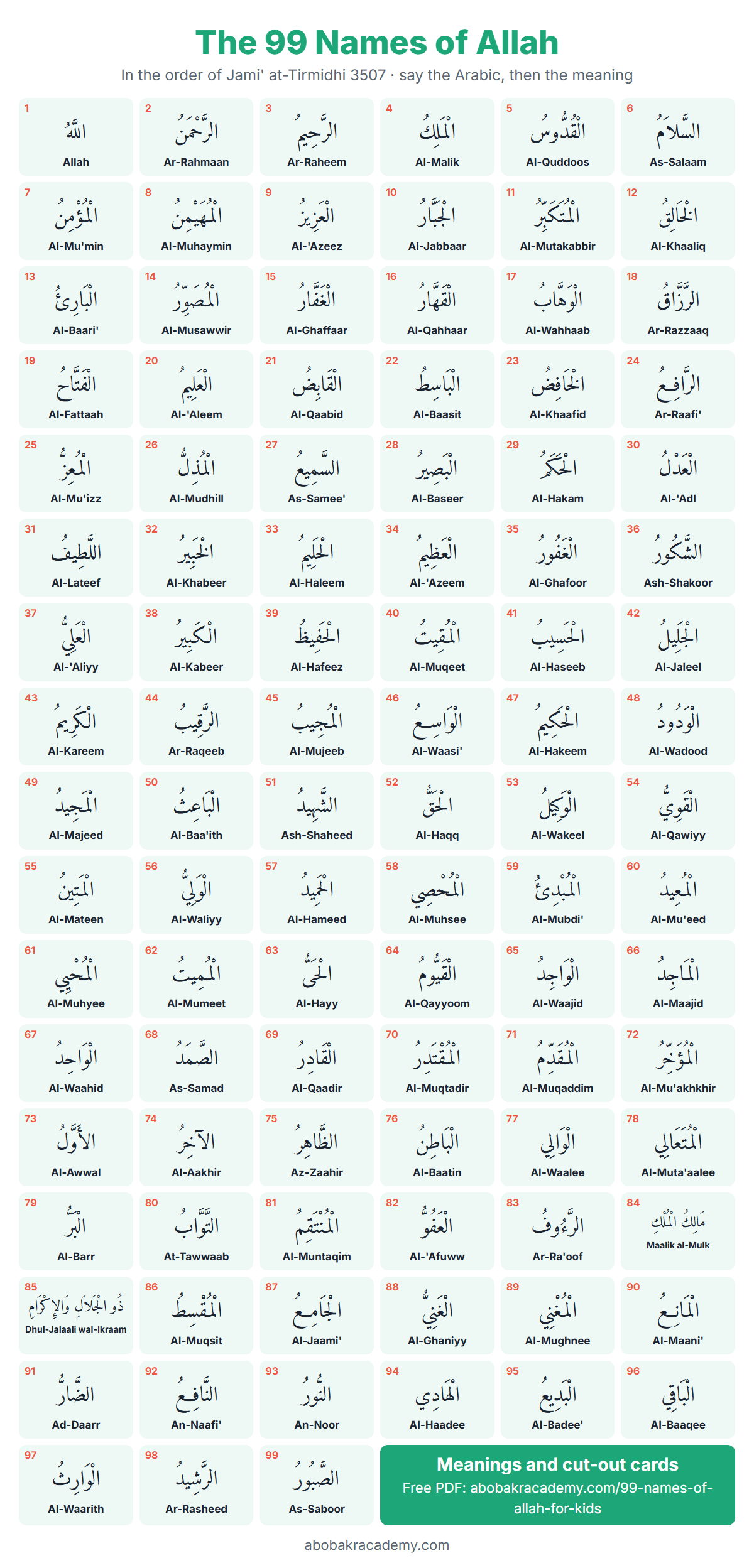
Download the 99 Names of Allah chart and cards (free PDF). Three pages list all 99 names with their meanings, large enough to read from across a room, and a fourth page has the ten starter names as cards to cut out. It is sized for A4 and prints on US Letter too if you choose “fit to page”. There is no sign-up.
Where does the list of 99 names come from?
This is worth knowing, because it explains why two charts can disagree.
The number 99 is certain. It is in Sahih al-Bukhari and Sahih Muslim, as above. But those narrations do not list the names. The list most people use comes from one narration in Jami’ at-Tirmidhi 3507, and Imam at-Tirmidhi himself called that report gharib, meaning it comes through a single chain. Scholars of hadith have long said that the list itself was most likely put together by one of the narrators, drawing on the Quran and Sunnah, rather than spoken word for word by the Prophet ﷺ. The grading shown for it on Sunnah.com is weak.
None of that makes the names wrong to learn. They describe Allah with meanings taken from the Quran and Sunnah, and Muslims have taught them to children for centuries. It just means the exact list is a scholarly selection, and different books sometimes swap a name or two.
Two differences you are likely to notice:
- This chart starts with Allah. In at-Tirmidhi’s narration, the list opens “He is Allah, besides whom there is no god” and then names 98 more. Counted the way the narration counts them, Allah is the first of the 99. Many charts instead start at Ar-Rahmaan and add Al-Ahad, “the One”, to make 99. Al-Ahad is a true name of Allah (Surah Al-Ikhlas calls Him ahad), but it is not in this narration.
- The Arabic is copied from the narration exactly. Every name in our table was taken from the Arabic text of Tirmidhi 3507 and checked character by character against it, including the vowel marks. If your child’s book spells one slightly differently, that is usually not a mistake: Arabic has more than one accepted way to write a few of these names.
What does “whoever counts them enters Paradise” mean?
The Arabic word in the hadith is ahsaahaa, which means to count, to take in, or to keep track of. Scholars have explained it as more than reciting a list from memory: knowing the names, understanding what they mean, and calling on Allah by them, as the verse in Surah Al-A’raf says.
For a child, that gives you a simple way to think about the goal. Memorising all 99 is a lovely achievement, but a child who knows ten names well and says “Ya Raheem, please help my grandma get better” has understood the point better than one who can race through the list without knowing what any of it means.
Common questions about the 99 names of Allah
How long does it take a child to learn all 99 names?
At one name a week, about two years, which is a comfortable pace for a child of six to ten. Many children learn the sounds much faster with a song, often within a few weeks, but the meanings take longer. Aim for the meanings. The sounds follow.
Can I name my child after one of the 99 names?
Names that belong to Allah alone, such as Ar-Rahmaan or Al-Khaaliq, are given with ‘Abd in front, meaning “servant of”: Abdur-Rahmaan, Abdul-Khaaliq, Abdullah. A few words on the list, such as Kareem or Rasheed, are also ordinary words that describe people, and are used as names without “al”.
Why does my child’s book have Al-Ahad?
Because it follows a different count. Many charts start at Ar-Rahmaan and include Al-Ahad to reach 99. This chart follows the narration in at-Tirmidhi exactly, which starts with Allah and does not include Al-Ahad. Both ways of counting are used by Muslims, and Al-Ahad is certainly a name of Allah.
Should my child learn the names in Arabic or in English?
Both, together. Say the Arabic name, then the meaning: “Al-Baseer, the All-Seeing.” The Arabic is what they will meet in the Quran and in du’a, and the English is what makes it mean something to them.
Is there a printable 99 names of Allah chart for kids?
Yes. The free PDF on this page has all 99 names with Arabic, pronunciation and meaning, plus ten starter cards to cut out. You can find more free sheets, including daily du’a cards, on our free printables page.
Daily duas, Islamic Studies and the month cards
The names sit naturally beside the daily du’as for kids, since so many du’as call on Allah by one of them. If you would like a teacher to go through the names with your child, they are part of our Islamic studies classes. For the calendar side of the year, there is an Islamic months chart with month cards in the same style.