
Hifz for Beginners: How to Start Memorising the Quran
To start hifz, make sure you can read the mushaf fluently with tajweed, choose one starting point (for most people the short surahs of Juz Amma), memorise a small portion every day, and spend most of each session revising what you already hold. Then have someone who knows the Quran hear you recite at least once a week, because you cannot catch your own mistakes.
Everything below is the detail behind those five steps, written for the adult or parent starting from nothing, including families where nobody at home reads Arabic. There is a free printable plan with a four-week tracker further down. If you would rather have a teacher set your daily portion and hear you recite, the first lesson is free.
وَلَقَدْ يَسَّرْنَا ٱلْقُرْءَانَ لِلذِّكْرِ فَهَلْ مِن مُّدَّكِرٍ
“And We have certainly made the Qur’an easy for remembrance, so is there any who will remember?” (Surah Al-Qamar 54:17)
How do you start hifz? The five steps
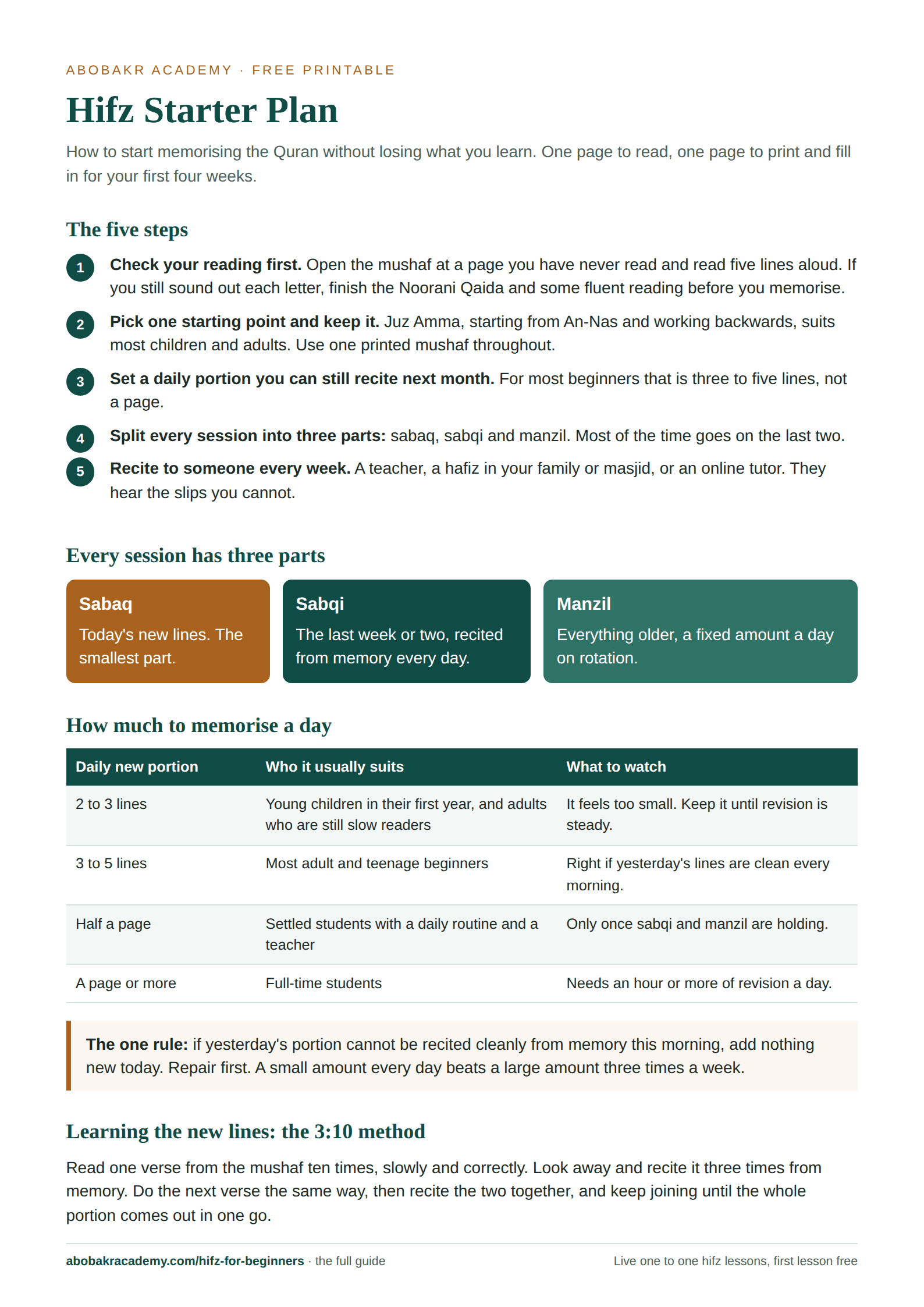
- Check your reading first. Hifz is memorising what you can already read correctly. If you still sound out letters one at a time, finish the Noorani Qaida and some fluent reading before you memorise anything.
- Pick one starting point and keep it. Juz Amma (the last part of the mushaf) or Surah Al-Baqarah. Both work. Switching between them does not.
- Set a daily portion you can still recite next month. For most beginners that is three to five lines, not a page.
- Split every session into three parts: the new lines (sabaq), the last week or two (sabqi) and everything older (manzil). Most of the time goes on the last two.
- Recite to someone every week. A teacher, a hafiz in your family or masjid, or an online tutor. They hear the slips you cannot.
Free printable: the Hifz Starter Plan (PDF)
The whole method on one page, plus a second page to print and fill in: a four-week tracker with a row for every day’s new lines, a box for whether they were still clean the next morning, sabqi, manzil and the weekly check with a teacher. Free, no email needed, and you can print as many copies as you like.
Download the Hifz Starter Plan (PDF, 2 pages)
Before you start: can you read the Quran well enough?
This is the step beginners skip, and it is the one that decides whether the rest works. If you memorise a verse while mispronouncing a letter, you memorise the mistake, and a mistake that has been repeated a hundred times is much harder to undo than one caught on the first day.
A simple test: open the mushaf at a page you have never read and read five lines aloud. If you can read them at a steady pace, joining the letters without stopping to work out each one, you are ready to begin. If you cannot, spend a few months on reading first. Our guide to the Noorani Qaida explains the book most children and adult beginners learn from, and the Quran for beginners course is the route for learning to read with a tutor.
You do not need to understand Arabic to memorise the Quran. Many huffaz around the world do not speak it. Reading a translation of the passage you are about to learn does help, though, because a verse you understand is easier to hold than a string of sounds.
How much should a beginner memorise in a day?
Almost everyone who abandons hifz does so for the same reason, and it is not difficulty or lack of sincerity. They add new material faster than they can hold what is already memorised, and somewhere around the sixth month the back of the pile quietly disappears.
The honest measure of a daily portion is not how much you can commit to memory today. It is how much you can still recite a month from now without prompting. Those are very different amounts, and beginners consistently mistake the first for the second.
| Daily new portion | Who it usually suits | What to watch |
|---|---|---|
| 2 to 3 lines | Young children in their first year, and adults who are still slow readers | It feels too small. Keep it anyway until revision is steady. |
| 3 to 5 lines | Most adult and teenage beginners | The right size if yesterday’s lines are clean every morning. |
| Half a page | Settled students with a daily routine and a teacher | Only once sabqi and manzil are holding. Half a page, five days a week, is two and a half pages a week. |
| A page or more | Full-time students | Needs an hour or more of revision a day to protect it. |
A simple rule keeps most people honest: if yesterday’s portion cannot be recited cleanly from memory this morning, do not add anything new today. Repair first.
Frequency matters more than size. A small amount every single day outperforms a large amount three times a week, because memorisation decays on the days you skip and you spend the next session rebuilding rather than advancing. How these daily amounts turn into years is worked out on a separate page, including why review rather than new pages decides the timeline.
Where should you start in the mushaf?
There are two conventional starting points, and beginners often waste weeks deciding between them.
The first is Juz Amma, the short surahs at the end of the mushaf. They are brief, most people already half-know several of them from years of hearing and reciting them in salah, and every one you finish becomes immediately usable in prayer. This is the standard route for children and for most adults starting out. Most people begin with An-Nas, the last surah, and work backwards towards An-Naba. For a child starting that way, our Surah An-Nas page has the first one verse by verse, with a recitation to copy and a week’s plan.
The second is beginning at Surah Al-Baqarah and working forward in the order of the mushaf. Progress is slower and the early stretch is long, but you build the Quran in its own sequence, which some students find easier to revise later.
For a beginner the first route usually wins, because early momentum is what carries you past the point where the novelty wears off. What matters more than either choice is not switching halfway. Changing plans costs more than either plan would have.
Whichever you choose, memorise from one printed copy of the mushaf and keep using it. Much of what you remember is where a verse sits on the page, and a different print moves every line.
What are sabaq, sabqi and manzil?
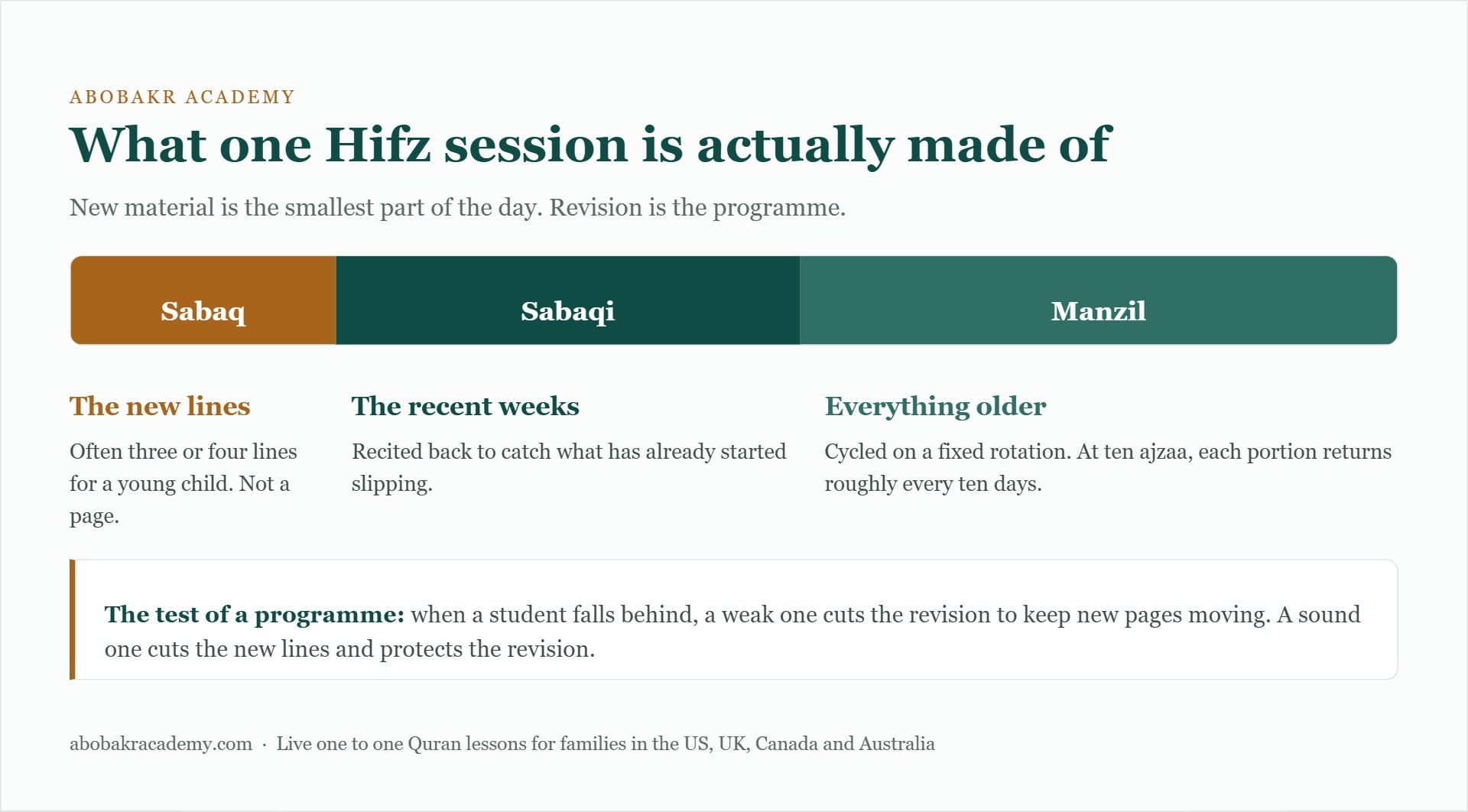
Traditional hifz splits every day’s work into three parts, and the names are worth knowing because a teacher will use them.
| Part | What it is | How it is done |
|---|---|---|
| Sabaq | Today’s new lines | Read, repeat and recite until they come out clean from memory. The smallest part of the session. |
| Sabqi | Recent material, roughly the last week or two | Recited from memory every day while it is still settling. This is where slips first show. |
| Manzil | Everything memorised before that | Cycled on a rotation, a fixed amount a day, so that no part goes untouched for too long. |
The error beginners make is doing only the first. New memorisation feels like progress and revision feels like standing still, so revision is what gets dropped on a busy day. Six months of that produces a student who has covered several juz and can reliably recite none of them.
For someone in their first year, most of a session should be revision rather than new material. That ratio feels wrong and is correct. It is also why a teacher listens to all three parts rather than only hearing the new portion, and why a lesson that only checks today’s lines is not really checking anything. Our free Quran revision planner is a printable sheet for keeping the manzil rotation honest.
What is the 3:10 hifz method?
The 3:10 method is a way of learning the sabaq one verse at a time. You read the verse from the mushaf ten times, slowly and correctly, then close your eyes or look away and recite it three times from memory. When the next verse is done the same way, you recite the two together, and you keep joining verses until the whole portion comes out in one go.
The ten readings do the work of getting the pronunciation and the look of the page right before you try to hold it; the three recitations test whether it has stuck. It suits beginners because it is easy to follow and it stops you rushing. Treat the numbers as a starting point rather than a rule: a long verse may need more readings, and a short one you already half-know may need fewer.
Can you do hifz by yourself?
You can do most of the memorising on your own. What you cannot do alone is check it. When you recite from memory, you hear what you meant to say, not what you said, so a dropped word, a swapped vowel or a letter pronounced wrongly passes straight through. That is why hifz has always been done in front of someone.
The minimum is one person who knows the Quran listening to you every week: sabaq, sabqi and a piece of manzil. That can be a hafiz in your family, a teacher at your masjid, or a tutor online. For families where no adult reads Arabic, this is the part a parent cannot supply, however committed they are, and it is the part to arrange first.
When should a child start hifz?
Children can begin learning to read the Quran from around four, and connected reading usually comes at seven and up, so that is when steady hifz of anything beyond the shortest surahs tends to start. A child can memorise Al-Fatiha and a few short surahs by listening long before they read, and that is worth doing. What age to start Quran goes through the stages in more detail.
For a young child the daily portion is smaller and the sessions are shorter, but the structure is the same: a little new, a lot of revision, and someone listening. Our short surahs tracker is a printable sheet a child can tick off as each surah is secured.
The mistakes that end most beginners’ hifz
- Adding new lines on days the old ones are shaky. The pile grows at the front and falls away at the back.
- Dropping revision when life gets busy. If a day is short, cut the sabaq and keep the manzil.
- Memorising with a pronunciation mistake. Correct it before it is repeated, not after.
- Changing the mushaf, the starting point or the plan. Each change costs weeks.
- Studying in long bursts with gaps between them. Twenty minutes every day beats two hours on a Sunday.
- Not using what you memorise. Recite your new surahs in salah. It is revision you were going to do anyway.
Hifz lessons with Abobakr Academy
If you would rather have a teacher hear you from the first lesson, our hifz lessons are live and one to one on a video call, for children from four and for adults. The teacher sets the daily portion, hears sabaq, sabqi and manzil in every lesson, and adjusts the pace when revision starts to slip. Most of the families we teach have nobody at home who reads Arabic, so each lesson ends with practice a student can do alone until the next one.
One of the teachers who takes hifz students is Sister Nouran, a hafiza of the whole Quran who also teaches tajweed and Qaida. A female teacher is available on request. You can meet the teachers before you book.
Lessons are usually 30 to 60 minutes. Plans start at $34 a month (see the prices) and the first lesson is free, with nothing to sign up to. If money is the obstacle, the free classes are there for exactly that. Comparing programmes before you commit? Our review of the best Quran memorization course options explains what separates a strong Hifz programme from a weak one, and our regular online lessons cover reading and tajweed if you are not ready for hifz yet.
Book a free hifz lesson on WhatsApp
Questions beginners ask about hifz
Is hifz compulsory in Islam?
Memorising the whole Quran is not required of every Muslim. What every Muslim needs is enough to pray, beginning with Al-Fatiha. Scholars describe preserving the whole Quran by memory as a communal duty, met as long as some people in the community carry it, and a great reward for those who do.
How can I do hifz easily?
There is no shortcut, but there is an easier path: small daily portions, one mushaf, most of your time on revision, and someone hearing you every week. People who try to go fast usually end up memorising the same pages twice.
How long does hifz take for a beginner?
It depends on the daily portion and on revision far more than on talent. A child who starts around seven and keeps half a page a day through the school year usually finishes somewhere between thirteen and sixteen years old. Adults who keep a steady daily routine finish in a few years. The full arithmetic is in how long it takes to memorise the Quran.
Can I start hifz as an adult?
Yes. Adults usually have less free time than children and a less forgiving memory, but more discipline and a clearer reason for doing it. Start with Juz Amma, keep the daily portion small, and protect your revision time the way you would protect an appointment.
Can I learn hifz online?
Yes. Hifz is recited and heard, so a live video lesson works well. What matters is that the teacher hears all three parts of your work, not only the new lines.
What if I forget what I memorised?
Everyone does, and the fix is the same: stop adding new lines, go back to the part that slipped, and rebuild it in small pieces until it is clean again. Forgetting is a sign the revision rotation is too long, not that you cannot do hifz.