
Online Tajweed Lessons That Correct You as You Recite
Online Tajweed Classes With a Teacher Who Hears Every Letter
Tajweed is the one part of Quran study that cannot be learned from a book alone. You can read every rule of madd and qalqalah correctly on the page and still produce the wrong sound, because the error is in your mouth and you cannot hear it yourself. What fixes it is somebody listening while you recite and stopping you at the moment the letter goes wrong.
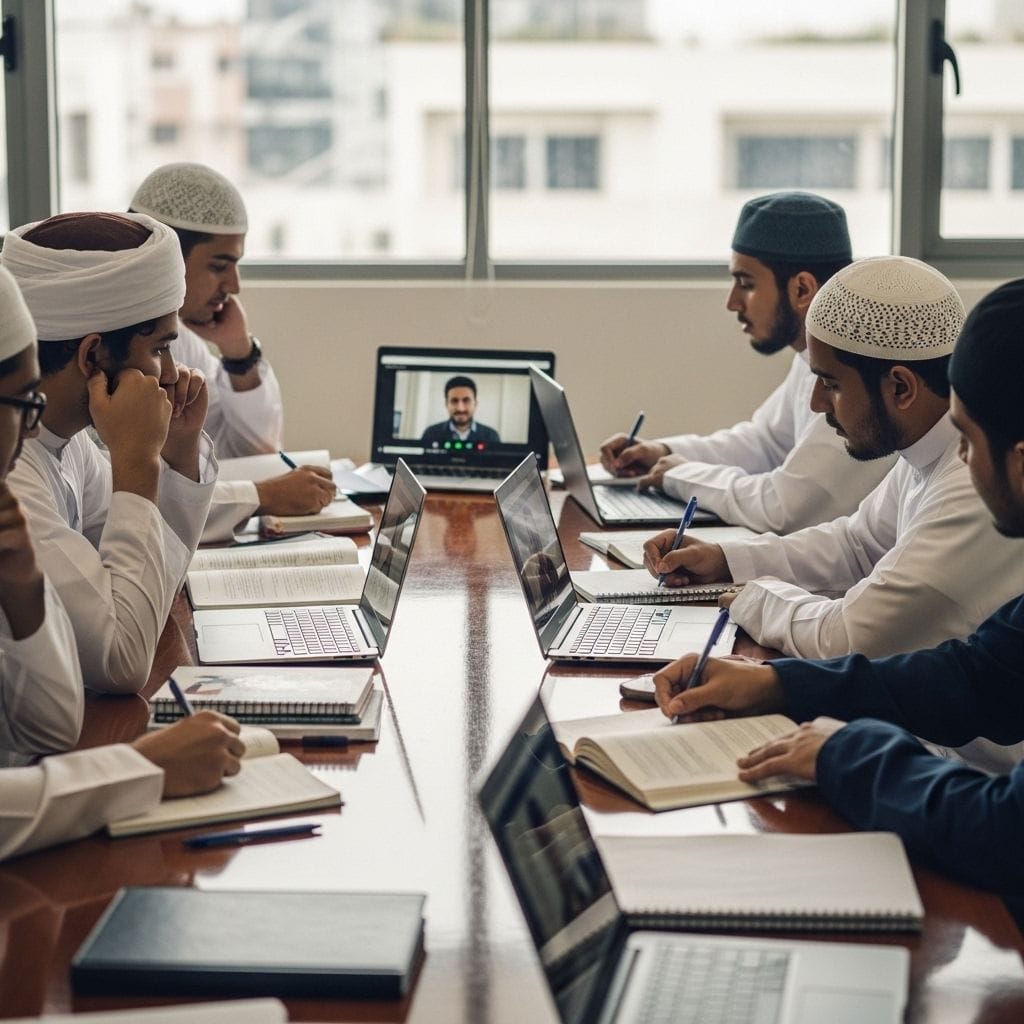
That is what these lessons are — the fastest way to learn tajweed online. You read aloud, live, to a tutor qualified in Quranic recitation, and the correction comes as you go rather than at the end. Sessions run one to one, or in a small group of two or three where a family prefers it.
Classes are open to children from about age four and to adults starting from nothing, so you can learn Quran recitation from home with scheduling that covers the US, UK, Canada and Australia. The first session is a trial, and where a programme charges for it that is stated before you book.

What Happens in an Online Tajweed Lesson
The session has a shape, and it is closer to a music lesson than a lecture.
You recite first. The tutor asks for a passage you have already seen, usually a few lines rather than a page, and listens without interrupting long enough to hear the pattern of errors rather than a single slip.
Then the correction narrows. Instead of telling you that your noon sakinah is wrong, the tutor isolates the one word where it went wrong, models the sound, and asks you to repeat that word alone until it is clean. A letter drilled on its own is a different task from the same letter buried in a verse, and both have to happen.
Then the passage is read again with the correction in place. This is the part beginners want to skip and the part that makes the correction hold, because the sound has to survive being surrounded by other sounds.
The last few minutes set the homework, which is almost always small: one rule, one passage, read aloud daily. Silent reading does nothing for tajweed. If you want the rules themselves laid out with letters and examples to work from between lessons, our guide to Tajweed rules covers them in order.
Most lessons run 30 to 60 minutes. Longer sessions of up to 120 minutes suit adults working toward Ijazah, but for a child a short lesson repeated often beats a long one once a week.
Why Tajweed Lessons Work Better One to One
Some subjects gain from a group. Spoken Arabic is one of them, since fluency needs a second person in the room. Recitation runs the other way.
In a group class the teacher hears the loudest reciter and the room in aggregate. A child who softens a heavy letter, or clips a madd by one count, is inaudible inside four other voices. The mistake is not caught, it is repeated for months, and by then it has become the way that child reads.
There is also the question of who is willing to be wrong in front of other people. Adults who learned to read as children and were never corrected often carry errors they are quietly embarrassed about, and very few will expose that in a group. Teaching one to one removes the audience, and the first few lessons stop being a performance.
We do teach pairs and small groups of two or three, usually siblings or friends who book together, and for the reading and revision portions of a session that works well. For correcting pronunciation, the ear has to be on one mouth at a time.
Tajweed Courses by Level
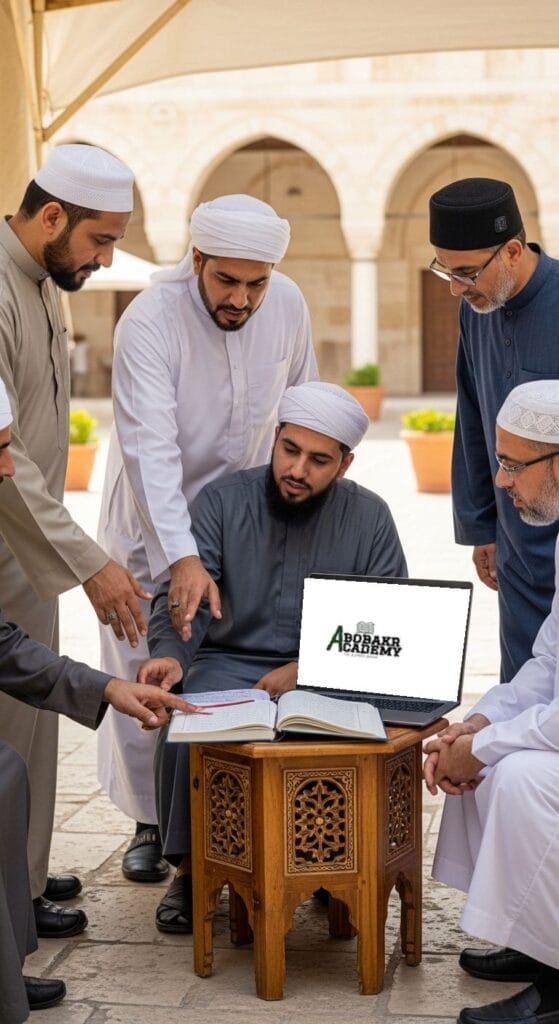
Abobakr Academy runs several of the best tajweed classes online, grouped by level:
Tajweed for Beginners

Learn Arabic letters, pronunciation (Makharij), and the basic Tajweed rules.
Intermediate Tajweed Course

Understand Noon Sakinah, Meem Sakinah, Madd rules, and practical Quran recitation.
Advanced Tajweed Program

Perfect your recitation with advanced Tajweed rules and detailed correction from expert teachers.
Tajweed Classes for Kids

Interactive and engaging Tajweed lessons designed specifically for children.
Finding Your Starting Point Before the First Full Lesson
Tajweed students arrive at four quite different places, and the wrong placement wastes a term.
Some cannot yet read Arabic script. They are not ready for tajweed rules and begin with letter recognition and joined forms, usually through Noorani Qaida, with pronunciation corrected from the first letter so there is no bad habit to unlearn later.
Some read slowly but accurately, sounding out. Here the work is fluency before rules, because tajweed applied to a reader still decoding letter by letter produces a stilted recitation that later has to be undone. Our Quran courses for beginners set out the order that sequence should follow.
Some read fluently with errors they cannot hear. This is the largest group and the most rewarding, because progress becomes fast once the errors are named.
Some read well already and want refinement, working toward Ijazah or preparing to teach.
The trial session exists to place you. It runs about 15 to 30 minutes and most of it is you reciting, because a conversation about your level tells the tutor far less than sixty seconds of reading does.

Tajweed Classes for Kids and for Adults Are Different Problems
A child under about ten mostly acquires pronunciation the way they acquire an accent, by imitation. You can show a seven year old the shape of a letter, have them copy it, and the sound settles without any explanation of the rule behind it. Explaining ikhfa to that child usually spends the lesson badly. Explaining it at eleven or twelve, once the sound is already reliable, is when the rule starts to be interesting.
Adults work in the opposite direction. An adult mouth has spent decades not making these sounds, and imitation alone tends to produce an approximation the learner sincerely believes is correct. Most adults need the rule stated, the articulation point described, and a reason for it. Told where the tongue sits and why, they get there in a few weeks. Left to copy by ear, some never do.
So the two are not the same course at different speeds. A child’s lesson is heavier on repetition and lighter on theory; an adult Quran class carries more explanation and more diagnosis.
What Ijazah and Al-Azhar Training Actually Tell You
Both credentials appear on almost every Quran academy website, so it is worth knowing what each one certifies.
An Ijazah in recitation is a licence to teach, granted after the holder has recited the entire Quran aloud to a teacher who corrected them, and it records the chain running back through that teacher’s own teachers. It certifies one specific thing: that this person’s recitation has been heard in full and passed by somebody qualified to judge it. For tajweed that is the credential that matters most, because tajweed is transmitted by ear rather than by text.
Training at Al-Azhar signals formal study of Arabic and the Islamic sciences. It is a strong indicator of scholarly grounding and a much weaker one of whether somebody can hold the attention of a restless nine year old.
Neither credential tells you whether a teacher can explain a rule a second way when the first way fails. That part you find out by sitting in on a lesson, which is why we would rather you tried one than took our word for it.
Our Quran tutors are qualified, many of them trained at Al-Azhar, and tajweed here is taught by tutors certified with Ijazah in recitation.

Booking Tajweed Lessons: Schedule, Cost and Cancellations
Our online Quran classes with tajweed are arranged between you and the tutor rather than dropped into a fixed timetable, which is what makes late evening slots in the US and UK workable. Most students take two or three sessions a week. For a child working on pronunciation, three short lessons beat one long one, because the sounds decay between sittings.
Pricing runs on total monthly hours rather than lesson length, so a schedule of short frequent lessons costs the same as fewer long ones for the same number of hours. The standard rate is $9.50 an hour and it falls to $7.00 an hour at ten hours a month or more; the full tiers are set out on our Quran classes pricing page. Families enrolling more than one child receive a 10% sibling discount.
Give us two hours before a lesson and it can be moved. A weekly subscription carries one free move each month, and studying the same subject twice a week carries two; after that the slot is treated as used. Should a tutor be pulled away by something nobody could plan for, you get either a stand-in or a session added back, never a second charge.
Fees are settled up front, by card through PayPal or by STC transfer. Anything you have paid for and not yet taken can be refunded.
Book a trial and recite for a few minutes. You will know from that session whether the correction is the kind you can work with.
Frequently Asked Questions
What is an online Tajweed academy, and how is it different from a local class?
An online Tajweed academy teaches you to read the Quran with tajweed online through live, one-to-one video lessons with a certified tutor. Unlike a crowded mosque class where one teacher manages many students at once, every learner, child or adult, gets full attention, so mistakes in pronunciation are corrected the moment they happen.
Do you teach both children and adults?
Yes. Our classes are structured for every age and level, from young children starting with Noorani Qaida to adults refining advanced rules. Each student follows a plan matched to their own pace.
Which Tajweed rules will I learn?
You work through the full set, the points of articulation (makharij), the characteristics of the letters (sifat), the rules of noon and meem sakinah, elongation (madd) and qalqalah, always applied to live recitation rather than memorised in the abstract.
Why is Tajweed often harder for learners in the West?
Several Arabic sounds, letters such as ع, غ, ح, خ, ق and ط, have no equivalent in English, so learners in the USA, UK, Canada and Australia rarely hear them correctly at home. A tutor who is native-fluent in Quranic Arabic catches and corrects these sounds early, before habits set in.
What are your teachers’ qualifications?
Many of our tutors are Al-Azhar trained, and our Quran teachers hold Ijazah in recitation, they teach Tajweed as a living discipline they are themselves authorised in, not from a textbook alone.
Can I, or my child, earn an Ijazah?
Yes. An Ijazah is a formal certificate of Quranic transmission: an unbroken chain of authorisation from teacher to student reaching back to the Prophet Muhammad ﷺ. Committed students who reach the required standard can work toward earning one.
How does a live online Tajweed class actually work?
Lessons run over Zoom or Google Meet. The student opens the meeting link, the tutor shares a digital mushaf on screen, and the two recite together, the tutor listening closely, correcting pronunciation in real time and setting practice for the week.
How many sessions per week do I need?
We recommend at least three sessions a week for steady, lasting progress. That rhythm introduces new rules while leaving time between lessons for practice and consolidation.
Which time zones do you cover?
We teach students across US Eastern and Pacific time, the UK (GMT), Central European time and Australian Eastern time, with flexible scheduling around school, work and family routines.
How do I get started?
Book a free trial lesson to meet a tutor and get a short assessment of your current level. From there we build a personalised plan and set your weekly schedule.
Tajweed is taught by Ijazah-certified specialists. You can meet the faculty before you book.