Most parents can say exactly how many pages their child has covered. Far fewer can say whether the child could read those pages again today without help. That gap is not carelessness. If you do not read Arabic script yourself, recitation stops sounding like effort the moment it stops sounding slow, and there is no obvious way to check whether the fluency underneath it is real.
You do not need Arabic to check. Almost everything a teacher listens for when judging whether a child is genuinely reading is audible in any language. It has to do with timing, repetition and who is doing the talking, not with meaning. This is the question we hear most often from families in the United States, the United Kingdom, Canada and Australia who have enrolled a child in online Quran classes for kids and have no way to audit what they are paying for. If you are still deciding when a younger child should begin at all, starting age is worth thinking through separately.
What looks like progress and usually is not
Three things reliably fool parents.
Speed. A child who reads faster this month than last may simply have absorbed the shape of a familiar page. Speed on known text is recall, not reading. Put the same child in front of an unseen line and the pace often collapses.
Page count. Pages covered measure what the teacher has presented, not what the child has kept. A programme can move through a great deal of material and leave very little behind it.
Reciting beautifully straight after the teacher. Repetition after a model is imitation, and every child sounds better doing it. It tells you their ear works, which is worth something, but it says nothing about whether they can decode the letters on their own.
Five things you can judge without knowing a word of Arabic
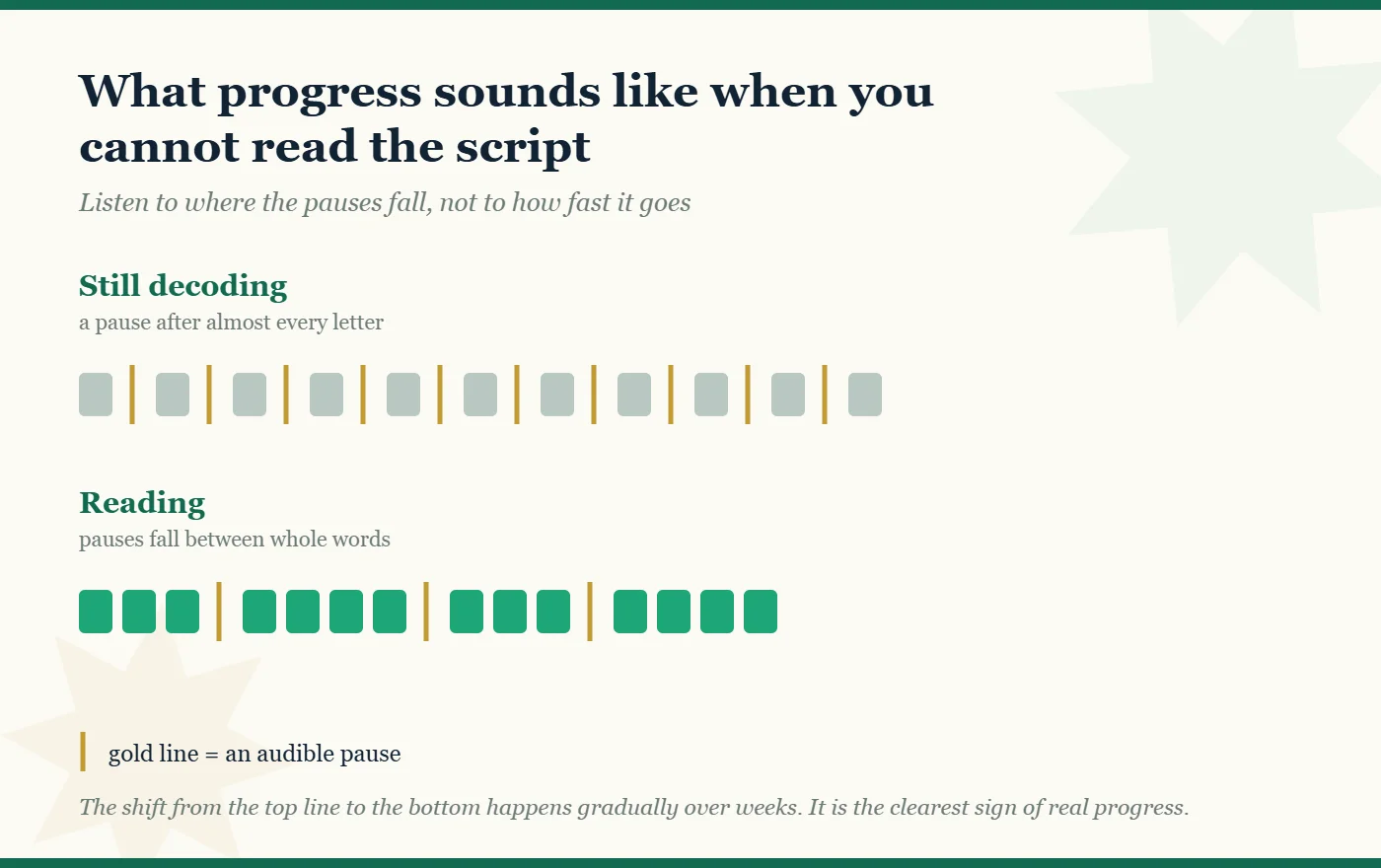
1. Where the pauses fall. Listen for whether your child hesitates inside words or between them. Pausing between letters means each character is still being worked out one at a time. Pausing between whole words means the letters have gone automatic and the word has become the unit they are handling. That shift is the clearest single sign of real progress, it happens gradually across weeks, and you can hear it without understanding a syllable.
2. Whether they correct themselves. Early on, the teacher catches every error. Somewhere in the second or third month a child who is genuinely learning will stop mid-word, go back, and fix something before anyone says anything. That first unprompted self-correction is a bigger milestone than finishing a surah. A child who only ever changes something after being told is being carried.
3. Whether yesterday’s line survives until today. Ask your child to read a line the teacher covered a day or two ago, cold, with no warm-up. Re-reading a page straight after the lesson proves almost nothing. Reading it the next morning proves it stuck.
4. Whether a repeated word sounds the same twice. Follow the shapes rather than the meaning. Most pages contain a word that appears more than once. If it comes out one way near the top and differently further down, the letters are not fixed yet. If it sounds identical both times, your child is reading it rather than guessing at it. This check needs no Arabic whatsoever, only attention.
5. Who is doing most of the talking. In a recitation lesson the student’s voice should occupy most of the time. If you listen in and hear mainly the teacher, with the child echoing in short bursts, that is a listening exercise. It has a place, but a child who only echoes will not be able to open the mushaf alone.
Individual letter sounds are the one thing on that list you can get properly specific about. If you want to go deeper, the Arabic letters children most often say wrong walks through five places in Al-Fatiha where a substituted letter is audible, and what each one should sound like.
A five-minute check any parent can run once a month
Run the same procedure every month and compare the evidence, because your memory of how your child sounded in March is not reliable. The same monthly habit is worth applying to the daily duas a child should be saying without a prompt, where the whole test is whether they arrive on their own.
- Choose one short passage learned at least three weeks ago, never the current lesson.
- Ask for it cold. No warm-up, no prompting, no teacher present.
- Record it on your phone and date the file.
- Write down two things only: roughly how long it took, and how many times they stopped.
- Next month, record the same passage and play both back to back.
The sheet below carries the same five steps plus a blank table for the log. Print it and keep it with the mushaf, or leave it open on a phone.
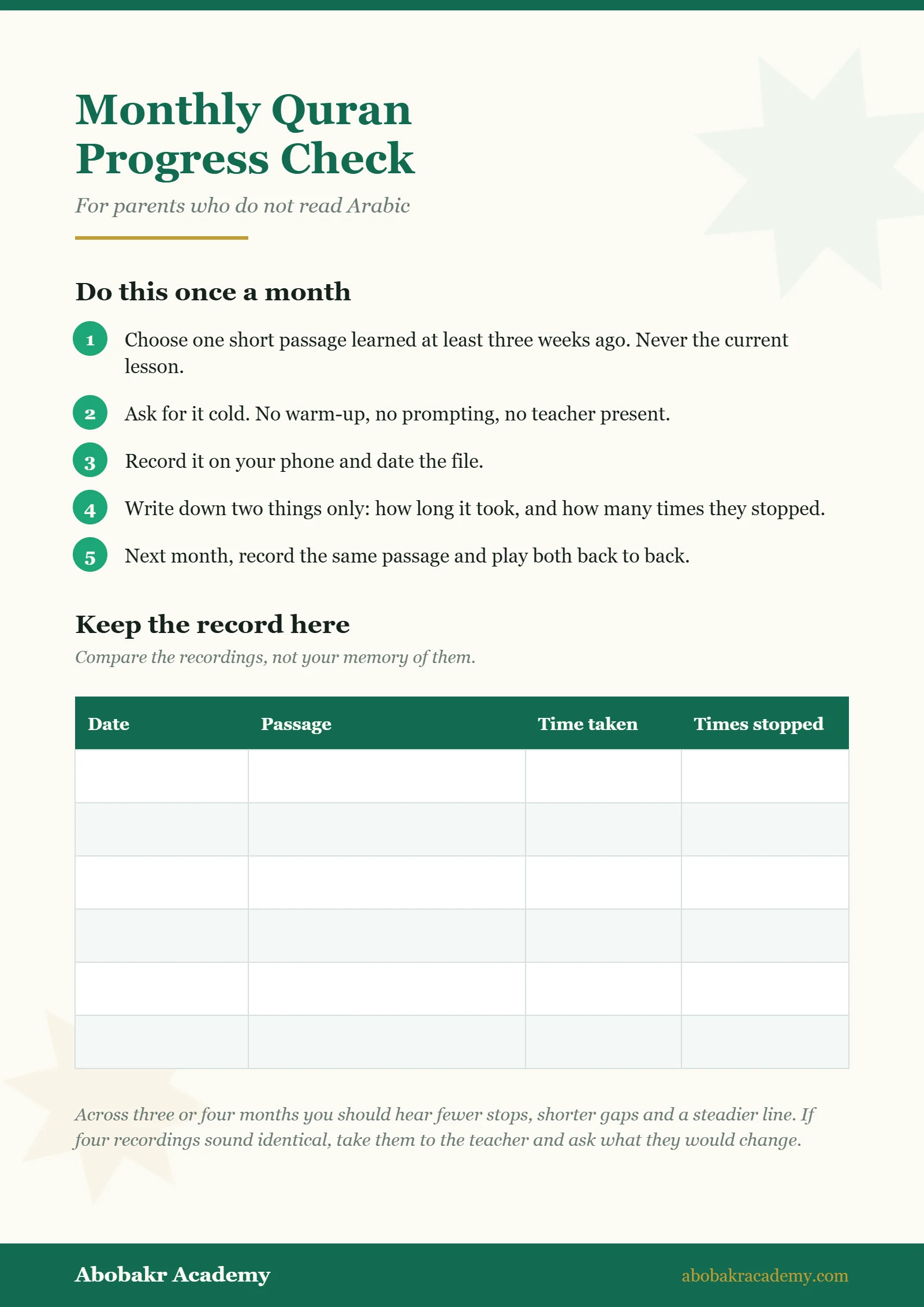
Download this sheet (PDF) One page, free, no sign-up. More printables on our free printables page.
Month to month you will hear very little. Across three or four months the difference is obvious even to an ear with no Arabic at all: fewer stops, shorter gaps, a steadier line. If four months of recordings sound the same, you now have something concrete to put to the teacher, which is a far stronger position than a vague sense that things are slow.
Recording your own child at the kitchen table is a different matter from recording a class. Our lessons are live and are not recorded, so the monthly file is yours to keep and compare.
Questions that get a real answer out of a Quran teacher
“How is he doing?” produces a warm and useless answer from almost any teacher, in any subject, anywhere. Ask these instead:
- Which mistake did she make most often this month?
- If she stopped lessons today, which pages could she still read unaided?
- What exactly should we practise at home this week, and for how long?
- What comes next, and why that rather than something else?
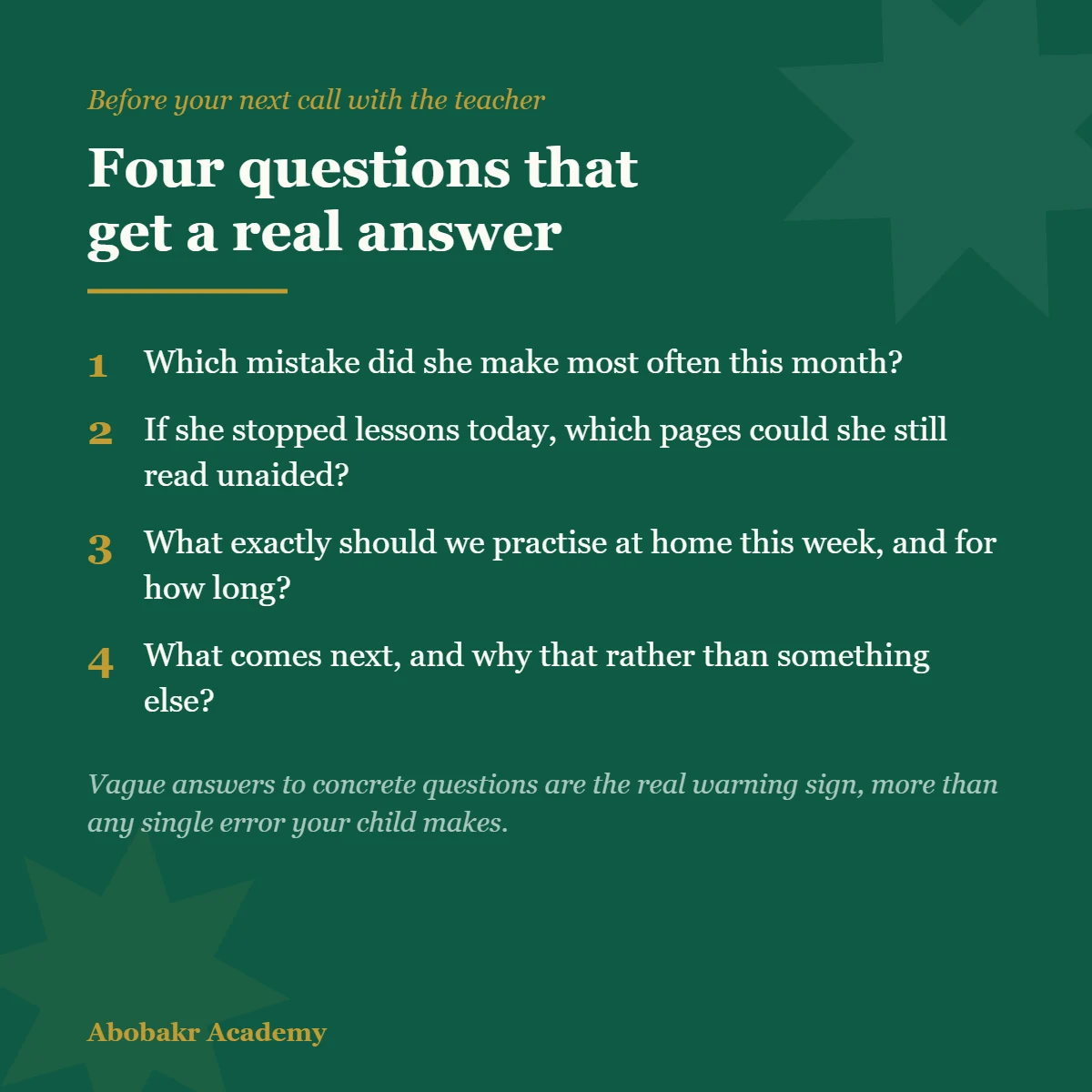
A teacher who is paying attention answers all four in specifics, usually inside a minute. Vague answers to concrete questions are the real warning sign, more than any individual error your child makes.
There is a fifth question worth adding once the recitation is steady, and it is the one almost nobody asks: does your child have any idea what the words mean? That is a separate skill from reading, it is nobody’s specific job in most timetables, and there is a ten minute a week way to start it that needs no Arabic from you at all.
What a normal plateau looks like
There is a stretch, after the alphabet is secure and before reading turns fluid, where a child appears to stop improving. Recitation gets slower rather than faster and errors go up. This is usually the point at which short vowel marks enter the picture and every character now demands two pieces of information instead of one. To a parent watching, it reads as going backwards. It is not, and withdrawing a child during it is the most common avoidable mistake we see. The same confusion happens on the memorization side, where a child who looks like they have stopped is usually carrying a review load nobody rebalanced, which is the point where hifz timelines quietly double.
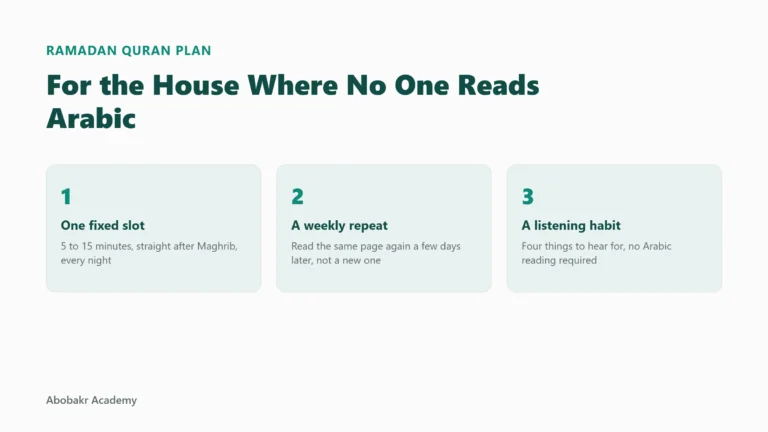
The recordings are how you separate a plateau from a stall. A plateau still shows movement across three months. A stall shows none. Protecting a short daily slot matters more here than adding lesson time, which is worth planning around the school year rather than leaving to chance; we wrote about building a Quran routine when school starts again for exactly that reason. For the slot itself, our Quran reading plan prints as a tracker with a box for the initials of whoever listened.
Signs something is genuinely wrong
- Months in, your child can still only read material already covered in class.
- The teacher cannot name a specific weakness when asked directly.
- New pages arrive every week and old pages are never revisited.
- Most of the lesson is the teacher’s voice.
- Your child cannot tell you what they are currently working on.
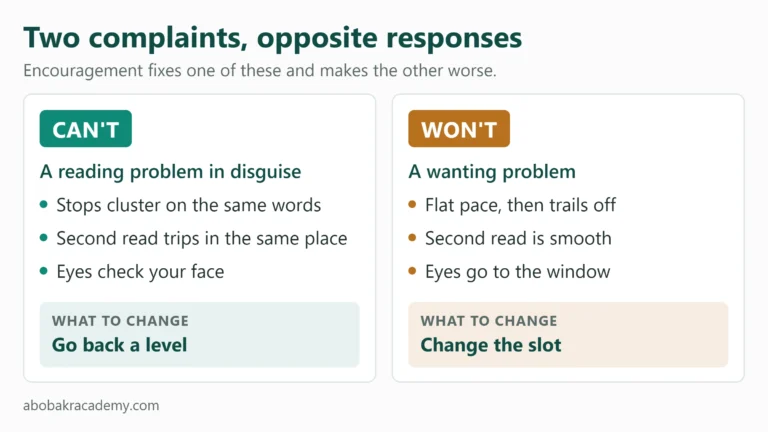
Any one of these is worth a conversation. Two or three together usually means the lesson has settled into a routine that is comfortable for everybody and moving nobody forward. If he has also begun resisting the lesson itself, that is a related but separate problem, and it is worth establishing whether he is unwilling or unable before you change anything.
How we handle this at Abobakr Academy
Every new student begins with a trial class, and what we send afterwards is an honest assessment of where that student actually is, not a sales note. That is deliberate. A parent who cannot read the script needs the starting point described in plain English, or the first three months are impossible to measure.
Lessons run from 30 minutes up to 120, and for most children 30 to 60 is the right length. Parents are welcome to sit in and listen; no tutor here objects, and a tutor who did would be telling you something useful. If a lesson has to move we ask for two hours’ notice, and a weekly subscription includes one cancellation a month. Where a tutor becomes unavailable for something outside their control, we arrange a replacement or a compensatory session rather than charging twice.
If you would rather see the teaching before paying for anything, our free Islamic classes page sets out what is available at no charge and what happens once the trial is over. Our free trial page describes what a first lesson actually consists of, and what the tutor will tell you afterwards.
How soon progress shows, and whether to sit in
How long before I should see real progress in my child’s Quran reading?
Expect the first clear shift in roughly two to three months of consistent weekly lessons, and expect it to show up as steadier pausing and the first self-corrections rather than as speed. Children who attend irregularly can take considerably longer, because reading skill fades between sessions faster than most parents anticipate.
Should I sit in on my child’s Quran lessons?
Sitting in occasionally is worth far more than sitting in constantly. Once a month is enough to hear the talk ratio and the pause pattern, and it avoids the child performing for you instead of working. Younger children in particular read differently when a parent is watching every week.
My child reads quickly but the teacher keeps correcting him. Is that a bad sign?
Usually it is the opposite. Frequent correction on unfamiliar text means the teacher is listening closely and the child is being pushed past what he already knows. Silence from a teacher throughout a whole lesson is the thing worth asking about.
How can I check Tajweed if I do not know the rules myself?
You cannot judge accuracy, but you can judge whether it is being taught at all. Ask which rule your child worked on this month and have them explain it to you in English; a child who has genuinely been taught a rule can usually name it and demonstrate it. Reading through the main Tajweed rules once yourself makes those conversations much easier to follow.
What should I do if my child has genuinely stopped improving?
Bring the recordings to the teacher and ask what they would change, before changing anything yourself. Most stalls come from pace rather than teaching, and are fixed by revisiting older pages instead of adding new ones. If nothing changes after a month of that, the pairing is probably wrong and a different tutor is a smaller step than a different academy.