
Free Printable Dua Cards for Kids
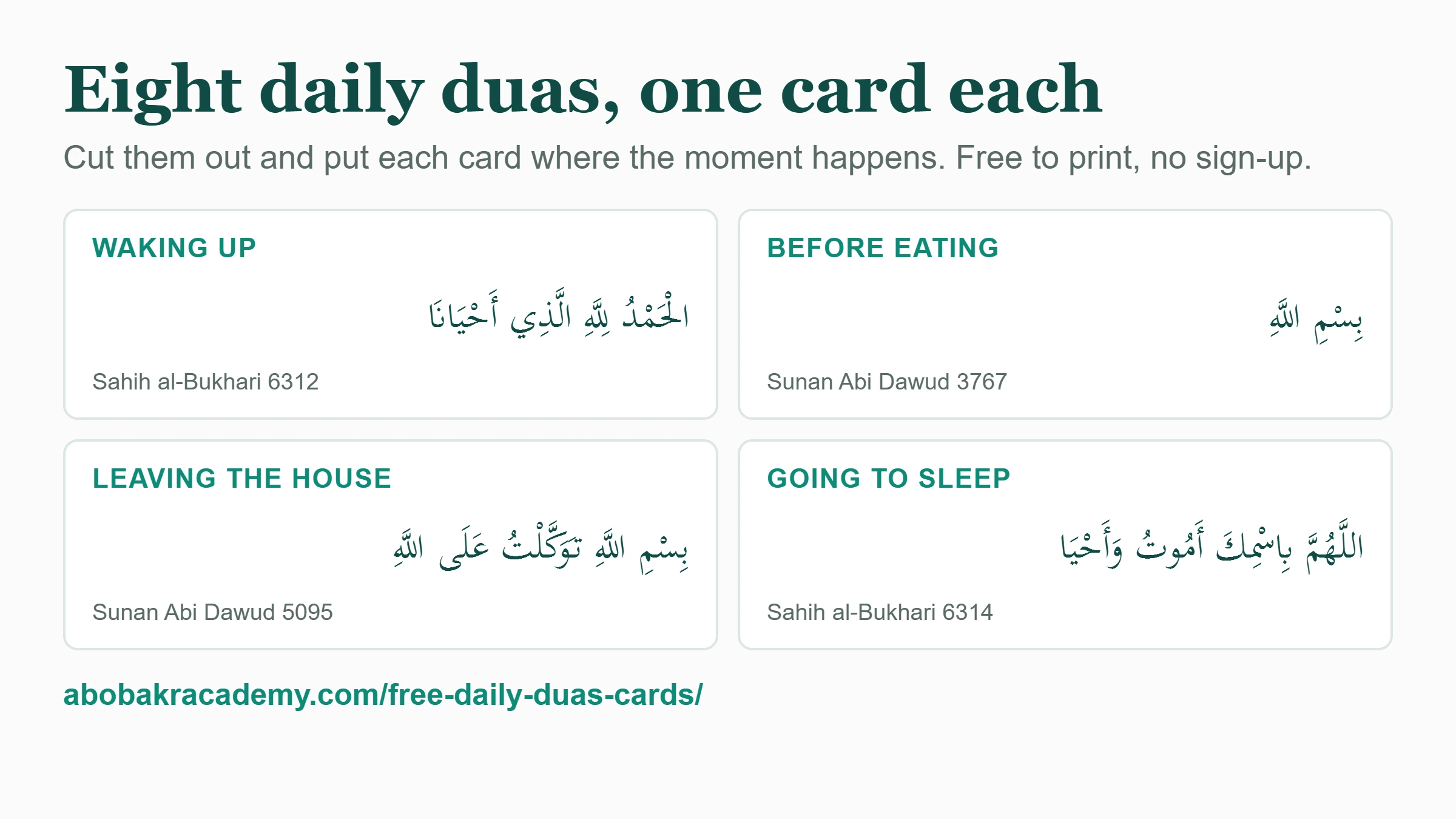
Eight cards, one A4 sheet. Cut along the dashed lines and put each card where the moment actually happens: the two food ones where you eat, the bathroom pair on the bathroom door, the sleeping one by the bed. A card a child walks past eight times a day will outperform an app somebody has to remember to open.
Every card carries the Arabic, a transliteration you can read out loud, the plain English meaning, and the exact source it comes from, so you can check any of them in about a minute without knowing a word of Arabic. Free to print, free to copy, free to hand out. No sign-up and no email address.
Download the print-friendly sheet (PDF)Black and white, one A4 page, 78 KB. For a weekend school running thirty copies.
Or print this page directly. Your browser’s print command will give you the same eight cards on one sheet with the rest of the page stripped out. No download needed.
The eight cards
Why every card has a reference on it
A dua sheet is only as good as its wording, and a parent who cannot read Arabic has no way to judge wording. So the reference is doing the work instead: it is the one thing on the card you can verify yourself. Click it, read the hadith, see the same words. Every one of these eight was opened on sunnah.com or quran.com before it went on the sheet, with the collection, the number and the grading where the source gives one.
That is a standard worth holding any printable to, including ours. If a sheet does not tell you where its duas came from, you cannot check it, and neither can anyone you hand it to.
How to use them without turning it into homework
Do not put all eight up at once. Take one, attach it to a moment that already happens, and leave it there until it arrives without anyone prompting. Bismillah before food is the easiest starting point, because the whole table can say it together and that does most of the teaching for you.
The order we suggest, roughly one a week, and what to listen for when you cannot check the Arabic, is in the article this sheet came from: the eight daily duas and when to say them.
Print it, copy it, host it yourself
There is no email form on this page and there never will be. If you run a weekend school, a homeschool co-op or a study circle, print as many as you need. You are also welcome to host either PDF on your own site rather than linking to ours, as long as the footer stays on the sheet, so anyone who picks it up secondhand can still find where the duas came from.
Our other free sheets, all on the same terms, are on the free printables page, and the rest of what we teach around daily practice sits under our Islamic Studies classes.
Questions
Is this really free, with no sign-up?
Yes. No email address, no account, no download gate. Print the page and you have it.
What age are these cards for?
Any child who can repeat a short phrase, which for most is around three. The shortest card is one word. Older children and adults who never learned them use the same eight.
Can my child say the meaning in English instead?
The Arabic is what is being taught, and it is short enough that young children manage it. Saying the English as well is a good idea, and for a while the English is what makes it a real sentence rather than a noise. Both, in that order.
Why only eight?
Because eight is roughly the number of moments a child already has in a normal day without anyone arranging them. A list of thirty becomes a project instead of a habit, and habits are the whole point of putting a card on a door. When the eight are steady and you want the next thing, the short surahs a child needs for prayer are where most families go.
Can I share this sheet with my school or study circle?
Please do. Print it, copy it, email it, or host the file on your own site. The only thing we ask is that the footer with the source page stays on it.
If you would like someone to check the sounds
The one thing paper cannot do is tell you whether your child is saying the words correctly, and two of these have sounds that do not exist in English. A teacher can hear in a single sitting what a parent cannot hear at all. That is what our free trial lesson is for, and if the answer afterwards is that your child does not need lessons yet, we will say so. Get in touch and tell us which cards are up on the wall.