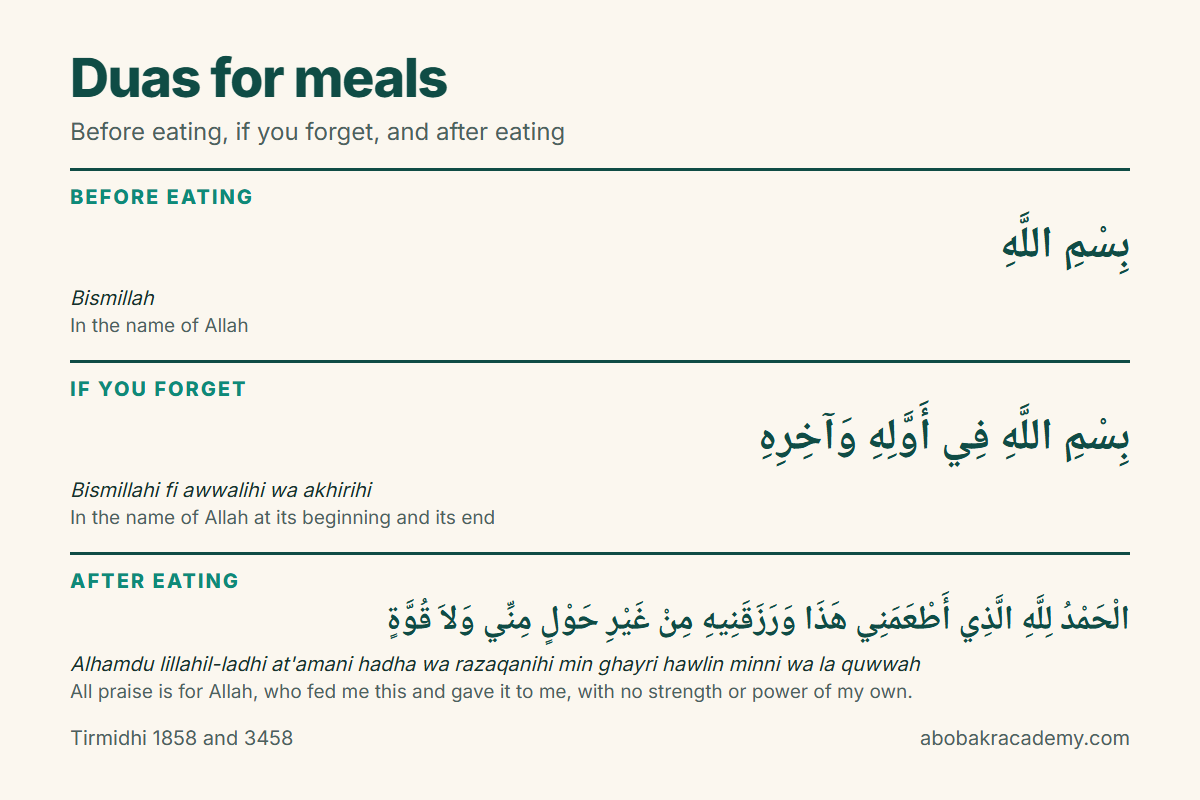
The dua after eating is alhamdu lillahil-ladhi at’amani hadha wa razaqanihi min ghayri hawlin minni wa la quwwah: “All praise is for Allah, who fed me this and gave it to me, with no strength or power of my own.” The Prophet ﷺ said that whoever eats and then says it has his past sins forgiven (Jami` at-Tirmidhi 3458, graded Hasan (Darussalam)).
Below you can hear it, copy it in Arabic and print it on a card for the table. There are two more after-meal duas from the Prophet ﷺ, the dua before eating and what to say if you forget it, the dua for the person who fed you, and the one for breaking a fast. Each comes with its source and its grade, because two duas that are shared everywhere have weak chains, and you should know which ones they are.
The dua after eating in Arabic
Alhamdu lillahil-ladhi at’amani hadha wa razaqanihi min ghayri hawlin minni wa la quwwah
All praise is for Allah, who fed me this and gave it to me, with no strength or power of my own.
Mu’adh bin Anas reported it from the Prophet ﷺ: whoever eats food and says this is forgiven what came before of his sins. Jami` at-Tirmidhi 3458, Hasan (Darussalam).
Tap the box to select the Arabic, then copy it.
الْحَمْدُ لِلَّهِ الَّذِي أَطْعَمَنِي هَذَا وَرَزَقَنِيهِ مِنْ غَيْرِ حَوْلٍ مِنِّي وَلاَ قُوَّةٍ
What each part means
| Say | Meaning |
|---|---|
| Alhamdu lillah | All praise is for Allah |
| alladhi at’amani hadha | who fed me this |
| wa razaqanihi | and gave it to me as provision |
| min ghayri hawlin minni | without any strength from me |
| wa la quwwah | and without any power |
The point of the words is the last line. You bought the food, cooked it and carried it to the table, and the dua still says none of it came from your own power. That is why it suits children so well: it turns “I’m full” into “thank you, Allah.”
Two more duas after eating
Both are from the Prophet ﷺ himself, both are authentic, and either can be said in place of the first or after it.
When the meal is cleared away
Alhamdu lillahi kathiran tayyiban mubarakan fih, ghayra makfiyyin wa la muwadda’in wa la mustaghnan ‘anhu, Rabbana
All praise is for Allah, much praise, good and blessed. We can never repay it, never leave it, and never do without it, our Lord.
Abu Umama reported that the Prophet ﷺ said this whenever his meal was taken away. Sahih al-Bukhari 5458.
After eating or drinking
Alhamdu lillahil-ladhi at’ama wa saqa wa sawwaghahu wa ja’ala lahu makhraja
All praise is for Allah, who gave food and drink, made it easy to swallow, and made a way out for it.
Abu Ayyub al-Ansari reported that the Prophet ﷺ said this when he had eaten or drunk. Sunan Abi Dawud 3851, Sahih (Al-Albani).
If all of this is too much for a small child, start with one word. The Prophet ﷺ said Allah is pleased with the servant who eats a meal and praises Him for it, or drinks and praises Him for it (Sahih Muslim 2734a). A three-year-old who says alhamdulillah after every meal is already doing the sunnah.
The dua before eating
Before eating, say bismillah (), “in the name of Allah.” When Umar bin Abi Salama was a boy, his hand used to wander all over the shared dish, and the Prophet ﷺ told him: say bismillah, eat with your right hand, and eat from what is nearest you (Sahih al-Bukhari 5376). He said he ate that way for the rest of his life. Those three lines are the whole of table manners for a child, and they come from a hadith about a child.
بِسْمِ اللَّهِ
If you forget to say bismillah
Say it as soon as you remember, in this form: بِسْمِ اللَّهِ فِي أَوَّلِهِ وَآخِرِهِ bismillahi fi awwalihi wa akhirihi, “in the name of Allah at its beginning and its end” (Jami` at-Tirmidhi 1858, Sahih (Darussalam)). There is more on bismillah, word by word, on our bismillah meaning page.
Dua for the host, or whoever made the food
Allahumma at’im man at’amani wa asqi man asqani
O Allah, feed the one who fed me, and give drink to the one who gave me drink.
Al-Miqdad reported that the Prophet ﷺ said this for whoever would bring him food and drink. Sahih Muslim 2055a.
At home this is the dua a child can say for the parent who cooked. It is also the polite thing to say at a friend’s house or an iftar you were invited to.
What to say after eating iftar
Breaking a fast has its own dua, said when you break it, not at the end of the meal:
Dhahabaz-zama’u wabtallatil-‘uruqu wa thabatal-ajru in sha Allah
The thirst has gone, the veins are wet again, and the reward is sure, if Allah wills.
Ibn Umar reported that the Prophet ﷺ said this when he broke his fast. Sunan Abi Dawud 2357, Hasan (Al-Albani).
When the iftar meal is over, say the dua after eating as you would after any meal.
Two duas you will see shared that have weak chains
These two are on many websites, posters and apps, and one of them leads Google’s own summary of this question. The words are good words of praise, and nobody is wrong to thank Allah with them. But the hadith they come from are graded weak, so they should not be taught to a child as something the Prophet ﷺ is known to have said. The three above are the ones to learn first.
Alhamdu lillahil-ladhi at’amana wa saqana wa ja’alana muslimin
All praise is for Allah, who gave us food and drink and made us Muslims.
Sunan Abi Dawud 3850, graded Da’if (Al-Albani). You will often see it written ending in “minal muslimin”; the narration itself ends in “muslimin”.
Allahumma barik lana fihi wa at’imna khayran minh
O Allah, bless it for us and feed us with better than it.
Jami` at-Tirmidhi 3455, graded Da’if (Darussalam) there. Some collections of daily duas list it as sound on other scholars’ grading, so you may meet both views.
A dua card for the table
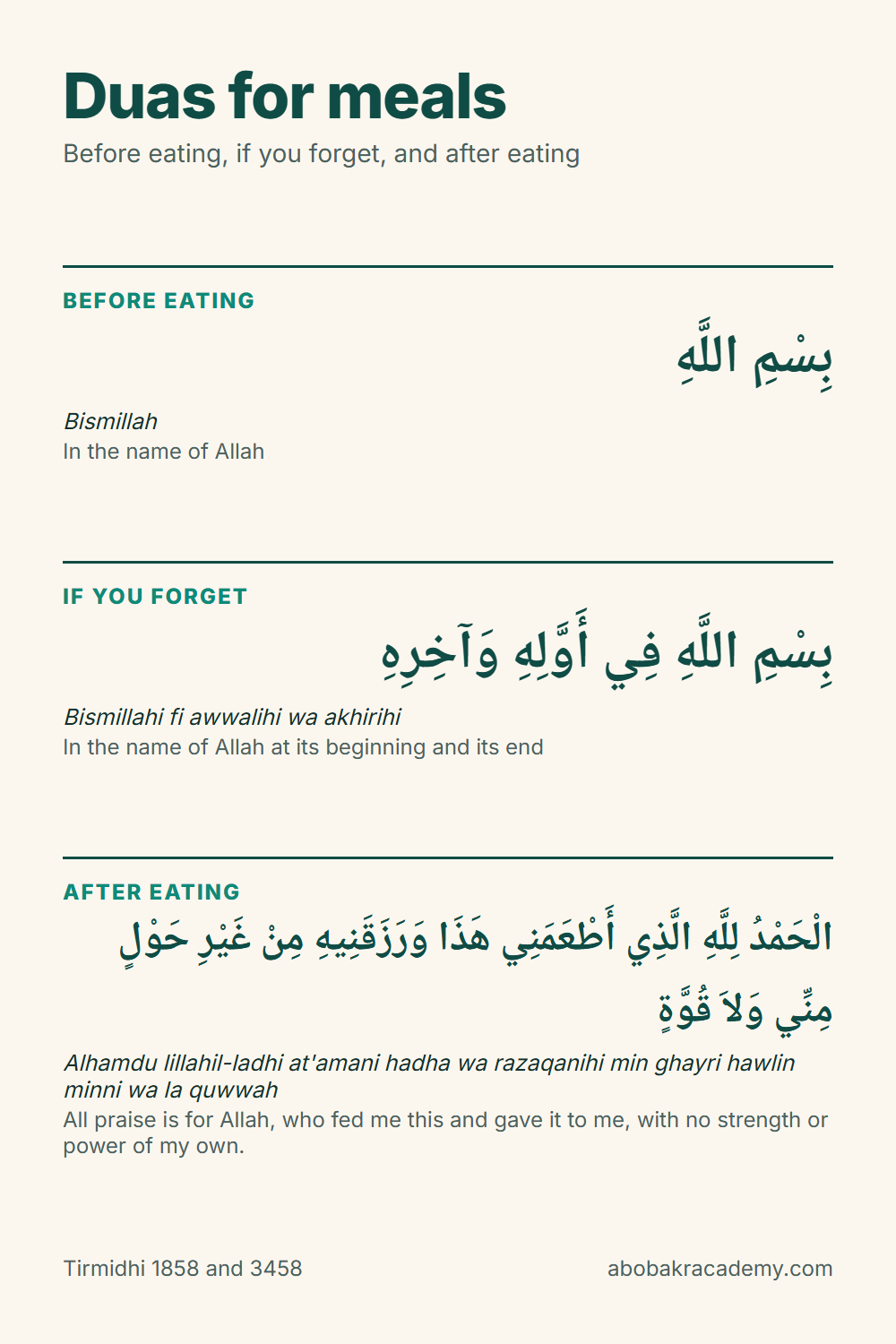
Download all seven duas as a one-page PDF to print for the kitchen or the dining table: before eating, if you forget, the three after eating, for the host, and at iftar, each with its source.
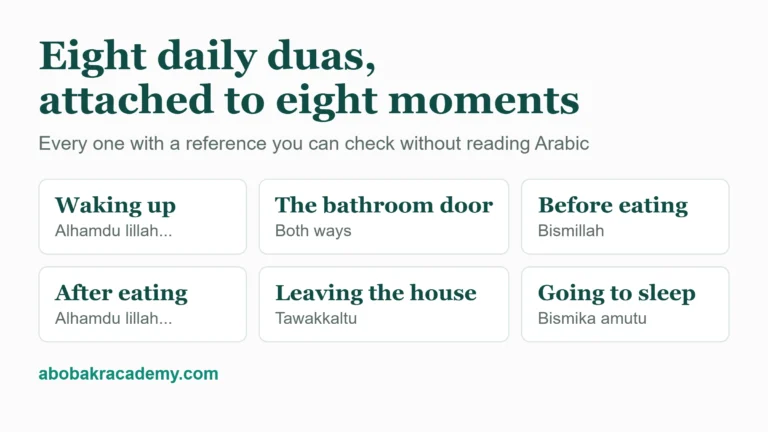
Children learn these by hearing them every day, long before they can read them. Say the dua aloud at the end of each meal and let your child finish the last word, then the last two, until the whole line is theirs. A week of meals is usually enough for the bismillah forms, and two or three weeks for the dua after eating. For the other duas of the day (waking, sleeping, the bathroom, leaving home), see our daily duas for kids, and for the short phrases Muslims say all day, the Islamic phrases page.
Questions about the dua after eating
What is the dua to say after finishing a meal?
Alhamdu lillahil-ladhi at’amani hadha wa razaqanihi min ghayri hawlin minni wa la quwwah: “All praise is for Allah, who fed me this and gave it to me, with no strength or power of my own.” It is in Jami’ at-Tirmidhi (3458), graded hasan.
What is the dua after eating in Arabic?
الْحَمْدُ لِلَّهِ الَّذِي أَطْعَمَنِي هَذَا وَرَزَقَنِيهِ مِنْ غَيْرِ حَوْلٍ مِنِّي وَلاَ قُوَّةٍ. You can copy it from the box near the top of this page.
What do Muslims say after finishing eating?
At the very least, alhamdulillah, “praise be to Allah.” Many say one of the three duas above, which the Prophet ﷺ said after his own meals.
What is the dua to say when eating?
Bismillah before the first bite. If you forget at the start, say bismillahi fi awwalihi wa akhirihi when you remember, even halfway through.
Is there a dua after drinking water?
Yes. Alhamdulillah after drinking is enough (Sahih Muslim 2734), and the dua of Abu Ayyub above, “who gave food and drink,” covers both.
What if I forget the dua after eating?
Say alhamdulillah when you remember. The dua is a sunnah and an act of thanks, not a condition for the meal.
Nobody at home reads Arabic? Your child can still learn every one of these.
Our tutors teach children one to one and online, by ear first, then from the letters up to reading the Quran. Duas like these are part of every lesson plan. See Quran classes for kids, or message us and the first lesson is free.