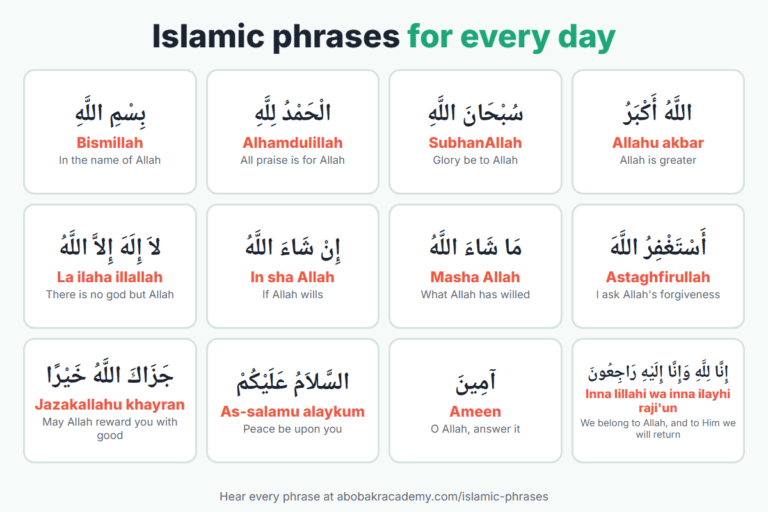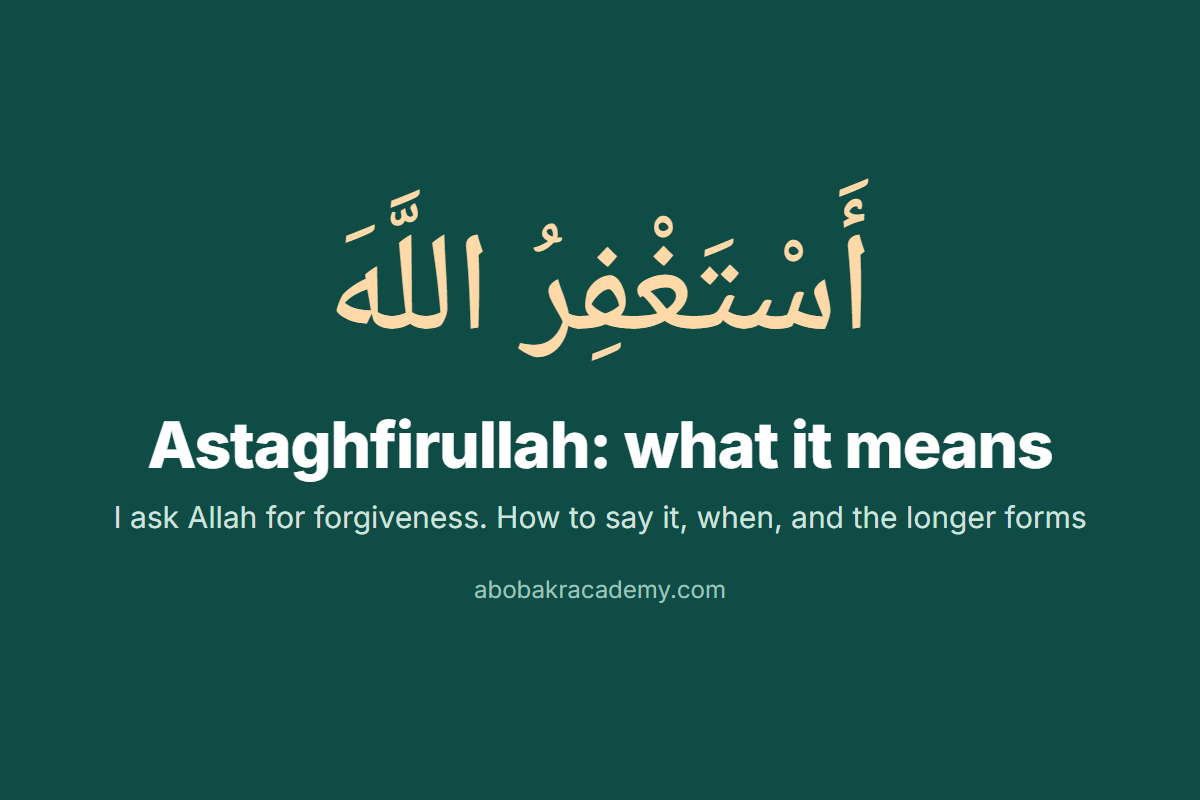
Astaghfirullah (أَسْتَغْفِرُ اللَّهَ) means “I ask Allah for forgiveness.” Muslims say it after a mistake, three times after every prayer, and many times through the day, because the Prophet did. It is also what people say when they hear something shocking, much as someone else might say “oh no.” Nobody has to have sinned to say it: it is a way of turning back to Allah, and it is never too small or too late.
On this page you can hear it said, copy it in Arabic, learn to pronounce the one tricky sound, read the verses and hadith behind it, and see the longer forms. There is also a section on teaching it to a child, which works even if nobody at home reads Arabic.
Astaghfirullah in Arabic: copy and paste
Tap or click a box to select it, then copy.
With vowel marks, the way a child learns to read it:
أَسْتَغْفِرُ اللَّهَ
Without vowel marks, the way you would type it in a message:
أستغفر الله
In English letters you will see astaghfirullah, astagfirullah, astaghfirallah and astaghfiru Allah. Any of them is fine in a message. Only the Arabic has one correct spelling, the one above.
What each word means
Astaghfirullah is two Arabic words said as one.
| Arabic | Say it | Meaning |
|---|---|---|
| أَسْتَغْفِرُ | astaghfiru | I ask forgiveness |
| اللَّهَ | Allāh | (of) Allah |
The first word comes from the root gh-f-r, whose basic sense is to cover. Asking for maghfirah, forgiveness, is asking Allah to cover a wrong: to pardon it and protect you from what it would bring. One of His names, al-Ghaffar, comes from the same root and means the One who forgives again and again.
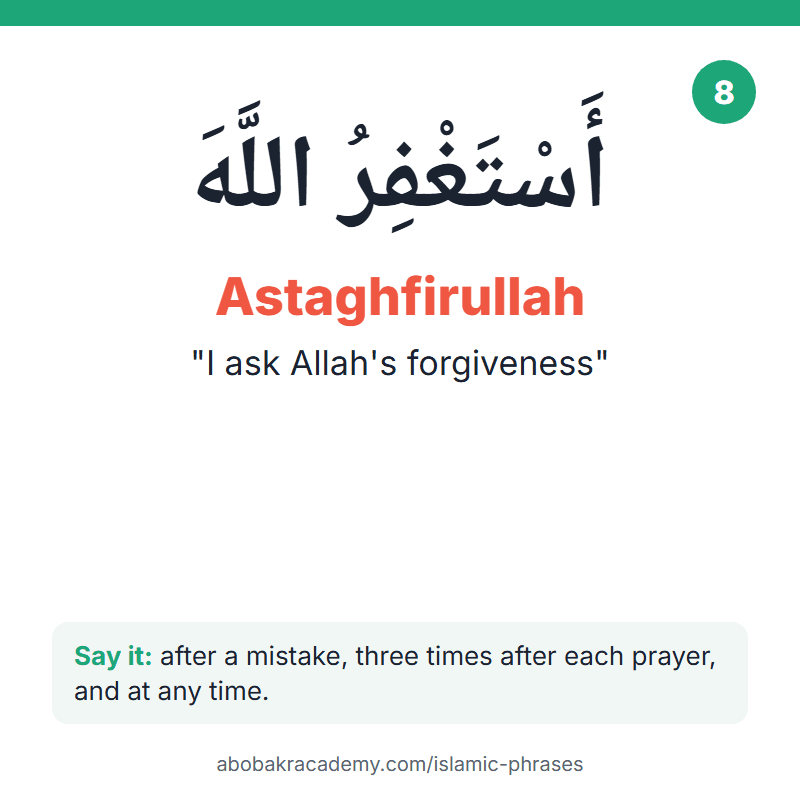
How to pronounce astaghfirullah
Say it in five beats: as-tagh-fi-rul-lah. Press play on the phrase at the top of the page to hear it at an easy pace, then try it alongside.
| Part | How to say it | Common slip |
|---|---|---|
| gh | A soft gargle at the back of the throat, like the French r in “Paris” | A hard g, as in “go” (astagfirullah) |
| fi | A short “fi”, as in “fit” | Stretching it to “fee” |
| rul | A short u joins the two words: astaghfiru + Allah | “astaghfir-allah”, which drops the u |
| lah | A long “laah”, with the l doubled and full | Rushing it into “la” |
If the gh sound is hard, don’t let it stop you. A child who says astagfirullah with a g is still asking Allah for forgiveness, and the sound comes with practice. Practise it on its own first, then with a vowel (gha), then in the whole word.
When Muslims say astaghfirullah
| When | What it looks like | Where it comes from |
|---|---|---|
| After every prayer | Three times, straight after the salam | Sahih Muslim 591 |
| After a mistake | As soon as you realise it, big or small | Al Imran 3:135, An-Nisa 4:110 |
| Through the day | Whenever you remember, a hundred times or more | Bukhari 6307, Muslim 2702a |
| When something is wrong | “He said what? Astaghfirullah.” | Everyday use |
The first three are worship. The last is a habit of speech. It shows you disapprove, and it reminds you to keep clear of the thing yourself. When something is wonderful rather than shocking, Muslims say subhanallah.
Astaghfirullah in the Quran
The Quran returns to asking forgiveness again and again. These are a few of the best-known verses. Press play to hear each one recited by Sheikh Mahmoud Khalil al-Husary.
The Prophet Nuh told his people what istighfar brings, in this life as well as the next:
71:10 “And said, ‘Ask forgiveness of your Lord. Indeed, He is ever a Perpetual Forgiver.”
71:11 “He will send [rain from] the sky upon you in [continuing] showers”
71:12 “And give you increase in wealth and children and provide for you gardens and provide for you rivers.”
And this is what to do after a wrong, whoever you are:
4:110 “And whoever does a wrong or wrongs himself but then seeks forgiveness of Allāh will find Allāh Forgiving and Merciful.”
And Al Imran 3:135 describes the believers promised Paradise in the verses around it:
3:135 “And those who, when they commit an immorality or wrong themselves [by transgression], remember Allāh and seek forgiveness for their sins – and who can forgive sins except Allāh? – and [who] do not persist in what they have done while they know.”
Translations: Sahih International, from Quran.com.
How many times did the Prophet say astaghfirullah?
More than seventy times a day, by his own account. Abu Huraira heard him say: “By Allah! I ask for forgiveness from Allah and turn to Him in repentance more than seventy times a day” (Sahih al-Bukhari 6307). In another narration he said a hundred times a day (Sahih Muslim 2702a).
Many parents find this the most useful part to pass on. The person closest to Allah asked His forgiveness more often than anyone, so a child who says it is doing what the best of people did.
Longer forms of istighfar
Astaghfirullah is the shortest form. These longer ones come from the hadith and are good to learn one at a time.
Astaghfirullaha wa atubu ilayh
“I seek Allah’s forgiveness and turn to Him in repentance.” These are the words in the Prophet’s own account of his daily istighfar (Bukhari 6307).
Astaghfirullah al-Azim
“I ask forgiveness of Allah the Magnificent, other than whom there is no god, the Living, the Sustainer of all, and I turn to Him in repentance.” The Prophet said whoever says it is forgiven, even if he had fled from battle (Jami at-Tirmidhi 3577, graded hasan by Darussalam). When people say “astaghfirullah al-azim” on its own, they are saying the opening of this.
Sayyid al-istighfar, the best way to ask forgiveness
“O Allah, You are my Lord. There is no god but You. You created me and I am Your servant, and I keep Your covenant and promise as best I can. I seek refuge in You from the evil of what I have done. I acknowledge Your favour on me and I acknowledge my sin, so forgive me, for no one forgives sins but You.” The Prophet called it the best way of asking forgiveness and said that whoever says it with certainty in the day and dies before evening is of the people of Paradise, and the same at night (Sahih al-Bukhari 6306). Many families say it in the morning and evening adhkar.
Astaghfirullah, tawbah or subhanallah?
| Word | Meaning | Use it for |
|---|---|---|
| Astaghfirullah | I ask Allah for forgiveness | After a mistake, after prayer, any time; when you hear of a wrong |
| Tawbah | Repentance, turning back | Not a phrase to say but what you do: regret the wrong, stop it, mean not to return, and put right what you can |
| Subhanallah | Glory be to Allah | Something beautiful or astonishing, and in dhikr after prayer |
Astaghfirullah said with the tongue is good on its own. Joined to tawbah, a real change of heart, it is complete. That is why the longer forms add “and I turn to Him.”
Can you say astaghfirullah to someone?
Not really, because the words are about you: “I ask forgiveness.” If a friend says something wrong and you say astaghfirullah, you are showing that it is wrong and asking forgiveness yourself, which is fine, but it is not a way of telling them off. To help them, gently suggest they ask Allah’s forgiveness, or ask Allah to forgive them yourself. Muslims have always made that dua for one another. Using astaghfirullah as a reprimand with children tends to backfire: they come to hear it as a scolding word rather than a comfort.
What is the worst sin in Islam?
Shirk, setting up a partner or rival to Allah. When the Prophet was asked which sin is greatest, he answered: “That you set up a rival unto Allah though He Alone created you” (Sahih al-Bukhari 4477). The Quran says Allah does not forgive it for someone who dies upon it, and forgives anything less for whom He wills (An-Nisa 4:48). And it ends any despair about the rest:
39:53 “Say, "O My servants who have transgressed against themselves [by sinning], do not despair of the mercy of Allāh. Indeed, Allāh forgives all sins. Indeed, it is He who is the Forgiving, the Merciful."”
Whatever the sin, the door is open while a person is alive. Astaghfirullah is how you knock.
Teaching astaghfirullah to children
Children learn this phrase best by hearing a parent say it about their own mistakes. You don’t need to read Arabic to do any of this.
- Say it after your own slips, out loud. “I snapped at you. Astaghfirullah, I’m sorry.” A child who hears this learns that grown-ups make mistakes too, and what to do next.
- Add it after prayer. Three times together after the salam, before getting up. It takes ten seconds and becomes part of the prayer for them. Our salah steps for kids show where it fits.
- Explain it once, kindly. “When we do something wrong, we tell Allah we’re sorry and ask Him to forgive us. He loves it when we ask.”
- Keep it out of telling-off. If they hear “say astaghfirullah!” only when they are in trouble, it turns into a punishment. Let it be the way back, not the penalty.
- Try a bedtime minute. Think of one thing from the day you’d do differently, then say astaghfirullah together. It works for adults as well.
To keep it in sight, print our free Islamic phrases printable (PDF): astaghfirullah is on it with the Arabic, the meaning and when to say it, alongside the other everyday phrases. A copy on the fridge or by the prayer mat does a lot of the reminding for you.
For more phrases like this one, with audio, see what inshallah means and our daily duas for kids.
Questions about astaghfirullah
What exactly does astaghfirullah mean?
“I seek Allah’s forgiveness.” It is two Arabic words: astaghfiru (I ask forgiveness) and Allah. The root of the first word means to cover, so it asks Allah to cover a wrong and pardon it.
How do you say astaghfirullah correctly?
In five beats: as-tagh-fi-rul-lah. The gh is a soft sound at the back of the throat, like a French r, not a hard g. Keep the short u between the two words (astaghfiru-llah) and give the final “laah” its full length.
How many times should you say astaghfirullah?
There is no limit. The fixed point is three times after every obligatory prayer (Sahih Muslim 591). Beyond that, the Prophet’s own count was over seventy a day in one narration and a hundred in another, so many Muslims aim for a hundred.
What is astaghfirullah al-azim?
“I ask forgiveness of Allah the Magnificent.” It is the opening of a longer form the Prophet taught, which continues “other than whom there is no god, the Living, the Sustainer of all, and I turn to Him in repentance” (Jami at-Tirmidhi 3577).
Is it OK to say astaghfirullah when you are shocked?
Yes. It is common and fine, since it shows you disapprove and turns your mind to Allah. Try not to let it become filler, because the words are still a request for forgiveness.
What do you reply when someone says astaghfirullah?
Nothing is required, because it is said to Allah, not to you. If they said it after a mistake, a kind word or “may Allah forgive us all” is a good reply.
Want your child to read and understand phrases like this, not just say them?
Our tutors teach children from families where nobody at home reads Arabic, one to one and online, from the alphabet to reading the Quran. See Arabic lessons for kids or book a free trial lesson.