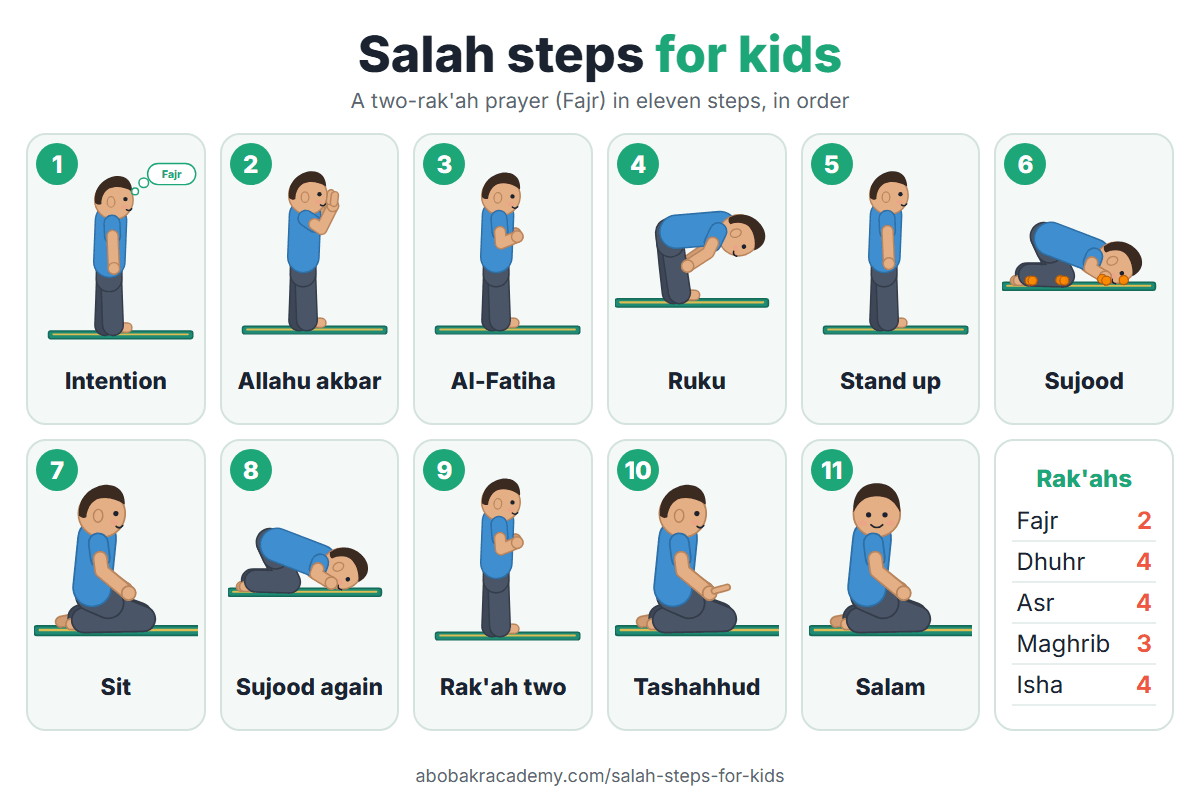
Salah is the prayer Muslims pray five times a day. Kids can learn it as eleven steps: face the qibla and intend, raise the hands and say Allahu akbar, recite al-Fatiha, bow, stand up, go down into sujood, sit, go down again, stand for the second rak’ah, sit for the tashahhud, and finish with the salam to the right and the left. That is a two-rak’ah prayer, like Fajr. The longer prayers repeat the same movements.
Below are the steps with a picture for each, the words said in every position with a button to hear them, al-Fatiha recited by Sheikh al-Husary, how many rak’ahs each prayer has, and a free printable chart and prayer tracker with no sign-up. Every phrase comes from the hadith that teaches it, and each hadith is linked.
Before you start
- Make wudu. Prayer starts clean. Our wudu steps for kids page has the ten steps and a printable.
- Wear clean clothes that cover the body. Boys cover from the navel to the knees at least; most children simply pray in long trousers and a top with sleeves. Girls usually wear a prayer scarf and a long dress or prayer garment.
- Find a clean place and face the qibla, the direction of the Kaaba in Makkah. Allah says فَوَلِّ وَجْهَكَ شَطْرَ الْمَسْجِدِ الْحَرَامِ, fa walli wajhaka shatral-masjidil-haram, “so turn your face toward al-Masjid al-Haram” (Surah Al-Baqarah 2:144). A compass app or the qibla setting on a phone will show the way.
- Know which prayer it is. The table further down has the five prayers and when each one is prayed.
How to pray salah: the 11 steps
Read these out while your child copies you on the mat. They take you through Fajr, the two-rak’ah dawn prayer, from the first Allahu akbar to the salam.
- Face the qibla and make your intention. After wudu, stand on a clean place facing the qibla, the direction of the Kaaba in Makkah. In your heart, decide which prayer you are about to pray. You do not have to say it out loud.
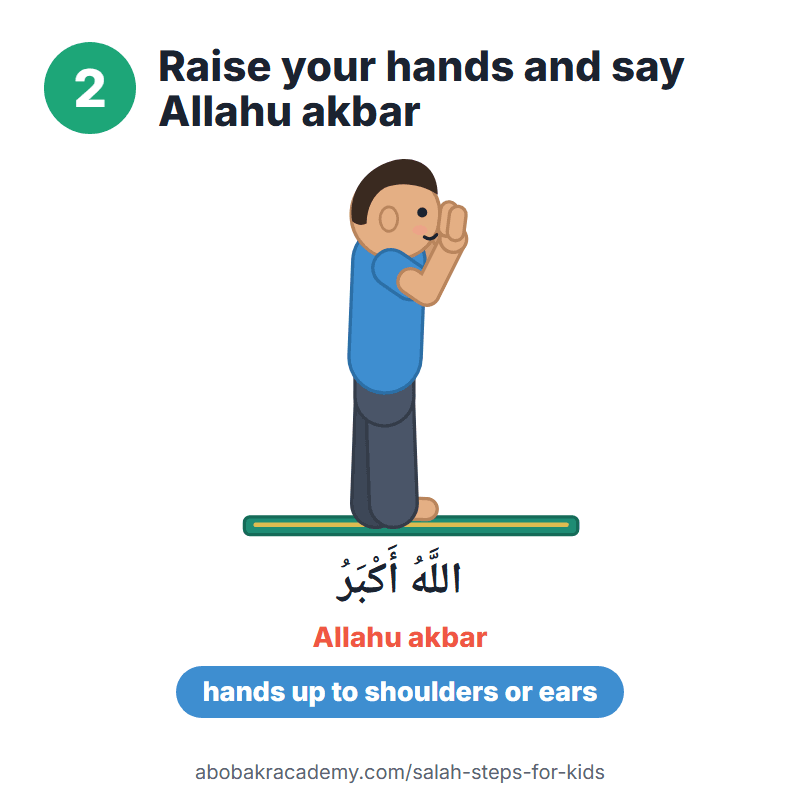
- Raise your hands and say Allahu akbar. Lift both hands, palms facing the qibla, up to your shoulders or your ears, and say Allahu akbar. This starts the prayer, and from here to the salam you say only the words of the prayer. In Arabic: اللَّهُ أَكْبَرُ (“Allah is the Greatest”).
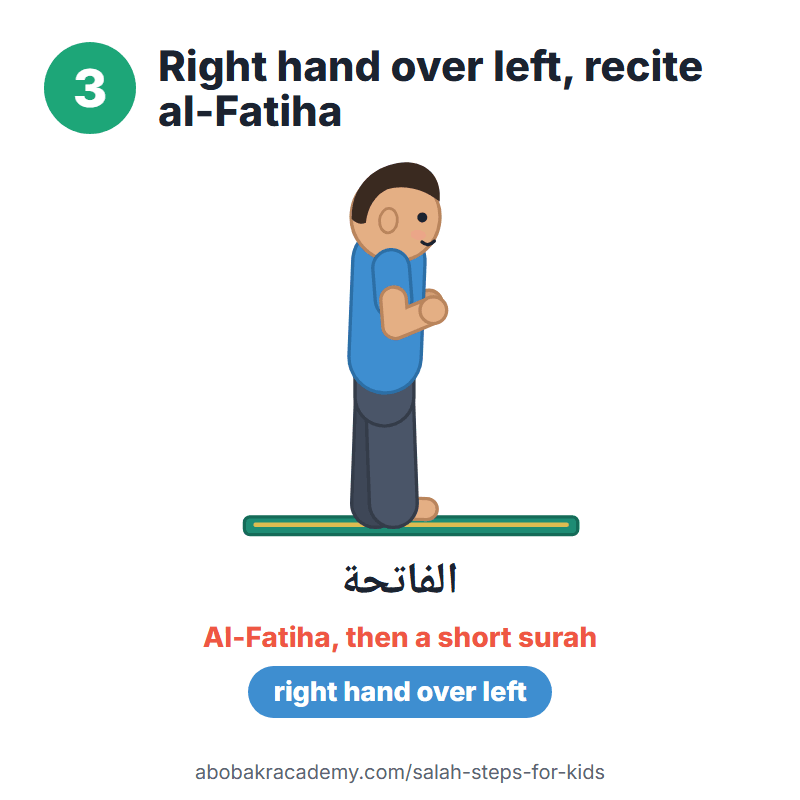
- Right hand over left, recite al-Fatiha. Put your right hand over your left forearm and recite Surah al-Fatiha. Then recite another short surah you know, such as al-Ikhlas.
- Bow and say Subhana rabbiyal-azim. Say Allahu akbar and bow, with your hands on your knees and your back flat. Stay still, and say Subhana rabbiyal-azim at least once. Children are usually taught to say it three times. In Arabic: سُبْحَانَ رَبِّيَ الْعَظِيمِ (“Glory be to my Lord, the Most Great”).
- Stand up straight again. Rise saying Sami’allahu liman hamidah, and once you are standing straight, say Rabbana wa lakal-hamd. In Arabic: سَمِعَ اللَّهُ لِمَنْ حَمِدَهُ (“Allah hears the one who praises Him”), then رَبَّنَا وَلَكَ الْحَمْدُ (“Our Lord, and all praise is Yours”).
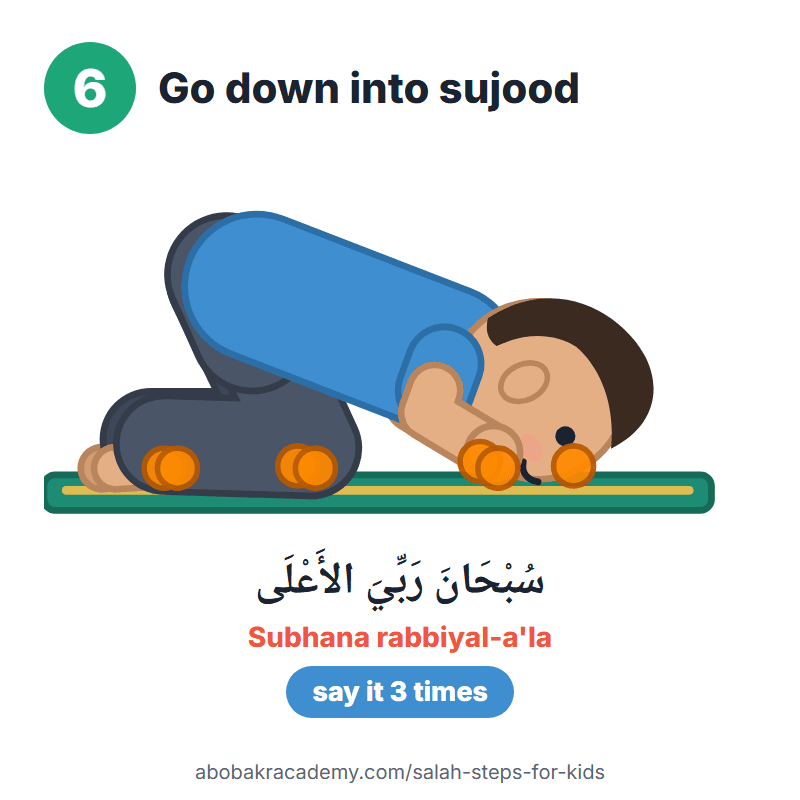
- Go down into sujood. Say Allahu akbar and go down. Seven parts touch the floor: your forehead with your nose, both hands, both knees and the toes of both feet. Keep your forearms up off the floor, point your toes toward the qibla, and say Subhana rabbiyal-a’la three times. In Arabic: سُبْحَانَ رَبِّيَ الأَعْلَى (“Glory be to my Lord, the Most High”).
- Sit up and say Rabbighfir li. Say Allahu akbar and sit up, resting on your left foot with your right foot upright. Sit still for a moment and say Rabbighfir li. In Arabic: رَبِّ اغْفِرْ لِي (“My Lord, forgive me”).
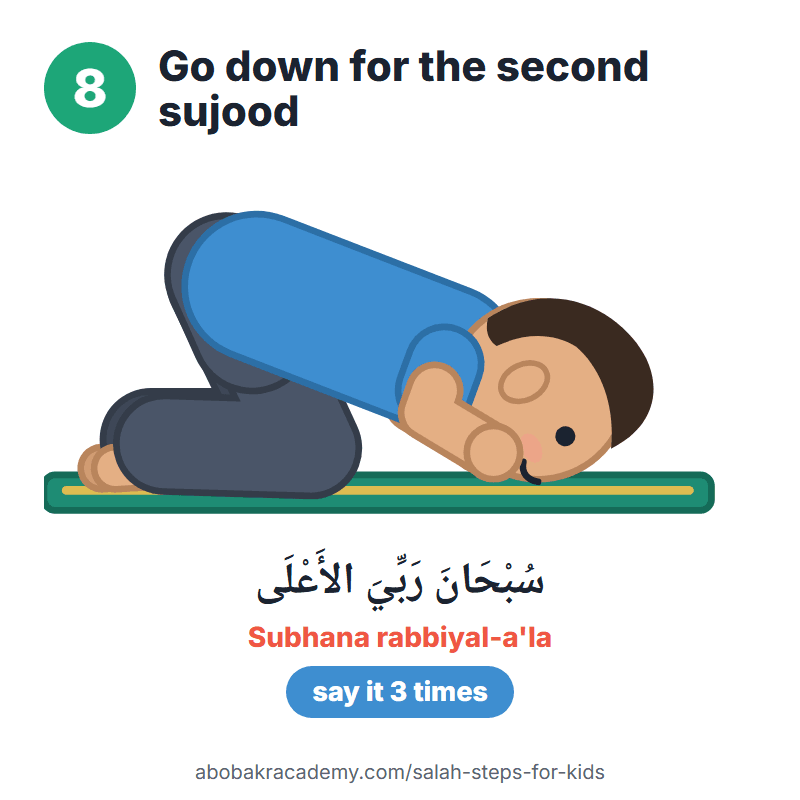
- Go down for the second sujood. Say Allahu akbar and go down again, exactly as before, and say Subhana rabbiyal-a’la three times. Every rak’ah has two sujood. In Arabic: سُبْحَانَ رَبِّيَ الأَعْلَى (“Glory be to my Lord, the Most High”).
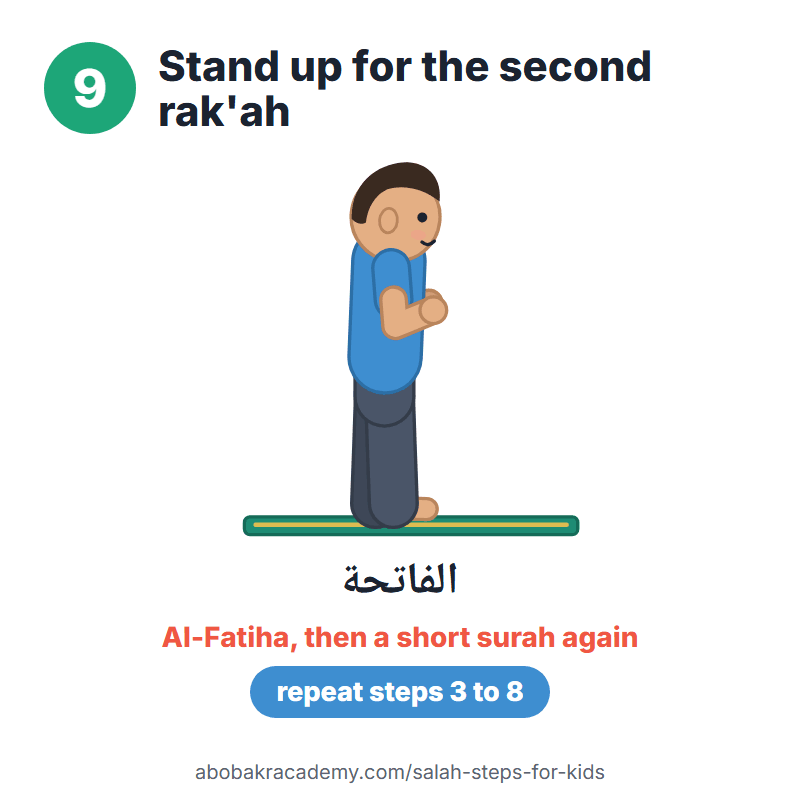
- Stand up for the second rak’ah. Say Allahu akbar and stand up. Recite al-Fatiha and a short surah again, then bow, rise and make two sujood, just like the first rak’ah.
- Sit and say the tashahhud. After the second sujood of the second rak’ah, sit again, rest your hands on your knees, raise your right index finger, and say the tashahhud. In the last sitting of a prayer, add the blessings on the Prophet, peace be upon him.
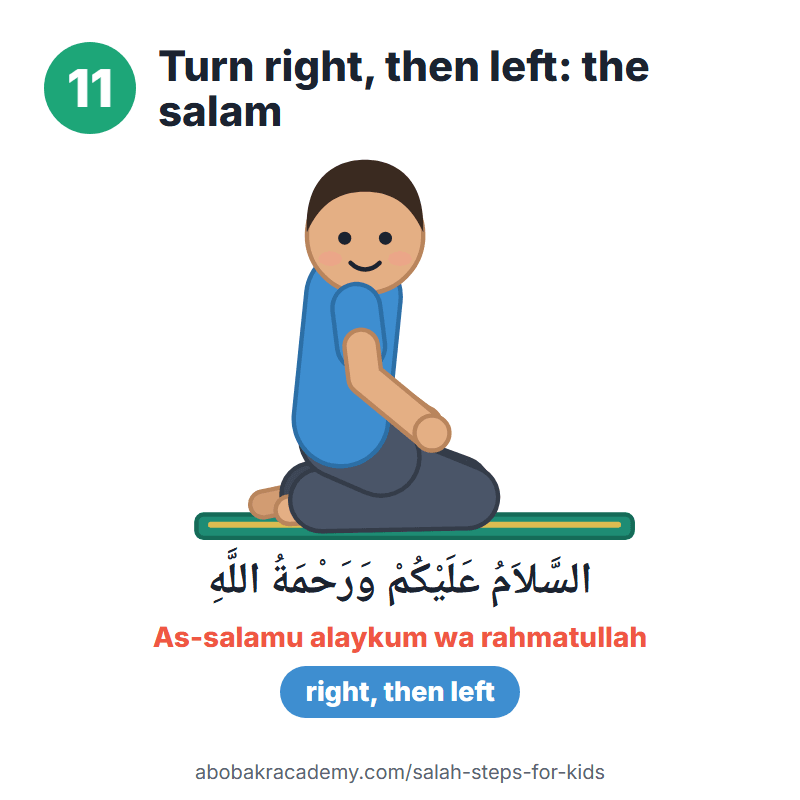
- Turn right, then left: the salam. Turn your head to the right and say As-salamu alaykum wa rahmatullah, then to the left and say it again. The prayer is finished. In Arabic: السَّلاَمُ عَلَيْكُمْ وَرَحْمَةُ اللَّهِ (“Peace be on you, and the mercy of Allah”). Straight after the salam, the Prophet would say astaghfirullah three times, a habit worth starting with your child from the first prayer.
Say Allahu akbar each time you move from one position to the next: going down into the bow, going down into sujood, sitting up, and standing up again. The only move that has different words is rising from the bow.
Salah steps with pictures
One card for each step, the same child in every picture. On the sujood card the seven parts that touch the floor are marked. The cards are in the printable too: cut them out, shuffle them, and ask your child to lay them out in order.





What to say in each position
Press the button to hear each phrase. The Arabic is copied from the hadith that teaches it, and the way to say it is written for an English speaker.
| When | Say | Meaning |
|---|---|---|
| Starting the prayer, and every move | اللَّهُ أَكْبَرُ Allahu akbar | Allah is the Greatest |
| In the bow (ruku) | سُبْحَانَ رَبِّيَ الْعَظِيمِ Subhana rabbiyal-azim | Glory be to my Lord, the Most Great |
| Rising from the bow | سَمِعَ اللَّهُ لِمَنْ حَمِدَهُ Sami’allahu liman hamidah | Allah hears the one who praises Him |
| Standing straight again | رَبَّنَا وَلَكَ الْحَمْدُ Rabbana wa lakal-hamd | Our Lord, and all praise is Yours |
| In sujood | سُبْحَانَ رَبِّيَ الأَعْلَى Subhana rabbiyal-a’la | Glory be to my Lord, the Most High |
| Sitting between the two sujood | رَبِّ اغْفِرْ لِي Rabbighfir li | My Lord, forgive me |
| Turning right, then left | السَّلاَمُ عَلَيْكُمْ وَرَحْمَةُ اللَّهِ As-salamu alaykum wa rahmatullah | Peace be on you, and the mercy of Allah |
Al-Fatiha and a short surah
Al-Fatiha is recited in every rak’ah of every prayer: “there is no prayer for the one who does not recite the Opening of the Book” (Sahih al-Bukhari 756). In the first two rak’ahs it is followed by another surah; al-Ikhlas is the one most children learn first. The recitation is Sheikh Mahmoud Khalil al-Husary’s teaching recitation, verse by verse, so a child can repeat after each one.
Surah Al-Fatihah (The Opener), 7 verses
| Verse | Say it | Meaning |
|---|---|---|
| بِسْمِ اللَّهِ الرَّحْمَٰنِ الرَّحِيمِ | Bismillahir-rahmanir-rahim | In the name of Allāh, the Entirely Merciful, the Especially Merciful. |
| الْحَمْدُ لِلَّهِ رَبِّ الْعَالَمِينَ | Al-hamdu lillahi rabbil-alamin | [All] praise is [due] to Allāh, Lord of the worlds – |
| الرَّحْمَٰنِ الرَّحِيمِ | Ar-rahmanir-rahim | The Entirely Merciful, the Especially Merciful, |
| مَالِكِ يَوْمِ الدِّينِ | Maliki yawmid-din | Sovereign of the Day of Recompense. |
| إِيَّاكَ نَعْبُدُ وَإِيَّاكَ نَسْتَعِينُ | Iyyaka na’budu wa iyyaka nasta’in | It is You we worship and You we ask for help. |
| اهْدِنَا الصِّرَاطَ الْمُسْتَقِيمَ | Ihdinas-siratal-mustaqim | Guide us to the straight path – |
| صِرَاطَ الَّذِينَ أَنْعَمْتَ عَلَيْهِمْ غَيْرِ الْمَغْضُوبِ عَلَيْهِمْ وَلَا الضَّالِّينَ | Siratal-ladhina an’amta alayhim, ghayril-maghdubi alayhim wa lad-dallin | The path of those upon whom You have bestowed favor, not of those who have earned [Your] anger or of those who are astray. |
Surah Al-Ikhlas (The Sincerity), 4 verses
| Verse | Say it | Meaning |
|---|---|---|
| قُلْ هُوَ اللَّهُ أَحَدٌ | Qul huwallahu ahad | Say, "He is Allāh, [who is] One, |
| اللَّهُ الصَّمَدُ | Allahus-samad | Allāh, the Eternal Refuge. |
| لَمْ يَلِدْ وَلَمْ يُولَدْ | Lam yalid wa lam yulad | He neither begets nor is born, |
| وَلَمْ يَكُن لَّهُ كُفُوًا أَحَدٌ | Wa lam yakun lahu kufuwan ahad | Nor is there to Him any equivalent." |
If your child does not know al-Fatiha yet, they can still pray beside you and say Allahu akbar and the tasbih while they learn it. Our list of short surahs to memorise gives the order most children learn them in.
The tashahhud and the blessings on the Prophet
This is the longest part to learn, so it is worth doing a line a week. It is said sitting, with the right index finger raised (Sahih Muslim 580). In the last sitting of every prayer the blessings on the Prophet, peace be upon him, come after it.
التَّحِيَّاتُ لِلَّهِ، وَالصَّلَوَاتُ وَالطَّيِّبَاتُ، السَّلاَمُ عَلَيْكَ أَيُّهَا النَّبِيُّ وَرَحْمَةُ اللَّهِ وَبَرَكَاتُهُ، السَّلاَمُ عَلَيْنَا وَعَلَى عِبَادِ اللَّهِ الصَّالِحِينَ أَشْهَدُ أَنْ لاَ إِلَهَ إِلاَّ اللَّهُ، وَأَشْهَدُ أَنَّ مُحَمَّدًا عَبْدُهُ وَرَسُولُهُ
At-tahiyyatu lillahi was-salawatu wat-tayyibat. As-salamu alayka ayyuhan-nabiyyu wa rahmatullahi wa barakatuh. As-salamu alayna wa ala ibadillahis-salihin. Ash-hadu an la ilaha illallah, wa ash-hadu anna Muhammadan abduhu wa rasuluh.
“All greetings, prayers and good words are for Allah. Peace be on you, O Prophet, and the mercy of Allah and His blessings. Peace be on us and on the righteous servants of Allah. I bear witness that there is no god but Allah, and I bear witness that Muhammad is His servant and His Messenger.”
Sahih al-Bukhari 831, on sunnah.com
Then, in the last sitting:
اللَّهُمَّ صَلِّ عَلَى مُحَمَّدٍ، وَعَلَى آلِ مُحَمَّدٍ، كَمَا صَلَّيْتَ عَلَى إِبْرَاهِيمَ وَعَلَى آلِ إِبْرَاهِيمَ، إِنَّكَ حَمِيدٌ مَجِيدٌ، اللَّهُمَّ بَارِكْ عَلَى مُحَمَّدٍ، وَعَلَى آلِ مُحَمَّدٍ، كَمَا بَارَكْتَ عَلَى إِبْرَاهِيمَ، وَعَلَى آلِ إِبْرَاهِيمَ، إِنَّكَ حَمِيدٌ مَجِيدٌ
Allahumma salli ala Muhammadin wa ala ali Muhammad, kama sallayta ala Ibrahima wa ala ali Ibrahim, innaka hamidun majid. Allahumma barik ala Muhammadin wa ala ali Muhammad, kama barakta ala Ibrahima wa ala ali Ibrahim, innaka hamidun majid.
“O Allah, send Your prayers on Muhammad and the family of Muhammad, as You sent them on Ibrahim and the family of Ibrahim; You are Praiseworthy, Glorious. O Allah, bless Muhammad and the family of Muhammad, as You blessed Ibrahim and the family of Ibrahim; You are Praiseworthy, Glorious.”
Sahih al-Bukhari 3370, on sunnah.com
How many rak’ahs is each prayer?
Every prayer is made of rak’ahs, and one rak’ah is steps 3 to 8: al-Fatiha, the bow, standing up, two sujood. These are the obligatory rak’ahs of the five daily prayers, seventeen in a day.
| Prayer | When | Rak’ahs |
|---|---|---|
| Fajr | dawn, before sunrise | 2 |
| Dhuhr | just after midday | 4 |
| Asr | afternoon | 4 |
| Maghrib | just after sunset | 3 |
| Isha | night | 4 |
In a prayer of three or four rak’ahs, sit after the second rak’ah and say the tashahhud, then say Allahu akbar and stand up for the third. In the third and fourth rak’ahs, recite al-Fatiha on its own. The last sitting, with the blessings on the Prophet and the salam, comes after the last rak’ah. (Sahih al-Bukhari 828; Sahih al-Bukhari 776)
Where families differ
A child may see their parents pray one way and the imam at the masjid another. The four schools of Islamic law agree on the steps above and differ on a few small details, each with evidence behind it. None of these makes a prayer wrong. Teach your child the way your family prays, and tell them the other way is also followed.
| Detail | What families do |
|---|---|
| Where the folded hands rest | On the chest, just below it, or lower down around the navel, depending on the school. Many Maliki families pray with the hands by their sides. |
| Raising the hands | At the first Allahu akbar only, or also before and after the bow (Sahih al-Bukhari 735). |
| How high the hands go | Up to the shoulders (Sahih al-Bukhari 735) or up to the ears (Sahih Muslim 391). |
| Saying Ameen after al-Fatiha | Out loud with the imam in some schools, quietly in others. |
| Sitting in the last tashahhud | On the left foot as in step 7, or with the left foot forward under the right leg and sitting on the floor (Sahih al-Bukhari 828). |
Teaching salah by age
The Prophet, peace be upon him, said to tell children to pray when they are seven (Sunan Abi Dawud 495, graded hasan sahih by Al-Albani). Most children are ready to copy much earlier. This is the order that works for most families.
| Age | What to teach |
|---|---|
| 3 to 5 | Pray beside you on a small mat. Copy the movements and say Allahu akbar. Listen to al-Fatiha every day. |
| 5 to 6 | Learn one step a week with the cards. Pray one prayer a day with you, the same one each day. Learn al-Fatiha and al-Ikhlas by heart. |
| 7 | All five prayers, with the tracker on the wall. Learn the tashahhud a line at a time. |
| 8 to 10 | The blessings on the Prophet, the three- and four-rak’ah prayers without help, and leading a family prayer now and then. |
Keep it short and warm. A child who prays two rak’ahs happily beside you learns more than one who is corrected all the way through. Correct one thing at a time, after the prayer rather than during it.
Free printable salah chart and prayer tracker (PDF)
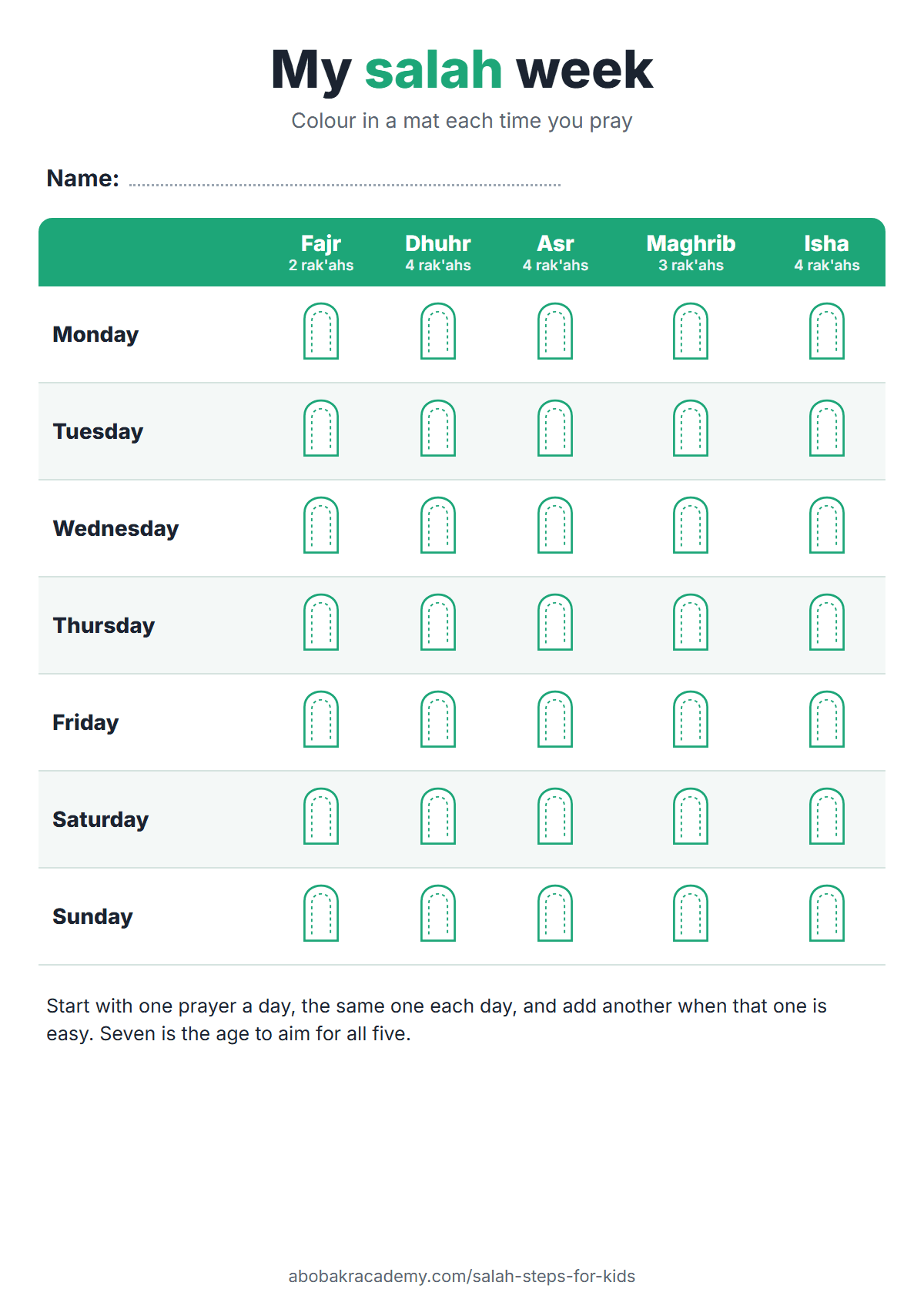
Download the salah printable (PDF, 6 pages). No email and no sign-up. It has:
- the eleven steps on one A4 poster, for the wall by the prayer mat;
- the eleven step cards, to cut out and put in order;
- a card with the words of every position, in Arabic, with a way to say them and the meaning;
- al-Fatiha, al-Ikhlas, the tashahhud and the blessings on the Prophet on one page;
- a week tracker with a box for each of the five prayers.
Where each step comes from
For parents who want to check. Each step on this page rests on the hadith below, and each links to its page on sunnah.com. Hadith from Sahih al-Bukhari and Sahih Muslim carry no grade there; for the others, the grade sunnah.com shows is given beside the name.
| Hadith | What it shows |
|---|---|
| Sahih al-Bukhari 1 | The intention is in the heart: deeds are by their intentions |
| Sahih al-Bukhari 631 | Pray as you have seen me praying |
| Sahih al-Bukhari 757 | The order, taught to a man who prayed too fast: takbir, recite, bow until still, stand straight, prostrate until still, sit until still |
| Sahih al-Bukhari 735 | Raising the hands to the shoulders at the opening takbir; Rabbana wa lakal hamd on rising from the bow |
| Sahih Muslim 391b | Or raising the hands to the ears |
| Sahih al-Bukhari 740 | The right hand over the left forearm |
| Sahih al-Bukhari 756 | Al-Fatiha in every rak’ah: no prayer without it |
| Sahih al-Bukhari 789 | Allahu akbar on standing up and on bowing; Rabbana lakal hamd is said standing; Two prostrations, with Allahu akbar going down and coming up each time |
| Sahih al-Bukhari 812 | Prostrating on seven: the forehead with the nose, both hands, both knees and the toes of both feet |
| Sahih Muslim 772 | Subhana rabbiyal azim in the bow; Sami’a Allahu liman hamidah on rising; Subhana rabbiyal a’la in prostration |
| Sunan Abi Dawud 874 (Sahih (Al-Albani)) | Allahu akbar; Rabbighfir li, sitting between the two prostrations |
| Sahih al-Bukhari 831 | The tashahhud; The tashahhud ends with the two testimonies |
| Sahih al-Bukhari 3370 | Sending blessings on the Prophet in the last sitting |
| Sunan Abi Dawud 996 (Sahih (Al-Albani)) | The salam to the right and then the left; As-salamu alaykum wa rahmatullah |
| Sunan Abi Dawud 495 (Hasan Sahih (Al-Albani)) | Children are told to pray from seven |
| Sahih al-Bukhari 4302 | A boy of six or seven led his people’s prayer because he knew the most Quran |
| Sahih al-Bukhari 828 | In the bow, the hands hold the knees and the back is bent level; Rising from the bow, standing straight until every vertebra is back in place; In sujood the toes point toward the qibla; Sitting on the left foot with the right foot upright; In the last rak’ah, the left foot forward and sitting on the floor |
| Sahih al-Bukhari 822 | Forearms off the floor in sujood |
| Sahih Muslim 580a | The right index finger raised in the tashahhud |
| Sahih al-Bukhari 776 | Al-Fatiha alone in the third and fourth rak’ah |
Teaching salah when you are learning it too
This site is built for families where nobody at home reads Arabic. You do not need to read it to teach salah: every phrase on this page has a button to hear it and a way to say it written in English letters, so you can learn it together. When your child is ready to read al-Fatiha from the Quran itself, our teachers start from the letters and explain everything in English. See Quran classes for kids; the first lesson is free.
Teaching a child to pray: what parents ask
How do I teach my child to pray salah step by step?
Pray beside them every day and let them copy you. Teach one step a week using the cards, starting with Allahu akbar and al-Fatiha, and let them pray one prayer a day with you before moving to all five. Put the tracker on the wall so they can see the week fill up.
What is the 7 7 7 rule for children in Islam?
It is a popular saying: play with a child for the first seven years, teach them for the next seven, and be their friend for the seven after that. We have not found it with a chain of narration in the hadith collections, so treat it as advice. What is authentic is the hadith telling parents to have children pray at seven (Sunan Abi Dawud 495).
How do you pray 4 rak’ahs?
Pray two rak’ahs as in steps 1 to 9, then sit and say the tashahhud. Say Allahu akbar and stand up for the third rak’ah, recite al-Fatiha on its own, and do the bow, standing and two sujood. Do the same for the fourth, then sit for the last tashahhud with the blessings on the Prophet, and finish with the salam. Dhuhr, Asr and Isha are prayed this way.
What do you say at the start of salah?
Allahu akbar, which means Allah is the Greatest, said with the hands raised. That begins the prayer. Many people then say a short opening du’a before al-Fatiha, but a young child can go straight to al-Fatiha.
Can a child lead salah?
Yes. Amr ibn Salama led his people’s prayer when he was six or seven, because he knew more Quran than anyone else there (Sahih al-Bukhari 4302). Leading the family in a prayer at home is a good way to make a child proud of what they have learned.
Is salah different for girls?
The steps and the words are the same for girls and boys. Girls cover their hair with a scarf and wear clothes that cover their arms and legs, and some schools teach girls to keep their arms closer to the body in the bow and in sujood.
Before and after salah: wudu, duas and surahs
- Wudu steps for kids: the washing that comes before every prayer, with a printable.
- The five pillars of Islam for kids: salah is the second pillar.
- Daily duas for kids: short du’as for the rest of the day, on printable cards.
- Short surahs to memorise: what to learn after al-Ikhlas, in order.
- Online Quran classes for kids: reading the Quran from the first letter, with a free first lesson.