
Quranic and Classical Arabic Course Online, One to One
A Quranic Arabic course teaches the vocabulary and grammar of the Quran, so you can follow what you recite without leaning on a translation. Quranic Arabic is Classical Arabic, the language of the Quran, the hadith and the early scholars. Ours is live and one to one, taught in English, for adults and older teens who can read the Arabic letters or are ready to learn them. Plans start at $34 a month and the first lesson is free.
Book a free lesson on WhatsApp How the free lesson works
Format
Live and one to one, with the same teacher each week
Taught in
English, with the Arabic on the page
Start from
Reading the letters, even slowly
Price
$8.50 an hour, down to $7.00. Plans from $34 a month
Female teacher
Available on request, at the same price
Changes
Move a lesson with two hours notice
How few words cover how much of the Quran
Course pages like to say that a small vocabulary covers most of the Quran, and quote anything from 40 to 80 per cent. We counted it. The Quran has 77,429 words, written in 14,883 different forms. The table shows how much of the text the most frequent forms cover.

| Most frequent word forms | Share of every word in the Quran |
|---|---|
| 10 | 16.0% |
| 50 | 29.9% |
| 100 | 37.9% |
| 266 | 50.0% |
| 500 | 57.9% |
| 1,000 | 66.3% |
| 2,000 | 74.6% |
How we counted. Every one of the 6,236 verses, word by word, from the text published by Quran.com, with the vowel marks set aside. A “form” is a word as written, so قال (he said) and وقال (and he said) count as two. Counted by root, as a teacher teaches them, an even smaller vocabulary covers the same share, which is why a course built on the most frequent words and roots pays back quickly. The same count gives the Quran’s other totals, listed in how many pages, verses and words are in the Quran.
The twelve words you meet most
These twelve alone are about one word in six of the whole Quran. Most are small words, which is exactly why they are learned first: a sentence cannot be followed without them.
| Word | Meaning | Times in the Quran |
|---|---|---|
| مِنْ / مَنْ | from / who (one spelling, two words) | 2,763 |
| ٱللَّه | Allah | 2,152 |
| إِنَّ / أَنْ | indeed / that | 1,592 |
| فِي | in | 1,185 |
| مَا | what, or not | 1,008 |
| ٱلَّذِينَ | those who | 810 |
| لَا | no, not | 810 |
| إِلَّا | except | 763 |
| عَلَىٰ | on, upon | 670 |
| وَلَا | and not, nor | 657 |
| وَمَا | and what, and not | 640 |
| قَالَ | he said | 410 |
The 100 most frequent words, free to print
The twelve are the start of a longer list. Our printable goes on to the 100 words you meet most, counted with their vowels so that مِن (from) and مَن (who) are two words, not one. Each has a way to say it, its meaning, how many times it appears and the verse it first appears in, with a box to tick when you know it. Together the 100 are 35 per cent of the Quran; ten a week takes ten weeks.
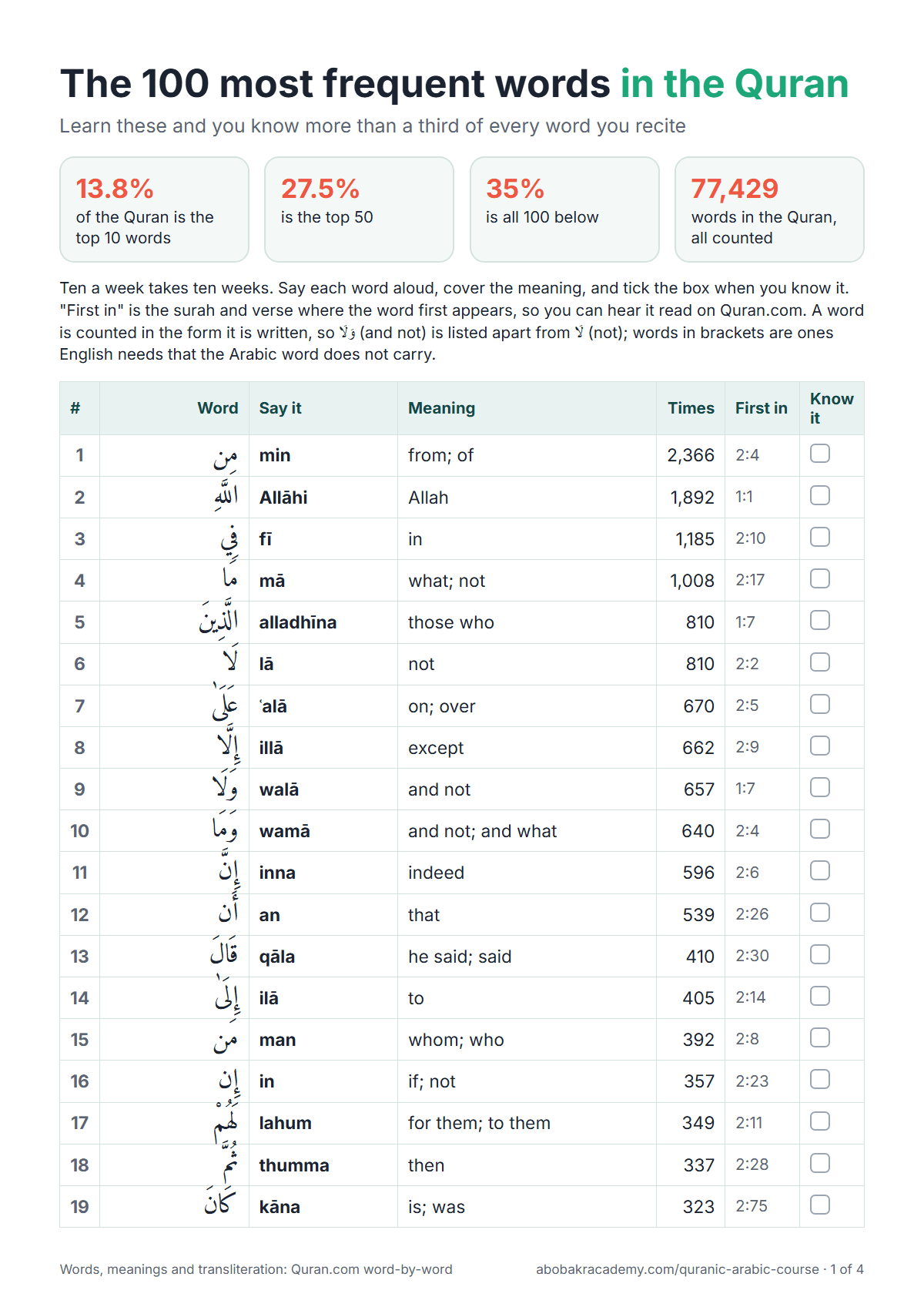
Download the 100 most frequent words in the Quran (PDF, 4 pages). No email and no sign-up.
What the course works through
The order matters more than the pace. Each stage uses what the one before it taught, on real verses from the first lesson.
| Stage | What it covers | What you can do at the end |
|---|---|---|
| 1. The most frequent words | The small words above, the pronouns, and the words for Allah, the Messenger and the Hereafter | Pick out who is speaking and to whom in a short surah |
| 2. Roots and patterns | How three-letter roots build families of words, and the patterns (sarf) that turn a root into a doer, a deed or a place | Guess the meaning of an unseen word from its root |
| 3. The sentence | Noun and verb sentences, attached pronouns, and the case endings (nahw) that mark subject and object | Say what each word is doing in a verse |
| 4. Reading whole passages | Surahs you already recite, taken verse by verse, with the teacher asking before explaining | Follow the meaning of the surahs of your prayer as you recite them |
If you cannot read the Arabic letters yet, start with them. Our Noorani Qaida guide explains how, and a teacher can take you through it first in the same lessons.
Quranic Arabic or Modern Standard Arabic?
They are the same language at different ages, and the difference decides which course suits you.
| Quranic Arabic | Modern Standard Arabic | |
|---|---|---|
| What it is | The classical Arabic of the Quran, fixed in its text | Today’s written and formal Arabic: books, news, speeches |
| Grammar | The same core grammar, with forms that are rare today | The same core grammar, with modern vocabulary |
| Vocabulary | The words of the Quran, heavy with faith and the Hereafter | Everyday and modern life: work, travel, technology |
| Speaking practice | Little; the aim is understanding | Yes, reading, writing and conversation |
| Choose it if | You want to understand what you recite | You want to read, write and speak Arabic generally |
For the general language, see our online Arabic classes. If you are still deciding, the best way to learn Arabic walks through the choice.
Ways to learn Classical Arabic online, compared
Here are the five usual routes. They differ most in how much time you spend with a teacher and what that time costs. The other schools’ figures are from their own course pages, read on 12 October 2026.
| Route | Example | Time with a teacher | Length | Cost |
|---|---|---|---|---|
| Free self-study | Learn Arabic Online, the Madinah books | None | Your own pace | Free |
| Group class by semester | Kitaab Academy | 2 hours a week, shared with a class | 15-week semesters, 7 levels | $600 a semester, about $20 an hour of class |
| Part-time programme | Cambridge Muslim College | One 2-hour class a week, shared | Two years | £1,500 programme fee |
| One to one by course | Qasid Online | One 50-minute private session a week, with self-paced work | 10-week courses, five levels | From $495 a course, about $59 an hour of teacher time |
| One to one by the month | This course | Two or three private lessons a week, 30 or 60 minutes | Four-week plans, paid in advance | From $34 a month, $7.00 to $8.50 an hour |
Which suits you depends on the goal. To read classical texts unaided, the long programmes are built for it. To follow the Quran you already recite, what helps most is a teacher who hears you read every week and a vocabulary taken in order of frequency, and that is what this course is for. Free material works well alongside any of them.
How a lesson runs
You and the teacher share a screen with the verse on it. The teacher asks what you can already see in it, then fills in what you missed, so you do the work of reading rather than listening to a lecture. Each lesson ends with a few words to learn before the next, taken from the surah you are working on.
Lessons are 30 or 60 minutes, and most students take two or three a week. Tajweed, the rules of how the Quran is recited aloud, is a separate skill taught in Tajweed lessons; this course is about what the words mean.
What it costs
The hourly rate falls as you book more hours in a month. Every plan is four weeks of lessons, paid in advance, and unused lessons are refundable.
| Schedule | Hours a month | Rate | Monthly |
|---|---|---|---|
| 2 lessons a week, 30 minutes | 4 | $8.50 an hour | $34 |
| 3 lessons a week, 30 minutes | 6 | $8.00 an hour | $48 |
| 2 lessons a week, 60 minutes | 8 | $7.50 an hour | $60 |
| 3 lessons a week, 60 minutes | 12 | $7.00 an hour | $84 |
A second family member takes 10 per cent off. Every plan is on the pricing page.
Who teaches
You are matched with one teacher, who stays with you. Three of them are below, as the about page lists them.
Ahmed Abdullah
Quran, Tajweed, Arabic
Ijazah in the Quran in the Hafs narration, with a connected chain. A graduate of Al-Azhar University, teaching Quran for more than ten years.
Dr. Jihad El-Sayed
Arabic for non-native speakers
A PhD in literary and critical studies, with degrees in Arabic and Islamic Studies education and in Arabic literature. Six years teaching Arabic at every level.
Mohamed Nayel
Taught in English
Teaches entirely in English, which suits a student who does not speak Arabic yet. Four years teaching Arabic, Quran and Islamic Studies to English speakers.
Classical and Quranic Arabic: names, self-study, free courses and reading first
What is Classical Arabic called?
In Arabic it is al-fusha, the eloquent language. In English it is called Classical Arabic or Quranic Arabic, after its best-known text. Modern Standard Arabic grew out of it and shares the name fusha.
What is the best way to learn Quranic Arabic?
Learn the most frequent words first, then roots and patterns, then sentence grammar, always on verses you already know. A teacher who asks you to read before explaining makes it stick far better than videos alone.
Can Arabic be self-taught?
The vocabulary can, and free books and sites cover the grammar well. What self-study misses is someone to catch a misread ending or a wrong guess at a word, and in the Quran one ending can change who is doing what. Many learners study alone and check their reading with a teacher once or twice a week.
How long does it take to learn Classical Arabic?
That depends on the goal. Programmes that aim at reading classical texts unaided run from one year to two, or five levels. Following the surahs you pray with is a smaller goal: the 100 most frequent words are 35 per cent of the Quran, and at ten a week they take ten weeks.
How is Quranic Arabic different from Arabic?
Quranic Arabic is the classical Arabic of the Quran; Modern Standard Arabic is today’s written Arabic. The grammar is largely the same, but the vocabulary and the aim differ: understanding the Quran rather than speaking about daily life.
Is there a free Quranic Arabic course?
Yes, there are free video courses and apps, and they are a fair way to start. What they cannot do is hear you read a verse and correct your understanding of it. Our first lesson is free, so you can compare.
Do I need to read Arabic before I start?
It helps to read the letters, even slowly. If you cannot yet, the teacher starts with the alphabet in the same lessons before moving on to meaning.
How many words do I need to understand the Quran?
By our count, 266 written word forms make up half of the Quran’s 77,429 words, and 2,000 make up three quarters. Counted by root, fewer are needed, so a few hundred well-chosen words carry you a long way.
Can children take this course?
It suits adults and teenagers best. Younger children do better learning Arabic generally first; see Arabic for kids.
Can I have a female teacher?
Yes. Female teachers are available on request at the same price. Give two or three possible times when you book, since availability depends on the hour.
Reading without understanding, or a free first lesson
If understanding the Quran without having read it before sounds far off, read reading the Quran without understanding it. When you are ready, book the free first lesson and bring a surah you want to understand.