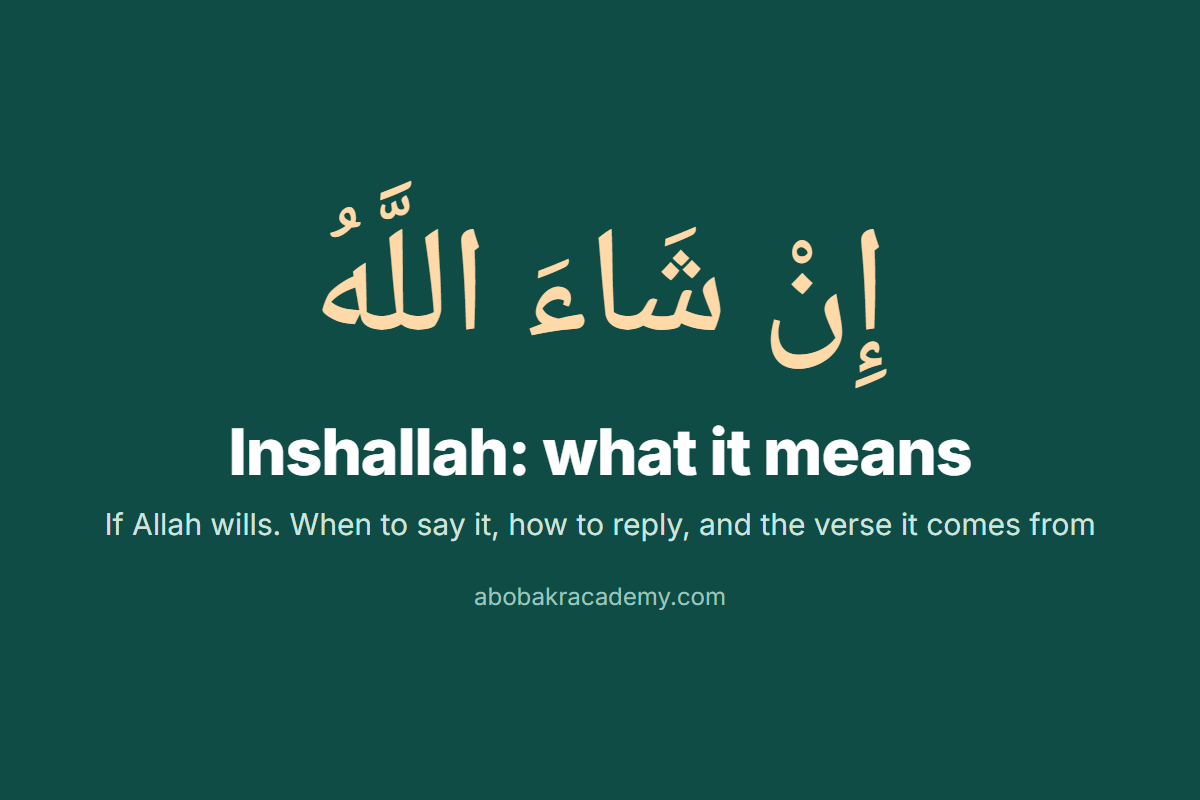
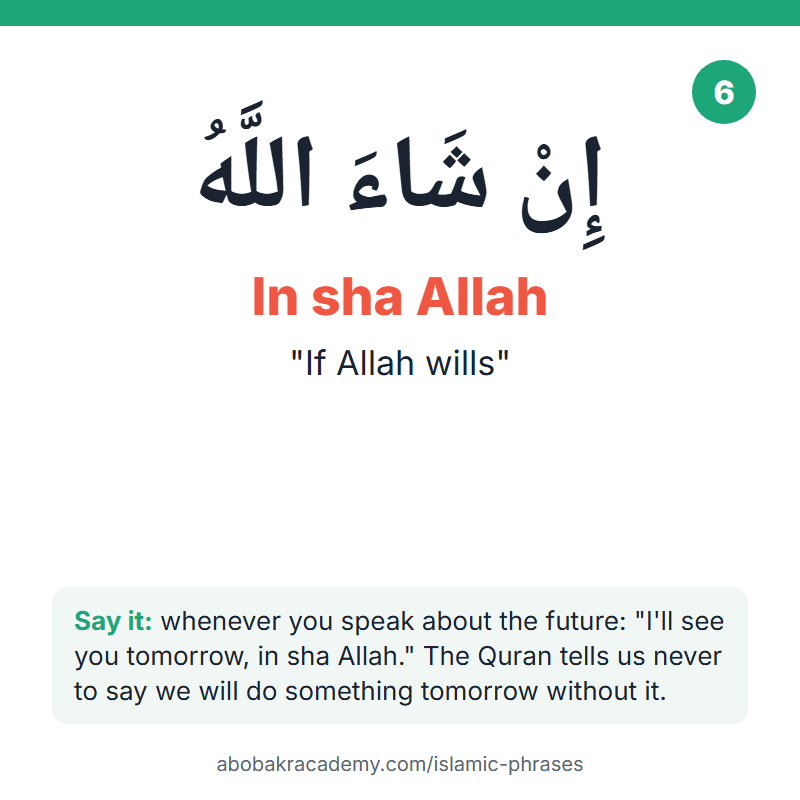
Inshallah (إِنْ شَاءَ اللَّهُ) means “if Allah wills”. Muslims say it whenever they talk about something they plan or hope to do: “See you tomorrow, inshallah.” It comes from the Quran, which tells believers never to promise anything for tomorrow without adding “if Allah wills” (Al-Kahf 18:23–24). There is no set reply. People usually say inshallah back, or ameen if it was a hope.
Below you can hear it said, copy it in Arabic, see what each of its three words means, and read the verse it comes from. There is also a short guide to using it properly, since it is easy to slip into saying it when you mean “probably not”.
Inshallah in Arabic: copy and paste
Here it is written two ways. Tap or click a box to select it, then copy.
With vowel marks, the way a child learns to read it:
إِنْ شَاءَ اللَّهُ
Without vowel marks, the way you would type it in a message:
إن شاء الله
In English it is spelled many ways: inshallah, in sha Allah, insha’Allah, InshaAllah, inshaallah. All of them are fine, because they are just ways of writing Arabic sounds in Latin letters. The Cambridge Dictionary lists it as inshallah.
What each word means
Inshallah is three Arabic words run together when spoken. Seeing them apart is what makes the meaning click.
| Arabic | Say it | Meaning |
|---|---|---|
| إِنْ | in | if |
| شَاءَ | shā’a | wills (literally “has willed”) |
| اللَّهُ | Allāh | Allah, God |
Put together: “if Allah wills”, or in everyday English, “God willing”.
One spelling to avoid in Arabic. Because the phrase sounds like one word, people sometimes type it as انشاء الله. That first part is a different word, inshā’, which means “creating” or “building”. The correct Arabic keeps the three words apart, as in the boxes above. This only matters when you write in Arabic script; in English letters any spelling is fine.
Where inshallah comes from in the Quran
The instruction is in Surah Al-Kahf. Allah tells the Prophet, and through him every believer, not to say “I will do that tomorrow” on its own, but to add “if Allah wills”. Press play to hear each verse recited by Sheikh Mahmoud Khalil al-Husary.
18:23 “And never say of anything, "Indeed, I will do that tomorrow,"”
18:24 “Except [when adding], "If Allāh wills." And remember your Lord when you forget [it] and say, "Perhaps my Lord will guide me to what is nearer than this to right conduct."”
Translation: Sahih International, from Quran.com.
The same words appear elsewhere in the Quran too, for example in Al-Fath 48:27, and the Prophet used them himself. When he heard about the dream that taught the call to prayer, he said it was a true vision, “in sha Allah” (Sunan Abi Dawud 499, graded hasan sahih by al-Albani).
When to say inshallah
Say it about anything that has not happened yet and that you mean to do or hope will happen. It is a reminder that you are making a real plan, and that the outcome is not in your hands.
| Situation | What you might say |
|---|---|
| Making plans | “We’ll visit Grandma on Saturday, inshallah.” |
| A promise to your child | “If you finish your homework, we’ll go to the park, inshallah.” |
| A hope | “Inshallah your exam goes well.” |
| A goal | “I’m going to finish Juz Amma this year, inshallah.” |
| Saying goodbye | “See you next week, inshallah.” |
You do not say it about the past. For something good that has already happened, Muslims say alhamdulillah (“all praise is for Allah”), and for something good they see, masha Allah. After a mistake, the phrase is astaghfirullah.
Is inshallah a polite way of saying no?
It gets used that way, and plenty of Muslims joke about it: ask a friend if they’re coming and hear “inshallah”, and you may already know they won’t. But that is a habit, not the meaning. The phrase is meant for things you really intend to do. If the honest answer is no, it is better to say no kindly than to borrow the name of Allah to avoid it. That is worth teaching children early, because they notice when “inshallah” means “never”.
Inshallah, mashallah or alhamdulillah?
These three get mixed up more than any others. The easy way to tell them apart is time: the future, something you see now, or something that has happened.
| Phrase | Meaning | Use it for |
|---|---|---|
| Inshallah | If Allah wills | The future: plans, promises, hopes |
| Masha Allah | What Allah has willed | Something good you see or hear about now: a new baby, a child’s good work |
| Alhamdulillah | All praise is for Allah | Thanks for anything, good news that has arrived, and the answer to “how are you?” |
All three, with audio and the verse or hadith behind each, are on our page of 21 Islamic phrases and their meanings.
Can non-Muslims say inshallah?
Yes. Arab Christians and Arabic speakers of every background say it daily, in the sense of “hopefully”. It has even travelled into other languages. The Spanish word ojalá (“I hope so”) comes from Arabic, from a phrase built on the same words, shā’a Allāh (Wiktionary). If you are not Muslim and a colleague says it to you, saying it back is friendly and perfectly natural.
Teaching inshallah to children
Inshallah is one of the easiest phrases for a young child to learn, because it attaches to something children do all day: talk about what happens next. You do not need to read Arabic to teach it.
- Say it yourself, every time. “Tomorrow we have swimming, inshallah.” Children copy what they hear far more than what they are told.
- Wait for them to add it. When your child says “I’m going to build a tower”, pause and let them finish: “…inshallah.” Make it a small game.
- Explain it once, simply. “We say inshallah because Allah decides what happens. We make our plan, and we ask Him to let it happen.”
- Keep your own inshallahs honest. If you say “inshallah” to the park and then never go, they learn that it means no.
If your family is learning Arabic from the start, our Arabic greetings with audio and ways to say thank you in Arabic are good next steps.
Questions about inshallah
What does inshallah mean in English?
Inshallah means “if Allah wills” or “God willing”. It is three Arabic words: in (if), shā’a (wills) and Allāh.
Why do Muslims say inshallah?
Because the Quran tells them to. Surah Al-Kahf 18:23–24 says never to say you will do something tomorrow without adding “if Allah wills”. Saying it is a way of making plans while remembering that what happens is up to Allah.
When should you say inshallah?
Whenever you talk about the future: plans, promises, hopes and goals. You do not say it about things that have already happened; for those, Muslims say alhamdulillah or masha Allah.
What do you reply when someone says inshallah?
There is no fixed reply. Most people say inshallah back. If the person was wishing something good for you, such as “inshallah you’ll get the job”, you can answer ameen.
Is it inshallah or mashallah?
They mean different things. Inshallah (“if Allah wills”) is for the future. Masha Allah (“what Allah has willed”) is for something good you see or hear about now, such as a new baby or a child’s good work.
How do you write inshallah in Arabic?
As three separate words: إن شاء الله, or with vowel marks, إِنْ شَاءَ اللَّهُ. Writing it as one word changes the first part into a different word that means “creating”.
Want your child to read phrases like this in Arabic, not just say them?
Our tutors teach children from families where nobody at home reads Arabic, one to one and online. Start with the alphabet and you will be reading words like these within weeks. See Arabic lessons for kids or book a free trial lesson.