

Maghrib at home. Your seven year old stands next to you, recites Al-Fatiha, then Surah Al-Ikhlas. Second rak’ah: Al-Fatiha, then Al-Ikhlas again. It is the only surah they have, and it has been the only surah they have since Ramadan. You would like to give them the next one. You open a list of short surahs online and find nineteen of them, in an order nobody explains, written in Arabic you cannot read and a transliteration you are not sure you trust.
This page is the version of that list written for the parent, not for the teacher. It says which surahs your child actually needs in order to pray, what order to take them in and why that order is not simply shortest first, and how you can tell whether a surah has gone in properly when you do not read Arabic yourself.
Start with the part almost nobody puts first
There is exactly one passage of the Quran that a prayer is not valid without, and it is not on any of these lists as an item to get to. The Prophet, peace be upon him, said: “Whoever does not recite Al-Fatiha in his prayer, his prayer is invalid.” (Sahih al-Bukhari 756.)
The second surah, the one that comes after Al-Fatiha in the first two rak’ahs, is the practice of the Prophet and is enormously encouraged. It is not a condition of the prayer being accepted. Islam Question and Answer puts it plainly: reciting a surah after Al-Fatiha in prayer is not obligatory, in obligatory or voluntary prayers, aloud or silent.
We are not in the business of issuing rulings, and if this matters to your family’s practice you should take it from your imam or from a source like the one linked above. But the practical consequence is worth stating, because it reorders the whole project. A child who rushes through a wobbly Al-Fatiha and then recites nine short surahs beautifully has it backwards. A child with a clean, correct Al-Fatiha and one surah after it is praying properly and has room to build.
So the honest first target is small. Al-Fatiha, correct. Then one more surah. Everything past that is building, not catching up.
The four to learn first, and why these four
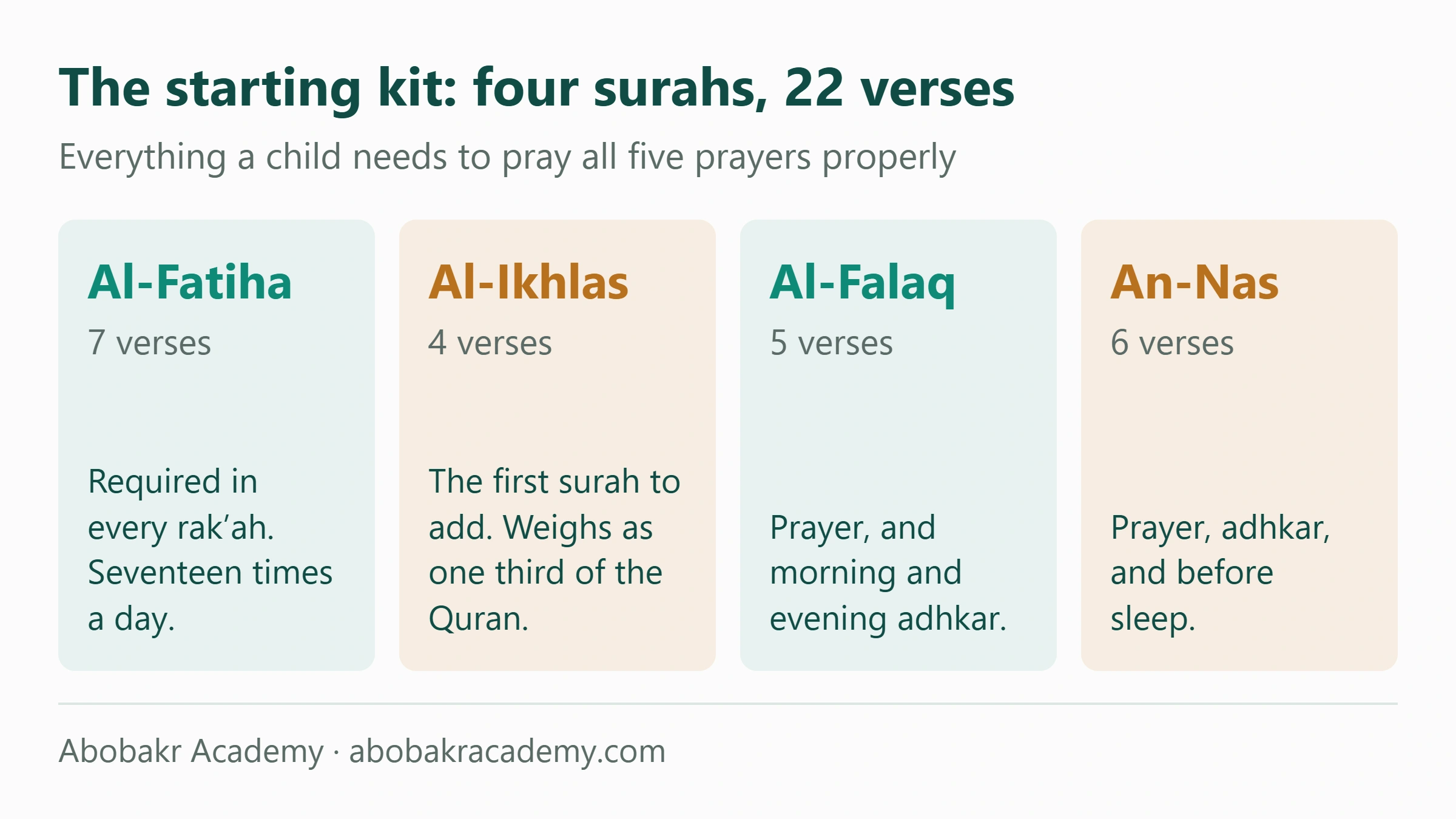
Four surahs make up the starting kit, and they total twenty two verses between them.
Al-Fatiha (surah 1, seven verses). Recited in every single rak’ah, which for a child praying all five means seventeen times a day. It is also the one they have heard most and will pick up fastest, and the one worth spending the most correction time on, precisely because it repeats seventeen times.
Al-Ikhlas (surah 112, four verses). The shortest realistic second surah and the one with the heaviest weight behind it. A man was heard reciting it over and over, and when this was reported to the Prophet, peace be upon him, he said: “By Him in Whose Hand my life is, this Surah is equal to one-third of the Qur’an.” (Sahih al-Bukhari 5013.) Four verses. You can see it on page 604 of the mushaf, which is the last page.
Al-Falaq (surah 113, five verses) and An-Nas (surah 114, six verses). These two earn their place twice over. They work in prayer, and they are also part of what many families recite in the morning, in the evening and before sleep. A surah your child says outside of salah as well as inside it gets roughly three times the repetition, which is why these two stick when others slip.
Those four are also the classic starting set for a reason that has nothing to do with rankings or lists: they sit at the very end of the mushaf, next to each other, so a child learning to read alongside memorizing can find them without navigating.
The list, from shortest to longest
These are the surahs of ten verses or fewer, plus Al-Fatiha. Verse counts are the standard ones and you can check any of them in one click on quran.com by putting the surah number after the slash. If the verse numbers printed in your child’s mushaf look unfamiliar, our guide to reading Arabic numerals shows each one beside the digit you already know.
| Surah | Number | Verses | Worth knowing |
|---|---|---|---|
| Al-Asr | 103 | 3 | Three verses, and the second one is long. Do not let the verse count fool you. |
| Al-Kawthar | 108 | 3 | The shortest surah in the Quran by word count. Three short lines, no traps. A very good second surah. |
| An-Nasr | 110 | 3 | Short, but two of the three verses end in unfamiliar sounds that children flatten. |
| Al-Ikhlas | 112 | 4 | The one to learn first after Al-Fatiha. |
| Quraysh | 106 | 4 | Pairs naturally with Al-Fil, which comes immediately before it. |
| Al-Falaq | 113 | 5 | Used in daily adhkar as well as prayer. |
| Al-Masad | 111 | 5 | Contains a name and a heavy closing verse. Harder than five verses suggests. |
| Al-Fil | 105 | 5 | A story, which children hold onto well. |
| Al-Qadr | 97 | 5 | Comes into its own in Ramadan, which is a good reason to time it for then. |
| Al-Kafirun | 109 | 6 | Six verses that repeat with small changes. This is where children merge lines. |
| An-Nas | 114 | 6 | Also repeats, but the repetition is easier to hear. |
| Al-Fatiha | 1 | 7 | The one that is required. Spend the most time here. |
| Al-Ma’un | 107 | 7 | Sentence structure is more complex than the length implies. |
| Ash-Sharh | 94 | 8 | Short verses, gentle rhythm. One of the easier eights. |
| At-Tin | 95 | 8 | Opens with two oaths that children often run together. |
| Al-Bayyinah | 98 | 8 | Eight verses, but several of them are long. Treat it as a step up. |
| Az-Zalzalah | 99 | 8 | Vivid imagery, which helps recall. |
| At-Takathur | 102 | 8 | Contains a phrase repeated almost identically twice. |
| Al-Humazah | 104 | 9 | The natural end of the beginner set. |
Nineteen surahs, and if your child holds all of them they can pray for months without repeating themselves. That is not the goal for this year. It is the map.
Why shortest and easiest are not the same list
Every list online sorts by verse count, and verse count is a poor guide to how long a surah will take your child. Three things make a short surah hard, and none of them shows up in the number.
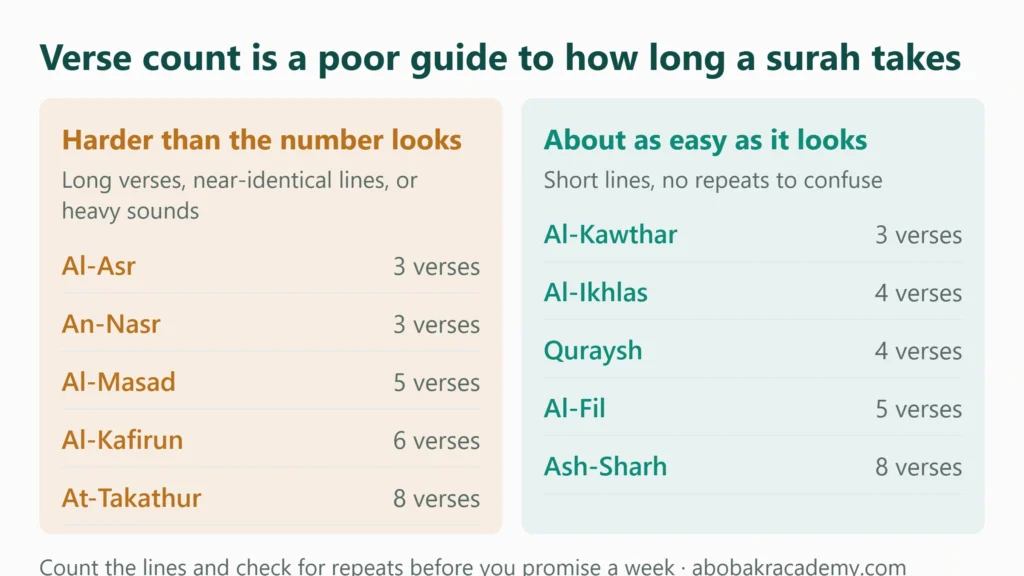
Long verses inside a short surah. Al-Asr is three verses. Its second verse is one of the longer single verses in this whole range. Al-Kawthar is also three verses and is three short lines. On paper they look identical. In practice one takes a child three days and the other takes two weeks.
Near-identical lines sitting next to each other. Al-Kafirun is the clearest case. Its verses circle back on themselves with small changes, and a child who has half-learned it will loop: they get to the fourth line, land on wording that sounds like the second, and start the middle again. This is not a memory failure, it is a structural trap, and the fix is to learn it line by line with a pause between each rather than as a flowing whole.
Sounds that do not exist in English. A five verse surah whose every line ends in a heavy letter is harder for a child raised in Manchester or Toronto than an eight verse surah that stays in easy territory. This is the one most lists ignore completely, and it is the one that produces a child who is fluent and wrong. We wrote separately about the letters children raised outside Arabic most reliably say wrong, and the same letters are what make certain short surahs slow.
So the working rule is: count the lines, not the verses. Then look at whether two lines nearly match. Then check whether the surah is full of heavy letters. A surah that passes all three is a one-week surah. A surah that fails two of them is a one-month surah, and pretending otherwise is how a child ends up feeling slow at something they are doing at a normal pace.
Transliteration will get you moving, and it will teach the wrong sounds
Almost every short surah list hands you transliteration with no comment, so here is the comment.
Transliteration is useful, and we are not going to pretend otherwise. A parent who cannot read Arabic can follow along, catch a dropped line, and help a child restart in the right place. For an adult beginner it is often the difference between starting this month and starting next year. We are not going to tell you not to use it.
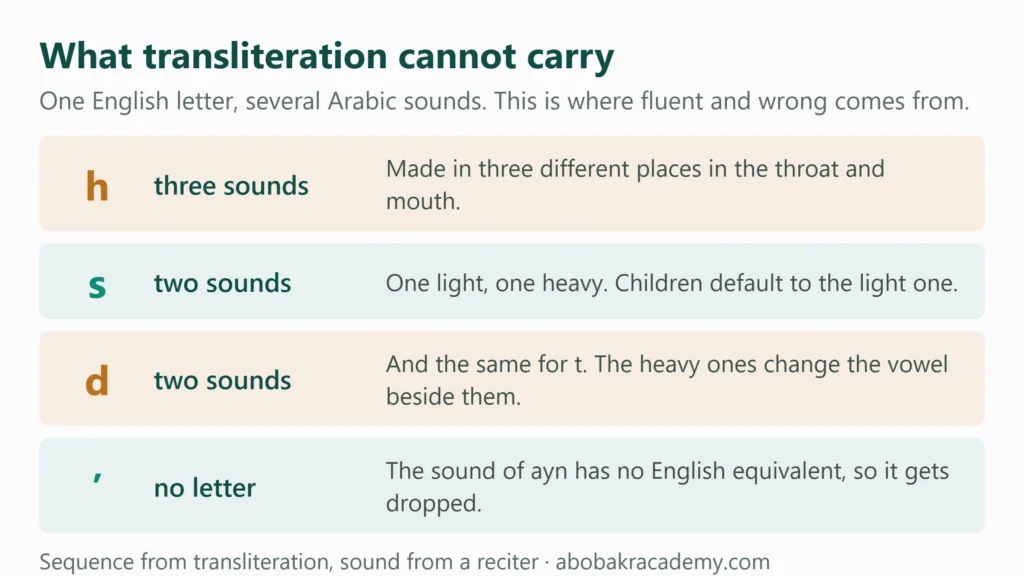
What it cannot do is carry sound. English has one h; Arabic has three sounds that all get written as h or kh in transliteration and are made in three different places. English has no equivalent at all for the letter ‘ayn, so transliterations write it as an apostrophe or leave it out, and a child reading from that will simply not make the sound. The same collapse happens with s, d and t, each of which has a light and a heavy version in Arabic that transliteration flattens into one letter.
The result is predictable and we hear it in trial classes constantly: a child who recites confidently, at speed, with the wrong consonant in the same three places every time, and who has now been reciting it that way for two years. Untraining that takes longer than teaching it correctly would have.
The practical position, which is what we tell parents: use transliteration to keep the sequence and the meaning, and get the sound from a recitation or a teacher, never from the spelling. If your child is learning to read the script alongside memorizing, they will eventually stop needing it. If you are an adult starting from zero, work through the letters properly first; a Qaida progress tracker is a cheaper way to find out where you are than guessing.
Four checks you can run tonight without reading Arabic
You do not need Arabic to tell whether a surah has actually gone in. You need to know what to listen for.
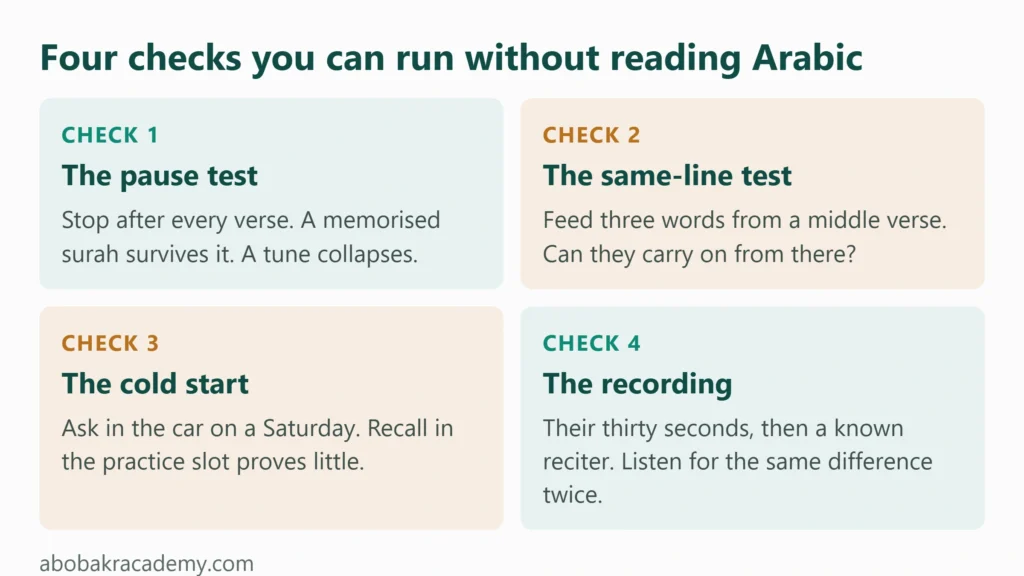
The pause test
Ask your child to recite the surah and stop after each verse, waiting for you to nod before continuing. A surah that is truly memorized survives this. A surah that is only a tune collapses, because the child was relying on momentum to get from one line to the next. If they cannot start a verse cold from its own beginning, they have memorized the melody, not the text.
The same-line test
Say the first two or three words of a middle verse and ask them to continue from there. Do it with a verse from the middle, never the first or last. Children who can do this have the surah stored as verses. Children who can only start from the beginning have it stored as one long ribbon, which is the thing that unravels after a school holiday.
The cold start
Ask for the surah at a time you have never asked before. Not during the daily session, not after Maghrib. In the car, on a Saturday morning, with no warm up. Recall in the practice slot means very little; recall outside it is the thing that shows up in prayer.
The recording
This is the one that does not need you to judge anything. Record thirty seconds of your child reciting on your phone. Then play a well known reciter reciting the same surah, and listen to the two one after the other, twice. You are not trying to grade it. You are noticing whether anything sounds different in the same place both times. If something does, you have a specific thing to hand a teacher, which is worth far more than “I think his pronunciation might be off”.
How long each one actually takes
Ranges, because children differ enormously and anyone quoting you a single number is selling something.
A four to six verse surah, at ten to fifteen minutes a day with an adult listening, takes most children somewhere between four days and three weeks. The spread is that wide because of the three difficulty factors above, not because of the child. An eight or nine verse surah roughly doubles it.
For a child who is also learning to read the script rather than working from sound alone, add time at the start and subtract it later; a beginner working through the alphabet, practising most days and being corrected twice a week, is generally reading short surahs slowly by the end of the third month, and from that point memorization gets faster because reading and memorizing stop being two separate jobs.
If you are looking further ahead than these nineteen surahs, the arithmetic changes completely and it is worth seeing it honestly before anyone quotes you a timeline. We did that separately, in some detail, in how long it actually takes to memorize the Quran.
What to do when they forget one, because they will
They will. Surahs recited daily in June are half gone by August, and the parts that survive are the beginnings. This is normal and it is not a sign that the memorization was poor.
The wrong response is to move on and hope. The right response is boring and works: keep a short review list, and recite one old surah every day alongside the new one. One. Not five. A child adding one new surah a month and reciting one old surah a day will end the year holding everything they learned. A child adding two a month and never looking back will end the year holding the last two.
Holidays are the specific danger, and we have written about what the school year and the long summer do to a child’s Quran routine and how to build the fortnight of recovery in rather than fighting it. The short version is that the first two weeks back should be old material only.
If your child has lost more than they are holding, that is usually a sign the sessions were too long and too infrequent rather than too easy. Structured memorization with a teacher listening several times a week fixes that faster than any change of method at home, mostly because the review actually happens.
A tracker you can print
The table above is the whole plan in one place, and there is a printable version of it below, laid out in the order we would actually teach them rather than shortest first. Stick it on the fridge. Tick the box when your child can pass the pause test on a surah, not when they first get to the end of it. Those are different days, usually about a week apart, and the gap between them is the most useful thing on the sheet.
There is a little more about how to use it, and the terms it is free under, on the tracker’s own page. Use the order that suits your household rather than the order in the table. If Ramadan is close, bring Al-Qadr forward. If your child has a younger sibling copying them, put the easy threes early so the little one has something to join in with. The only fixed part is the beginning: Al-Fatiha until it is right, then Al-Ikhlas.
Frequently asked questions
How many short surahs does my child need before they can pray properly?
One, plus Al-Fatiha. Al-Fatiha is required in every rak’ah, and a surah after it in the first two rak’ahs is the Prophet’s practice rather than a condition of the prayer’s validity. A child with a correct Al-Fatiha and Surah Al-Ikhlas can pray all five prayers today.
Which surah should a complete beginner memorize first?
Al-Fatiha, then Al-Ikhlas. Al-Ikhlas is four short verses, it is the one your child has heard most often after Al-Fatiha, and it carries the report that it weighs as one third of the Quran. After that, Al-Falaq and An-Nas, because they are used in daily adhkar as well as in prayer and so get far more repetition than anything else on the list.
Is it better to memorize from transliteration or from Arabic script?
From script, once your child can decode letters, because transliteration cannot represent several Arabic sounds and will quietly teach the wrong one. Transliteration is a reasonable temporary bridge for sequence and meaning, especially for adult beginners, as long as the sound itself comes from a recitation or a teacher rather than from the spelling.
What is the shortest surah in the Quran?
Al-Kawthar, surah 108, is the shortest by word count. Three surahs have three verses each: Al-Asr, Al-Kawthar and An-Nasr. Al-Kawthar is the easiest of the three for a beginner because all three of its verses are short, while Al-Asr’s second verse is long.
Does my child need to learn the surahs in the order they appear in the mushaf?
No. There is no requirement to memorize in mushaf order, and most families work backwards from the end because that is where the short surahs are. What matters more is grouping surahs that sit next to each other, like Al-Fil and Quraysh, since learning them together makes both easier to hold.
Should my child memorize a surah before they can read it?
Young children almost always memorize by ear first, and that is fine. The risk is that a child who only ever learns by ear can end up eight or nine surahs deep with no ability to read a new line, which is a hard place to start from at eleven. Run the two in parallel: memorize by ear, learn the letters at the same time, and let them meet in the middle.
How long does it take to memorize the whole of Juz Amma?
Juz Amma has thirty seven surahs, and the last third of them are far longer than anything in the table above. The nineteen surahs in this list take several months. For the whole juz, twenty to twenty five minutes on four evenings a week gets most children through it in roughly a year, and shorter or less regular sessions push it towards two. It is the slowest juz anyone memorizes, because it is the first one: the child is learning how to memorize at the same time as memorizing, so timelines quoted for the full Quran do not scale down neatly to this one.
If you want a teacher listening
Most of what is on this page you can do yourself, tonight, without a word of Arabic. The one part you cannot do alone is hear the sounds that do not exist in English, and that is precisely the part that gets baked in and stays. If you would like someone qualified listening to your child once or twice a week while they work through these, our one to one Quran classes for children are built around exactly that, and the first session is a short trial so you can hear how it goes before committing.
Book a trial lesson and tell us which surah your child is on. We will start there.