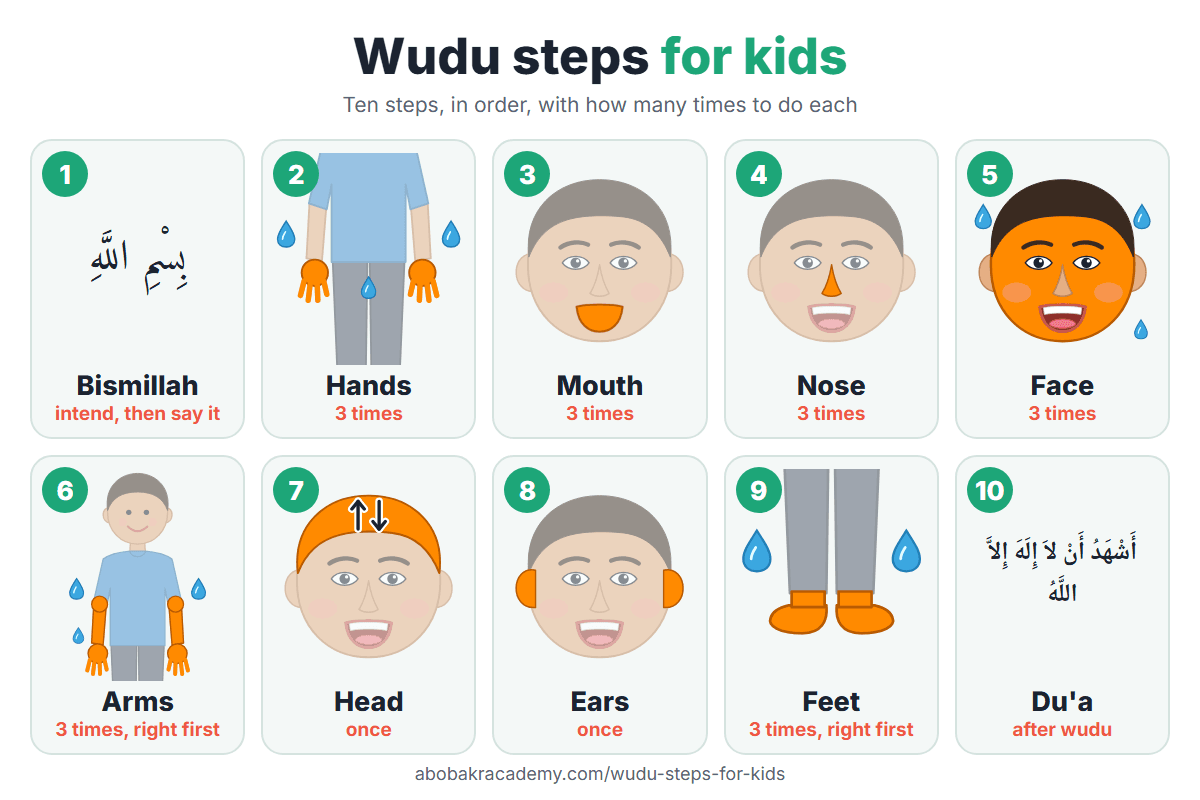
Wudu is the washing a Muslim does before prayer. Kids can learn it as ten steps: make the intention and say Bismillah, wash the hands, rinse the mouth and nose, wash the face and the arms up to the elbows, wipe the head and ears, wash the feet up to the ankles, and finish with a short du’a. Each part that is washed is done three times, and the right arm and foot go before the left.
Below are the steps with a picture for each, the four parts Allah names in the Quran, the du’a with a button to hear it, what breaks wudu, and a free printable chart, step cards and week tracker with no sign-up.
How to make wudu: the 10 steps
Read these out while your child copies you at the sink. The number after each step is how many times to do it.
- Intend, and say Bismillah. Know in your heart that you are making wudu to pray, then say Bismillah, بِسْمِ اللَّهِ, which means “In the name of Allah”.
- Wash your hands, three times. Wash both hands up to the wrists, and rub between your fingers.
- Rinse your mouth, three times. Take water in your right hand, swish it round your mouth and spit it out.
- Rinse your nose, three times. Breathe a little water gently into your nose, then blow it out.
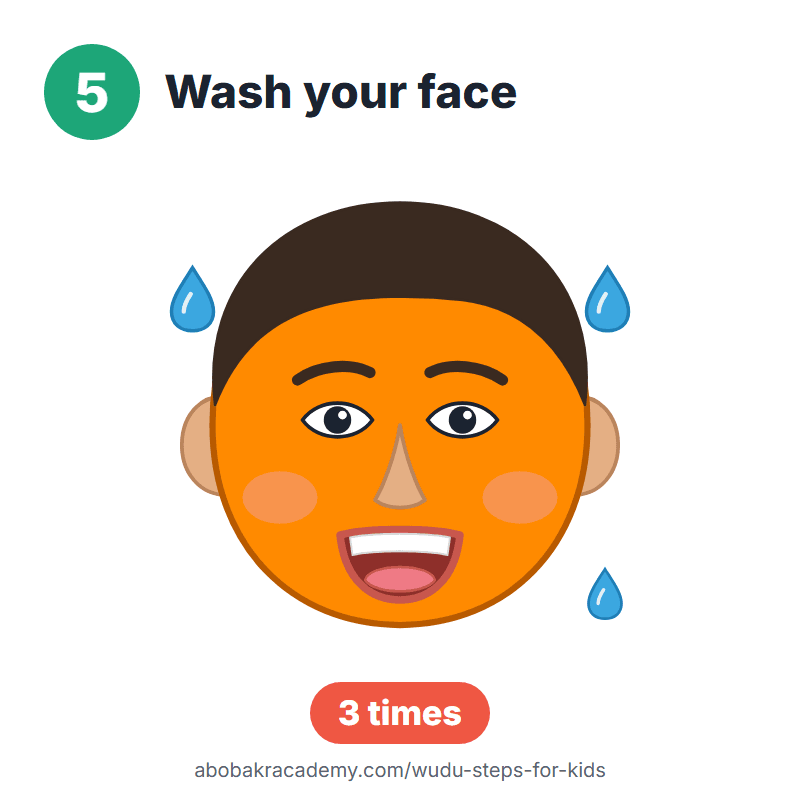
- Wash your face, three times. Wash your whole face, from your hairline to your chin and from one ear to the other.
- Wash your arms to the elbows, three times. Wash your right arm from the fingertips up to and over the elbow, then your left arm the same way.
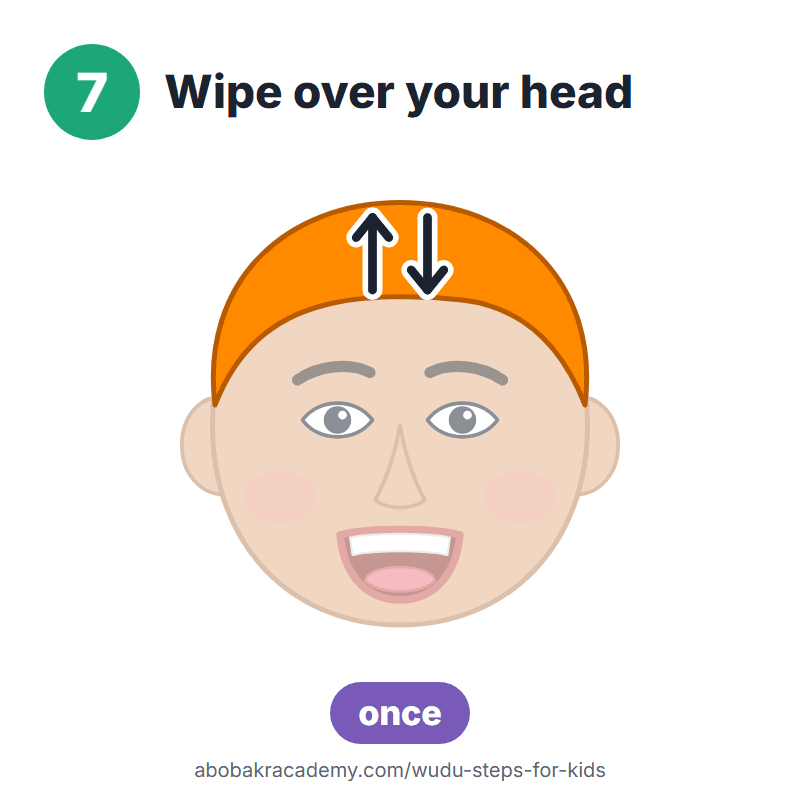
- Wipe over your head, once. Wet your hands and wipe them over your head from the front to the back, then bring them back to the front.
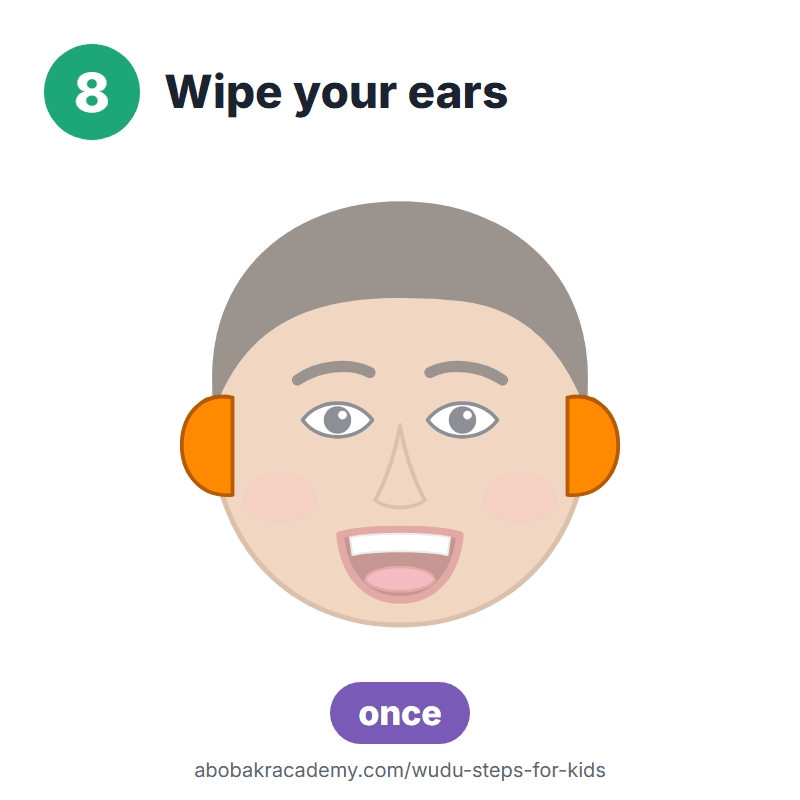
- Wipe your ears, once. With your hands still wet, wipe inside your ears with your first fingers and behind them with your thumbs.
- Wash your feet to the ankles, three times. Wash your right foot up to and over the ankle, getting between the toes, then your left foot the same way.
- Say the du’a. Finish by saying the du’a after wudu, below.
That is all of wudu. Once the order is familiar it takes a couple of minutes.
Wudu steps with pictures
One card for each step, drawn so the part to wash is the bright one. The cards are in the printable too: cut them out, shuffle them, and ask your child to put them back in order.





The four parts of wudu named in the Quran
Allah names the parts of wudu in Surah Al-Ma’idah, verse 6: “wash your faces and your forearms to the elbows and wipe over your heads and wash your feet to the ankles” (Sahih International translation). The table gives the Arabic words from the verse and the step each one belongs to.
| Word in the verse | Meaning | Step |
|---|---|---|
| وُجُوهَكُمْ | your faces | 5. Face |
| أَيْدِيَكُمْ | your hands and arms | 6. Arms |
| الْمَرَافِقِ | the elbows | 6. Arms |
| بِرُءُوسِكُمْ | over your heads (wipe) | 7. Head |
| أَرْجُلَكُمْ | your feet | 9. Feet |
| الْكَعْبَيْنِ | the two ankles | 9. Feet |
Every school of Islamic law counts these four as required: the face, the arms to the elbows, wiping the head, and the feet to the ankles. The other steps come from the way the Prophet ﷺ made wudu, as his companions described it. The schools differ on a few of them, such as whether the intention or rinsing the mouth and nose is required. A young child does not need that detail yet. Teach all ten, in order, and the four are covered.
The du’a after wudu
When the washing is done, say this du’a. It is in Sahih Muslim, number 234.
أَشْهَدُ أَنْ لاَ إِلَهَ إِلاَّ اللَّهُ وَحْدَهُ لاَ شَرِيكَ لَهُ وَأَشْهَدُ أَنَّ مُحَمَّدًا عَبْدُهُ وَرَسُولُهُ
Ash-hadu an la ilaha illallah, wahdahu la sharika lah, wa ash-hadu anna Muhammadan abduhu wa rasuluh.
“I bear witness that there is no god but Allah, alone, with no partner, and I bear witness that Muhammad is His servant and His Messenger.”
Sahih Muslim 234, on sunnah.com
Many families add a second line: اللَّهُمَّ اجْعَلْنِي مِنَ التَّوَّابِينَ وَاجْعَلْنِي مِنَ الْمُتَطَهِّرِينَ, said Allahumma-j’alni minat-tawwabin, waj’alni minal-mutatahhirin, which means “O Allah, make me one of those who repent, and make me one of those who purify themselves.” That line comes from Jami at-Tirmidhi, number 55, and sunnah.com gives the grading of its chain as weak (da’if, Darussalam), so this page keeps it apart from the du’a in Sahih Muslim. Its two key words are the ones the Quran uses in Surah Al-Baqarah, verse 222: Allah loves التَّوَّابِينَ, those who repent, and الْمُتَطَهِّرِينَ, those who purify themselves.
Where each step comes from
For parents who want to check. Each step on this page is described in the hadith below, and each links to its page on sunnah.com. Where sunnah.com shows a grade, it is given.
| Hadith | Grade on sunnah.com | What it shows |
|---|---|---|
| Sahih Muslim 234b | in the Sahih | The du’a after wudu |
| Jami at-Tirmidhi 55 | Da’if (Darussalam) | The second line many families add to the du’a |
| Sunan Abi Dawud 101 | Sahih (Al-Albani) | Say Bismillah at the start |
| Sahih al-Bukhari 159 | in the Sahih | The order: hands three times, mouth and nose, face three times, arms to the elbows three times, wipe the head, feet to the ankles three times |
| Sahih Muslim 226a | in the Sahih | The right arm before the left, the right foot before the left |
| Sahih al-Bukhari 185 | in the Sahih | Wipe the head from the front to the back and back again |
| Sunan an-Nasa’i 102 | Hasan (Darussalam) | Wipe inside the ears with the first fingers and the back with the thumbs |
| Jami at-Tirmidhi 38 | Sahih (Darussalam) | Wash between the fingers and toes |
| Sahih al-Bukhari 157 | in the Sahih | Washing each part once counts |
| Sahih al-Bukhari 158 | in the Sahih | Washing each part twice counts |
| Sahih al-Bukhari 168 | in the Sahih | Start with the right |
| Sahih al-Bukhari 135 | in the Sahih | Passing wind breaks wudu |
| Sahih al-Bukhari 137 | in the Sahih | A doubt does not break wudu: only a sound or a smell |
| Sunan Abi Dawud 203 | Hasan (Al-Albani) | Sleep breaks wudu |
| Sunan Abi Dawud 495 | Hasan Sahih (Al-Albani) | Children are taught to pray at seven |
What breaks wudu?
Wudu stays until something breaks it, so one wudu can last for more than one prayer. Three things break it that every child should know:
- Going to the toilet. The verse of wudu names coming from الْغَائِطِ (al-gha’it), the place where one relieves oneself, as a reason to purify again.
- Passing wind, even a little (Sahih al-Bukhari 135).
- Falling asleep (Sunan Abi Dawud 203, graded hasan by Al-Albani). Scholars differ over a light doze while sitting up.
If your child is not sure whether their wudu broke, the answer is in Sahih al-Bukhari 137: someone who only imagines it carries on unless they hear a sound or notice a smell. A doubt does not break wudu. Scholars list a few more things, and the schools differ on some of them. The three above are the ones a young child needs.
Free printable wudu chart and step cards (PDF)
Download the wudu printable (PDF, 5 pages). No email and no sign-up. It has:
- the ten steps on one A4 poster, for the wall by the sink;
- the ten step cards, to cut out and put in order;
- the du’a card, with the Arabic, a way to say it and the meaning;
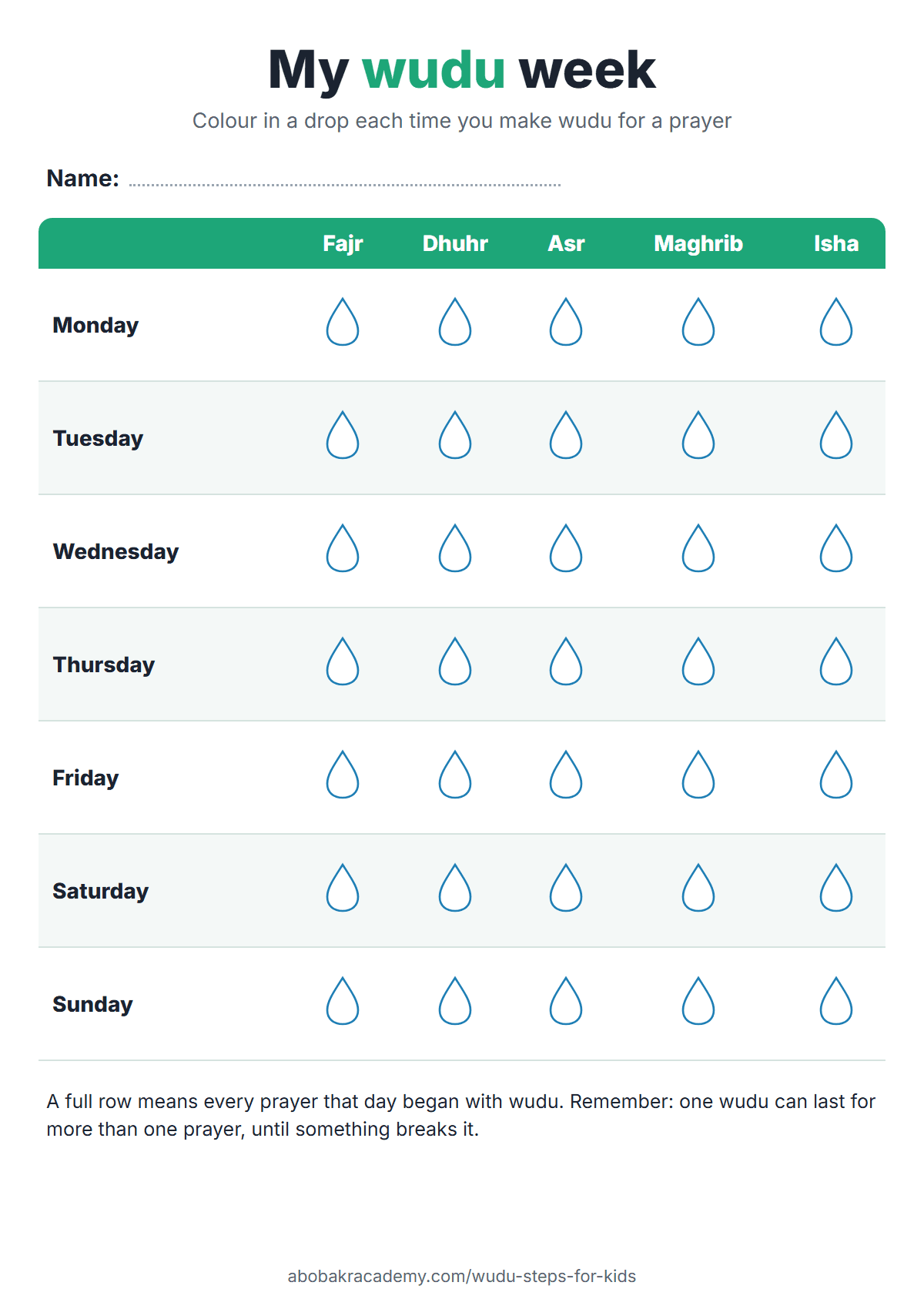
- a week tracker with a box for each prayer, to colour in after each wudu.
Teaching wudu when you are learning it too
This site is built for families where nobody at home reads Arabic, and wudu needs very little of it: Bismillah at the start and the du’a at the end. The du’a has a play button above, so you can learn it together.
- Practise dry first: go through the ten steps with no water, in the living room, until the order is known.
- A step stool at the sink lets a child reach the tap and keep the water off the floor.
- Roll the sleeves up past the elbow before starting. The elbow is part of the wash, and a sleeve in the way makes it easy to stop at the wrist.
- If the sink is too high to lift a foot to, use the bath or the shower tray for the feet.
- Make one wudu a day together, before the same prayer each day, and let the chart on the wall do the reminding.
When your child is ready to read the Quran itself, our teachers start from the letters and explain everything in English. See Quran classes for kids; the first lesson is free.
Age, girls, three washes, and what breaks wudu
At what age should a child learn wudu?
Children are taught to pray at seven, in a hadith graded hasan sahih by Al-Albani (Sunan Abi Dawud 495), and wudu comes before prayer, so seven is the age to have it learned by. Younger children can copy a parent at the sink well before that.
Is wudu different for girls?
No. Girls and boys make wudu with the same ten steps, in the same order, and say the same du’a.
Do you have to wash each part three times?
No. Washing each part once, so that the water reaches all of it, is enough: the Prophet ﷺ made wudu washing each part once (Sahih al-Bukhari 157) and twice (Sahih al-Bukhari 158). Three times is how Uthman showed his wudu (Sahih al-Bukhari 159), and it is the way this page teaches.
Does a small fart break wudu?
Yes. Passing wind breaks wudu, however little (Sahih al-Bukhari 135). A child who only thinks it might have happened does not need a new wudu unless they heard or smelled something (Sahih al-Bukhari 137).
What do you say before and after wudu?
Say Bismillah before you start. When you finish, say: Ash-hadu an la ilaha illallah, wahdahu la sharika lah, wa ash-hadu anna Muhammadan abduhu wa rasuluh (Sahih Muslim 234).
What are the four fard of wudu?
Washing the face, washing the arms up to the elbows, wiping the head, and washing the feet up to the ankles. They are the four named in Surah Al-Ma’idah, verse 6.
After wudu: duas, the five pillars and the body in Arabic
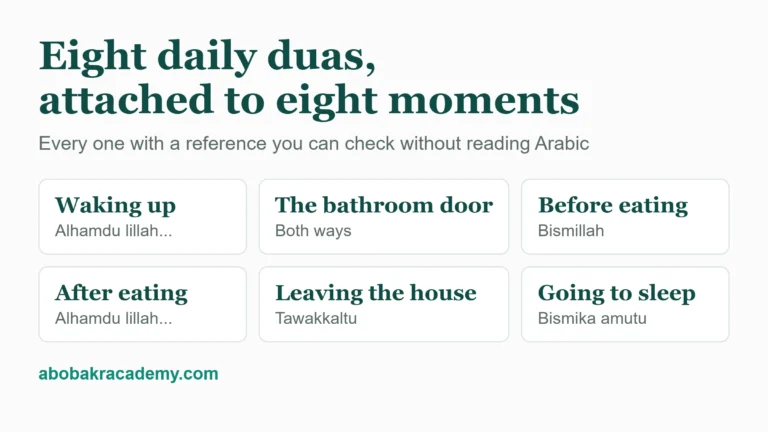
- Daily duas for kids: eight short du’as, each tied to a moment in a child’s day, on printable cards.
- The five pillars of Islam for kids: salah is the second pillar, and wudu comes before it.
- Body parts in Arabic: the Arabic word for every part washed in wudu, with a button to hear each one.
- Free printables: more charts and worksheets for Muslim children.
- Online Quran classes for kids: from the first letter, with a free first lesson.