Ask a child what month it is and they will tell you it is September. Ask them what month it is in the Islamic calendar and most will not know, even though they probably know Ramadan and can tell you when Eid is coming. The September they answered with has an Arabic name too, and both sets of names for the twelve Gregorian months are on our page of months in Arabic, with audio.
This page gives them the rest. Below are the twelve Islamic months in order, in Arabic with the vowel marks, with a way to say each one, what the name means, and what happens in each month. There is a free printable chart, a set of month cards and a short worksheet, with no sign-up.
The Islamic year has twelve months: Muharram, Safar, Rabee’ al-Awwal, Rabee’ al-Aakhir, Jumaadaa al-Oolaa, Jumaadaa al-Aakhirah, Rajab, Sha’baan, Ramadaan, Shawwaal, Dhul-Qa’dah and Dhul-Hijjah. Each month starts with the new crescent moon and lasts 29 or 30 days, so the year is about eleven days shorter than the one on your wall calendar. Four of the months are sacred: Muharram, Rajab, Dhul-Qa’dah and Dhul-Hijjah.
What are the 12 Islamic months in order?
Here they are from the first month of the year to the last. The four sacred months are marked with a star. Arabic reads from right to left, and the “say it” column doubles long vowels (aa, ee, oo) so a child holds them for longer.
| # | Month | Say it | What the name means |
|---|---|---|---|
| 1 | الْمُحَرَّم | Muharram ★ | Sacred, the month in which fighting was forbidden |
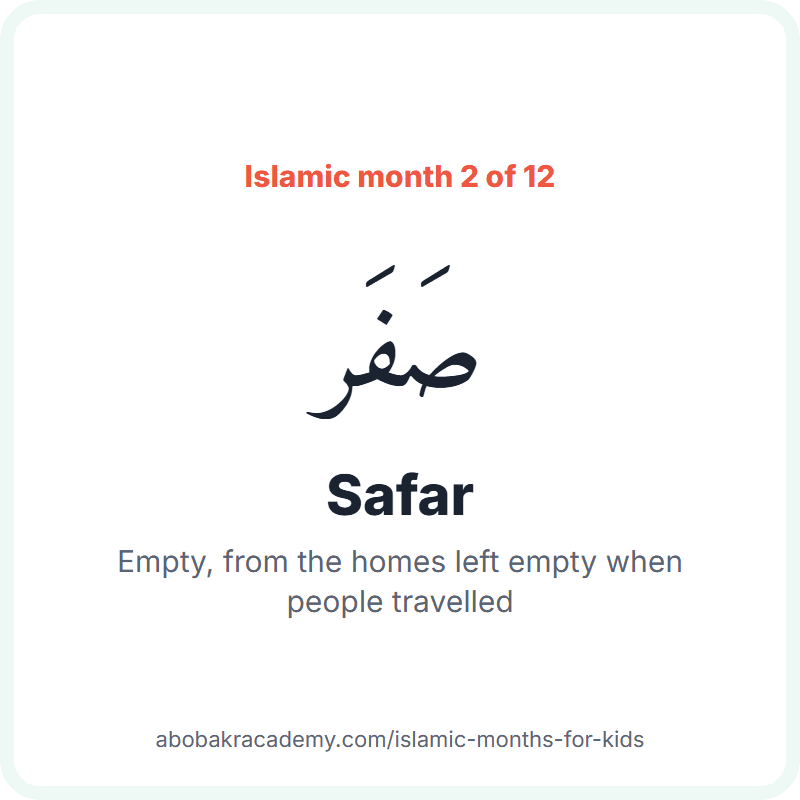
| 2 | صَفَر | Safar | Empty, from the homes left empty when people travelled |
| 3 | رَبِيع الأَوَّل | Rabee’ al-Awwal | The first spring |
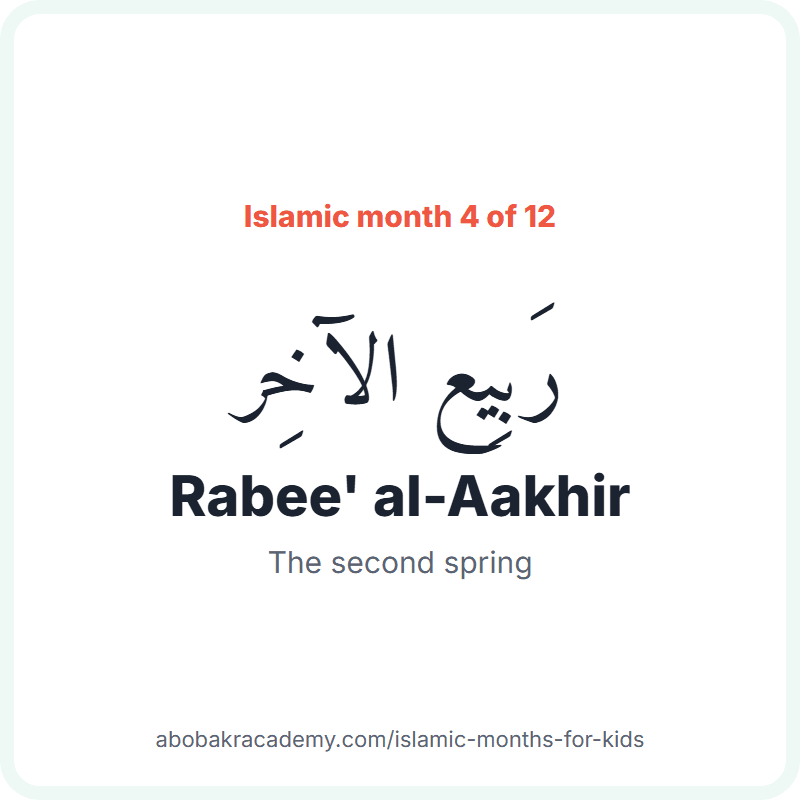
| 4 | رَبِيع الآخِر | Rabee’ al-Aakhir | The second spring |
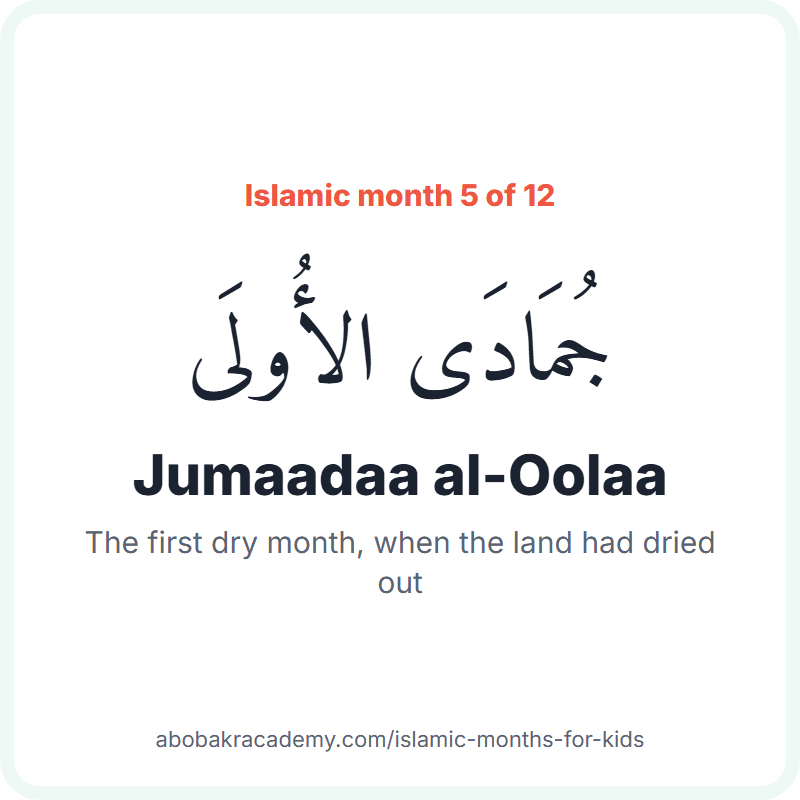
| 5 | جُمَادَى الأُولَى | Jumaadaa al-Oolaa | The first dry month, when the land had dried out |
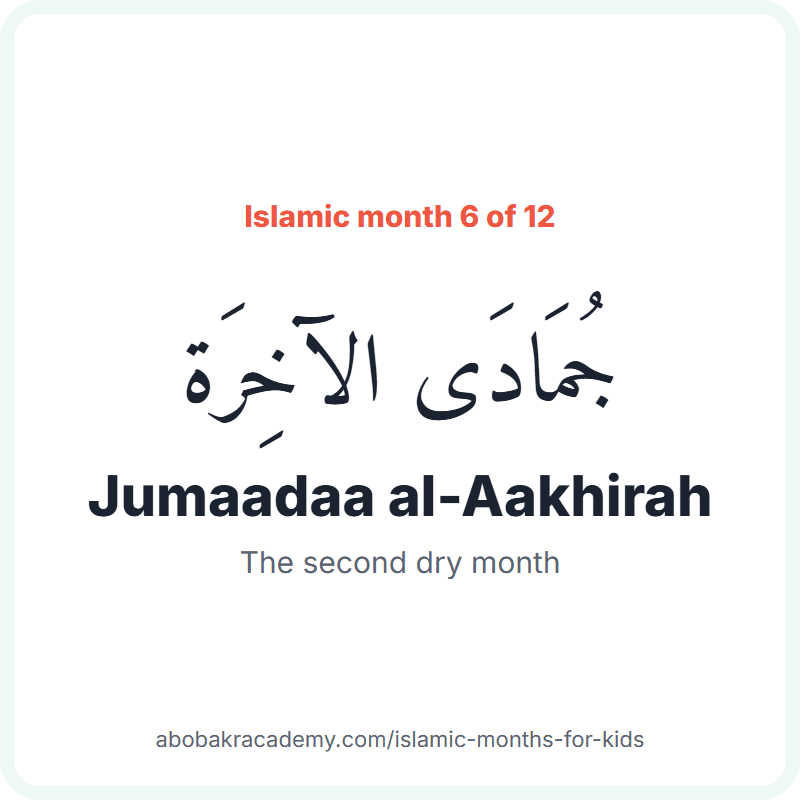
| 6 | جُمَادَى الآخِرَة | Jumaadaa al-Aakhirah | The second dry month |
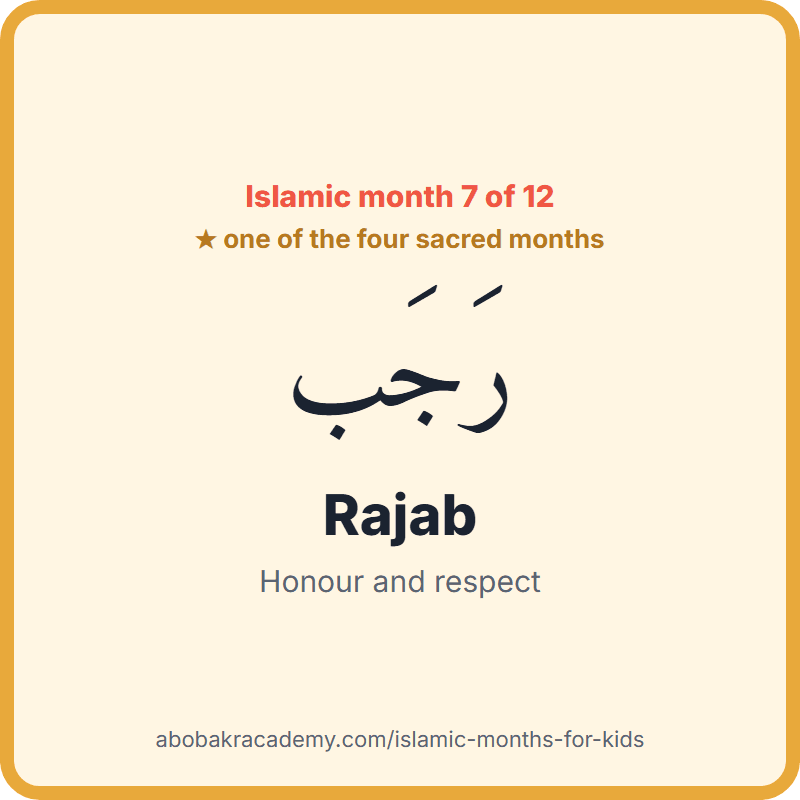
| 7 | رَجَب | Rajab ★ | Honour and respect |
| 8 | شَعْبَان | Sha’baan | Spreading out, when tribes split up to look for water |
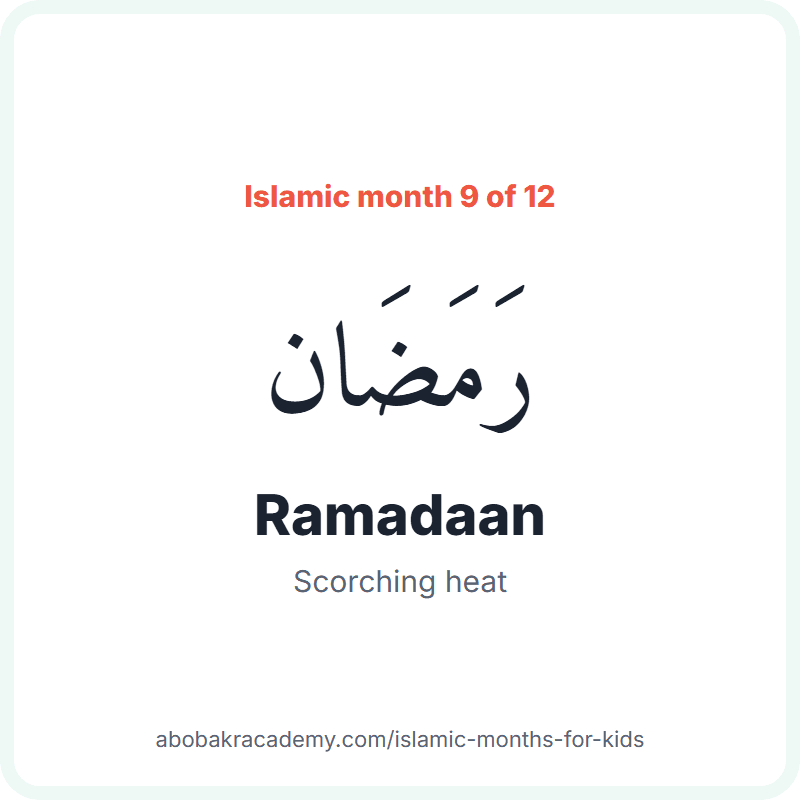
| 9 | رَمَضَان | Ramadaan | Scorching heat |
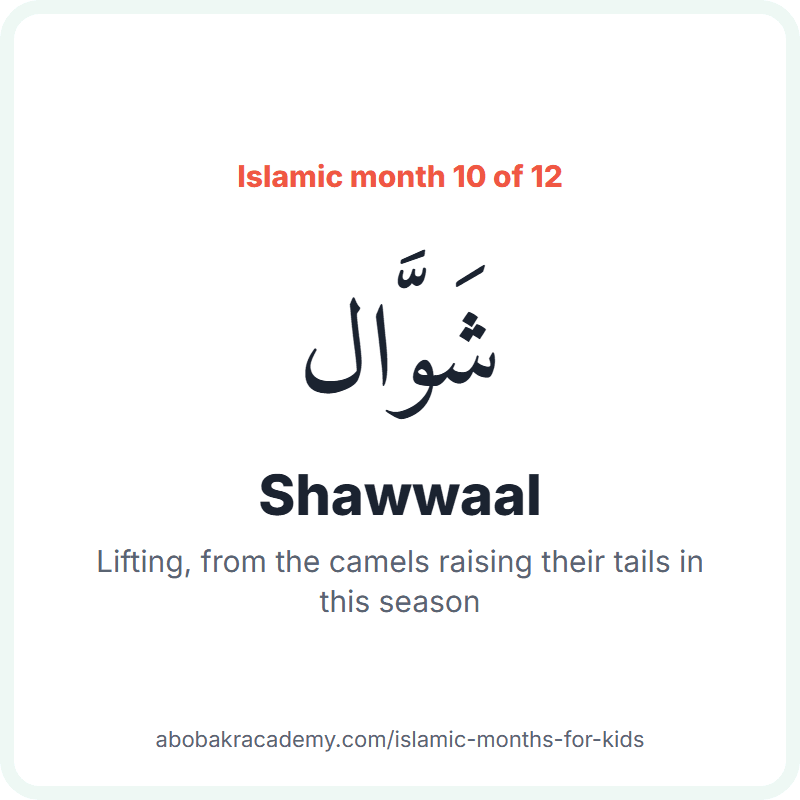
| 10 | شَوَّال | Shawwaal | Lifting, from the camels raising their tails in this season |
| 11 | ذُو الْقَعْدَة | Dhul-Qa’dah ★ | Sitting, the month people stayed home and did not fight |
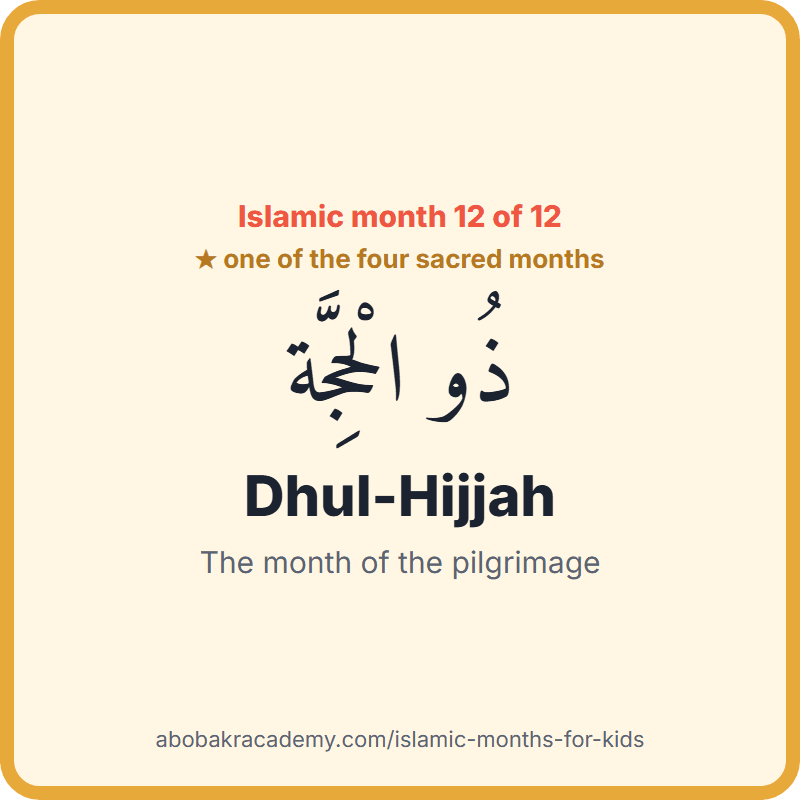
| 12 | ذُو الْحِجَّة | Dhul-Hijjah ★ | The month of the pilgrimage |
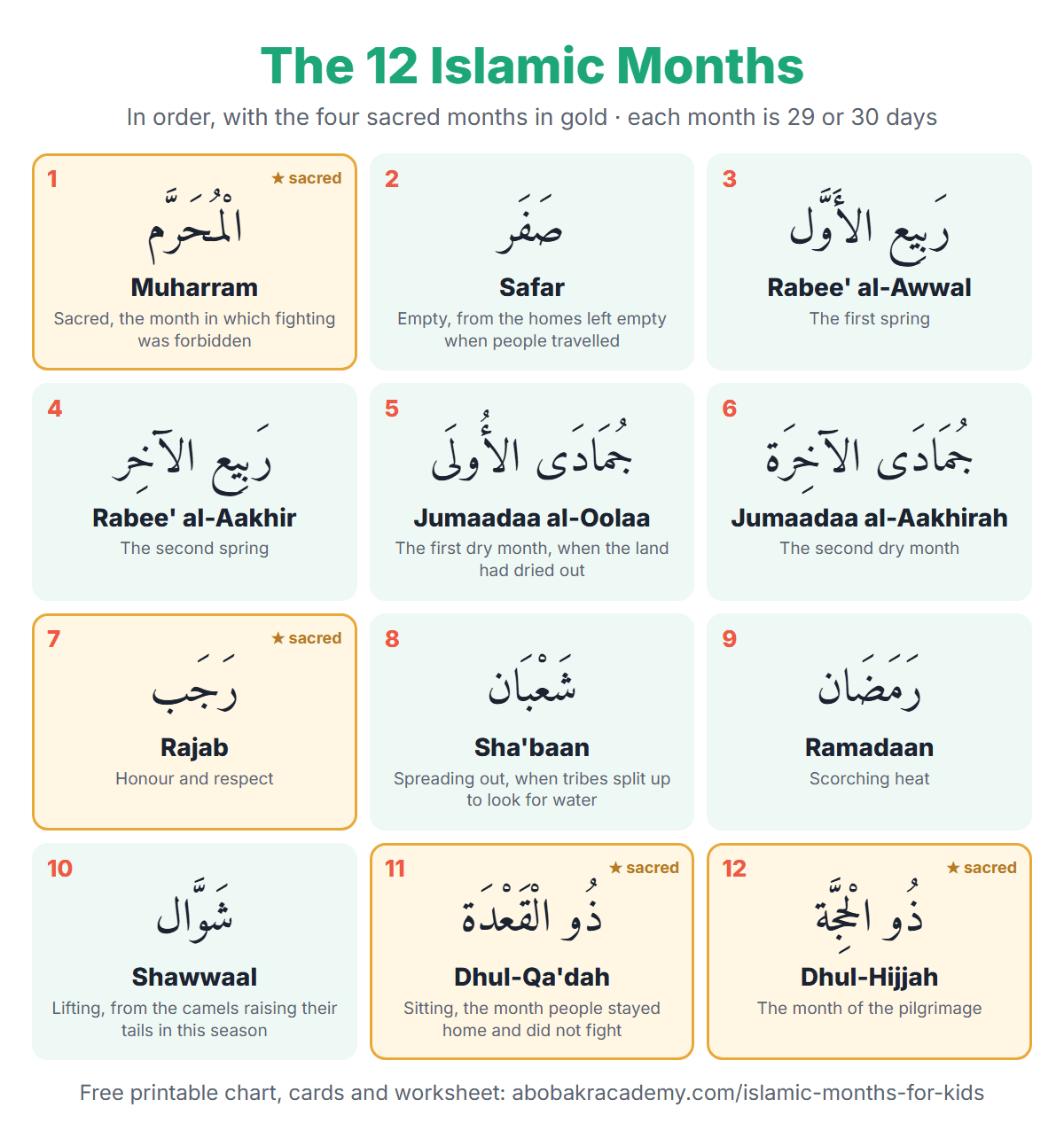
Most of these names are older than Islam. The meanings in the last column are the ones the classical Arabic dictionaries give, and they come from the seasons and the way of life in Arabia when the names were first used. That is why Ramadaan means scorching heat even when it falls in winter.
What happens in each Islamic month?
Some months have days every Muslim child should know. Others have none, and that is worth saying too, because a child who hears about Ramadan and the two Eids can easily think every month is supposed to be special.
| Month | What a child should know |
|---|---|
| Muharram ★ | The Islamic year begins. The 10th is Ashura, the day Allah saved Prophet Musa, and the Prophet ﷺ fasted it and told Muslims to fast it too. (Sahih al-Bukhari 2004) |
| Safar | Some people used to think Safar was an unlucky month. Among the old superstitions the Prophet ﷺ rejected was a belief about Safar, and scholars explain that no month is unlucky. (Sahih al-Bukhari 5707) |
| Rabee’ al-Awwal | The month in which the Prophet ﷺ arrived in Madinah after the Hijrah, the journey the Islamic calendar counts its years from. |
| Rabee’ al-Aakhir | No special days. A good month to settle a steady routine of Quran and du’a. |
| Jumaadaa al-Oolaa | No special days. Keep the routine going. |
| Jumaadaa al-Aakhirah | The month just before Rajab, which is the next sacred month. |
| Rajab ★ | One of the four sacred months. The Prophet ﷺ named it himself: Rajab, which comes between Jumada and Sha’ban. (Sahih al-Bukhari 4662) |
| Sha’baan | The warm-up for Ramadan. Apart from Ramadan, the Prophet ﷺ fasted in no month more than he did in Sha’ban. (Sahih al-Bukhari 1969) |
| Ramadaan | The month of fasting, and the month the Quran was first sent down. Laylat al-Qadr is in its last ten nights. (Surah Al-Baqarah 2:185) |
| Shawwaal | Eid al-Fitr is on the 1st. Fasting six days of Shawwal after Ramadan is like fasting the whole year. (Sahih Muslim 1164) |
| Dhul-Qa’dah ★ | One of the four sacred months, and the first of three in a row. (Sahih al-Bukhari 4662) |
| Dhul-Hijjah ★ | Hajj happens now. Good deeds in its first ten days are loved more than at any other time. The Day of Arafah is the 9th and Eid al-Adha is the 10th. (Sahih al-Bukhari 969) |
Which Islamic months are sacred?
Four of them. The Quran says that Allah made the number of months twelve, and that four of them are sacred (Surah At-Tawbah 9:36). The Prophet ﷺ named them: three in a row, Dhul-Qa’dah, Dhul-Hijjah and Muharram, and Rajab on its own between Jumaadaa and Sha’baan (Sahih al-Bukhari 4662).
A simple way to help a child remember: the last two months of the year and the first month of the next are all sacred, so the year turns over in the middle of a sacred stretch. The fourth one, Rajab, sits by itself two months before Ramadaan.
How long is an Islamic month?
Always 29 or 30 days, and never 31. An Islamic month begins when the new crescent moon is seen after sunset, and it ends when the next one is seen. The Prophet ﷺ said that a month can be 29 nights, and that if cloud hides the moon at the end of Sha'baan, Sha'baan is completed as 30 days (Sahih al-Bukhari 1907).
That is also why Muslims in different countries sometimes start Ramadan or celebrate Eid a day apart. The moon was seen in one place a night earlier than in another, or a community follows a calculated calendar instead of a sighting. In the Quran the new moons are “measurements of time for the people and for Hajj” (Surah Al-Baqarah 2:189, in the Sahih International translation).
Why does Ramadan come earlier every year?
Because twelve moon months add up to about 354 days, while the year on a wall calendar has 365. The Islamic year finishes about eleven days sooner, so every month, Ramadan included, arrives about eleven days earlier each year.
Over a lifetime that adds up. Ramadan moves all the way round the seasons in about 33 years, so a child who fasts their first Ramadan in the long days of summer will one day fast it in the short days of winter. It is one of the easiest ways to show a child that the Islamic calendar is a real, living thing and not just a list to learn.
Why do Islamic years start from the Hijrah?
Because the Companions chose it. When they began numbering the years, they did not count from the day the Prophet ﷺ first received revelation, or from the day he died, but from the day he arrived in Madinah (Sahih al-Bukhari 3934). That journey is the Hijrah, and it is why Islamic years are written with AH, “after the Hijrah”. The Hijrah is one of the Seerah stories children learn in our Islamic Studies classes.
How can you teach the months if you do not read Arabic?
Start from the months your child already knows, then fill in the gaps. Most children know three things: Ramadan, the Eid after it, and the Eid with the sheep or the Hajj. Those are Ramadaan, Shawwaal and Dhul-Hijjah. Put those three on the chart first, and then Muharram as the start of the year. Now the other eight are just the spaces between them.
- Say the new month together. When a new Islamic month starts, say its name at dinner and find it on the chart. Twelve times a year is enough to make the list stick without drilling it.
- Use the cards in order. Shuffle the twelve month cards from the printable and let your child lay them out from Muharram to Dhul-Hijjah. You can check the order against the chart without reading a word of Arabic.
- Count the sacred ones. Ask your child to find the four starred months. Then ask which three are next to each other.
- Link each month to a date they care about. A birthday, the first day of school or a holiday. Ask which Islamic month it fell in this year, and which month it will fall in next year. That is the eleven-day shift, learned without a single number.
Each month also has its own card below. Print the card for the month you are in and put it somewhere your child will see it every day, then swap it when the new moon brings the next month.




If your child is also learning the days of the week, the days of the week in Arabic use the same “say it” spelling as this page, so the two sit well side by side.
Free printable Islamic months chart for kids
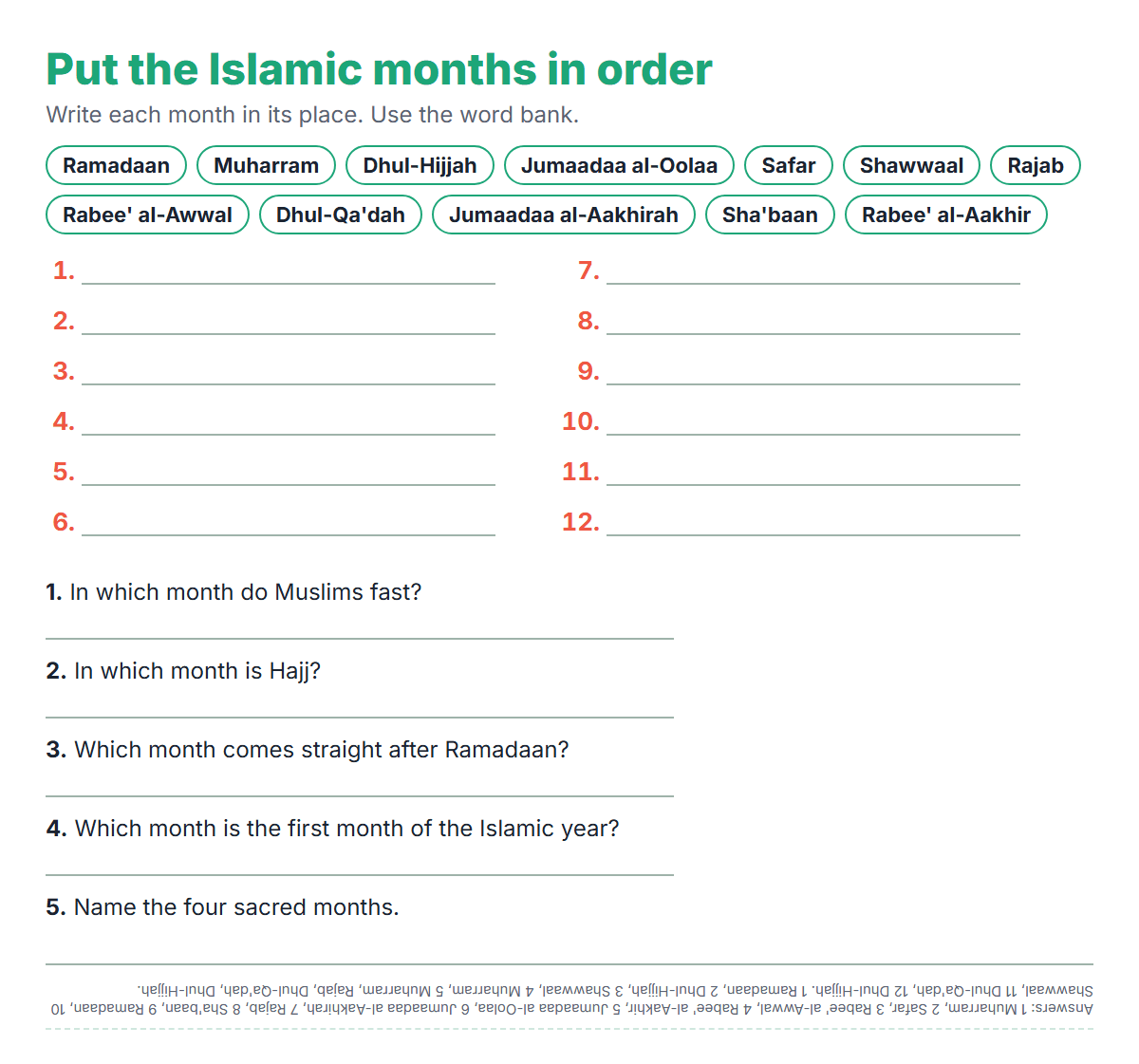
Download the Islamic months chart, cards and worksheet (free PDF). Page one is the chart of all twelve months with the sacred months marked. Page two is twelve month cards to cut out and put in order. Page three is a short worksheet with the answers at the bottom. It is sized for A4 and prints on US Letter if you choose “fit to page”. There is no sign-up.
Common questions about the Islamic months
Can an Islamic month have 31 days?
No. An Islamic month follows the moon, so it is always 29 or 30 days long. A month of 31 days only exists in the solar calendar.
What is the first month of the Islamic year?
Muharram. The Islamic New Year is the first day of Muharram, and the last month of the year is Dhul-Hijjah, the month of Hajj.
How many days are in an Islamic year?
About 354, sometimes 355. That is roughly eleven days fewer than the solar year, which is why Islamic dates move earlier every year.
Which month is named in the Quran?
Only one: Ramadaan, the month in which the Quran was sent down (Surah Al-Baqarah 2:185). The Quran mentions that there are twelve months and four sacred ones, but it names Ramadaan alone.
How do I know the Islamic date today?
Ask your local mosque, which will announce the start of each month, or use the calendar your community follows. Dates can differ by a day between countries because the new moon is not seen everywhere on the same night.
Ramadan, Hajj and duas through the year
When Ramadaan is on its way, the Ramadan Quran reading plan helps a family plan the month. For Dhul-Hijjah there is a step by step guide to Hajj, and the daily duas for kids fit any month of the year. The 99 names of Allah for kids work well as a companion to this chart, and more free sheets are on our free printables page. For a reading target in Ramadan itself, the 30-day Quran reading plan lists the verse each day starts on. When the new moon is sighted, the greetings to say are on our page about Ramadan Mubarak, with audio.