To teach a child the Quran, let them hear it every day before they read it, teach the Arabic letters by sound from about age four, then work through a qaida before moving to the mushaf. Keep sessions short (10 to 15 minutes a day under seven, 20 to 30 after), memorise short surahs by repeating after a reciter, and correct pronunciation early and gently. Above all, make it something they love rather than something they fear.
None of the work you do at home needs you to read Arabic. This guide is written for the parents we teach most: families in the US, UK, Canada and Australia where nobody at home reads the script. It sets out what to teach at each age, how long each session should be, what you can check yourself, and the point where a teacher earns their place.
What to teach at each age
Children move through the same stages whatever age they start. A nine-year-old beginner will pass through the first two in weeks rather than years, so read the table by stage first and age second.
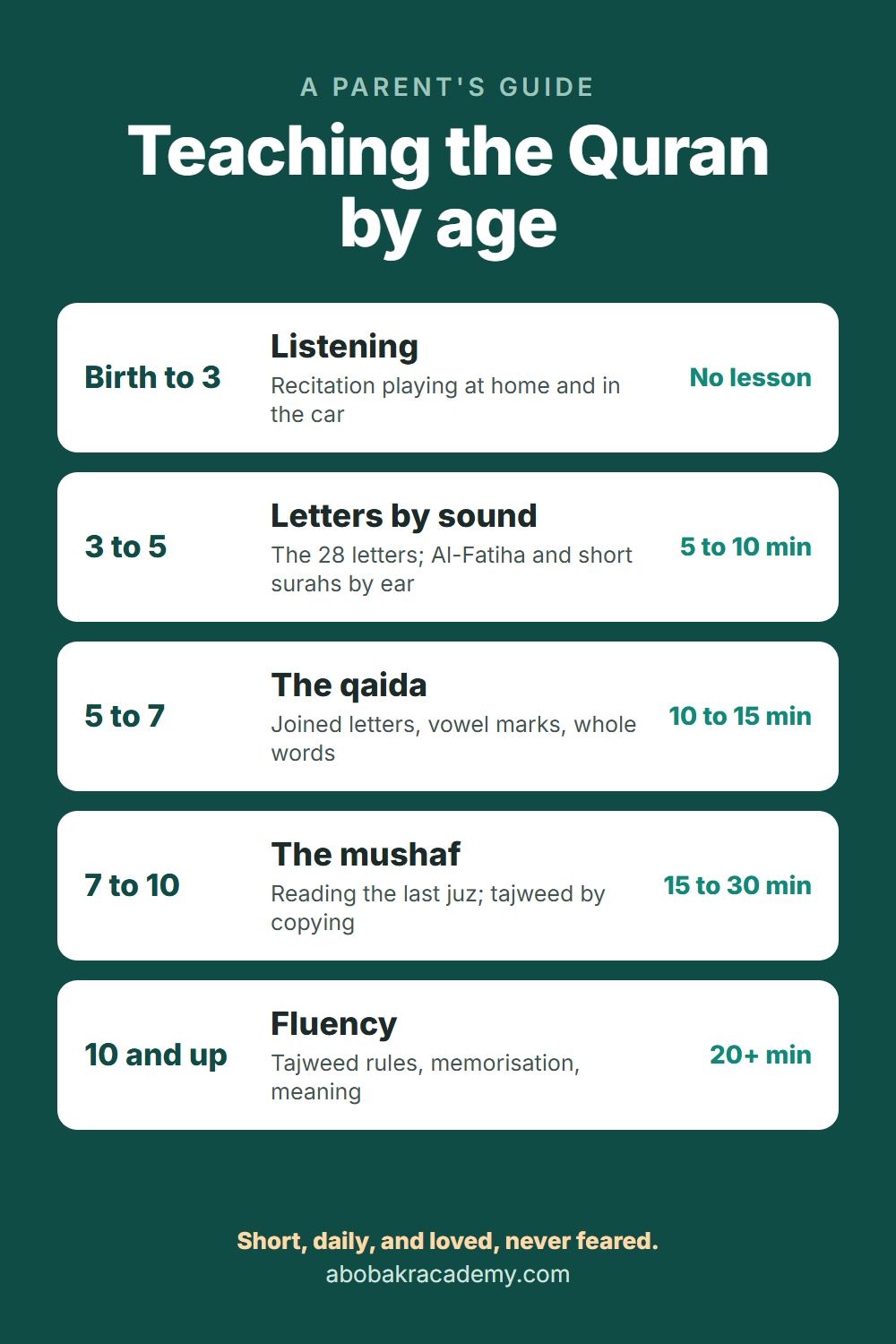
| Age | What they learn | Time a day | What you do at home |
|---|---|---|---|
| Birth to 3 | The sound of recitation. Al-Fatiha and a few short surahs heard so often they become familiar. | No lesson. Recitation playing in the house or the car. | Play the same reciter every day. Say bismillah aloud before meals and at bedtime. |
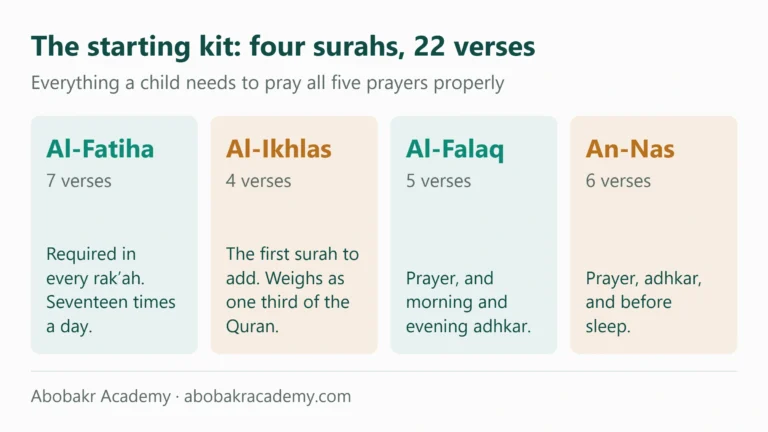
| 3 to 5 | The 28 letters by sound and shape. Al-Fatiha, Al-Ikhlas and An-Nas learned by ear. | 5 to 10 minutes | A letter chart at child height, flashcards as a game, one line of a surah repeated after the reciter. |
| 5 to 7 | A qaida: joined letters, short vowels, then longer words. | 10 to 15 minutes | Keep the same time every day, sit beside them, and listen for where the pauses fall. |
| 7 to 10 | Reading from the mushaf, starting with the last juz. Tajweed learned by copying the teacher. | 15 to 30 minutes | Record one passage a month and compare. Ask the teacher which mistake came up most. |
| 10 and up | Fluent reading, tajweed rules by name, a memorisation target, the meaning of what they recite. | 20 to 30 minutes or more | Protect revision time. Old pages forgotten are the most common reason progress stalls. |
Seven steps to teach your child the Quran at home
1. Let them hear it before they read it
Children learn to speak by listening for years before they say a word, and recitation works the same way. Play one clear reciter in the house every day, at the same times: in the car, at breakfast, as they fall asleep. Pick one and stay with them, so the rhythm a child absorbs is consistent. By the time letters arrive, the sounds they make are already familiar.
2. Teach the letters by sound first
Start with what a letter sounds like, then what it looks like. Put an Arabic alphabet chart on the wall at your child’s eye level and turn alphabet flashcards into a game of find-the-sound. A handful of letters have no English equivalent, and children tend to swap them for the nearest English sound; the letters children say wrong lets you hear each one against the sound it gets confused with.
3. Work through a qaida before the mushaf
A qaida is a short primer that takes a child from single letters to joined letters, vowel marks and finally whole words. The Noorani Qaida is the most widely used; Nour Al Bayan and Yassarnal Quran do the same job. Finish it properly. Children who move to the mushaf with the qaida half done tend to read the familiar pages from memory and stall on anything new. A qaida progress tracker on the fridge shows both of you how far they have come.
4. Keep sessions short, and at the same time every day
Ten minutes every day does more than an hour on Sunday. Under seven, 10 to 15 minutes is plenty; older children can manage 20 to 30. Attach the session to something that already happens, like straight after Fajr, after breakfast or after Maghrib, so it never has to be negotiated. End while your child is still enjoying it. If school terms keep breaking the habit, our guide to a Quran routine that survives the school year covers how to hold the slot.
5. Memorise short surahs by repeating after a reciter
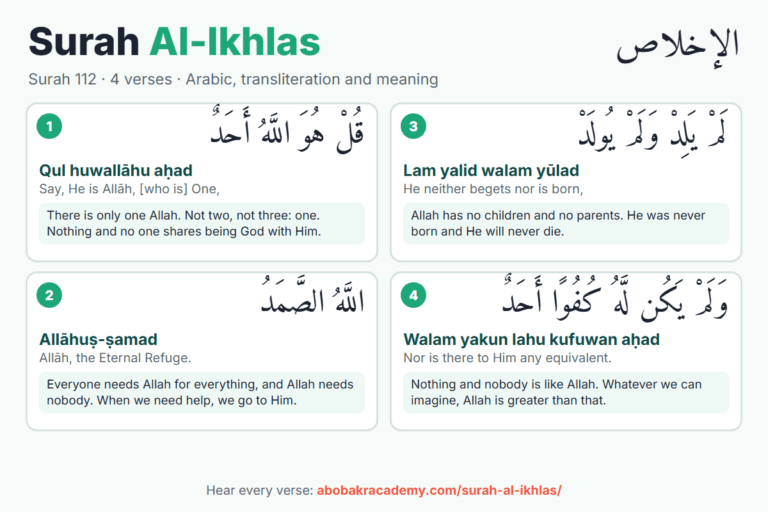
The oldest method is still the best for young children: the reciter says a line, the child repeats it, three times, then the next line, then the two together. Try it now with Al-Ikhlas, four short verses, using al-Husary’s teaching recitation, which is slow and clear enough to copy.
Qul huwallāhu aḥad
Say, "He is Allāh, [who is] One,
Allāhuṣ-ṣamad
Allāh, the Eternal Refuge.
Lam yalid walam yūlad
He neither begets nor is born,
Walam yakun lahu kufuwan aḥad
Nor is there to Him any equivalent."
One verse a day is a good pace for a five-year-old. When they can say all four without the recording, move on, and come back to it at the end of every week. Our list of short surahs to memorize gives the usual order with audio for every verse, and the short surahs tracker is a chart your child can colour in as each one is learned.
6. Correct pronunciation early, and gently
Tajweed for a young child is not a set of rules to learn; it is copying a good reciter closely. Mistakes that are corrected in the first months disappear, and mistakes that go uncorrected for a year become habits that take far longer to undo. This is the step where a parent who does not read Arabic genuinely needs help, because you cannot hear an error you do not know. When your child is ready for the rules by name, our page on tajweed rules sets them out with examples from the Quran.
7. Make it something they love, never something they fear
The Prophet ﷺ said, “The best among you are those who learn the Qur’an and teach it” (Bukhari 5027). He also said that a person who recites with difficulty, stumbling over the words, receives a double reward (Muslim 798), which is worth telling a child who finds it hard. Praise effort and name what they did well. Never use the Quran as a punishment or extra recitation as a consequence. If your child has already started to resist, read what to do when a child does not want to learn Quran before you push harder.
If you do not read Arabic yourself
Most parents who ask us this question assume they cannot teach the Quran at all. You cannot be the one who corrects pronunciation, but the three jobs that decide whether a child actually learns are yours, and none of them needs Arabic.
Keeper of the slot. The daily session happens because you make it happen, every day, at the same time.
The listener. You can hear whether your child pauses between letters or between whole words, whether they correct themselves without being told, and whether a word sounds the same each time it appears.
The recorder. Record one passage on your phone once a month. Played side by side, three months of recordings show progress or a stall more clearly than any report.
Our guide to checking your child’s Quran progress when you don’t read Arabic walks through each of those checks and the questions that get a real answer out of a teacher. Many parents also end up learning alongside their child, which turns out to be easier than expected when the lessons are in English; the same approach for Arabic is in teaching Arabic to kids when you don’t speak it.
A week of Quran for a five-year-old and a nine-year-old
Two lessons a week with a teacher and short practice on the other days is the pattern that works for most families we teach. At two ages, it looks like this.
| Day | Age 5 (10 minutes) | Age 9 (20 minutes) |
|---|---|---|
| Monday | Lesson with the teacher: two new qaida lines | Lesson with the teacher: new half page, one tajweed point |
| Tuesday | Read Monday’s lines twice; three letters on the flashcards | Read the new half page twice; record it |
| Wednesday | One verse of a short surah, repeated after the reciter | Revise last week’s page, cold |
| Thursday | Lesson with the teacher: check Monday’s lines, two more | Lesson with the teacher: correct Tuesday’s recording, new half page |
| Friday | Read Thursday’s lines; the surah verse again | Memorise two verses of the current surah |
| Saturday | Letter game: find the sound on the chart | Revise everything memorised this month |
| Sunday | Rest, or listening only | Read to a parent or grandparent; rest |
Print this plan (PDF): the stages by age on one side and a blank week to fill in on the other. Free, no sign-up.
What the 7-7-7 rule says, and what the hadith says
The 7-7-7 rule divides childhood into three stages of seven years: play with them for the first seven, teach and discipline them for the next seven, and be their companion for the seven after that. It is widely shared as a saying of Ali ibn Abi Talib, but it is not found with a chain in the major hadith collections, so treat it as parenting wisdom rather than a teaching of the Prophet ﷺ.
The hadith that does set an age is about prayer: “Command your children to pray when they become seven years old” (Abu Dawud 495, graded hasan sahih by al-Albani). Many families take seven as the age when Quran practice becomes a daily expectation too, with listening and letters as play before then. That fits the table above.
When to bring in a teacher
A teacher is not needed for the first stage, and plenty of parents manage the letters on their own. Bring one in when any of these is true:
- Your child has reached the qaida and you cannot tell whether the vowel sounds are right.
- They read familiar pages smoothly and stumble on every new one.
- The daily slot keeps slipping because it depends on you alone.
- They are ready for tajweed or memorisation, which needs someone who can hear the mistakes.
At Abobakr Academy, children start from age four, one to one and online, in lessons of 30 to 60 minutes. Teachers explain in English, so the lesson works in a home where nobody else reads Arabic, and you are welcome to sit in. A female teacher is available if you ask. The Noorani Qaida classes for kids cover the letter and qaida stages, and our online Quran classes for kids cover reading, tajweed and memorisation after that.
Questions parents ask
How can I teach Quran to my child?
Play recitation daily, teach the letters by sound, finish a qaida, then read from the mushaf. Keep sessions short, learn short surahs line by line after a reciter, and have a teacher correct pronunciation.
At what age should a child start learning the Quran?
Listening can start from birth and letters from about four. Most children are ready for a structured qaida between four and six. Our page on what age to start Quran covers the signs of readiness.
How many minutes a day should a child study Quran?
10 to 15 minutes for children under seven, 20 to 30 minutes for older children. A short session every day works better than a long one once a week.
How long does it take a child to learn to read the Quran?
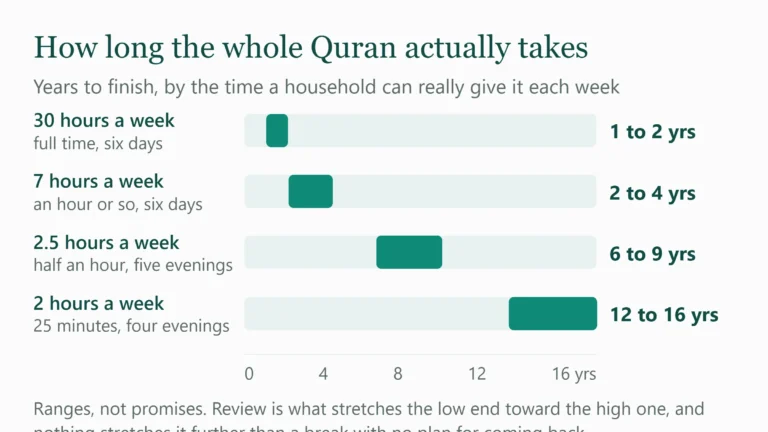
With short daily practice and two lessons a week, most children who start at five or six finish a qaida in six months to a year, then read slowly from the mushaf. Older beginners usually move faster.
Can I teach my child the Quran if I can’t read Arabic?
Yes, for most of it. You can play recitation, keep the daily routine, use letter charts and listen for progress. Correcting pronunciation needs someone who reads Arabic, so that part goes to a teacher.
How do I explain the Quran to a child in a simple way?
Tell them it is Allah’s words to us, sent to the Prophet ﷺ to show people how to live. Then explain one short surah at a time in a sentence a child can repeat: Al-Ikhlas says Allah is One and nothing is like Him. Stories of the prophets make the rest easier to follow.
Should children learn the meaning as well as the reading?
Yes, in small doses alongside the reading. Telling a child what a short surah means makes it easier to remember and to love. Reading the Quran without understanding explains where meaning fits.
Want a teacher to take the part you can’t?
Our tutors teach children from age four, one to one and online, explaining everything in English. The first lesson is free, with nothing to sign. Book a free trial lesson or see Quran classes for kids.