Most families do not notice the gap until the first lesson back. The child sits down in September, opens the mushaf at the page they finished in June, and cannot read it at the speed they were reading it two months earlier. Nothing has gone wrong. This happens to almost every child, and how the next three weeks are handled decides whether the year starts well or turns into an argument.
What follows applies whether your child studies with a tutor or with you at home. Building a Quran routine for kids around a new school timetable is a different problem from keeping one going through the holidays, and our teachers working with younger students see the same pattern every September.
What slips over a summer
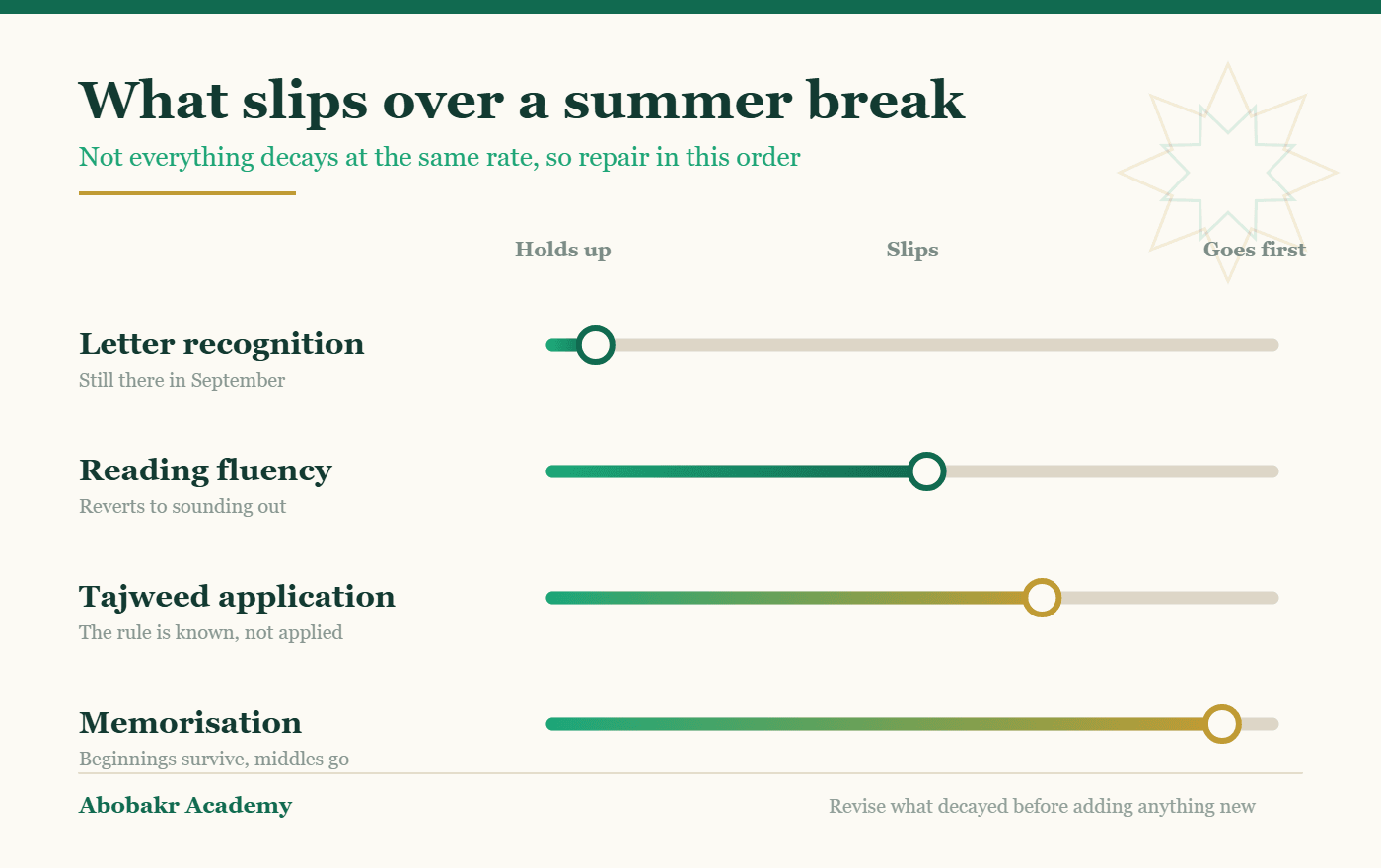
Not everything decays at the same rate, which is worth knowing because it tells you what to repair first.
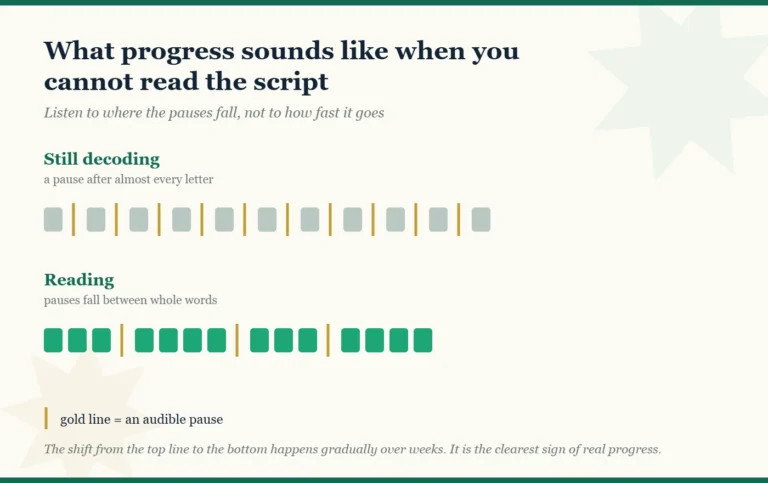
Letter recognition is stubborn. A child who genuinely knew the letters in June still knows them in September. What goes is fluency, the speed of moving from seeing a word to saying it. Reading that had become smooth reverts to sounding out, and to a parent listening it sounds like the child has forgotten far more than they have.
Memorisation is the opposite. It fades fast, and without anyone noticing. Surahs recited daily in June are half gone by August, and the parts that survive are the beginnings. A child will start confidently and stall in the middle, which is the normal shape of decayed hifz rather than a sign of carelessness.
Tajweed rules sit in between. The knowledge stays, the application goes first. Expect a child to be able to tell you what ikhfa is while not doing it.
Why the September restart usually goes wrong
The common mistake is restarting at the level the child finished at. It feels logical. It also means the first three lessons are spent failing, and a child who fails in the first three lessons decides they have got worse and stops wanting to go.
Adults recover from a bad restart because they understand what is happening. Children read it as evidence about themselves. That is why the first fortnight counts for more than the rest of the term.
The second mistake is scheduling for the parent you intend to be rather than the parent you will be in week six. Four sessions a week booked in early September, in the first flush of a new school year, usually collapses by half term and takes the habit down with it.
Re-baselining without making it feel like a punishment
Go back deliberately. Start the child a little below where they finished, on material they will get right, and let the first week be easy. Fluency returns much faster than it was built, usually within two or three weeks, because the underlying recognition never left.
For memorisation, revise before adding anything new. Which surahs get revised on which day is the part worth writing down rather than holding in your head, and there is a printable sheet for planning that revision if it helps. A child who spends the first fortnight recovering surahs they already know will hold them far better than one who is pushed straight into new material on top of a shaky base. Nothing new goes in until the old material comes out cleanly.
Say out loud what you are doing and why. A child told we are going back a bit because everyone does after a break hears something completely different from a child who is silently moved back a level.
Fitting Quran into a school week
The scheduling question parents ask is when there is time. The more useful question is when the child still has attention left, because those are not the same window. One part of this needs no window at all: the daily dua cards attach to moments the school day already has, so they keep going in the weeks when the lesson slot does not.
The after-school hour is worse than it looks
The slot straight after school looks ideal on paper and is often the worst hour of the day. The child has been concentrating since morning, has not eaten properly, and still has homework ahead. Lessons in that window tend to be technically attended and largely wasted.
Early mornings work better than most parents expect
Before school is unpopular with everyone and works surprisingly well, particularly for memorisation, which benefits from a mind that has not yet been filled with anything else. Fifteen minutes of revision before breakfast holds more than forty minutes at nine at night.
Weekends carry more than you think
A family that cannot protect two weekday slots can still run a real programme on a weekend session plus short daily revision at home. The daily part is what matters. The lesson checks the work, but it does not replace it. If your child already reads, our Quran reading plan sets the daily portion in pages, or in minutes for a child still learning.
When homework and Quran collide
They will collide, usually around the time exams or projects appear, and the family that has decided in advance what happens copes far better than the family improvising at seven in the evening.
The workable rule is to protect the daily revision and let the lesson move. Ten minutes of revision survives almost any week. A full lesson does not, and trying to force it through a genuinely overloaded evening teaches a child that Quran is the thing that gets fought over.
Practically, that means knowing your rescheduling terms before you need them. Ours ask for two hours notice, and a weekly subscription includes one cancellation a month, so a clash can be moved rather than lost. Families who use that deliberately in a heavy week keep the habit intact. Families who cancel without moving the lesson usually lose the slot and then the routine. Homeschooling families have more room to move it: the Muslim homeschool weekly plan puts the Quran lesson in the morning, before the other subjects.
What a realistic first term looks like
Roughly the first three weeks go on recovery, and it is a mistake to read progress before that. From there a child working steadily through a school term will normally rebuild to their June level and move meaningfully past it by the winter break.
That is a slower headline than most parents expect and a faster one than most fear. What moves it is rarely talent or the number of lessons. It is whether the short daily practice happens on ordinary days, the unremarkable Tuesdays when nobody feels like it.
Judging whether that is happening is harder if you do not read Arabic yourself, though there are still several things you can check without waiting for the tutor to tell you.
Signs the routine is not working
- The child can recite for the tutor but not for you. Usually a sign the material is being held short term rather than learned.
- Revision only happens on lesson days. This is the most common failure, and it can hold progress back for a whole year.
- Sessions keep moving. A slot rescheduled repeatedly is a slot that does not fit the week, and it is better replaced than defended.
- Reading has been fluent for months but tajweed never improves. That is a correction problem rather than a practice problem.
- Your child stops mentioning it. Children narrate the things going well.
Two of those five are scheduling problems rather than effort problems, and both are easier to fix than parents expect. Our page on how lessons work covers how slots are set, how often a tutor should be changed, and what a workable week looks like at each age.
Restarting after summer, forgotten surahs and exam weeks
How soon after school starts should we resume Quran lessons?
Within the first two weeks, while the household is still building its new timetable. Waiting until things settle usually means waiting until the calendar is full and Quran has nowhere to sit.
My child forgot surahs they knew perfectly. Is that normal?
Entirely, and it is not a sign they memorised badly. Hifz decays without daily contact, and it comes back much faster than it went in. Recover before adding, and if you are not sure which surahs to put back first, work through the short surahs in the order they are worth holding rather than the order they were learned in.
How many lessons a week does a school-age child need?
Fewer than most parents assume, provided the daily home revision happens. A schedule that survives a hard term beats a heavier one abandoned in October, and it is easier to add a session later than to recover a broken habit.
Should Quran study pause during exam periods?
Reduce rather than pause. Dropping to daily revision with no formal lesson protects both the exams and the habit. A full stop of several weeks costs more to rebuild than the exams were ever going to.
My child says they are too tired. How do I tell tiredness from avoidance?
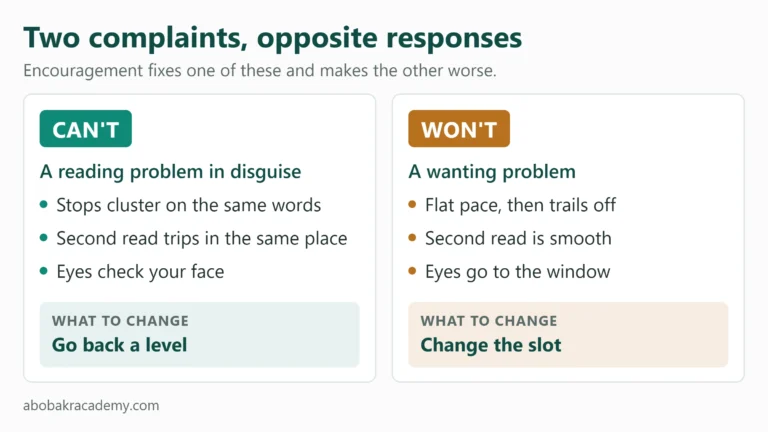
Move the slot before you judge it. If a child who resists at five is willing at eight in the morning, it was the timing. If the resistance follows the lesson wherever you put it, something in the lesson itself needs looking at, and the first thing to settle is whether he will not do it or cannot do it, because those two need opposite responses.
If the restart is not going well and you cannot see why, a tutor listening to your child read for half an hour will usually locate it faster than another month of trying. Our Quran classes for kids run one to one, so the lesson is built around where your child is rather than where the syllabus says they should be.