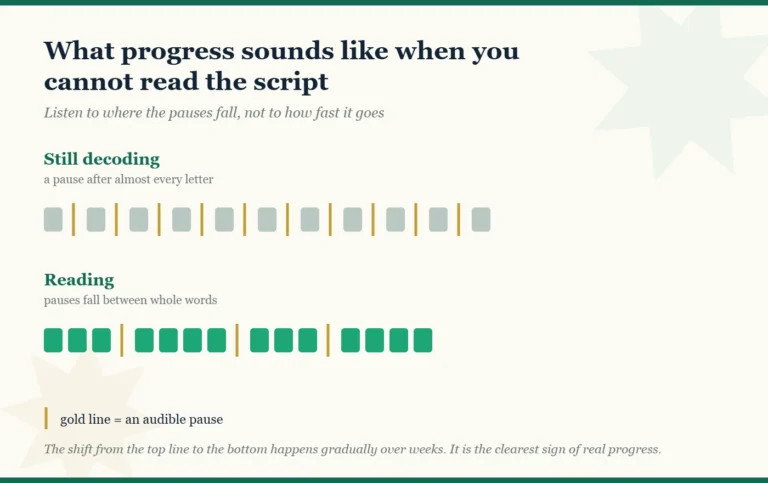


Your six year old can sing the Arabic alphabet. She has had the app since Ramadan, she knows all twenty eight letter names, and she got a certificate on the screen for it. Then you open a page of the Quran in front of her and she cannot read a single word. Not a hard word. Any word. She looks at the line and looks at you, and you have no way of telling her what went wrong, because you cannot read it either.
Nothing went wrong. She learned the letters the way the app taught them, one at a time, standing alone. Almost no Arabic word contains a letter standing alone. This page is about what to do instead, written for the household where no adult reads Arabic, which is most of the families we teach.
First, decide which of the two Arabics you actually want
Almost every argument about teaching children Arabic is really two conversations that have been stapled together, and separating them saves years.
Most parents who tell us they want their child to “learn Arabic” want the first one and have been quietly sold the second. The tell is what happens after six months of a vocabulary app: the child knows the words for lion, apple and aeroplane, and still cannot read Al-Fatiha.
These are not the same register of the language either, which is a point we make for adults in the guide to matching the method to the goal and which holds just as firmly for children. Conversational apps teach modern spoken Arabic. The Quran is classical. They overlap, but not where a beginner needs them to.
So answer this before buying anything. If the goal is that your child can read the Quran and understand their prayer, that is the reading project, and the rest of this page is about it. If the goal is that they can talk to their grandmother, that is the speaking project, and the last section is for you.
Why the alphabet app stops working around week three
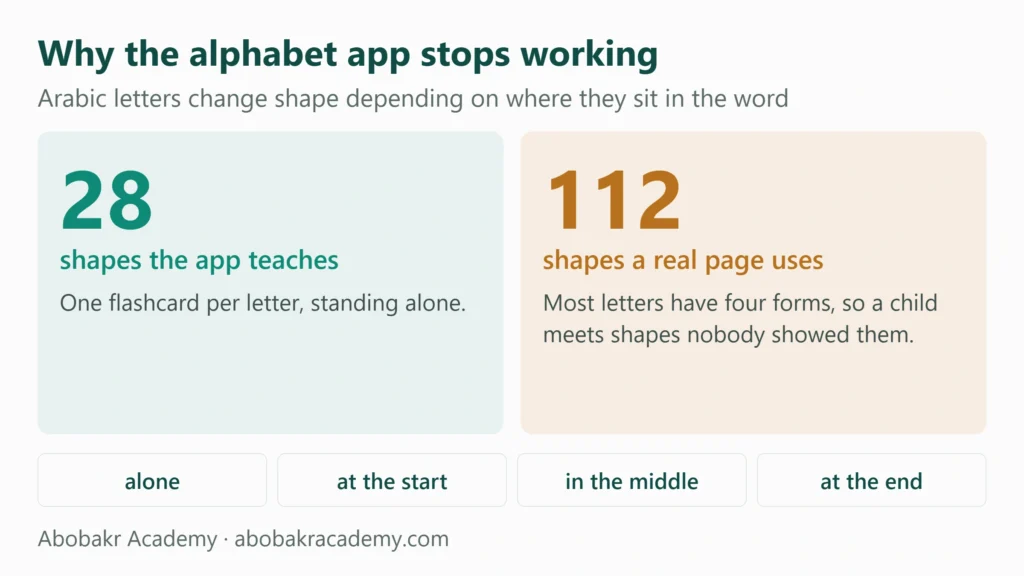
Arabic letters change shape depending on where they sit in a word. Most have four forms: standing alone, at the beginning, in the middle, and at the end. Omniglot’s Arabic alphabet page shows the whole table if you want to see it laid out.
This is the single largest thing that separates learning Arabic script from learning to read English, and it is the thing almost every app skips. The app teaches the isolated form, because the isolated form is what fits on a flashcard. Your child learns twenty eight shapes, feels successful, opens a real page, and meets a hundred and twelve shapes she has never seen.
She has not forgotten anything. She was taught a quarter of the alphabet and told it was all of it.
The fix is not more drilling. It is to introduce the joined forms from the first week, alongside the isolated one, so a letter is never learned as a single picture. A wall chart does this better than any app, because all four forms sit next to each other where the child can see the family resemblance. Ours is free to download and print and it shows every letter in all four positions, which is the whole reason it exists.
One caveat, and it matters if your household is not quite the one described above. If your child already understands spoken Arabic from grandparents or from you, do not start at the alphabet at all. They have a head start that alphabet drilling throws away, and it bores them into disliking the whole thing. That case is covered in our page on Arabic classes for children who understand more than they will say.
The first ninety days, when nobody at home reads Arabic
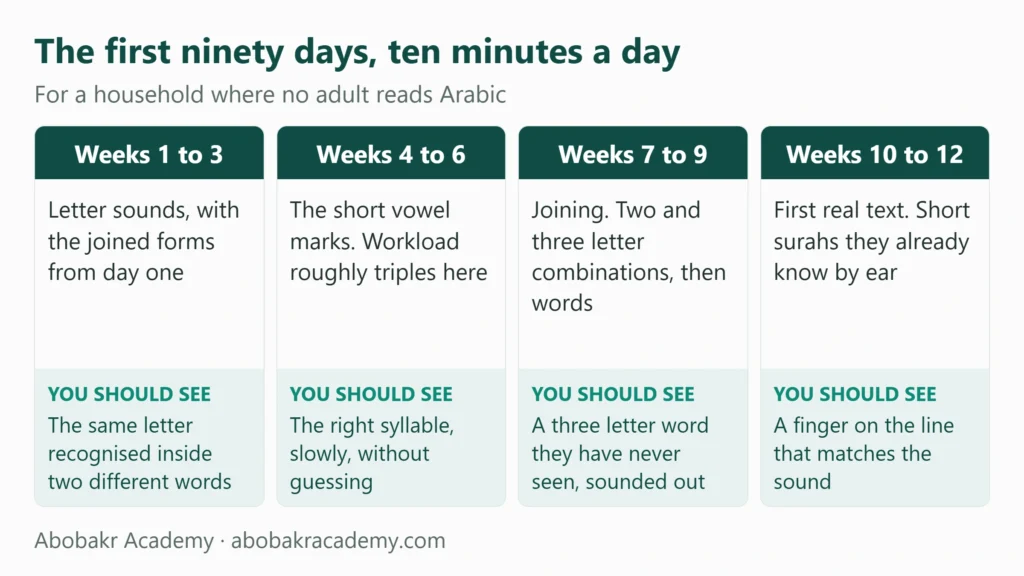
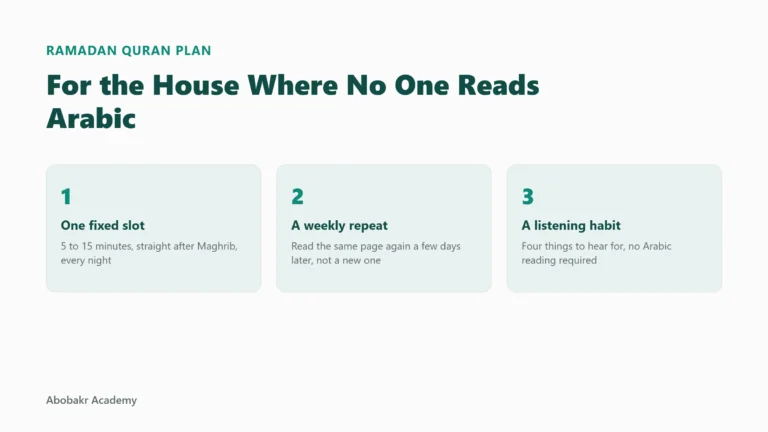
This is the sequence we use, compressed into something a parent can run at home between lessons. Ten to fifteen minutes on most days beats an hour at the weekend, and that is not a motivational slogan, it is the single clearest pattern among learners who get anywhere.
| Weeks | What the child works on | What you should be seeing by the end |
|---|---|---|
| 1 to 3 | Letter names and sounds, and from day one the joined forms alongside the isolated one. Groups of four or five letters, not all twenty eight. | They can point to the same letter in two different words and say it is the same letter. This is the milestone that matters, not reciting the alphabet in order. |
| 4 to 6 | The short vowel marks. Each letter now has three sounds rather than one, so this stage roughly triples the workload and is where most home attempts quietly stop. | Given a letter with a mark on it, they produce the right syllable without hesitating. Slowly is fine. Guessing is not. |
| 7 to 9 | Joining. Two-letter and three-letter combinations, then real short words. Still no meaning attached, and that is deliberate. | They can sound out a three-letter word they have never seen. If they can only read words they have memorized, they are not reading yet. |
| 10 to 12 | The first real text. Short surahs they already know by ear are ideal, because the ear catches what the eye misses. Al-Fatiha is the usual first page. | They follow a line with a finger and the finger matches the sound. Losing their place is normal at this stage; recovering it without help is the sign. |
Ninety days gets a child who works most days to slow, accurate reading of short words. It does not get them fluency, and anyone promising fluency in a term is describing a different child in a different country.
Three ways to tell it is working when you cannot read the page
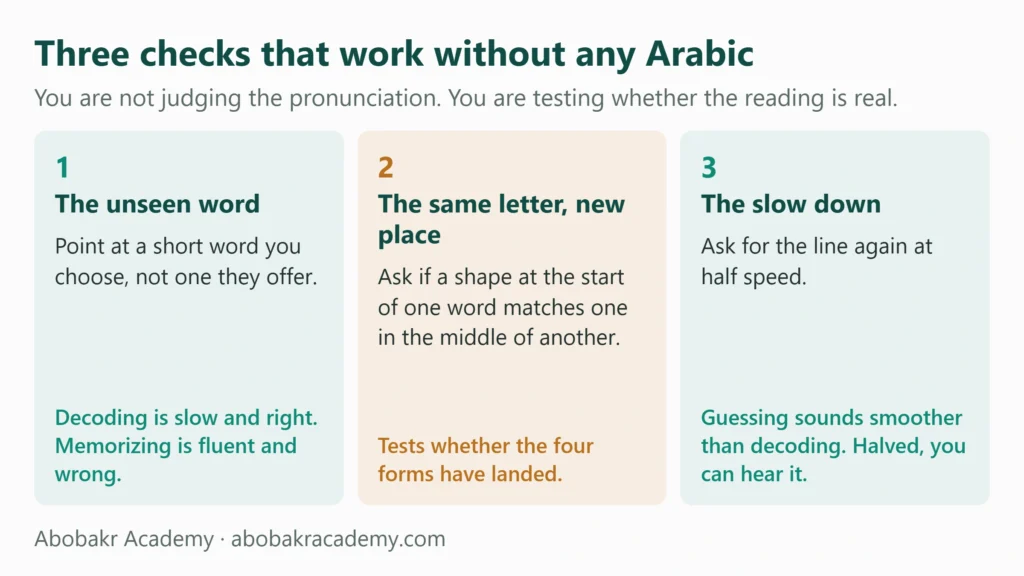
You do not need Arabic for any of these. You need to know what to ask for.
The unseen word
Ask your child to read something they have not been taught. Any short word from anywhere on the page, chosen by you, not by them. A child who is really decoding will sound it out slowly and often get it right. A child who has memorized the lesson will either freeze or produce something fluent and wrong. This one test separates real progress from the appearance of it, and it takes fifteen seconds.
The same letter in a new place
Point at a letter in the middle of a word, then find what looks to you like a different shape elsewhere on the page and ask whether it is the same letter. You are testing whether the four forms have landed. If your child only recognises letters at the start of words, that is a specific, fixable gap, and it is worth telling their teacher in exactly those words.
The slow down
Ask them to read a line half as fast. Speed hides errors, and children learn very early that reading quickly makes adults nod. Halved, the guesses become audible even to an ear that knows no Arabic, because guessing sounds different from decoding. It sounds smoother.
The one thing you cannot do alone
Everything above works without Arabic. This does not.
Arabic has sounds English does not have, and several of them come in pairs that English collapses into one letter. There are three sounds that all get written as h or kh in transliteration and are made in three different places in the throat. There is a light s and a heavy s, a light d and a heavy d, a light t and a heavy t. And there is ‘ayn, which has no English equivalent at all, so transliterations write it as an apostrophe and a child reading from that simply does not make the sound.
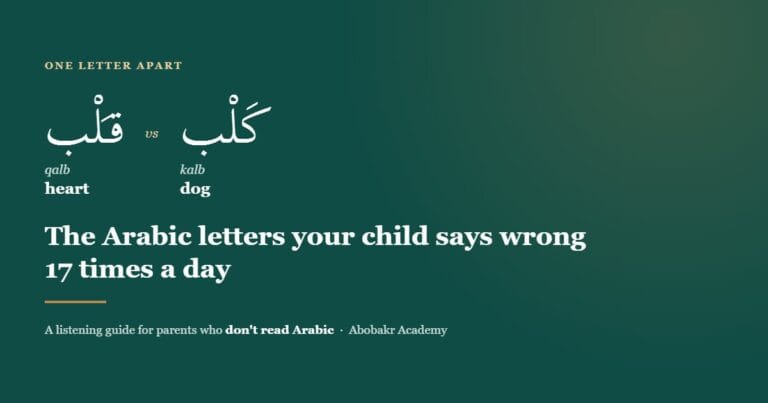
A parent who does not speak Arabic cannot hear these, and that is not a failing. What happens instead is predictable: the child recites confidently, at speed, with the same wrong consonant in the same three places every time, for two years, and untraining it later takes longer than teaching it correctly would have. We wrote separately about the letters children raised outside Arabic most reliably say wrong, using Al-Fatiha as the test passage, since it is the one every child already has.
The honest position: use apps and charts and your own ten minutes a day for the letters, the vowels and the joining, all of which you can supervise. Get the sounds from a person, whether that is a teacher, a relative or a recitation you play daily. The sounds are the part that sets.
How long the reading project actually takes
Ranges, because children differ and anyone quoting a single number is selling something.
A child of six or seven, practising most days with correction once or twice a week, is usually reading short words slowly by the end of the third month and reading short surahs haltingly somewhere between six and nine months. Reading any page of the Quran carefully, with occasional help, is more often a two-year mark than a one-year one.
An older child moves faster through the letters and slower through the habit, because a nine year old finds beginner material embarrassing in a way a six year old does not. Starting earlier helps, and there is a real window here: a child starting structured Arabic at seven has years to build before the teenage years, when new-language learning slows and self-consciousness about mistakes rises.
If your child is already in lessons and you want to know whether the months are producing anything, the separate question of how to check a child’s Quran progress without reading Arabic covers what to watch month to month.
If it was the speaking project you wanted after all
Then the honest answer is harder, and it is worth saying plainly rather than selling around.
A child does not become conversational in a language nobody in the house speaks, on thirty minutes a week. That is not what a weekly lesson is for. What a weekly lesson does do is build vocabulary, keep the sound of the language in the child’s ear, and give them somebody to speak it with, which is more than most households can manufacture alone.
The families whose children actually end up speaking Arabic do one of three things, usually more than one: they find other Arabic-speaking children, they spend real time somewhere Arabic is the street language, or they change what happens at home, which for a non-speaking parent means learning alongside the child rather than supervising them. That last one works better than it sounds. A parent doing the same lesson is the only version of immersion available to a household starting from zero, and children are noticeably more willing when the adult is also getting things wrong.
Apps are very good at the vocabulary half of this and should not be dismissed. They are simply not a route to reading, and they will not produce a speaker on their own either.
For what a weekly session with a teacher covers at each age, our online Arabic classes page sets out how the lessons are structured.
A plan you can print
The ninety-day table above is the whole method in one place, and it is meant to be stuck on a fridge rather than read once. Work down it in order. Do not skip the vowel marks because they look boring, since that is the stage that decides whether week ten works.
Tick a stage when your child passes its check in the right-hand column, not when you have finished the weeks. Those are different days, and the gap between them is the most useful thing on the sheet.
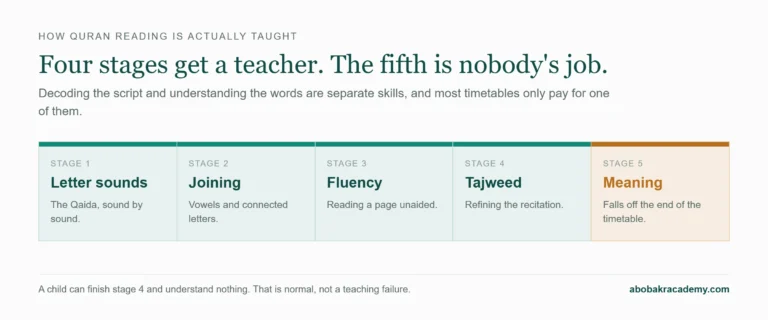
The plan also has a page of its own with the four stages written out and the three checks explained, if you would rather read it through before you print anything.
Frequently asked questions
Can I teach my child Arabic if I do not speak it at all?
You can teach them to read it, which is the finite half and the half most families actually want. Letters, vowel marks and joining are all supervisable without Arabic, using a chart and ten minutes a day. What you cannot supply is the pronunciation of the sounds English does not have, and that needs a person or a recording.
What age should a child start learning Arabic?
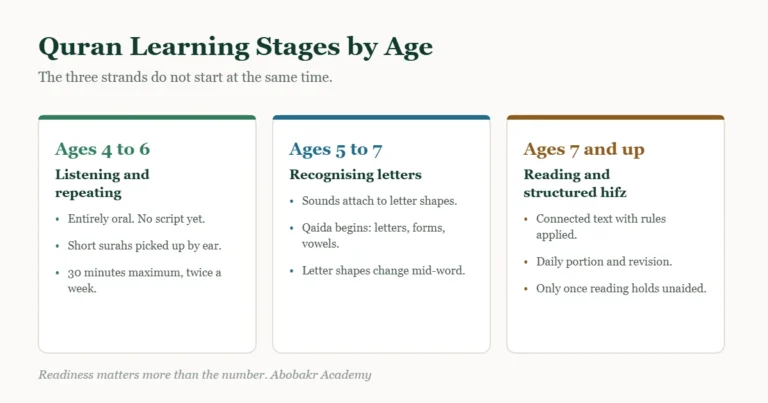
Around five or six for letters, if they are already reading in their first language or close to it. Earlier than that, listening and songs do more good than formal work. Starting at seven still leaves years before the teenage slowdown, so a late start is not a lost cause.
Why can my child say the alphabet but not read a word?
Because Arabic letters change shape according to their position in the word, and most apps teach only the isolated form. Your child learned one shape per letter and real text uses up to four. It is the commonest stall point and it is fixed by teaching the joined forms from the start rather than as an advanced topic.
Should my child learn Arabic or Quran reading first?
Quran reading first, for almost every family in this situation. It is finite, it is the immediate need for prayer, and the script is shared, so nothing is wasted if they go on to spoken Arabic later. Doing both at once tends to mean neither gets the daily ten minutes.
Are Arabic learning apps worth using?
For vocabulary and for keeping the sound of the language around, yes. For learning to read, only as a supplement, because most teach isolated letter forms and none can hear your child’s pronunciation. Treat an app as a flashcard box rather than a teacher.
How many minutes a day does this need?
Ten to fifteen on most days is the working amount for a young child, and consistency beats duration by a wide margin. Two twenty-minute sessions a week produces noticeably less than ten minutes on six days, which is the pattern behind almost every child who gets somewhere.
My child gets frustrated and refuses. What now?
Shorten the session before you change the method. Most refusal at this stage is a length problem rather than a motivation problem, and five focused minutes that end while the child is still willing beats fifteen that end in tears. If refusal is specifically about the vowel-mark stage, that is expected, and it passes.
If you would like someone listening
Most of this page you can run yourself, tonight, with a printed chart and no Arabic at all. The part you cannot run is the part that sets permanently, which is the sound. If you would like a qualified teacher on the other end of it once or twice a week while your child works down the ninety-day plan, that is what our lessons are built for, and the first one is a short trial so you can hear how your child responds before committing to anything.
Book a trial lesson and tell us where your child is on the plan. If they are at week one, that is the most common place to start.