Quran

19 articles
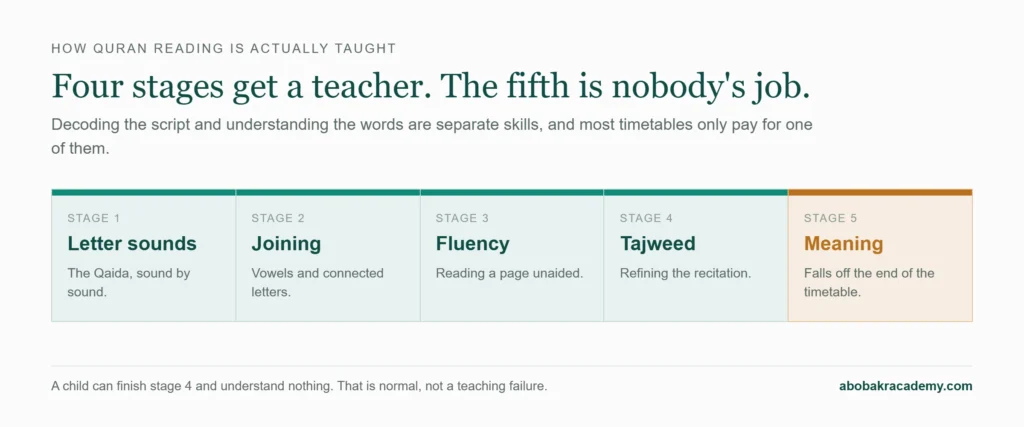
Learning to read the Quran, from the first letters through to reciting a full page with confidence. Most of what is here is written for households where no adult reads Arabic, so the checks work by ear rather than by reading.

A Ramadan Quran Reading Plan for the House Where No One Reads Arabic
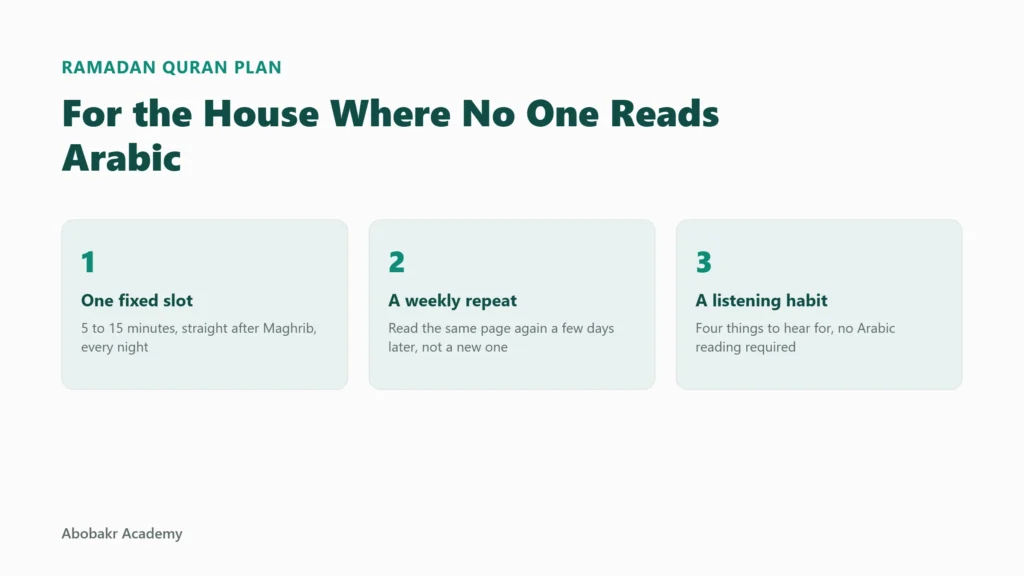
Overview graphic for a Ramadan Quran reading plan built for households where no adult reads Arabic: one fixed reading slot after Maghrib, a weekly repeat of recent pages, and a listening habit that needs no Arabic reading skill.

If you’ve already worked out that “read a juz a day” doesn’t mean much when the person doing the reading is a nine-year-old who’s still sounding out letters, or an adult who hasn’t opened a mus-haf since Sunday school, you’re not doing Ramadan wrong. You’ve just noticed something most Ramadan planners don’t account for: they’re written for households where at least one adult already reads Arabic fluently. Yours might not be one of them, and that changes what a workable plan actually looks like. Why the Usual Ramadan Plans Don’t Fit This House Search for a Ramadan Quran reading plan and you’ll find the same handful of formats: a juz a day to finish the whole Quran by Eid, a page-a-prayer schedule built around the five daily prayers, or a “pick your pace” chart with three or four speed options. All of them assume the reader can already read. None of them tell you what to do when the reader is learning the letters themselves, or when you, the parent, are the one who’d have to check the reading and can’t. That’s not a small gap. It’s the reason so many well-intentioned Ramadan plans get abandoned by the second week: the child loses momentum because nobody at home can tell if they’re actually reading correctly, and the parent quietly stops asking because they don’t know what a right answer sounds like either. Start With Who’s Actually Reading, Not Who You Wish Was Reading A workable plan starts by being honest about who’s doing what this Ramadan. In most of the families we work with, that’s some mix of three people, and each one needs a different kind of plan. Reader What Ramadan usually does to their reading What actually helps The child mid-way through learning to read Parents push a bigger daily target because it’s Ramadan, and the child falls further behind on accuracy Keep the daily amount the same as any other month; add a short listening habit instead (see below) The parent restarting their own reading Guilt about “not knowing enough to lead by example” stops them starting at all A fixed 10 minutes after Maghrib, reading whatever they can manage, with no target to finish anything The homeschooling parent tracking more than one child One shared chart for children at different stages, so it fits nobody well One row per child on the same weekly sheet, with different daily amounts written in If two or three of these people live in your house, that’s fine. The plan below has a lane for each of them, and none of the lanes requires you to check a recitation by ear in Arabic you don’t read yourself. The Three-Part Shape That Actually Survives Ramadan Tutors who run Ramadan intensives lean on the same three-part structure whether the student is six or sixty: new material, recent material, and older material on rotation. Ramadan tends to blow this up, because everyone wants to add new material and nobody wants to spend Ramadan on revision. That’s backwards for a house with a learning reader. New material is the smallest, most fragile part of the day precisely because it hasn’t been tested yet, and a child who takes on too much new reading during Ramadan loses the confidence to keep going once the month ends and the extra attention does too. For a family without a fluent Arabic reader at home, the practical version of this looks like three short, separate things rather than one long session: A fixed reading slot, five to fifteen minutes, same time every day. Straight after Maghrib works for most families because everyone’s already sitting down. A weekly repeat of whatever was read three or four days ago. Not new pages. The same ones, again, out loud. One short listening habit, covered in full further down, that gives you something to check even though you can’t read the text yourself. New material is deliberately the smallest piece. Most of the day’s few minutes go to reading something again, not reading something new. What an Actual Tuesday Looks Like Plans that stay vague fail. Here’s what this looks like in a real house, not a chart. 7:45pm, straight after Maghrib. Your daughter opens her mus-haf to the page she read yesterday, not a new one. She reads it out loud, slowly, while you sit nearby doing something else, half-listening. 7:52pm. She finishes. You ask her to read it once more, this time recording it on your phone. Ninety seconds, done. 8:00pm. You play Saturday’s recording back to back with tonight’s, not to grade it, just to hear whether it sounds steadier. It usually does, and telling her so takes ten seconds and matters more than you’d think. Once a week, Friday evening. You send both recordings to her Quran teacher with one line: “Is this improving, and is there anything I should be listening for that I’m missing?” That’s the whole homework loop, and it costs the teacher two minutes to answer. That’s the entire plan on a normal night. No juz count, no chart to fill in with a marker, nothing that requires you to know whether a letter was pronounced correctly. It survives busy nights because there’s almost nothing to it, which is the point. Four Things You Can Listen For Without Knowing Arabic This is the part most Ramadan guides skip, because they’re written by people who can already read the text and check it. You can’t do that, but you can do this: listen for pace, not pronunciation. None of these require reading a single Arabic letter. They’re about how the reading sounds, not what it says. Hesitation before a word, not during it. A pause mid-word is normal while sounding out a letter. A pause right before a whole word, every time it appears, usually means the word hasn’t actually been learned yet, just guessed at from memory of the page. A flat pace with no pauses at all. Real reading has natural stopping

The Arabic Letters Your Child Says Wrong 17 Times a Day

The Arabic words qalb meaning heart and kalb meaning dog side by side, one letter apart, above the article title

Al-Fatiha comes round seventeen times a day. Two rak’ahs at Fajr, four at Dhuhr, four at Asr, three at Maghrib, four at Isha, and the same seven verses in every one of them. That repetition is exactly why it’s worth listening to. Whatever your child is doing with those sounds, they’re doing it seventeen times a day and have been since they learned to pray. If a letter is being substituted, this is where the groove is deepest. It’s also the one passage you can check without reading Arabic, because you already know how it goes. You’ve heard it thousands of times. Your ear knows more than you think. What actually goes wrong The usual explanation is that Arabic has sounds English doesn’t have. That’s true, but it hides the useful part. Most of these letters have an English near-neighbour standing right beside them. Your child already owns that neighbour, reaches for it in both places, and produces one letter twice. They’re not failing at some exotic new sound. They’re flattening a pair into one. One letter on this page has no neighbour at all, and that one behaves differently: instead of a substitution you get a gap. One English sound, two Arabic lettersYour child already owns the English sound and reaches for it twice. English “k”as in kiteكkaflight, further forwardقqafdeeper, heavier English “h”as in hatهhaopen, unobstructedحhaasqueezed, rasping English “s”as in sunسseenlight and thinصsadheavy and full English “d”as in doorدdaltongue tipضdadside of tongue, longer Nothingno equivalentعaynmiddle throat, voicedNothing to substitute, so children skip it. Listen for a gap, not a wrong sound.Four English sounds standing in for eight Arabic letters, plus one letter with no English equivalent at all. That distinction is what makes this checkable. You’re not judging whether a sound is correct, which would need Arabic. You’re listening for whether two sounds are different from each other, which needs nothing but ears. How much this matters One pair genuinely swaps one word for another. قلب is qalb, heart. كلب is kalb, dog, and it’s one letter away. It’s the example most teachers reach for and it earns its place. Don’t carry that too far, though. Most substitutions don’t produce a different word. They produce something that isn’t a word at all, which is a different sort of error. Scholars do treat clear errors more seriously than hidden ones, and substituting one letter for another sits in the serious category. I’d rather say that plainly than hedge it. But the classical answer to the worry that follows is already there: the Prophet ﷺ said the one who recites the Qur’an proficiently is with the noble scribes, and the one who recites it and stumbles, finding it hard, has two rewards (Muslim 798, also Bukhari 4937 in slightly different wording). A child working at a sound is in the second group. That’s a good place to be, not a shameful one. Where these sounds are madeArabic uses the whole throat and mouth. English uses only the front half. هhadeepest throatع حayn · haamiddle throatق كqaf · kafback of tongueضdadside of tongueد س صdal · seen · sadtongue tipFrom the deepest part of the throat on the left to the tip of the tongue on the right. Note that qaf and kaf are tongue sounds, not throat sounds. Qaf and kaf Your English “k” is essentially kaf. There’s no English sound at all where qaf lives, so qaf gets swallowed by the neighbour next door. Both come from the back of the tongue against the roof of the mouth, not from the throat. Qaf sits further back and heavier, kaf slightly forward and lighter. Where to hear it: مَالِكِ يَوْمِ الدِّينِ in verse four carries kaf. الصِّرَاطَ الْمُسْتَقِيمَ in verse six carries qaf. The test: these two letters have clearly different names, so just ask. “Say qaf. Now say kaf.” Any child past the first Qaida lessons knows them. If you hear the same English “k” twice, you’ve found something worth passing on. The two h sounds Here the letter names won’t help you, because both ح and ه come out as some version of “ha” and that’s precisely why they collapse. So use words instead. You already know these two. ه comes from the deepest part of the throat and it’s open, breath with nothing in its way. ح comes from the middle of the throat, the same breath squeezed until the air rasps through a tightened passage. They differ in where they’re made and in how hard the air has to work. Where to hear it: الْحَمْدُ, the first word of verse two, opens on ح. اهْدِنَا, the first word of verse six, opens on ه. The test: ask for those two words, one after the other. ه should sound easy, like fogging a mirror. ح should sound tighter and rougher, closer to the start of clearing your throat but without the scrape at the back. That scrape belongs to غ, another letter entirely. If both words start with the same soft English “h”, they’ve been flattened together. Ayn, the one with no neighbour Ayn (ع) is the letter with nothing standing beside it in English. Not a rough approximation, nothing. It’s voiced, made in the middle of the throat with a genuine constriction, and most English speakers need months to get near it. Because there’s nothing to substitute, children don’t substitute. They skip. What you’re listening for is an absence. Where to hear it: عَلَيْهِمْ, in the last verse, begins on ayn. It appears twice in that verse, so you get two goes at it. Verse five gives you two more, inside نَعْبُدُ and نَسْتَعِينُ. The test: listen to the start of عليهم. There should be a real sound there, deliberate and slightly tight in the throat. If the word simply opens on a plain “a”, the way an English speaker would say “alay-him”, the ayn has been dropped. Be patient with this one. It’s the hardest to hear on the list and the slowest to fix.

Your Child’s Quran Routine When School Starts Again

Chart showing what a child loses over a summer break: letter recognition holds up, reading fluency slips, and tajweed application and Quran memorisation go first

Most families do not notice the gap until the first lesson back. The child sits down in September, opens the mushaf at the page they finished in June, and cannot read it at the speed they were reading it two months earlier. Nothing has gone wrong. This happens to almost every child, and how the next three weeks are handled decides whether the year starts well or turns into an argument. What follows applies whether your child studies with a tutor or with you at home. Building a Quran routine for kids around a new school timetable is a different problem from keeping one going through the holidays, and our teachers working with younger students see the same pattern every September. What actually slips over a summer Not everything decays at the same rate, which is worth knowing because it tells you what to repair first. Letter recognition is stubborn. A child who genuinely knew the letters in June still knows them in September. What goes is fluency, the speed of moving from seeing a word to saying it. Reading that had become smooth reverts to sounding out, and to a parent listening it sounds like the child has forgotten far more than they have. Memorisation is the opposite. It decays quickly and quietly. Surahs recited daily in June are half gone by August, and the parts that survive are the beginnings. A child will start confidently and stall in the middle, which is the normal shape of decayed hifz rather than a sign of carelessness. Tajweed rules sit in between. The knowledge stays, the application goes first. Expect a child to be able to tell you what ikhfa is while not doing it. Repair fluency and memorisation first. Letter recognition rarely needs rebuilding. Why the September restart usually goes wrong The common mistake is restarting at the level the child finished at. It feels logical. It also means the first three lessons are spent failing, and a child who fails in the first three lessons decides they have got worse and stops wanting to go. Adults recover from a bad restart because they understand what is happening. Children read it as evidence about themselves. That is the whole reason the first fortnight matters more than the rest of the term. The second mistake is scheduling for the parent you intend to be rather than the parent you will be in week six. Four sessions a week booked in early September, in the first flush of a new school year, is a schedule that quietly collapses by half term and takes the habit down with it. Re-baselining without making it feel like a punishment Go back deliberately. Start the child a little below where they finished, on material they will get right, and let the first week be easy. Fluency returns much faster than it was built, usually within two or three weeks, because the underlying recognition never left. For memorisation, revise before adding anything new. A child who spends the first fortnight recovering surahs they already know will hold them far better than one who is pushed straight into new material on top of a shaky base. Nothing new goes in until the old material comes out cleanly. Say out loud what you are doing and why. A child told we are going back a bit because everyone does after a break hears something completely different from a child who is silently moved back a level. Fitting Quran into a school week The scheduling question parents ask is when there is time. The more useful question is when the child still has attention left, because those are not the same window. The after-school hour is worse than it looks The slot straight after school looks ideal on paper and is often the worst hour of the day. The child has been concentrating since morning, has not eaten properly, and still has homework ahead. Lessons in that window tend to be technically attended and largely wasted. Early mornings work better than most parents expect Before school is unpopular with everyone and works surprisingly well, particularly for memorisation, which benefits from a mind that has not yet been filled with anything else. Fifteen minutes of revision before breakfast holds more than forty minutes at nine at night. Weekends carry more than you think A family that cannot protect two weekday slots can still run a real programme on a weekend session plus short daily revision at home. The daily part is what matters. The lesson checks the work, but it does not replace it. When homework and Quran collide They will collide, usually around the time exams or projects appear, and the family that has decided in advance what happens copes far better than the family improvising at seven in the evening. The workable rule is to protect the daily revision and let the lesson move. Ten minutes of revision survives almost any week. A full lesson does not, and trying to force it through a genuinely overloaded evening teaches a child that Quran is the thing that gets fought over. Practically, that means knowing your rescheduling terms before you need them. Ours ask for two hours notice, and a weekly subscription includes one cancellation a month, so a clash can be moved rather than lost. Families who use that deliberately in a heavy week keep the habit intact. Families who cancel without moving the lesson usually lose the slot and then the routine. What a realistic first term looks like Roughly the first three weeks go on recovery, and it is a mistake to read progress before that. From there a child working steadily through a school term will normally rebuild to their June level and move meaningfully past it by the winter break. That is a slower headline than most parents expect and a faster one than most fear. The variable that moves it is not talent and rarely the number of lessons. It is whether the short

Noorani Qaida: The Complete Beginner’s Guide

Noorani Qaida — the complete beginner’s guide, Abobakr Academy

If you have ever asked a Quran teacher where a complete beginner should start, the answer. Almost anywhere in the world, is the same two words: Noorani Qaida. It is a thin booklet, usually under forty pages, and it has probably taught more people to read the Quran than any other text in history. Our own tutors open it with a five-year-old in Manchester in one lesson and a fifty-year-old in Texas in the next. The booklet does not care how old you are. What Is Noorani Qaida? Noorani Qaida (القاعدة النورانية) is a beginner’s primer that teaches the reading of Quranic Arabic from absolute zero. It starts with the individual Arabic letters, then combines them step by step, letter shapes, vowel marks, joined forms, elongations, until the learner can read full verses of the Quran accurately. It was compiled by Sheikh Noor Muhammad Haqqani, a scholar from Ludhiana in India, in the late nineteenth century, and editions of it are now printed everywhere from Karachi to Cairo to London. What makes the Qaida unusual is that it teaches reading and correct pronunciation at the same time. A child who finishes it properly doesn’t just recognize words. They already apply the basic rules of Tajweed without knowing the rule names, because every exercise was designed around them. That is why serious Quran programs, including our own Quran course for beginners, still build their first months around it rather than replacing it with something modern. How the Lessons Are Structured Most editions arrange the material into seventeen short lessons. The exact numbering varies slightly between prints, but the progression is always the same: Lessons 1–2: The alphabet. The twenty-eight letters in their isolated forms, each pronounced from its correct articulation point (makhraj). Our free printable Arabic alphabet chart covers exactly this stage, with the joined forms the next lessons move on to. This is where a teacher matters most. Several Arabic sounds simply don’t exist in English. Lessons 3–4: Joined and compound letters. Arabic letters change shape depending on where they sit in a word; these lessons drill all the positions, plus special compounds like لا. Lessons 5–7: The short vowels. Fathah, kasrah and dammah, the three marks that turn silent letters into syllables, followed by tanween (the doubled end-vowels). Lessons 8–10: Combining sounds. Reading two- and three-letter combinations fluently, the stage where actual “reading” clicks for most learners. Lessons 11–13: Long vowels and softness. The elongating letters (huroof maddah) and the soft letters (huroof leen) that stretch sounds to two counts. Lessons 14–15: Sukoon and shaddah. Silent letters and doubled letters, the marks that give Quranic words their rhythm. Lessons 16–17: Applied reading. Full words and short verses from the Quran, read with the stretching and stopping rules learned earlier. Nothing in the booklet is decorative. Each page drills exactly one new idea on top of everything before it, which is why skipping ahead almost always ends in re-learning later. Why This Method Still Works Noorani Qaida is phonics for Quranic Arabic. Instead of memorizing whole words by sight, which collapses the moment a learner meets an unfamiliar verse, it builds sound-by-sound decoding that works on any page of the Quran. Modern literacy research arrived at the same conclusion for English reading a century later: systematic phonics beats whole-word memorization. Sheikh Haqqani simply got there first. The second reason is pronunciation. Because every exercise is read aloud to a teacher who corrects the articulation points immediately, mistakes never get the weeks of repetition they need to become habits. Learners who start with apps or YouTube alone often read quickly but carry a dozen fossilized pronunciation errors that take months to undo. How Long Does Noorani Qaida Take? With two to three lessons per week, most students finish in this range: Children aged 5–8: six to twelve months. Younger children move slowly through the letters but rarely need to unlearn anything. Children aged 9–14: four to eight months, often faster because their attention span supports longer sessions. Adults: three to six months. Adults grasp the logic quickly; their real battle is pronunciation. Our tutors often spend two or three full sessions just on the throat letters with adult beginners, and that patience pays off for years. Rushing is the classic mistake. A student who finishes in three months reading hesitantly has gained less than one who finishes in six reading smoothly. The Qaida is a foundation, and cracks in it show up in every later stage. Noorani Qaida for Adults Plenty of adults feel embarrassed opening a children’s primer. Don’t be. Every adult in our program held the same worry in week one and forgot it by week three. In our experience adults who commit to two sessions a week read their first full verse within a couple of months, and nobody will make you feel behind for starting late. If that’s you, our guide on learning to read the Quran as an adult walks through the full journey the Qaida begins. Learning Noorani Qaida Online: Teacher or App? Apps and printed qaidas are useful for revision, but the Qaida was designed as a listen-and-repeat text. The teacher recites, the student mimics, the teacher corrects on the spot. That feedback loop is the method. Remove it and you keep the pages but lose the system. A live teacher also adjusts pace lesson by lesson, spending three sessions on the throat letters for one student and one session for another. This is exactly how our Noorani Qaida classes for kids run: one-to-one video lessons with qualified tutors, including Al-Azhar trained teachers, scheduled around US, UK, Canadian and Australian time zones. Adults follow the same curriculum privately at their own pace. What Comes After the Qaida? Finishing Noorani Qaida means you can decode and pronounce any Quranic text. The path from there is well established: fluent reading practice (nazra) through the shorter surahs, then formal Tajweed study to name and polish the rules you have been applying by ear, and for those

Learning Quran Recitation – Complete Step-by-Step Guide.

Learning Quran Recitation

Learning Quran recitation is the process of mastering the proper pronunciation, intonation, and rhythm of the sacred Arabic text as it was revealed to the Prophet Muhammad. It is formally known as Tajweed and serves as a fundamental act of worship and a way to build a deep spiritual connection with the divine message. Learning Quran recitation, known as Tajweed, is the art of accurately pronouncing Arabic letters and sounds according to Islamic rules. Quran recitation involves mastering makharij (articulation points), sifat (qualities of pronunciation), rhythm, intonation, and proper pauses. The goal is to recite the Quran with clarity, beauty, and reverence. Beginners typically progress through structured steps, starting with letters, then combining them into words and verses. This gradual approach makes learning the Quran for beginners easier to follow before moving into advanced recitation practice. Advanced levels include tarteel (slow, reflective recitation), tahqiq (precision), and hadr (presence and emotion). The Holy Quran is the divine word of Allah, revealed as guidance, mercy, and light for humanity. So, learning Quran Recitation is one of the most rewarding journeys a Muslim can undertake. Every Muslim, whether a child, adult, new Muslim, or parent, should strive to learn Quran recitation and develop a strong connection with the Book of Allah. Learning Quran Recitation is not simply about reading Arabic words. It is about understanding pronunciation, applying Tajweed rules, appreciating the beauty of the Quran, and reciting it correctly as it was revealed to the Prophet Muhammad ﷺ. Through consistent learning and proper guidance, anyone can master Quran recitation regardless of age or previous experience. This comprehensive guide will explain everything you need to know about Learning Quran Recitation, including its benefits, Tajweed, learning methods, online classes, and how to choose the best Quran course for your needs. For step-by-step help from a qualified teacher, see how Tajweed is taught here or browse the full range of Quran online classes. Key Aspects of Learning Quran Recitation Learning Quran Recitation involves several important components that work together to help students read the Quran correctly. The first aspect is recognizing Arabic letters. Since the Quran was revealed in Arabic, learners must become familiar with the shapes, sounds, and pronunciation of each letter. Understanding how letters connect within a word is essential for accurate reading. Another important aspect of learning Quran Recitation is mastering pronunciation. Every Arabic letter has a specific articulation point. Proper pronunciation preserves the meaning of Quranic verses and helps students avoid common mistakes. Tajweed is another crucial element. Understanding tajweed quran rules helps students apply correct pronunciation, pauses, and letter qualities during recitation. These are the rules that govern Quran recitation and ensure that every letter receives its proper rights and characteristics. Abobakr Academy provides key aspects to learn Quran recitation, including: Learning the Quran Recitation letters and sounds Understanding Quranic words Applying Tajweed rules Practicing fluency through regular reading Receiving feedback from qualified teachers Listening to expert reciters through audio and video resources Successful Learning Quran Recitation combines all these elements to create a strong foundation for lifelong Quran learning.     Benefits of Learning Quran Recitation for Muslims Learning Quran Recitation offers countless spiritual, educational, and personal benefits. The greatest benefit is strengthening your relationship with Allah. Every letter recited from the Holy Quran brings rewards and blessings. The Prophet Muhammad ﷺ taught that those who recite the Quran will receive immense rewards for every letter they read. Learning Quran Recitation also increases understanding of Islamic teachings. As students become more comfortable reading the Quran correctly, they develop a deeper appreciation for its messages and guidance. Additional benefits include: Improved concentration and discipline Enhanced spiritual connection Greater confidence during prayer Better memorization abilities Increased understanding of Quranic Arabic Stronger Islamic identity for kids and adults For children, learning Quran Recitation builds a foundation for future Quran memorization and Islamic education. For adults, it provides an opportunity to reconnect with the Quran and improve their worship. The beauty of Learning Quran Recitation lies in its lifelong rewards. Every lesson learned continues benefiting the student both in this world and the Hereafter. The Importance of Learning Quran Recitation with Tajweed Learning Quran Recitation without Tajweed is incomplete. Tajweed refers to the set of rules that govern the proper recitation of the Quran. These rules ensure that every letter is pronounced correctly and every word is recited according to authentic Quranic traditions. Learning Quran Recitation with Tajweed protects the Quran from incorrect pronunciation that could alter meanings. When students learn Tajweed, they gain the ability to: Pronounce Arabic letters accurately Observe proper elongation rules Apply pauses correctly Improve fluency and confidence Beautify their recitation Learning Quran Recitation with Tajweed also helps students appreciate the artistic beauty of Quran recitation. The rhythm, melody, and precision of proper recitation create a powerful spiritual experience. Qualified teachers play a vital role in teaching Tajweed because students often need personalized feedback to identify and correct mistakes. Whether studying Surah Al-Kahf, Surah Yasin, or any chapter of the Quran, Tajweed helps preserve the authenticity and beauty of the Holy Quran. Learning Quran Recitation for Kids and Adults Learning Quran Recitation is suitable for people of all ages. Children and adults can both achieve excellent results when they follow structured learning methods. For kids, lessons should be engaging, interactive, and age-appropriate. Young learners benefit from visual tools, audio examples, games, and positive encouragement. Programs designed for minimuslims often focus on making Quran learning enjoyable while building strong foundations. Adults may have different learning needs. Older learners often improve fastest with structured lessons and personal guidance. Many adults begin learning Quran Recitation later in life or return after years without practice. Adult learners often appreciate structured lessons, flexible schedules, and personalized guidance. Common goals for adults include: Learning to read the Quran correctly Improving Tajweed skills Increasing fluency Understanding Quranic Arabic Preparing for memorization The key to successful Learning Quran Recitation for both kids and adults is consistency. Small daily efforts often produce better results than occasional intensive study

Learning the Quran for Beginners: How to Start Reading and Reciting

Learning the Quran for Beginners

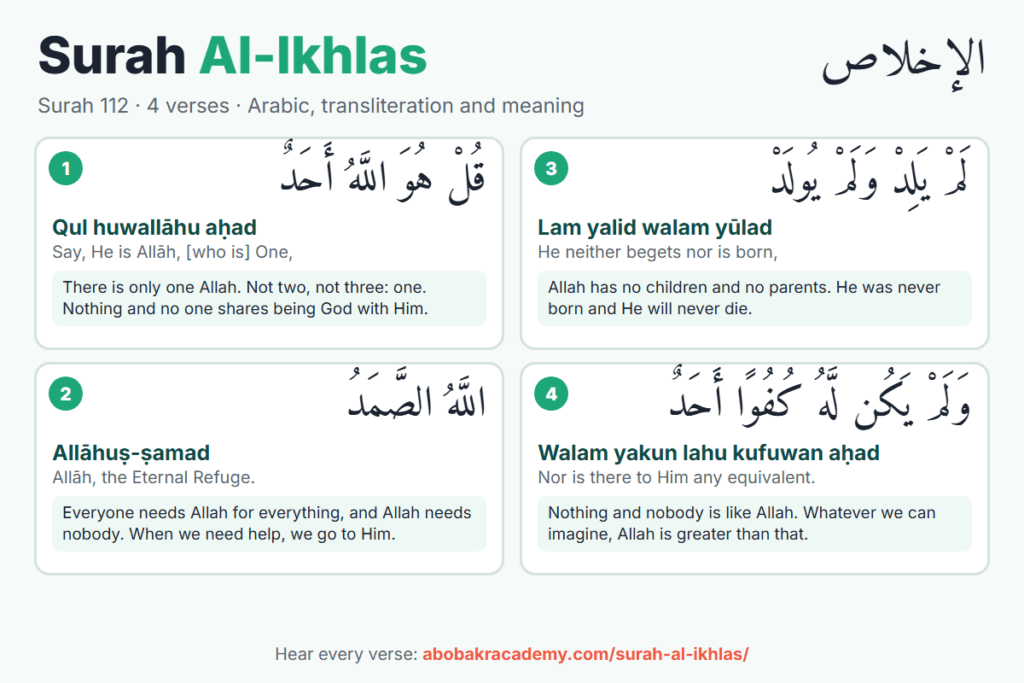
Arabic script trips up new readers for a specific reason: the same letter changes shape depending on whether it opens, sits in the middle of, or closes a word. A beginner who has only memorized the isolated letter forms often can’t recognize that letter once it’s joined to others, and that’s usually where progress stalls, not at vocabulary or meaning. The fix is to practice letters in their connected forms from early on, alongside the harakat (the short vowel marks) that tell you how each letter is actually pronounced. Our free printable Arabic alphabet chart sets out all four positional forms on one page, which makes the joined shapes easier to recognise. Once joined letters and harakat feel familiar, short verses stop looking like a wall of unfamiliar shapes and start reading as words. We teach reading in that order, letter shapes in context, then harakat, then short surahs, rather than front-loading vocabulary before the reading mechanics are solid. Importance of Learning the Quran for Beginners Learning the Quran for beginners is important because the Quran serves as the primary source of guidance for Muslims. Every Muslim who starts to learn the Quran gains access to the teachings, wisdom, and values contained within the Holy Quran. Through regular Quran reading, students strengthen their connection with Allah and improve their understanding of Islamic principles. Another reason to learn the Quran for beginners is essential is that it helps believers perform acts of worship correctly. When students learn how to read the Quran accurately, they can recite verses during prayers with confidence. Learning the Quran also improves Quran recitation skills and allows learners to appreciate the beauty of the Quranic message. Learning the Quran contributes to personal growth and character development. The Quran teaches honesty, patience, kindness, and responsibility. As learners read Quran passages regularly, they gain valuable lessons that positively influence daily life. Understanding the Quran for beginners becomes easier when learning is gradual and guided by experienced teachers. The spiritual rewards of reading the Quran are immense. Every letter recited from the Quran carries blessings, making Quran learning a source of continuous reward. Whether students read the Quran online or attend Quran classes in person, every step of learning the Quran for beginners brings them closer to Allah.     Foundational Requirements for Learning the Quran for Beginners Learning the Quran as a beginner starts with a sincere intention to learn for Allah’s pleasure, followed by learning the Arabic alphabet (Noorani Qaida), mastering basic Tajweed for proper pronunciation, and practicing with short Surahs for 15–20 minutes daily. The fundamental requirements and a clear path to learning the Quran to study the Quran include: 1. Spiritual & Physical Foundations Pure Intention (Niyyah): Approach the Quran as an act of worship to seek guidance and reward, rather than treating it as a standard academic task. Physical Purity: It is required to be in a state of ritual purity (Wudu) before touching or holding the physical Arabic Mushaf. Etiquette: Sit in a respectful, clean space, preferably facing the Qiblah, and read with a calm, focused mind. 2. Practical Learning the Quran for Beginners Roadmap Master the Arabic Alphabet: You must learn the 28 Arabic letters, their shapes, and how to pronounce them. This is best achieved using a foundational booklet known as a Noorani Qaida. Vowel Marks (Harakat): Understand the short vowel marks (Fatha, Kasrah, Dammah) so you can properly connect letters and form words. Basic Tajweed Rules: Tajweed ensures you pronounce every letter from its proper articulation point (Makharij). Start with the most basic rules, such as elongation (Madd) and nasal sounds (Ghunnah). 3. Study Materials & Tools The Right Mushaf: Use a clear, standard script, such as the Madani script. Color-Coded Tajweed Mushafs are highly recommended for beginners as they visually guide you when to apply specific pronunciation rules. Audio Recitation: Relying solely on transliteration can lead to pronunciation mistakes. Listen to certified reciters to train your ear to the correct Arabic sounds. Qualified Teacher: The Quran is an oral tradition. Enlisting the help of a Knowledgeable Online Quran Tutor is crucial for receiving corrections and ensuring accuracy. 4. Establishing a Routine Start with Short Surahs: Do not start from the beginning of the Quran. Once students become comfortable with short Surahs, an online course built around memorisation can help them move toward memorization in a structured way. Begin with Juz ‘Amma (the final chapter), starting from Surah Al-Fatiha and Surah Al-Ikhlas, to quickly build your confidence and fluency. Consistency is Key: Dedicate 15–30 minutes daily rather than attempting long, infrequent study sessions. Daily contact with the text builds strong, lasting habits. Patience and dedication: Learning the Quran for beginners is a gradual process that requires practice and repetition. Students who remain committed to their Quran learning journey often experience steady improvement and long-term success. Reading aloud from the first week Beginners often spend weeks studying letters silently before attempting to say anything. It feels safer and it slows everything down. The Quran is an oral text, transmitted by recitation, and the skill being built is a physical one: your mouth has to learn where each letter is produced. Say every letter out loud from the first session, even when it comes out wrong. Wrong and audible can be corrected. Silent and uncertain cannot. The sequence that works is short and strict. Single letters until you recognise them instantly. Letters with harakat, so you are reading sounds rather than names. Two-letter and three-letter combinations. Then short words, then a full ayah. Skipping a rung tends to cost more time than it saves, because the gap reappears later as a stubborn hesitation you cannot explain. Learning the Quran for Beginners at Home Learning the Quran for beginners at home provides a comfortable and distraction-free environment for study. Many families prefer learning the Quran for beginners at home because it allows students to learn at their own pace while maintaining a familiar routine. Creating a dedicated study space can significantly improve learning

Book a free class