Your child finishes a page, closes the mushaf, and you realise you have no idea what any of it meant. Neither do they. If that is where you are, the short answer is that reading the Quran without understanding it is normal, it is rewarded, and it is also not the end of the road. The recitation counts on its own. What it does not do by itself is give a nine year old a reason to keep coming back at fifteen, and that is the part worth working on now rather than later.
This is written for the parent who cannot check any of it themselves. No Arabic at home, a child who decodes the script better than you ever will, and a quiet worry that something is going on the whole time that you are locked out of. You do not need Arabic to fix this. You need about ten minutes a week and a slightly different question to ask the teacher.
First, the part nobody wants to ask out loud
Does it count if he does not understand a word of it?
Yes. That is the settled scholarly position, and it is not a consolation prize. The reward attaches to the recitation itself, letter by letter:
“Whoever recites a letter from Allah’s Book, then he receives the reward from it, and the reward of ten the like of it. I do not say that Alif Lam Mim is a letter, but Alif is a letter, Lam is a letter and Mim is a letter.”
Jami’ at-Tirmidhi 2910
Nothing in that is conditional on comprehension. A seven year old sounding out Surah Al-Kahf on a Friday morning, with no idea that it contains a story about a cave, is doing something real. If you have been carrying guilt about all those years of recitation lessons “not counting”, you can put it down. The scholars are clear on this, and the detailed ruling is worth reading in full if you want the reasoning rather than the summary.
And then, in the same breath, the Quran asks something more of its readers:
“Do they not then reflect on the Quran? Or are there locks upon their hearts?”
Surah Muhammad 47:24
Both things are true at once. Reciting is worship. Reflecting is a second thing, asked for separately, described as one of the reasons the Book was sent down at all. Your child is doing the first. The question in front of you is when to start the second, and what it looks like in a house where nobody speaks Arabic.
Why fluent recitation and zero comprehension is the normal order, not a mistake
Parents often assume something went wrong in the teaching. It usually did not. Arabic reading is taught as a decoding skill first, and decoding is genuinely separable from meaning.
Think about what the Noorani Qaida does. It teaches a child to see a letter, know its sound, join it to the next one, apply the vowel marks and produce the correct noise. That is a mechanical skill and it can be trained to a high standard in a child who has no vocabulary at all. It is closer to learning to read music than to learning a language. A child can sight-read a Chopin piece perfectly and have no idea what the composer was going through.
English speakers do a smaller version of the same thing constantly. You can read “the defendant filed a demurrer” out loud with confident pronunciation and no idea what a demurrer is. Your child is doing that for six hundred pages.
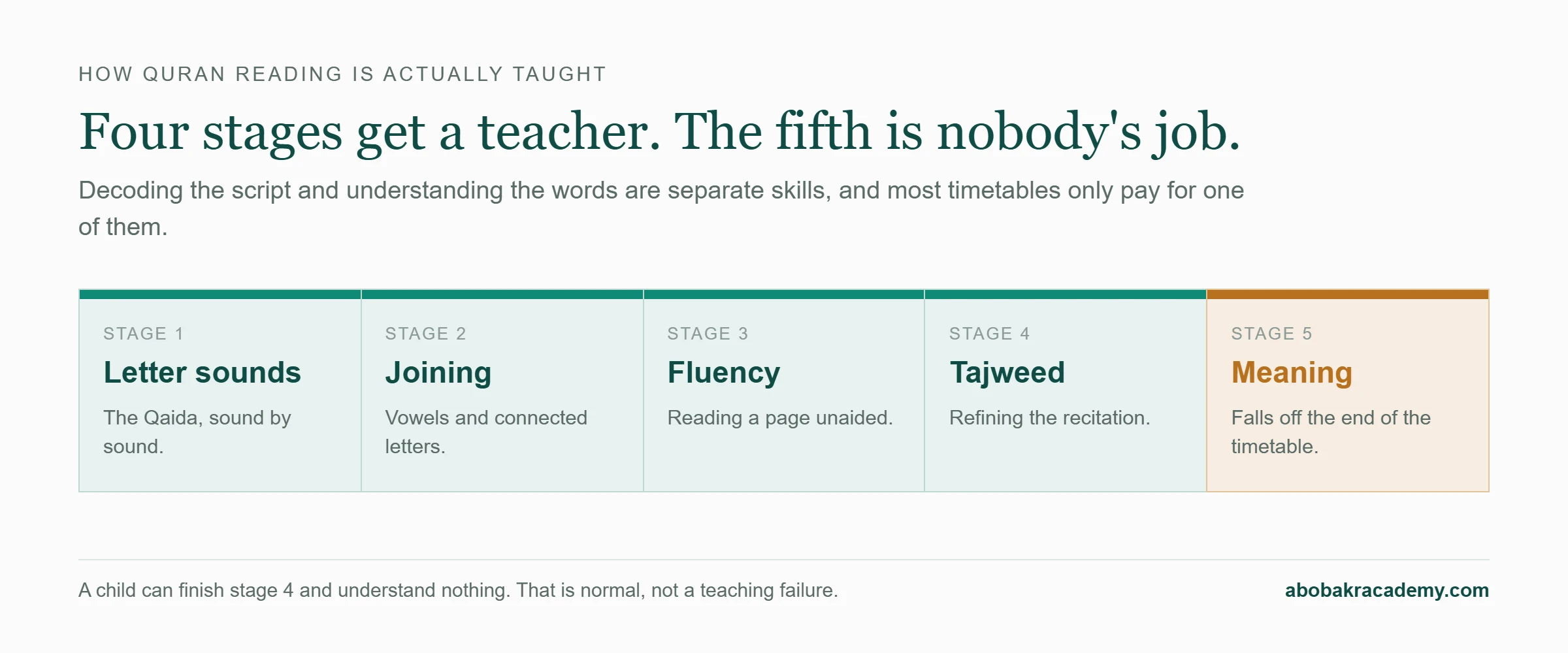
So the sequence goes: sounds, then joining, then fluency, then Tajweed refinement, then, if anyone bothers, meaning. The last step falls off the end of most timetables because it is nobody’s specific job. The recitation teacher is measured on recitation. The weekend school is measured on how much has been memorised. Meaning sits in the gap between them, and gaps are where things get lost.
When it starts to cost you something
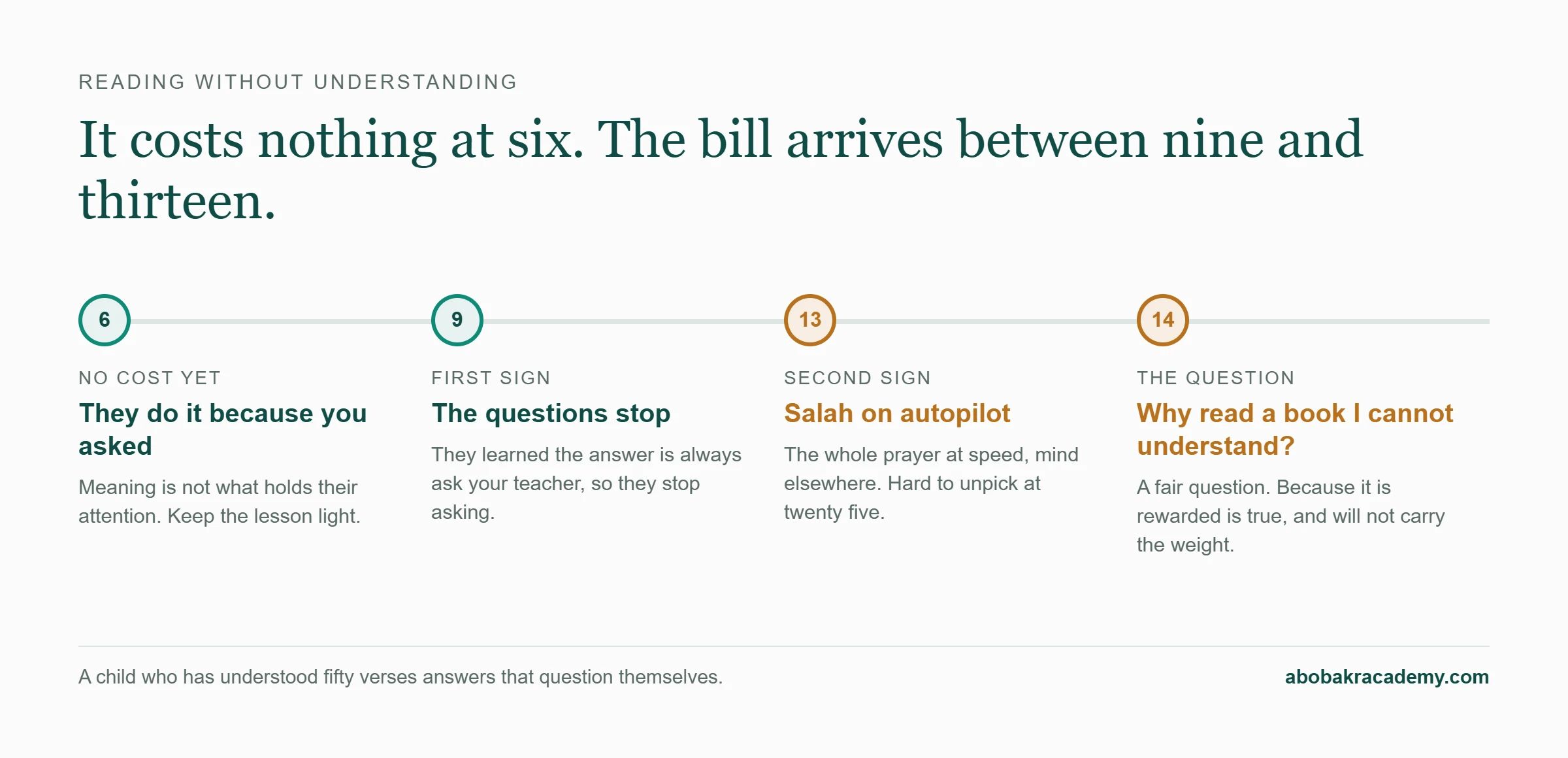
At six, no cost. A child that age is happy to do a thing because you asked and because there are stickers involved. Comprehension is not what is holding their attention, and pushing grammar at them will only make the lesson heavier.
Somewhere between nine and thirteen, the bill arrives. It usually shows up as one of these, and you will recognise yours:
The child stops asking questions about it. Younger children ask constantly, what does this bit mean, why does it say that. When the questions stop, it is often because they learned that the answer is always some version of “I don’t know, ask your teacher.” Curiosity is not infinite, and it stops being spent on doors that never open.
Salah goes on autopilot. They can say the whole thing at speed with their mind entirely elsewhere, because to them it genuinely is a sequence of sounds. That is a hard habit to unpick at twenty five.
Or the sharpest version, which usually arrives around fourteen: “why am I reading a book I can’t understand?” That is a fair question, not a difficult teenager, and the answer “because it’s rewarded” is true but will not carry the weight they are putting on it. What carries the weight is a child who already knows, from experience, that the book says things, because they have understood a hundred verses of it themselves.
The good news buried in the statistics you cannot check
Quranic Arabic is not an infinite vocabulary. The same words come round again and again, and a small core of them carries a startling share of the text. You do not have to take that on trust, and you do not need Arabic to test it.
Here are nine of them. Your child already pronounces every one of these correctly and has probably never been told what a single one means.
That exercise is doing something specific. It moves your child from producing sound to noticing pattern, which is the door comprehension walks through. It also puts you in the room as a participant instead of an audience, and that changes the temperature of the whole thing more than any curriculum does.
One verse a week, and what it looks like
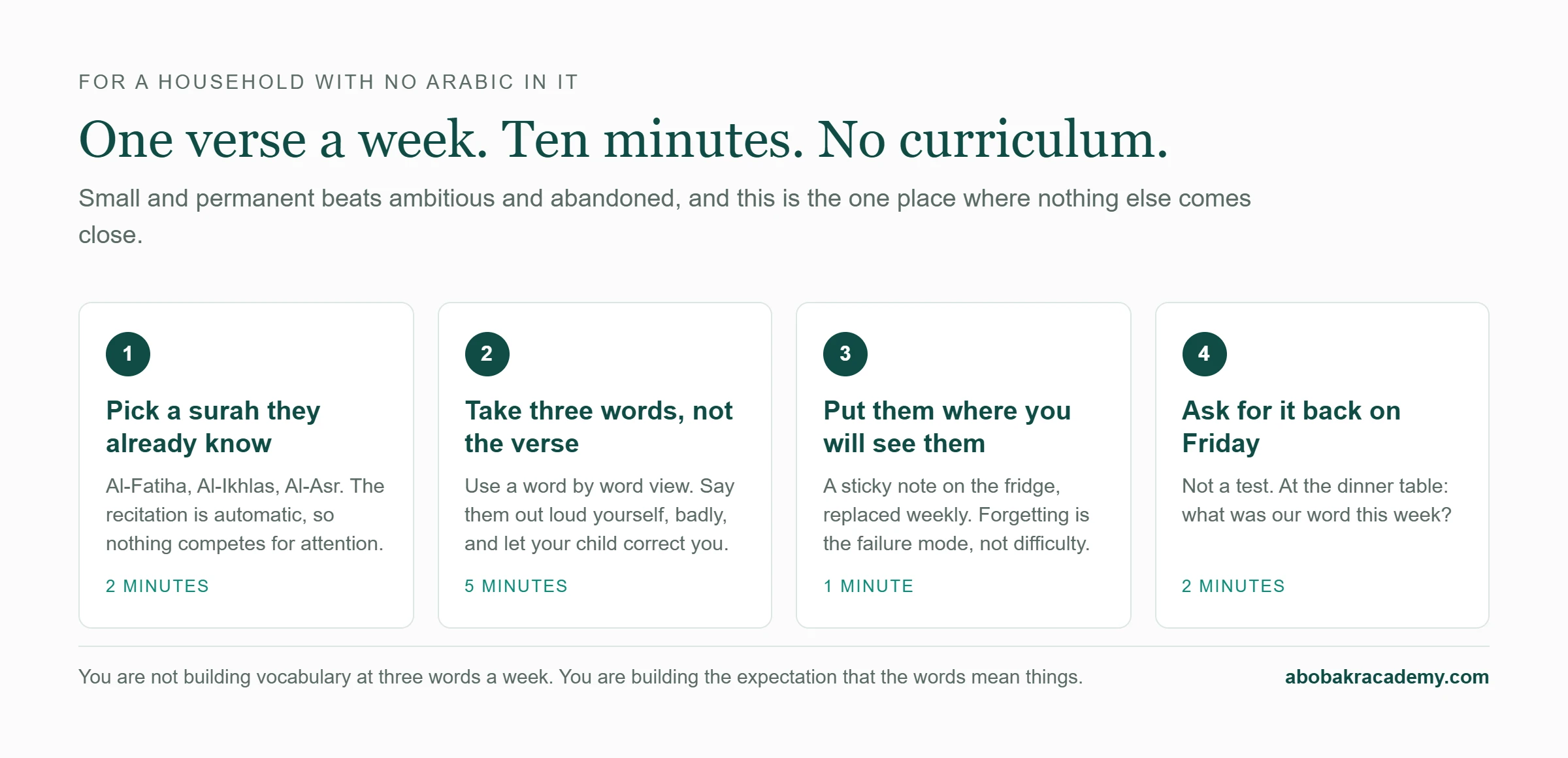
No course and no app subscription: one verse, once a week, in a household with no Arabic in it. This is the version that lasts through a busy week.
Pick from what they have already memorised
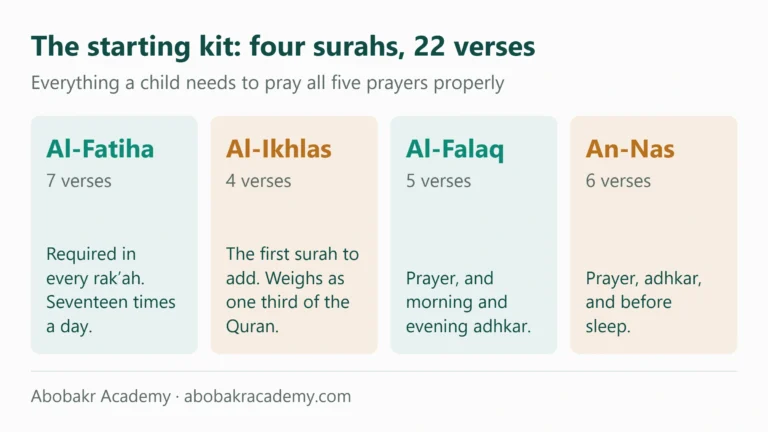
Start with Al-Fatiha, Al-Ikhlas, Al-Asr or An-Nas. The recitation is already automatic, so nothing competes for attention, and every one of those short surahs gets said several times a day. Meaning attached to a verse they say in every prayer will be reinforced seventeen times tomorrow without anyone doing anything. An-Nas is the easiest of the four to start with: five of its twenty words are the same word, an-nas, and every word is listed with its meaning on our Surah An-Nas word by word page.
Take three words, not the whole verse
Open the word by word view on quran.com, which gives you each word with its meaning underneath. Pick three. Say them out loud yourself, badly. Your bad pronunciation is useful here, because your child gets to correct you, and a child correcting a parent is a child paying close attention.
Ask for it back on Friday
Not a test. Dinner table, in passing: what was our word this week? You are not building vocabulary at four words a week, you are building the expectation that the words mean things. That expectation is the actual product.
Write them somewhere visible
A sticky note on the fridge with three words on it, replaced weekly, outperforms most paid resources for this specific job, because the failure mode of every good intention here is forgetting, not difficulty.
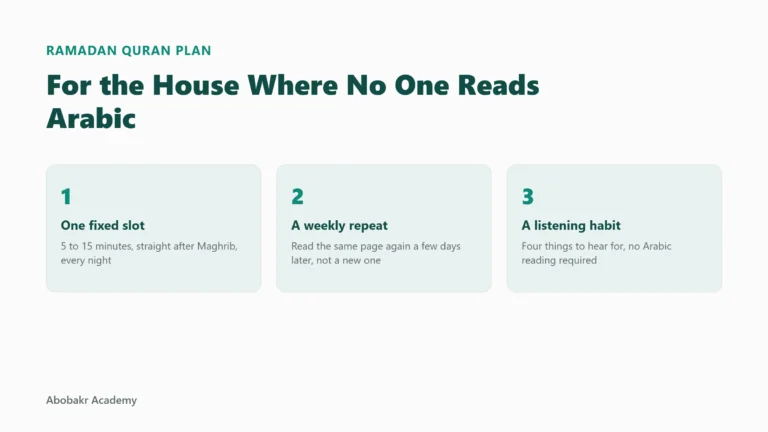
If Ramadan is coming up, this same ten-minute shape is the base of our Ramadan Quran reading plan for a family in exactly this position, adjusted for the month rather than replaced.
Some of the meaning is already sitting inside the recitation
There is a shortcut here that most parents never hear about. Arabic mushafs carry small letters above the line telling the reciter where they may stop and where stopping would damage the sense. Those marks exist because where you pause changes what the sentence says. A child who learns them is being taught meaning through the back door, even in a purely recitation lesson.
It is the cheapest comprehension win available, because it is already on the page and it is already the teacher’s job. If nobody has walked your child through the little marks that tell a reciter where to breathe, that is a fifteen minute conversation with a real payoff.
The one sentence to send your child’s teacher
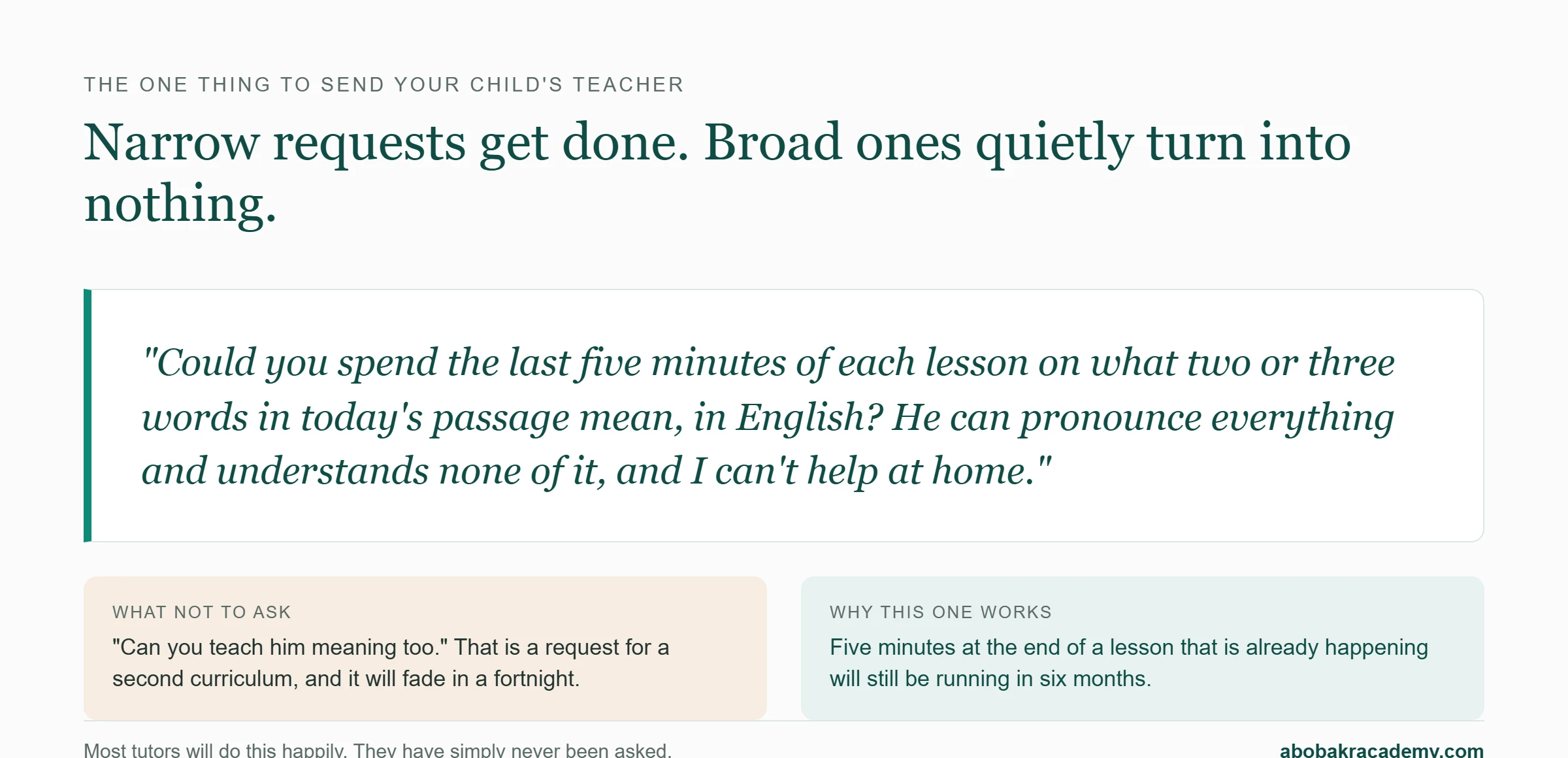
Most tutors will happily do this and simply have not been asked, because parents ask about progress through the pages and never about anything else. So ask for something narrow and specific:
A narrow request tends to get done. “Can you teach him meaning too” asks for a second curriculum, and it usually comes to nothing. Five minutes at the end of a lesson that is already happening will still be running in six months.
If you want to know whether it is landing, you do not need Arabic for that either. There are a handful of checks you can run by ear that tell you more than a monthly report does.
Where translation is enough, and where it is not
An English translation is an interpretation. Two translators will render the same verse differently, and neither is the Quran, which is why nobody calls a translation a mushaf. That is a real limit and you should know about it.
For a child, though, the choice is between an imperfect translation and nothing at all. A ten year old who knows that Surah Al-Asr is about people losing at the game of time, in slightly clumsy English, is in a better position than one who knows only the sounds. Use the translation. Just do not mistake it for the destination.
Where it stops being enough is around the point your child starts noticing that different translations disagree, or asks why one word got four English words. That is a good problem and it means they are ready for study of the language the Quran is in rather than more translation. For most children that is a teenage question, not a nine year old one.
What this will not do
Three words a week will not make your child fluent in Arabic. It is not a curriculum and it should not be sold to you as one. Fluency in Quranic Arabic is years of grammar, morphology and vocabulary, and any page that suggests otherwise is selling something.
It will not fix a child who has decided they hate the lesson. If that is the situation, meaning is the wrong tool, and a change of teacher usually is not either. That one is worth a longer conversation than an article.
And it will not show up in any assessment. Nobody tests this. Your child’s hifz record and Tajweed marks will look identical whether or not you ever do it, which is exactly why it gets skipped, and exactly why doing it is worth something.
One honest note about cost, since we teach this for a living: a weekly one to one lesson is more expensive per hour than an app or a group class, and for pure decoding practice an app genuinely is fine. What a person gives you that software does not is the answer to “what does this word mean” at the moment your child asks it, which is the only moment it lands.
Questions parents ask about this
Is it wrong to read the Quran without understanding it?
No. Recitation is an act of worship in its own right and carries reward letter by letter, which is the position across the schools of thought. Understanding is encouraged as a separate and additional good, not as a condition for the first one to count.
Should my child learn meanings before finishing the Qaida?
No, and trying usually slows both down. The Qaida is a decoding tool and works best when it stays one. Finish it, keep it short, and let meaning start as a five minute add-on afterwards. If you want to see where your child is in that process, the Qaida progress tracker is free to download and print, with no email required.
My child memorised whole surahs with no idea what they mean. Was that wasted?
Not at all, and it is worth saying clearly, because a lot of parents worry about this. Memorised text is the best possible raw material for meaning later, because the sounds are already in place and the child only has to attach the sense. Children who memorise young and learn meaning at fourteen very often report that the surah suddenly opens up. Nothing was wasted; it was stored for later.
Is a translation app enough?
For your purpose, mostly yes. The word by word view on a site like quran.com does the job for three words a week and costs nothing. Apps stop being enough when your child starts asking why the translation says one thing and the recitation clearly has more words in it, which is a grammar question and needs a teacher.
At what age should meaning start?
Anywhere from about eight, and it is rarely too late. Before eight, focus on the recitation and on the child enjoying the lesson. The one age to watch is the run up to thirteen, because a child who reaches their teens having never understood a verse is much harder to bring back than one who has understood fifty. Reading starts well before meaning, and the age to start Quran reading is usually four to seven.
Can a teacher teach meaning if my child does not speak Arabic at all?
Yes, and it is the normal case for the families we teach. A lesson in English, about an Arabic text, with a teacher who has both, is how nearly all of this works for households abroad. It is not a compromise arrangement.
We only have twenty minutes a week. Is there any point?
Twenty minutes a week is more than most children get. Spend it on one verse from a surah they already pray with, and skip the rest of this article.
Where to start this week
Take the surah your child says most often. Look up three words. Put them on the fridge. Ask on Friday. That is the whole thing, and it is deliberately small enough that you will still be doing it in March.
If you would rather have a teacher doing the five minutes at the end of each lesson, that is what our tutors do, and many of them trained at Al-Azhar. We run one to one Quran lessons for children and, when a child is ready for the language itself, Arabic lessons that start from the alphabet. Tell us your child’s age and roughly where they are in the Quran, and we will suggest a sensible starting point rather than a package. You can send us a message here.