
Free Short Surahs Tracker: A Printable Chart for Parents Who Do Not Read Arabic
A free one-page printable for the nineteen short surahs, in the order we would actually teach them rather than shortest first. It has a column for the day your child reached the end of a surah, a separate tick box for the day they could really recite it, and the four checks a parent who does not read Arabic can run to tell those two days apart. No email address, no sign-up, nothing to fill in first.
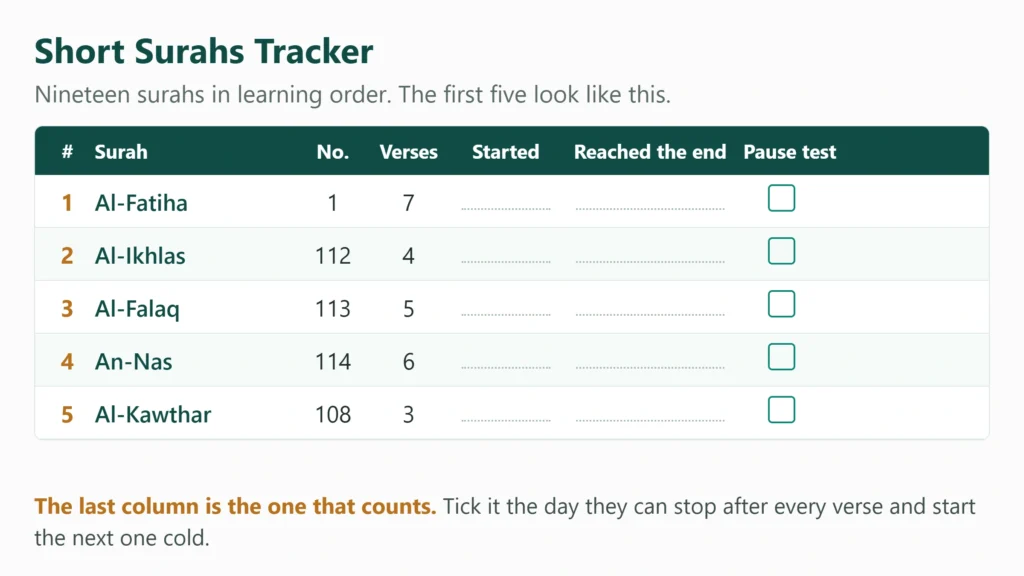
What is actually on the sheet
Most Quran trackers you can find are a grid of empty boxes. This one is opinionated, because a blank grid does not tell a parent anything they did not already know.
The order it uses, and why it is not shortest first
Al-Fatiha comes first, because it is the one passage a prayer is not valid without and your child recites it seventeen times a day. Then Al-Ikhlas, then Al-Falaq and An-Nas, which do double duty in the morning and evening adhkar and so get roughly three times the repetition of anything else on the list.
After that the sheet stops following verse count, and that is deliberate. Al-Asr and Al-Kawthar both have three verses and are not remotely the same amount of work: Al-Asr’s second verse is one of the longest single verses in this whole range, and Al-Kawthar is three short lines with no traps in them. Al-Kafirun has six verses that circle back on themselves with small changes, which is where a half-learned surah loops and restarts in the middle. The order on the sheet accounts for that. Sorting by verse count does not.
The reasoning behind each position is set out in full in our guide to which short surahs to memorize and in what order, along with the four checks and what to do when a surah is forgotten.
The one column that matters
There are two date columns on the sheet and they are usually about a week apart.
A child reaches the end of a surah, recites it start to finish, and everyone claps. That is the first column. It does not mean the surah is memorized. It usually means they have learned a tune, and a tune collapses the moment anything interrupts it: a cough in the second verse, an imam pausing, a younger sibling joining in a line early.
The pause test is the second column, and it is the real one. Ask your child to recite the surah stopping after every verse, waiting for you to nod before continuing. If they cannot start each verse cold from its own beginning, the surah is not in yet. Tick the box on the day this works, not on the day they first reach the end.
Parents who track only the first column end the year believing their child holds fifteen surahs and discover in Ramadan that four of them survive. Parents who track the second one are usually right.
How to use it week to week
One new surah at a time, and one old surah revised every day alongside it. Once your child holds more old surahs than there are days in the week, that single line stops being enough, and our free Quran revision planner sets out the rotation that replaces it. Not five. A child adding a surah a month and reciting one old one daily will end the year holding everything they learned; a child adding two a month and never looking back will end the year holding the last two.
Ten to fifteen minutes a day with an adult listening is enough. A four to six verse surah takes most children somewhere between four days and three weeks at that pace, and the spread is that wide because of how the surah is built rather than because of the child. There is no benefit at all to pushing the pace and a real cost to it, which is that the review load quietly outgrows the session and the older surahs start going.
Holidays are the specific danger. The first two weeks back after a long break should be old material only, which is the same advice we give for restarting a Quran routine at the start of the school year.
If you cannot follow the Arabic at all
That is the household this sheet was designed for, and it changes nothing about how you use it. All four checks work by ear and in English. You are not judging whether the pronunciation is correct, which you cannot do and should not try to; you are noticing whether the recall is solid and whether the same thing sounds different in the same place twice.
The one thing you cannot detect from the kitchen is a consonant that does not exist in English being replaced by the nearest one that does, which is what transliteration teaches and what tends to set in permanently. If you want to know what to listen for, we wrote about the letters children raised outside Arabic most reliably say wrong, using Al-Fatiha as the test passage since every child already knows it.
Use it, copy it, and host it yourself if you want
This tracker is free. There is no email wall, no account, and no watermark to remove.
Teachers, madrasah administrators and homeschool parents are welcome to print it, photocopy it for a class, and upload the file to their own site or parent portal. You do not need to ask us first, and you do not need to link back, though we would obviously be glad if you did.
If you would like it adapted, a version without our name on it, or the same sheet laid out for a different set of surahs, write to us and we will make it.
Our other free printables
Four more, all on the same terms: the Arabic alphabet chart for a child starting from the letters, the Tajweed rules chart for a reader who has the letters and needs the rules, the Noorani Qaida progress tracker for the stage between those two, and the stop signs chart inside our guide to the marks that tell a reader where to stop.
If you would like a qualified teacher listening while your child works down this sheet, our one to one Quran classes for children are built for exactly this, and the first session is a short trial. Tell us which surah they are on and we will start there.
For the sheets that come before memorisation, see the printables index.