
Free Printable Arabic Alphabet Flashcards
Most Arabic flashcard sets print one letter per card, on its own. That is the shape a letter almost never has inside a real word, and it is the single reason so many children can name all twenty eight letters and still not read a line of Arabic.
These cards show all four shapes on every card. They are free to print for your own family or a classroom, with no sign-up and no email form. If you would rather someone guided the process, we teach the same sequence live.
What is on each card?
Four things, and the fourth is the one most sets leave out.
- The letter on its own, large enough to read across a room.
- Its name in transliteration, so you can say it without reading Arabic.
- The closest English sound, with an honest note where there is no English equivalent.
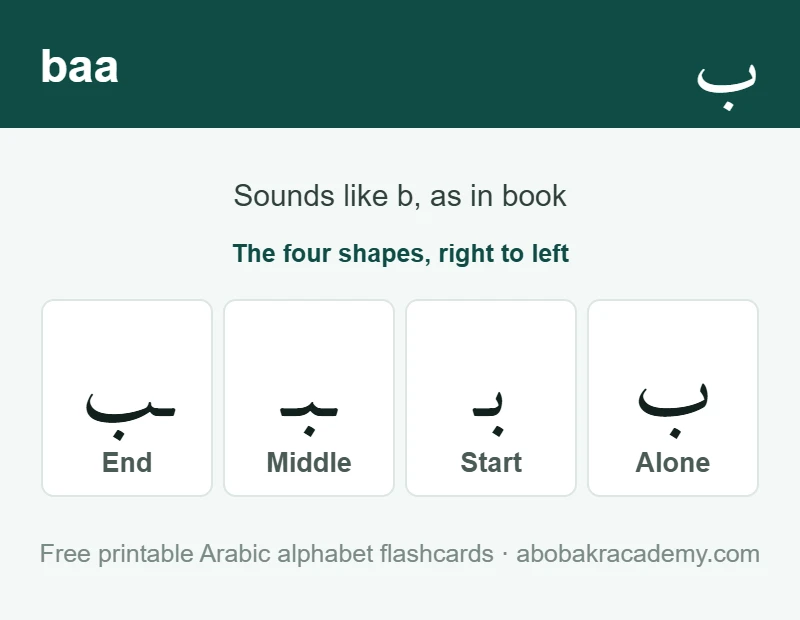
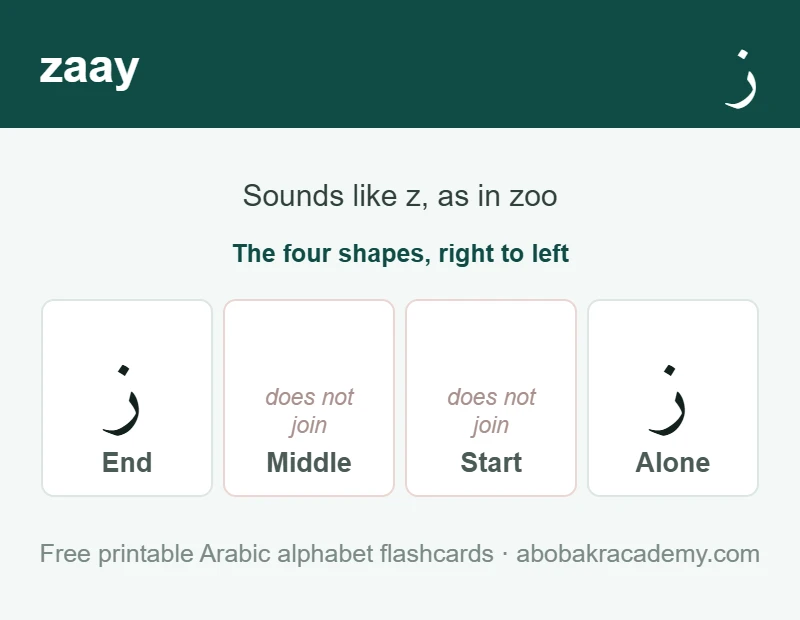
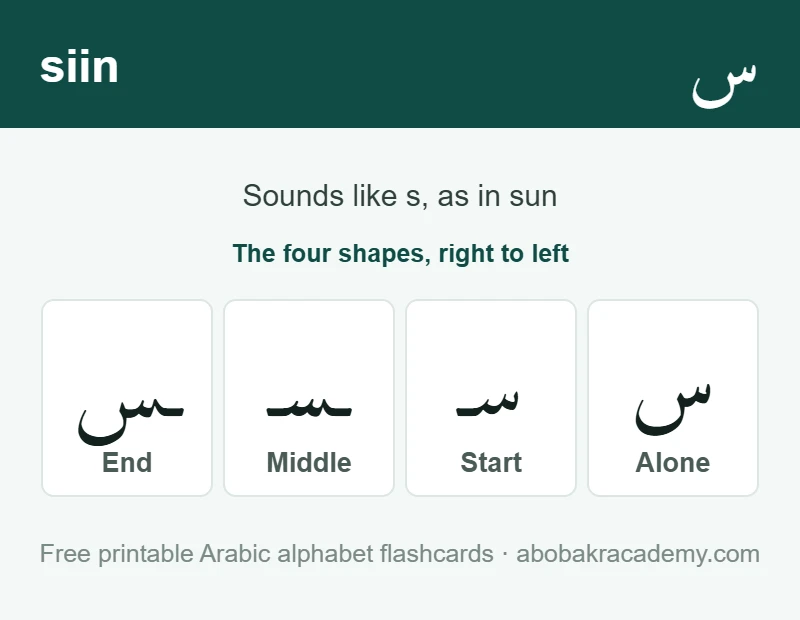
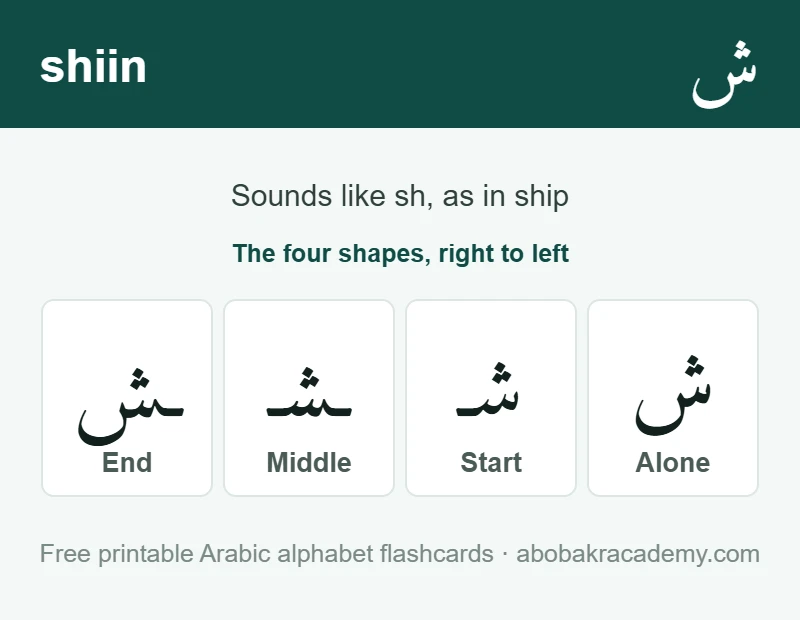
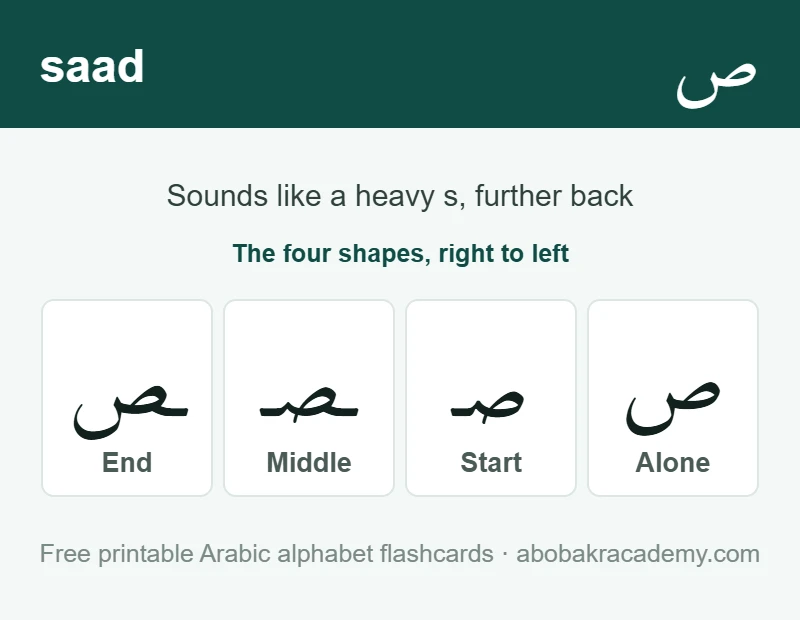
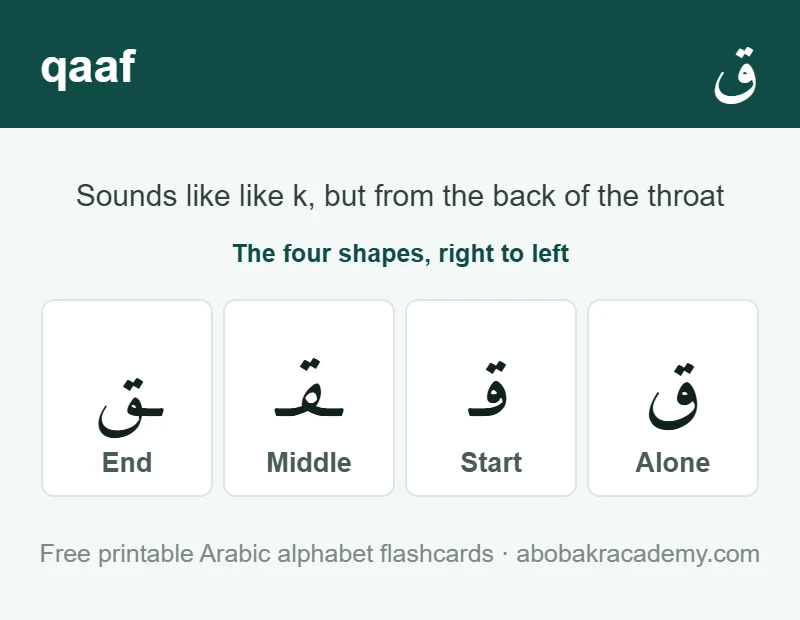
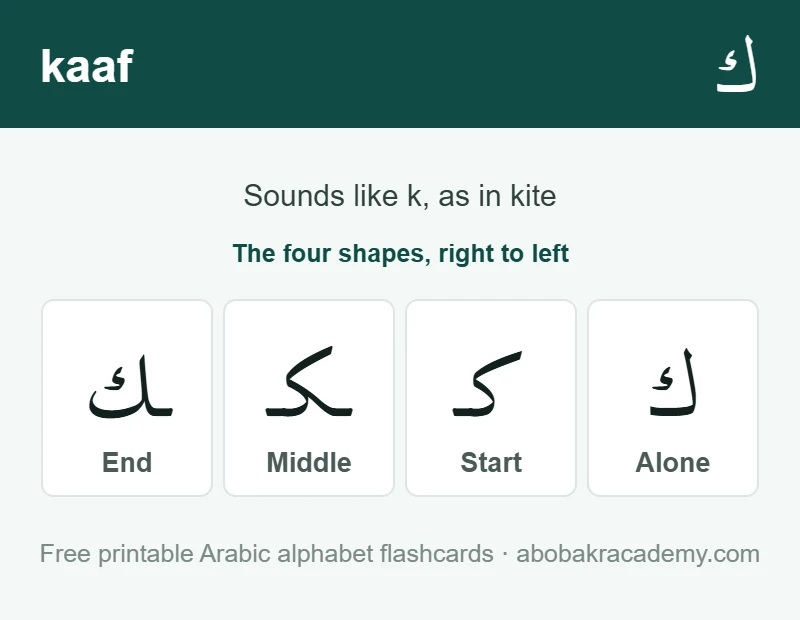
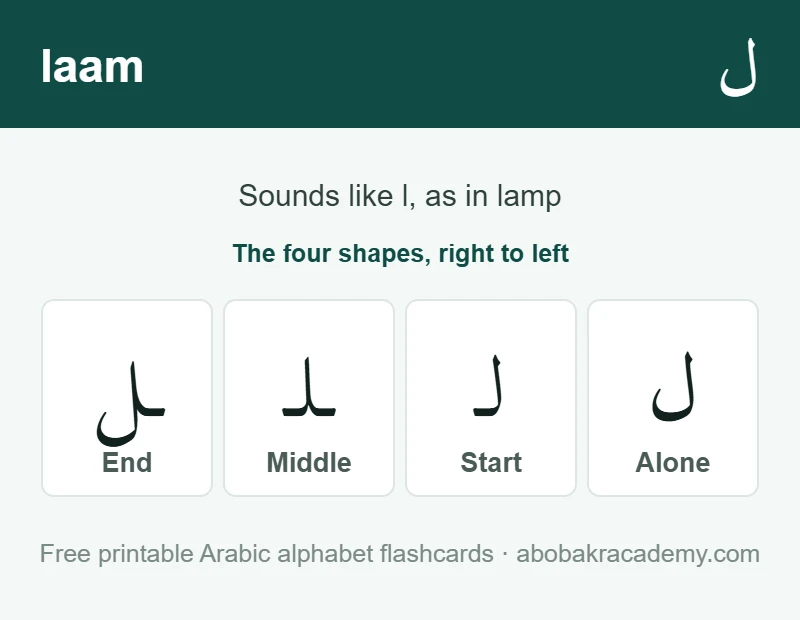
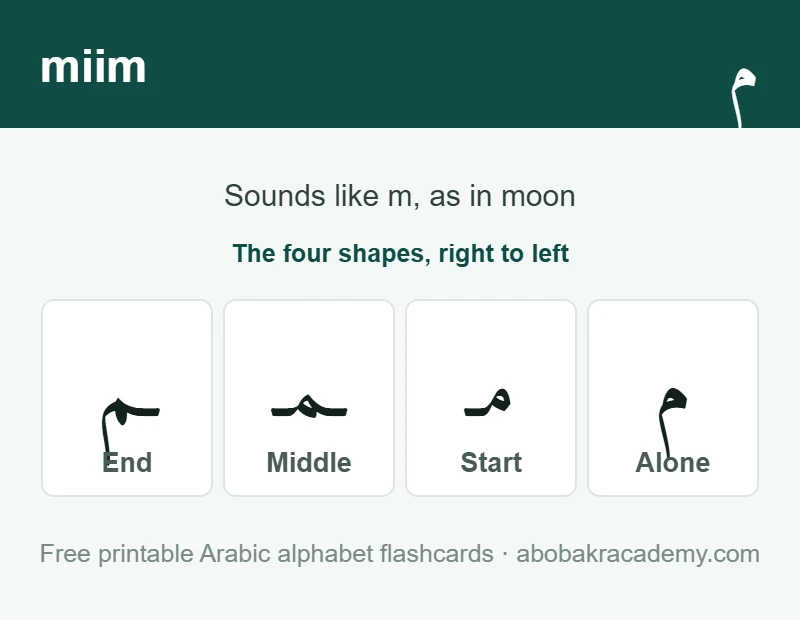
- All four positional forms along the bottom: on its own, at the start of a word, in the middle, and at the end.
does not join forward
does not join forward
does not join forward
does not join forward
does not join forward
does not join forward
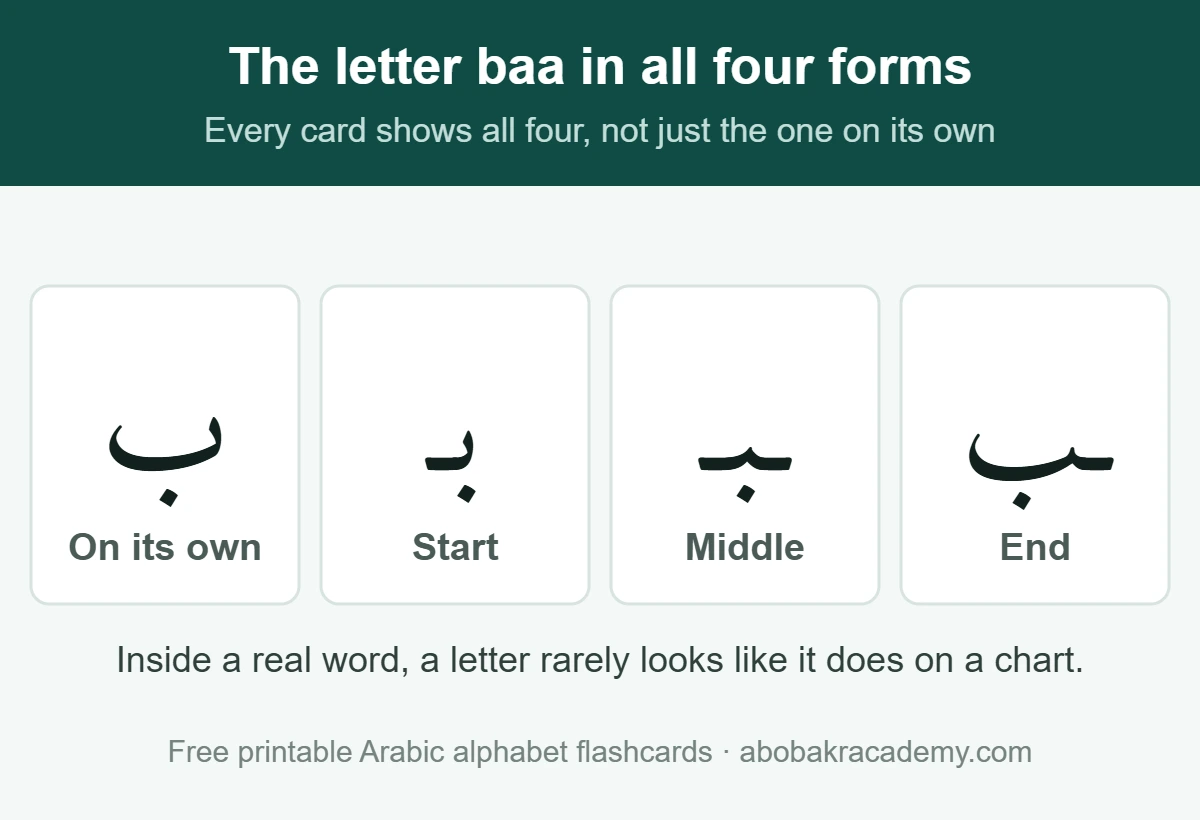
Why do the cards show four shapes and not one?
Because Arabic joins up. A letter at the start of a word, in the middle, at the end, or standing alone can look different enough that a beginner does not recognise it as the same letter. Nobody warns you about this, because to anyone who already reads Arabic it is too obvious to mention.
The result is a learner who recites the alphabet perfectly, opens a real page, and recognises almost nothing. They are not bad at Arabic. They learned one shape out of four. Our free Arabic alphabet chart sets the same four shapes out as a wall chart, and the tracing worksheets are for the hand rather than the eye.
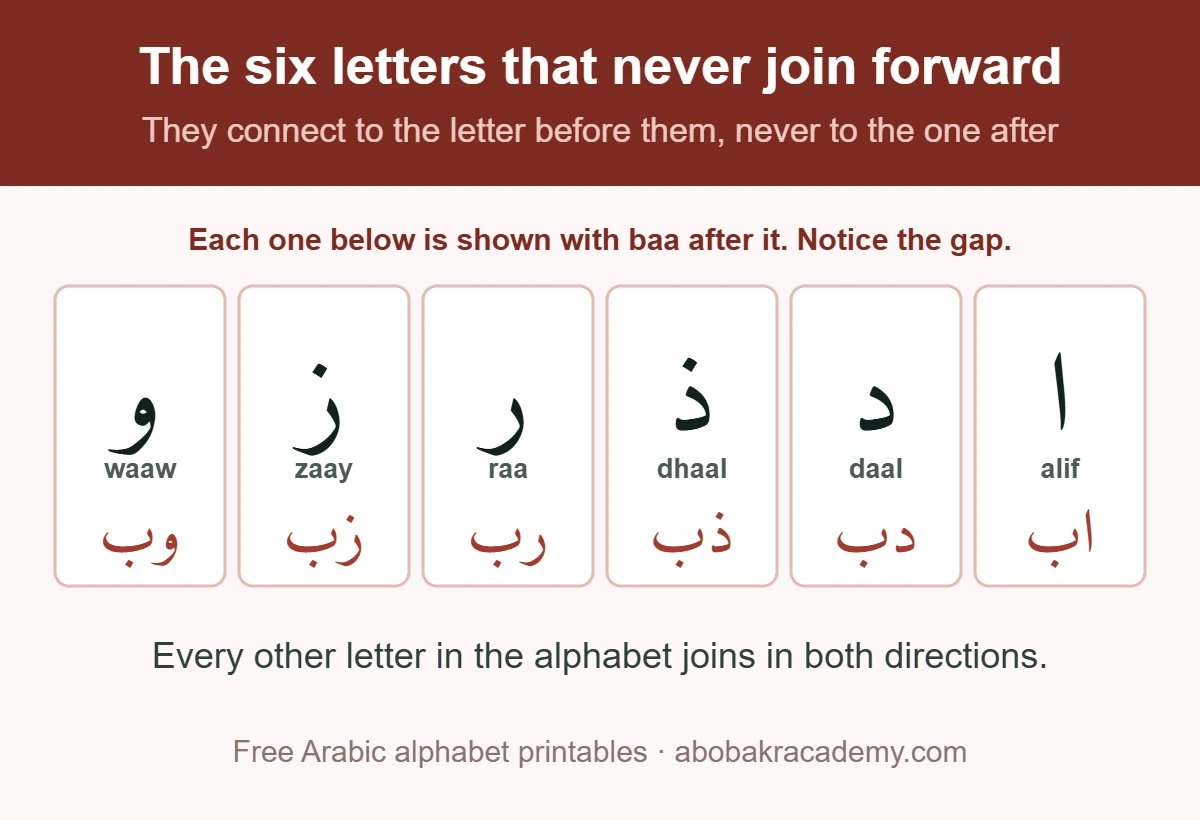
The six letters that never join to the letter after them
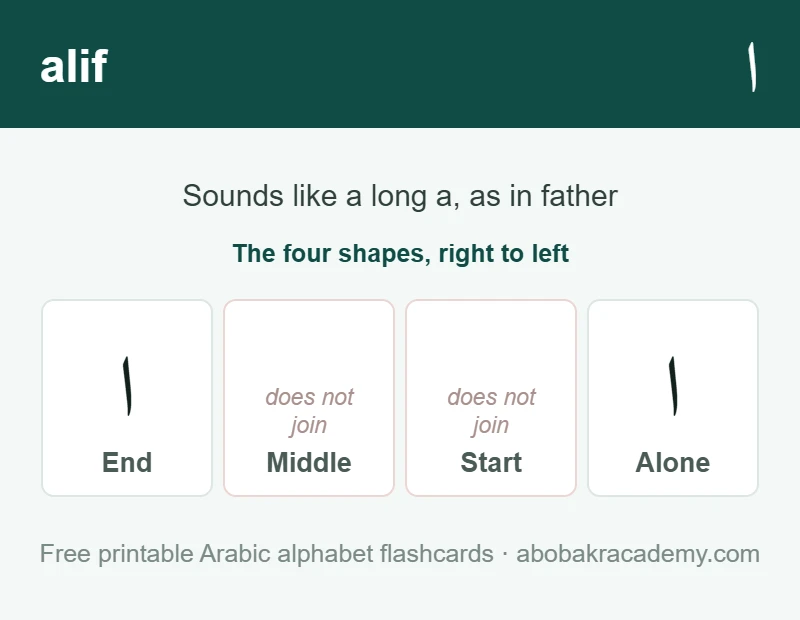
Six letters break the pattern: alif, daal, dhaal, raa, zaay and waaw. They accept a join from the letter before them but never pass one on to the letter that follows. They are marked on their cards.
This is worth knowing early, because it explains something that otherwise looks like a misprint. For these six the start form is identical to the standalone form, and the middle form is identical to the end form. It also explains the gaps inside written Arabic words: a space in the middle of what looks like one word is usually one of these six ending a segment.
All twenty eight letters, with the sound each one makes
The same information as the cards, in a form you can scan.
| Letter | Name | Sound in English | Joins to the next letter? |
|---|---|---|---|
| ا | alif | long a, as in father | No |
| ب | baa | b, as in book | Yes |
| ت | taa | t, as in table | Yes |
| ث | thaa | th, as in think | Yes |
| ج | jeem | j, as in jam | Yes |
| ح | haa | a breathy h from low in the throat | Yes |
| خ | khaa | kh, as in the Scottish loch | Yes |
| د | daal | d, as in door | No |
| ذ | dhaal | th, as in this | No |
| ر | raa | a light tapped r, as in Spanish | No |
| ز | zayn | z, as in zoo | No |
| س | seen | s, as in sun | Yes |
| ش | sheen | sh, as in shoe | Yes |
| ص | saad | a heavy s, mouth wide and full | Yes |
| ض | daad | a heavy d, tongue pressed flat | Yes |
| ط | taa (heavy) | a heavy t, fuller than taa | Yes |
| ظ | dhaa (heavy) | a heavy version of th in this | Yes |
| ع | ayn | from deep in the throat, no English equal | Yes |
| غ | ghayn | close to a gargled French r | Yes |
| ف | faa | f, as in fish | Yes |
| ق | qaaf | a k made further back in the mouth | Yes |
| ك | kaaf | k, as in kite | Yes |
| ل | laam | l, as in leaf | Yes |
| م | meem | m, as in moon | Yes |
| ن | noon | n, as in night | Yes |
| ه | haa (light) | h, as in house | Yes |
| و | waaw | w, or a long oo | No |
| ي | yaa | y, or a long ee | Yes |
Every card in the set
Before you print, this is all twenty eight cards. Each one carries the letter on its own and the three joined shapes, so nothing on the printed card is a surprise.
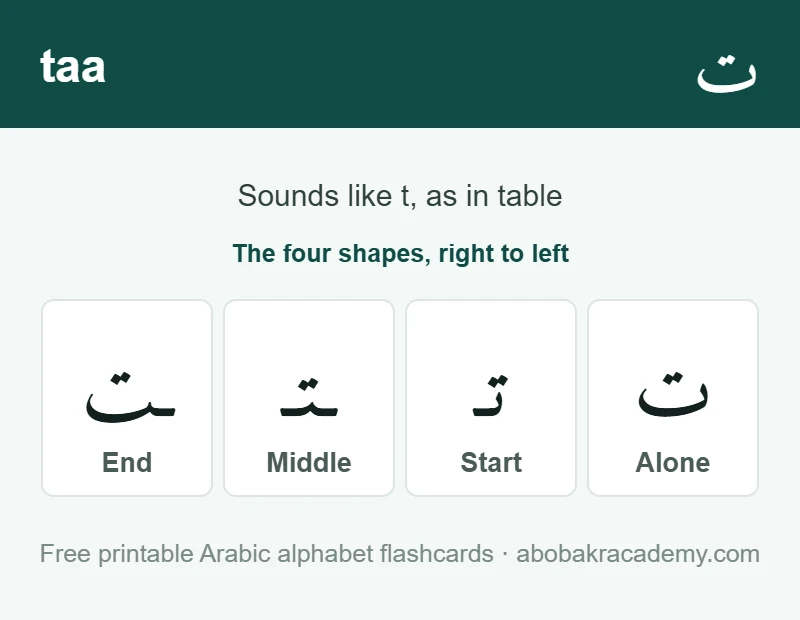
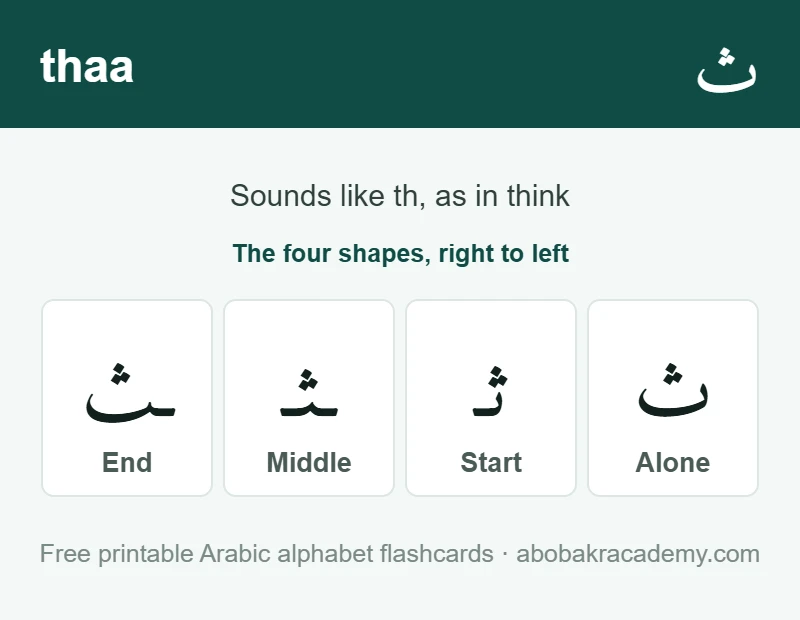
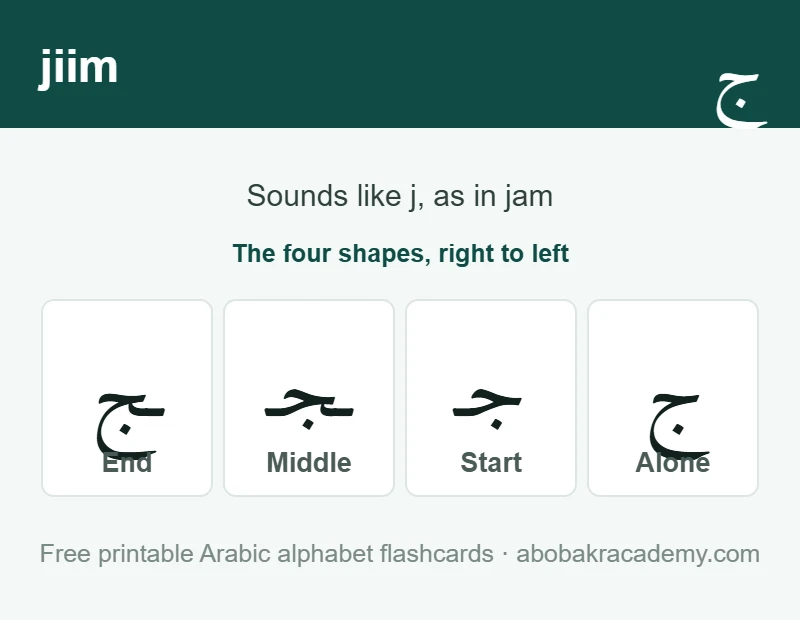
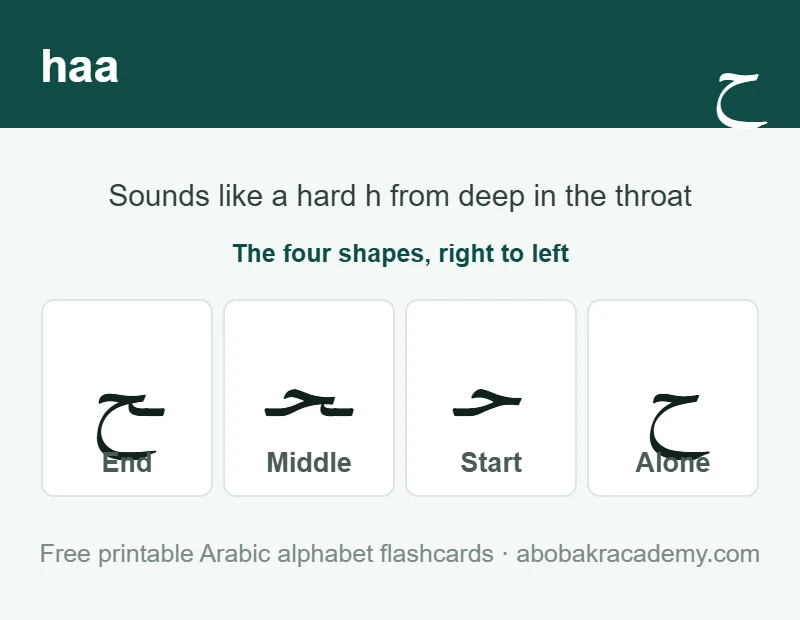
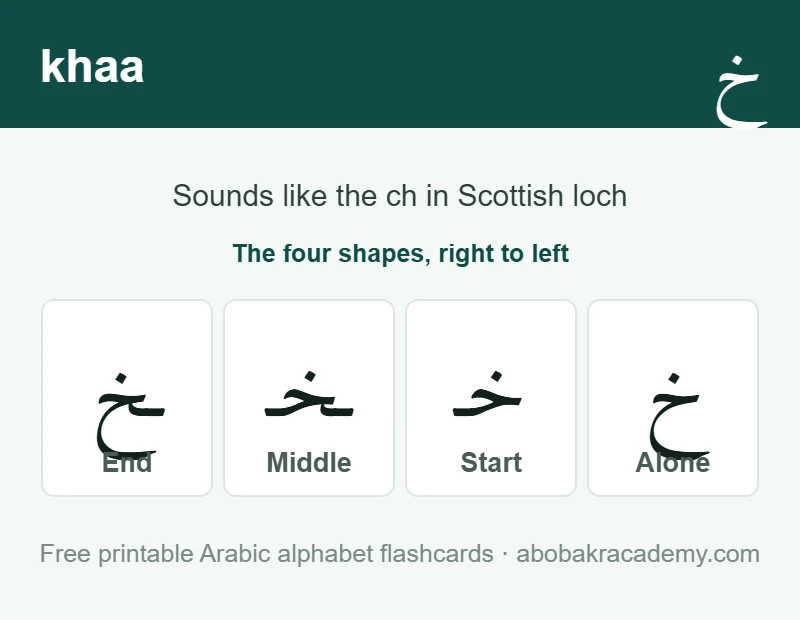
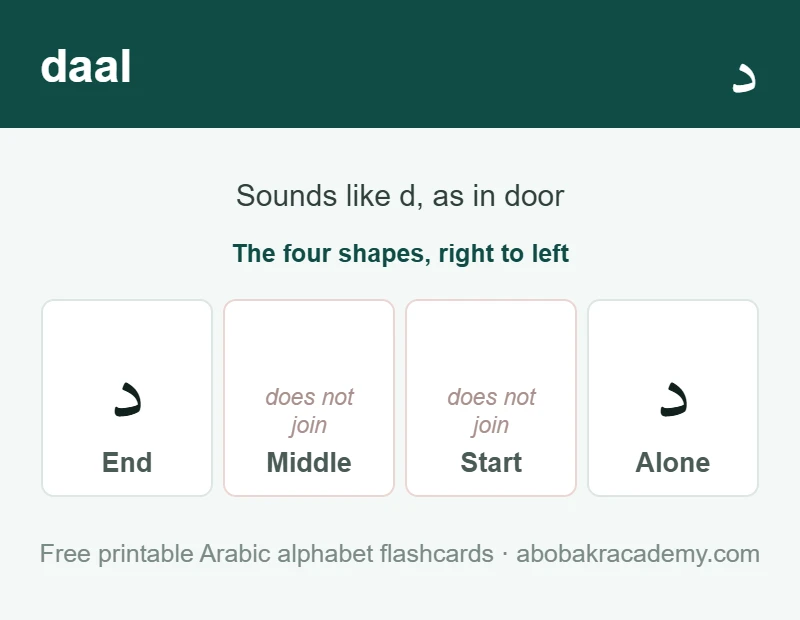
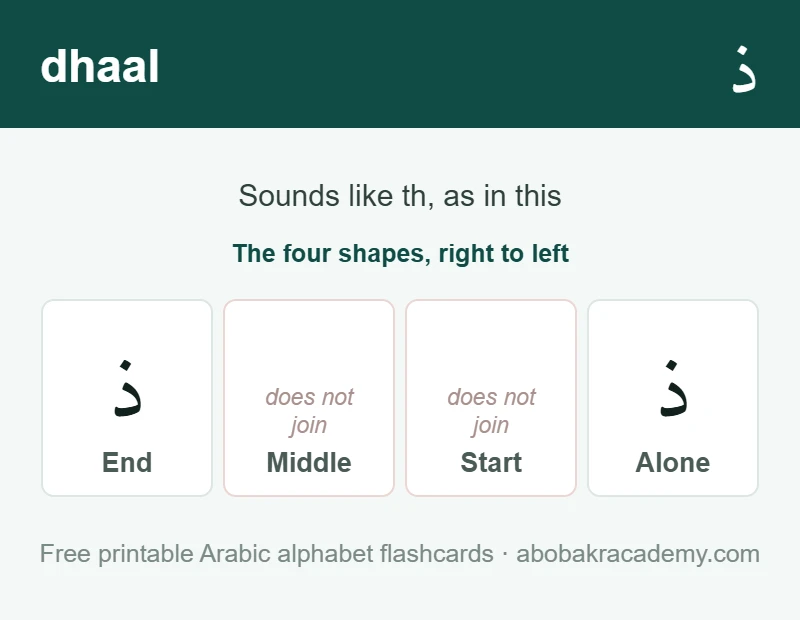
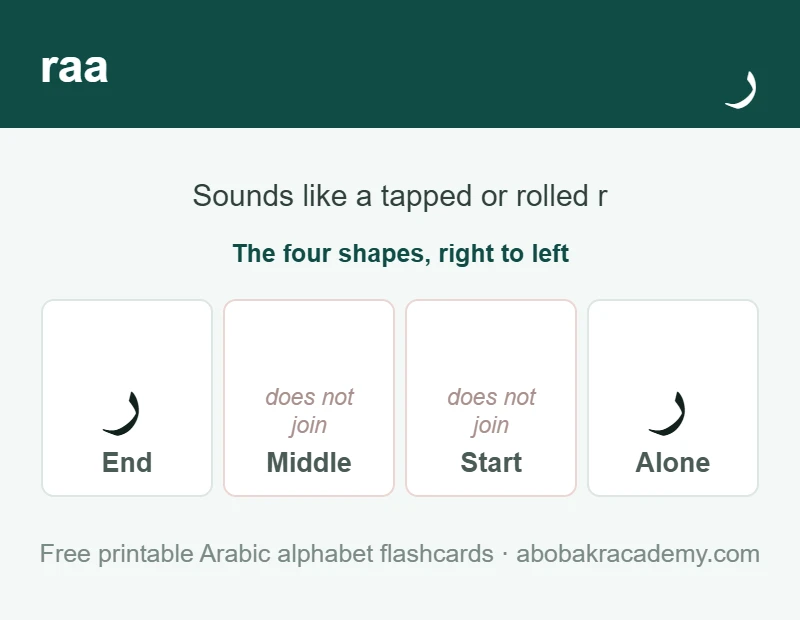
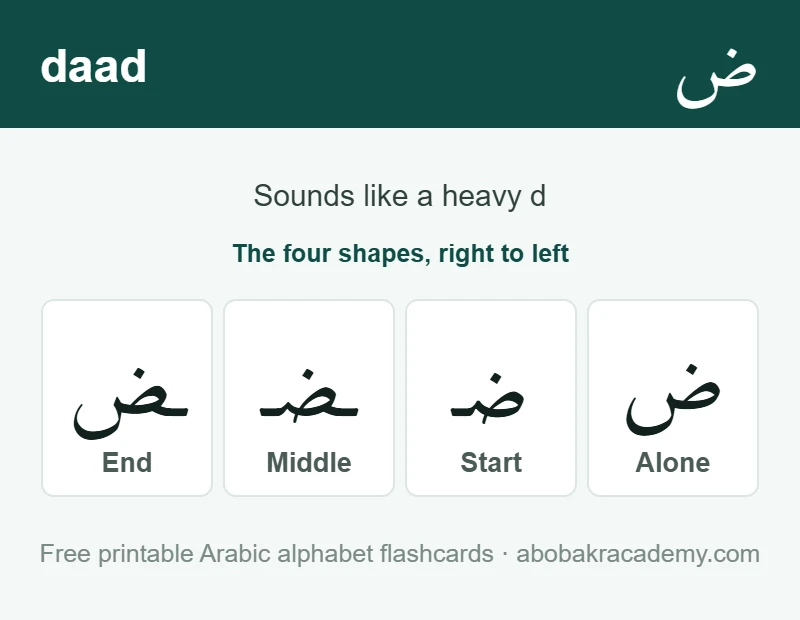
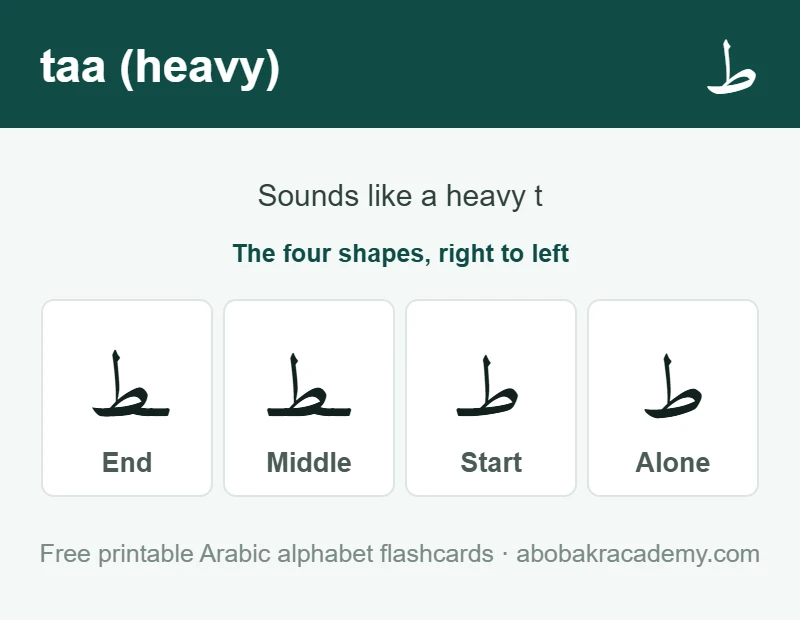

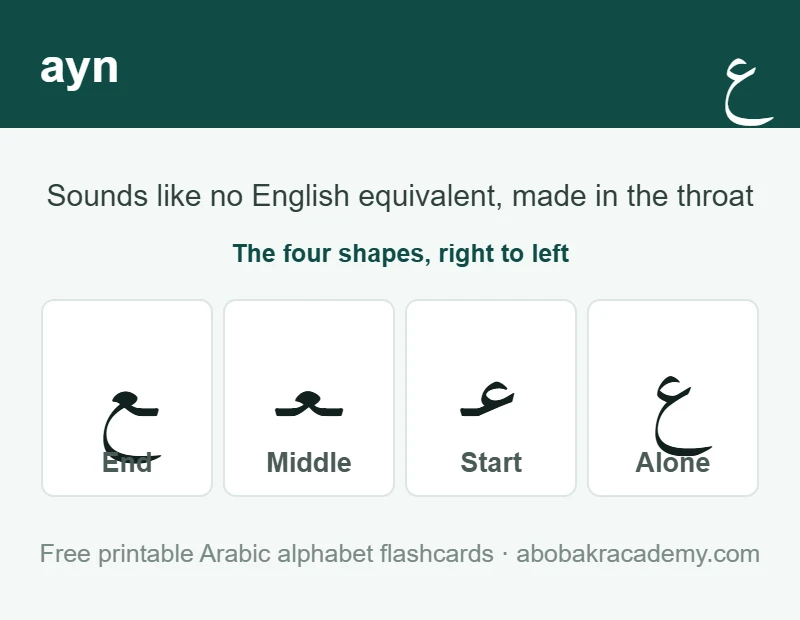
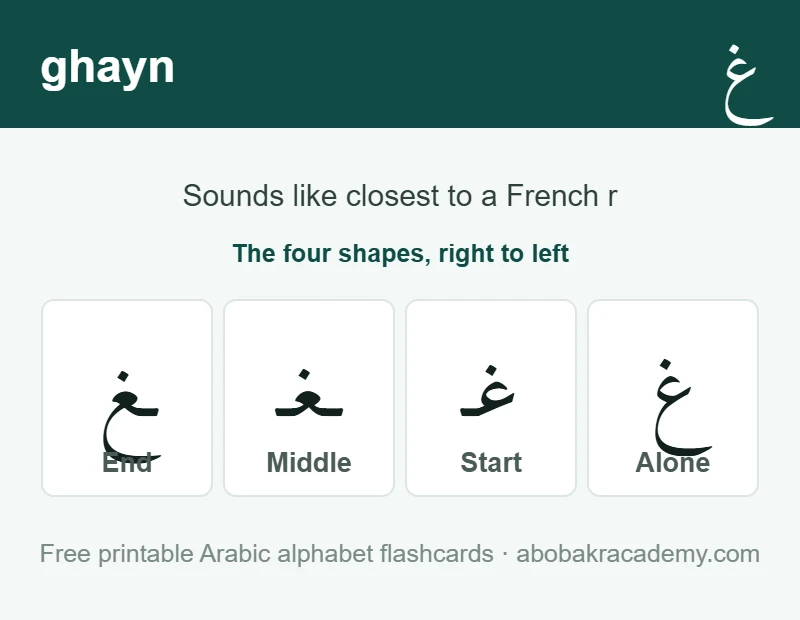

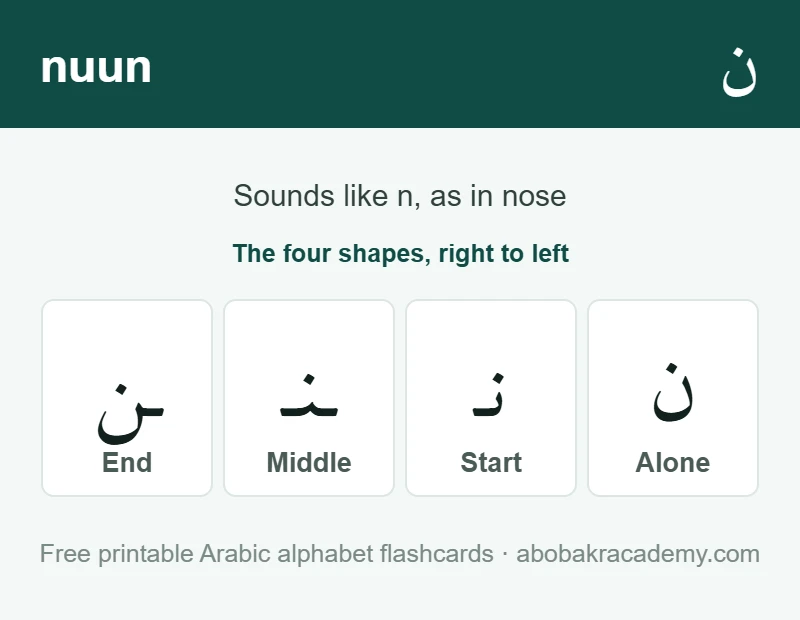
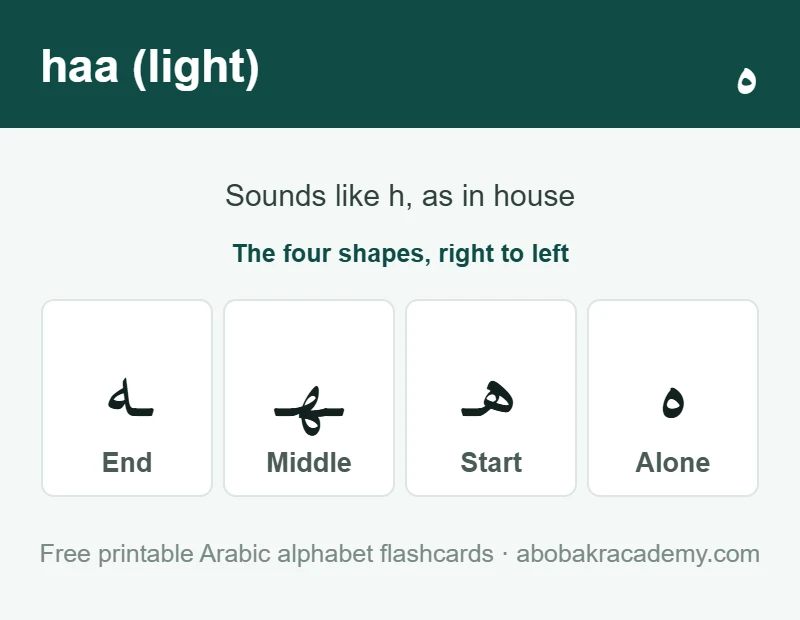
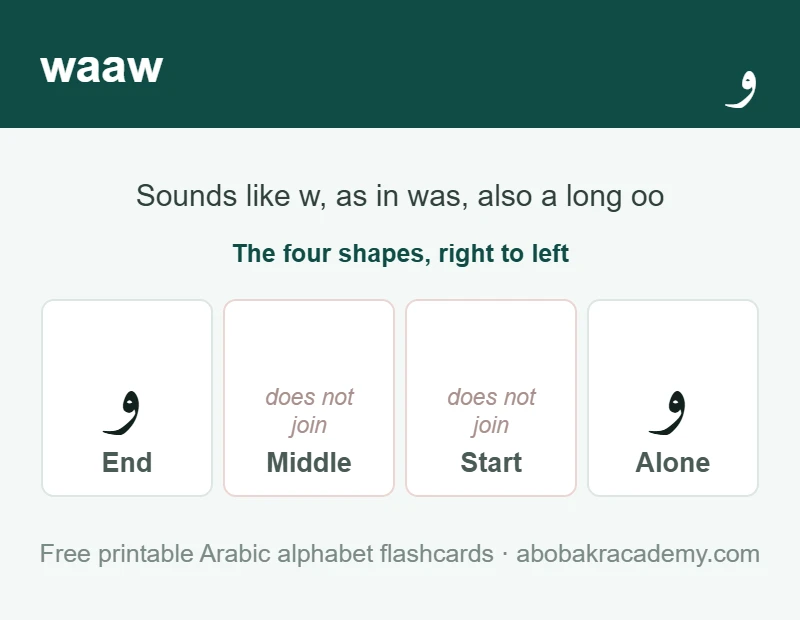
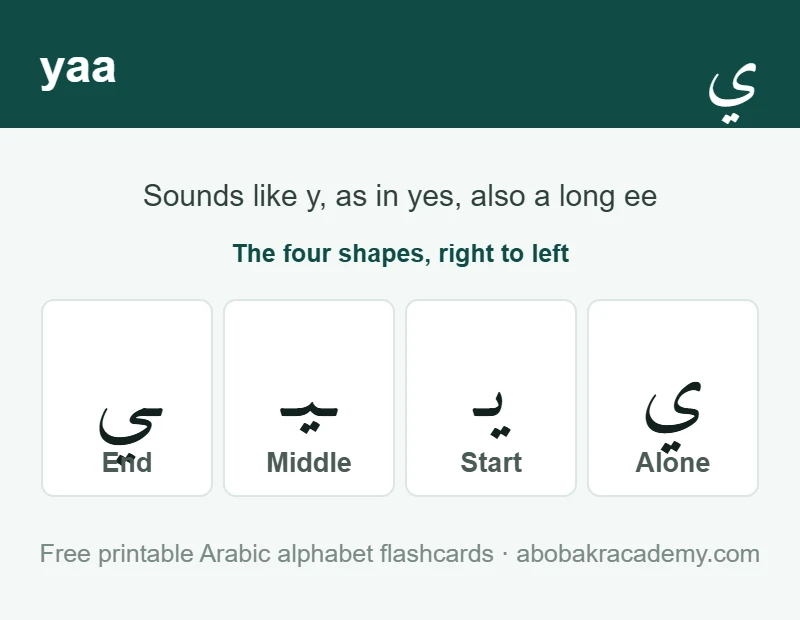
How do you use flashcards with a child who cannot read yet?
Short and often beats long and rare. Five minutes a day will move a child further than forty minutes on a Sunday.
- Start with eight cards, not twenty eight. Add one only when the eight are solid.
- Work down the order on the cards rather than jumping to the letters in their name. Letters that share a shape sit together, so baa, taa and thaa differ only in dots and learning them as a group is faster.
- Once a letter is named confidently, cover the big letter and ask them to name it from the four small forms instead. That is the test that matters, and it is the one most flashcard sets cannot do.
- Say the sound, not just the name. A child who knows the name baa but not the sound b cannot use it to read.
If your child is already past single letters, the Noorani Qaida is the sequence most teachers follow next.
Using these in a class or co-op
Print and hand them out freely, for family, classroom, madrasah or homeschool use. You do not need to ask us. We would rather they were useful than protected. If you republish them online, a link back is appreciated and is the only thing we ask.
What to use next, and where these letterforms come from
Flashcards are the first step and they are deliberately not the whole thing. A card teaches recognition. Writing teaches recall, and reading teaches both at once, so the cards work best alongside two or three of the other free sheets. What none of them can do is hear your child say the letter, and that is what our online Arabic lessons for kids are for.
Print the free Arabic alphabet chart and keep it on the wall, so the child has somewhere to look when a card stumps them. Move to the Arabic alphabet tracing worksheets once they can name about ten letters on sight. When they start meeting letters inside real words rather than on their own, how Arabic letters change at the beginning, middle and end of a word explains the part that confuses nearly every beginner, and the alphabet with a word for each letter gives them something to read.
Two more that help the adult rather than the child. If nobody at home reads Arabic, teaching Arabic to your child when you do not speak it is the honest version of how that works. And the letters children most often say wrong will tell you which mistakes to correct and which to leave alone for now. The rest are on the free printables page.
The letter names and the order used on these cards follow the Unicode Standard’s Arabic code chart, and the transliteration follows the Library of Congress Arabic romanization table. We say where they came from because a parent who cannot read Arabic has no way to check us otherwise.
Printing the cards, vowel marks and what to do next
Are these really free?
Yes, and there is no email form in front of them. Print the page straight from your browser.
What paper should I use?
Ordinary paper works. Card stock lasts longer if the cards will be handled daily, and printing on both sides is unnecessary because everything a learner needs is on the front.
Do the cards include the vowel marks?
No. They cover letter shapes and sounds, which is the first stage. Harakat come after a learner can recognise letters in all four positions, and mixing the two at once is a common reason beginners stall.
My child knows the letters but still cannot read. What now?
That is the normal gap, and it is almost always the positional forms plus joining. Use the four small forms on each card rather than the big letter, then move to two- and three-letter combinations. If it persists past a few weeks, it is worth having someone listen.
Is there a version with pictures or words?
Not on these cards, deliberately. A picture gives a child a second way to guess the answer without reading the letter. Our reference table of all 28 Arabic letters with a word for each is the place for example words, once recognition is solid.
Other free printables
These cards are one of the free sheets on this site. The rest, in the order a child needs them, are on the printables page.
If you want a teacher to take it from here, we teach Arabic and Quran one to one and in small groups to families across the US, UK, Canada and Australia, and the first class is free.