The trial class finishes, everyone says salaam, and the teacher says something warm and vague about consistency and two years, in shaa Allah. You nod. Then you close the laptop and realise you have no way at all to test that sentence. You do not read Arabic. You cannot tell a strong page from a shaky one. And you are about to commit a child, and a monthly fee, to something you cannot measure.
That is the actual question behind “how long does it take to memorize the Quran”. It is not really about the Quran. It is about whether the number you were quoted is honest, and whether your particular house can sustain it.
So let us do the arithmetic properly, on paper, the way you would with anything else you were about to commit years to.
The short answer, before the caveats
A child who starts around seven, holds half a page a day through the school year and slows over the summers, finishes somewhere between thirteen and sixteen years old. An adult with a job who manages three sessions a week and a page each time is looking at four to six years. Someone doing a full page a day with nothing interrupting them finishes in two, and a small number of people do.
Those are the ranges. Any teacher who gives you a single number instead of a range is either guessing or selling.
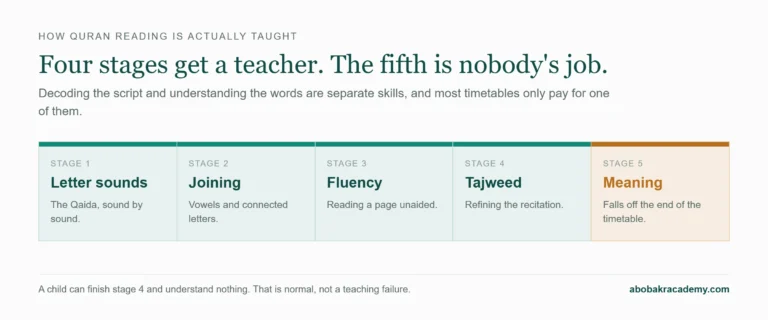
They also assume a child who can already read Arabic without help, which is a separate piece of work that comes first. If your child is not there yet, the reading has to be solid before the memorizing starts, and that changes the clock considerably.
But the ranges are the least interesting part of this, and they are not what you should be deciding on. What matters is the number underneath them, which almost nobody shows you, and which changes the whole shape of the commitment.
Start with the only fixed number in the calculation
A standard mushaf runs to 604 pages. That is the one figure in this entire exercise that does not move. Everything else is a variable you and your child control.
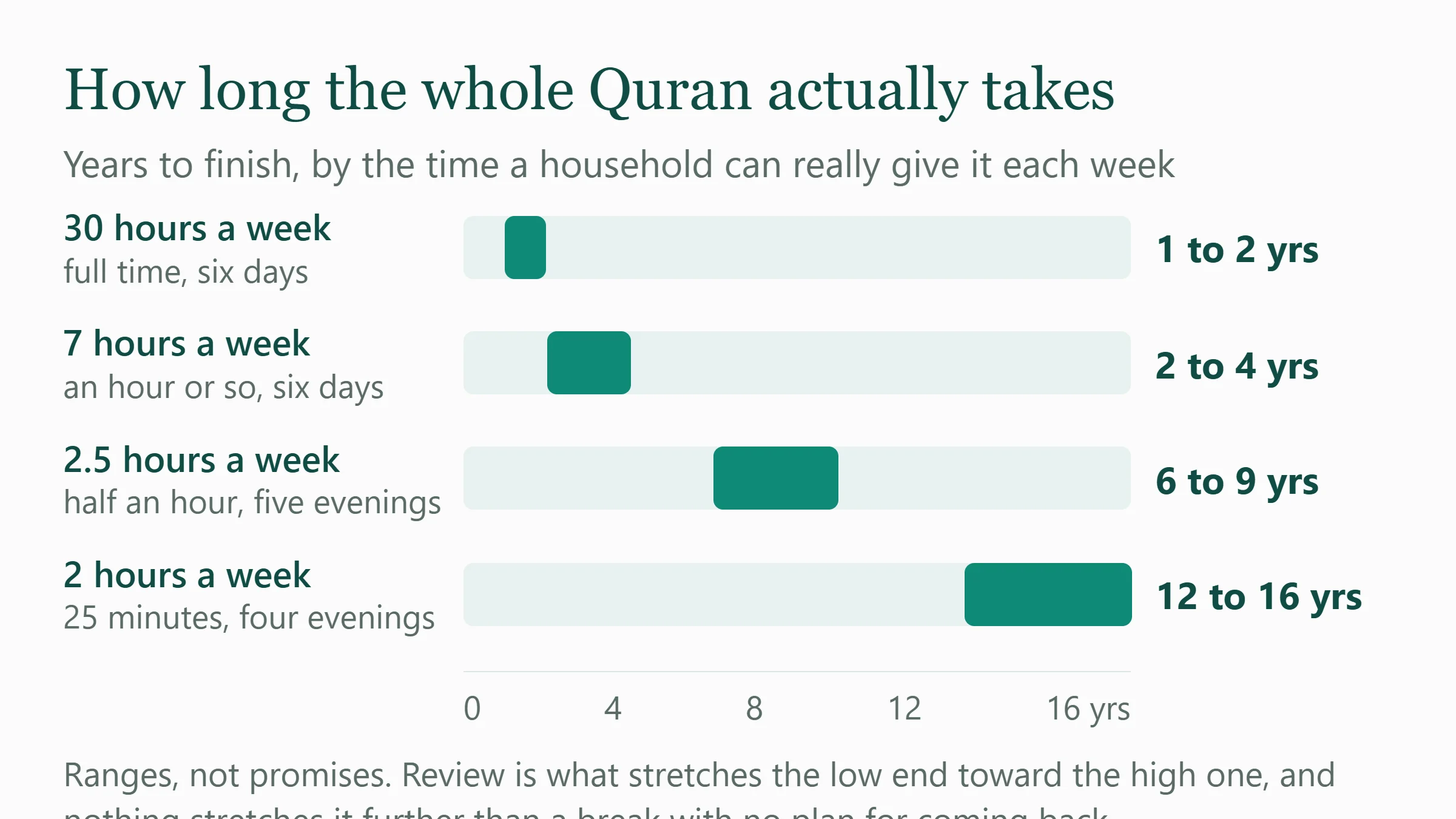
So the naive sum is easy. Half a page a day, five days a week, is two and a half pages a week. Divide 604 by 2.5 and you get about 242 weeks, which is four and a half years of unbroken work.
Hold that number for a second, because the real one is six to nine years for a child on exactly that pace. The gap between four and a half and nine is not sloppiness. It is the entire subject of this article.
Look at what the sum quietly assumed. No illness, no exams, no travel, no Ramadan disruption, no summer, no week where the child simply refuses. Every half page going in first time. And, much bigger than all of those, it assumed that once a page is memorized it stays memorized.
None of them hold. The last one is the one that doubles the timeline.
The number that sets the timeline is review, not new memorization
Here is the thing that separates a real hifz plan from a spreadsheet. New memorization is flat. Half a page today, half a page tomorrow, half a page next April. The workload never changes.
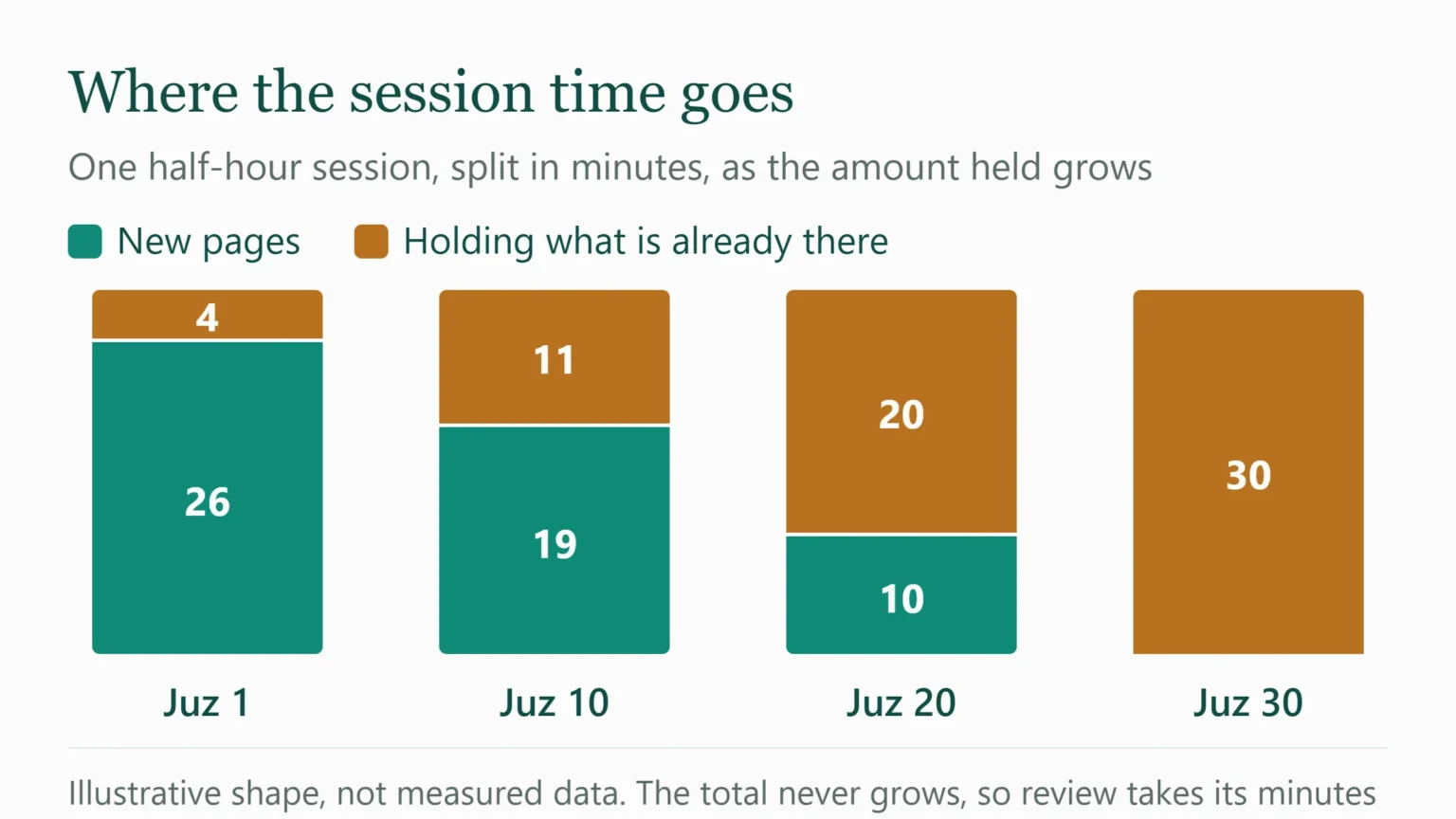
Review is not flat. It grows with everything already memorized. When your child holds one juz, keeping it warm costs a few minutes. When they hold ten, keeping those ten warm costs most of the session. There is a point, usually somewhere around the twelfth to fifteenth juz, where the review load overtakes the new work and the child is spending forty minutes holding on to what they have and eight minutes adding to it.
That crossover is where most children stall. Not because they got lazy and not because the teacher got worse. Because the arithmetic changed underneath them and nobody adjusted the plan.
The Prophet, peace be upon him, put it more sharply than any study plan could. Memorized Quran, he said, is more prone “to break away than a camel in its bind”. That is not a warning about effort. It is a description of how memory behaves, and it means that a plan built only around new pages is built wrong.
Tonight: ask your child to recite something they finished six months ago. Cold, no warm-up, no prompt from the page. If it comes out hesitant or stops halfway, the plan has too much new work in it and not enough old. That is a scheduling problem, and it is fixable in a week.
What this looks like on an actual school week
Every published hifz schedule you have found assumes a student whose entire day is available. Three months, six months, one year, two years. Those plans are real. They are also written for someone doing six to eight hours a day in a residential programme with a teacher in the room.
Your child gets twenty-five minutes after homework, on the evenings when there is no football and nobody is exhausted. That is a completely different calculation, and running it against a residential schedule is how families conclude they are failing when they are simply doing a different thing.
So here is the honest version, in the units you actually have.
| What your week really looks like | New material a week | Realistic finish |
|---|---|---|
| 20 to 25 minutes, 4 evenings | About 1 page | Juz Amma in roughly a year; the whole Quran is 12 years or more |
| 30 minutes, 5 evenings | 2 to 2.5 pages | 6 to 9 years, and this is the commonest case |
| 60 to 90 minutes, 6 days | 5 to 7 pages | 2 to 4 years, nearer two only if nothing interrupts |
| 5 hours or more, 6 days | 15 to 20 pages | 1 to 2 years |
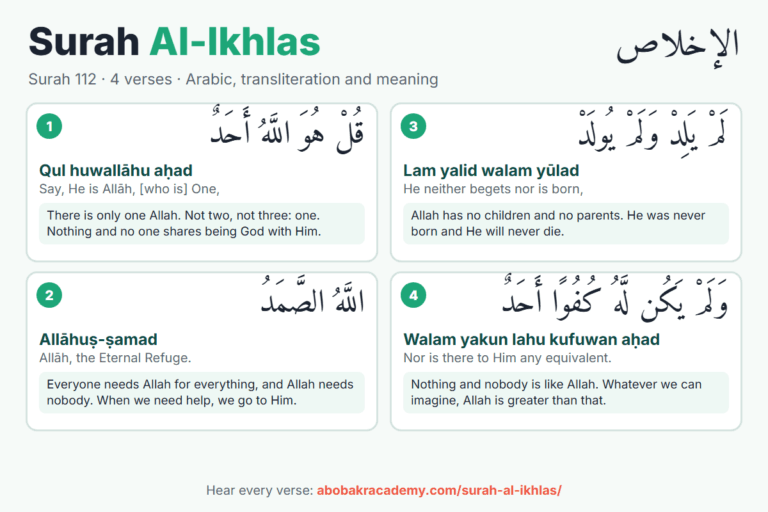
Read the first row again, because it is the one most families are actually in, and it is the one nobody writes about. Twenty-five minutes four times a week is not a failed hifz programme. It is a real and honourable pace that gets a child through Juz Amma inside a year, and Juz Amma is most of what they will recite in prayer for the rest of their life. If your child is at the start of that and you are deciding what to give them next, the short surahs worth learning first, and the order to take them in, is a smaller and more useful question than the twelve-year one. A short surahs tracker records the day each one is really held, not only the day it was reached.
Why the three-month plans are not lying to you
They are not. People genuinely complete the Quran in three months, and some do it in forty days. The programmes exist, mostly in Egypt, Turkey, Pakistan and parts of the Gulf, and they work.
What they cost is worth saying plainly, because the pages advertising them rarely do. A forty-day hifz means eight to ten hours a day of nothing else. It means school stops or was never running. It usually means living at the institute. And retention afterwards depends entirely on a review schedule that is as demanding as the memorization was, sustained for years. A child who completes in forty days and then stops reviewing will not hold it, and the same is true of a child who took six years.
We do not run that kind of programme and we will not pretend the pace is available to a family in Manchester or Toronto with two working parents. What we do run is built around the review load rather than the page count, which is a slower headline and a better outcome. If someone quotes you three months for a child doing half an hour after school, that is the moment to ask what the review schedule looks like.
How to tell if it is going well when you do not read Arabic
This is the part parents ask for most and find least often, because it requires the teacher to hand you a way of checking their own work. Four tests. None of them needs a word of Arabic.
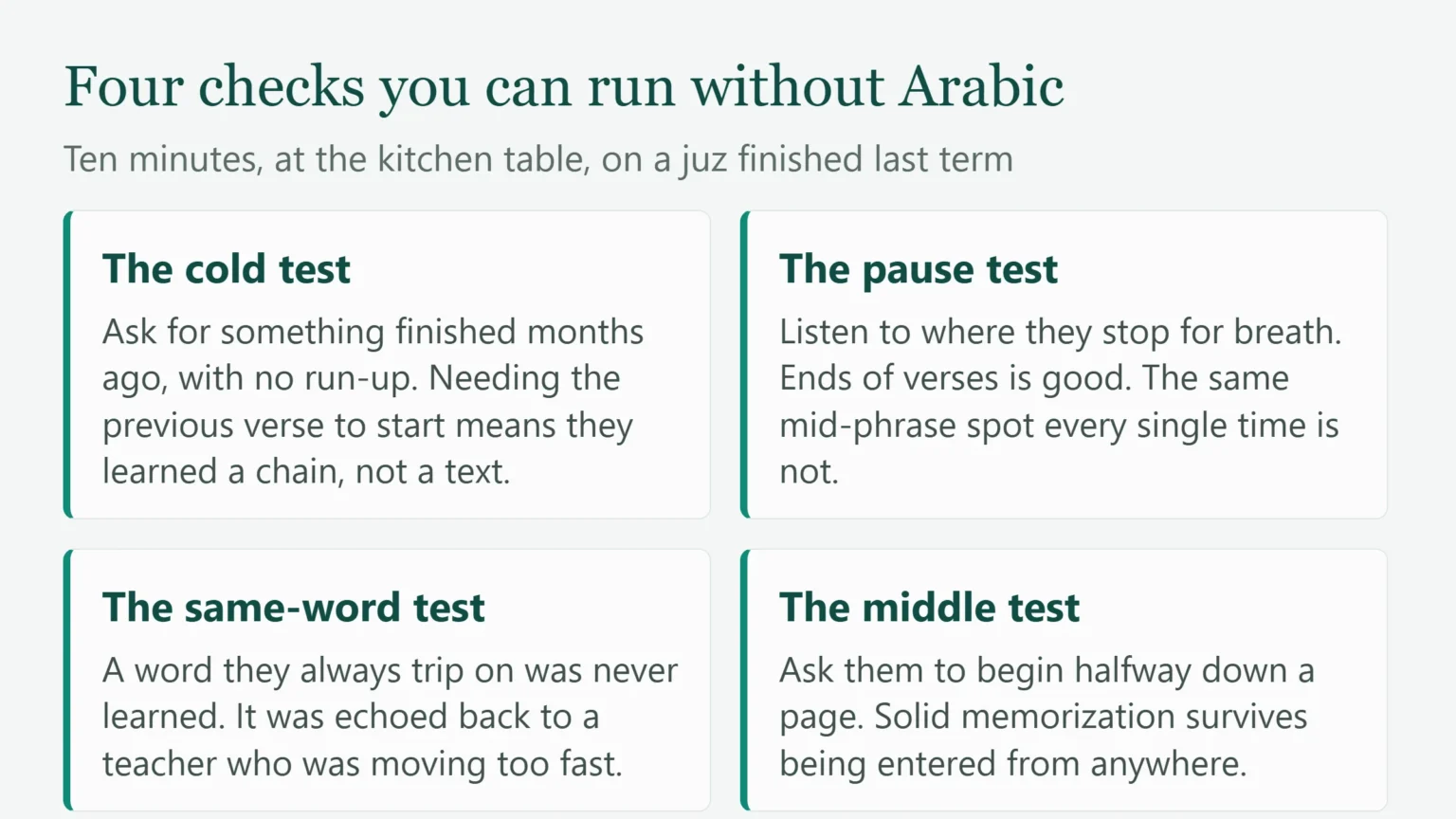
The cold test
Pick something finished at least three months ago and ask for it with no run-up. Strong memorization starts immediately. Weak memorization needs the previous verse as a launch pad. If your child can only start a passage by reciting the one before it, they have memorized a chain, not a text, and the chain will break in the middle one day.
The pause test
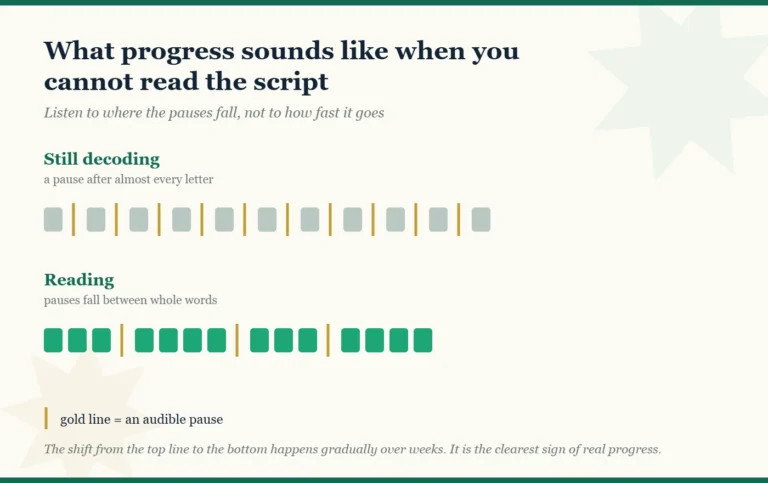
Listen to where they stop for breath. A child who has learned properly pauses where the verse pauses, at the ends of ayat, and where the little stopping marks above the line tell them to. A child who is reciting from muscle memory pauses where their memory runs out, which is usually mid-phrase and always in the same spot. You do not need to understand a word to hear the difference. One sounds like speech, the other sounds like a list.
The same-word test
If they stumble on the identical word every single time, that word was never learned. It was echoed back to a teacher who was moving too fast, and it has been sitting there as a hole ever since. Mark it, tell the teacher, and expect it fixed inside a fortnight.
The middle test
Ask them to start from the middle of a page rather than the top. This one is uncomfortable and it is the most revealing. Solid memorization survives being entered from anywhere. If starting anywhere but the top produces silence, the page is not really held yet, whatever the tracker says.
Run all four once a month, on a different juz each time, and write down which ones failed. Three months of that is better evidence about your teacher and your plan than any progress report you will ever be sent.
If you want the wider version of this, we keep a monthly check covering reading as well as memorization, built for exactly this problem of judging work you cannot read.
What to do after a gap
Every hifz has one. Ramadan ends and the routine dissolves with it, which is why the month is worth planning as its own thing rather than letting it swallow the schedule. Exams. A house move. A long illness. A summer where nobody could face it.
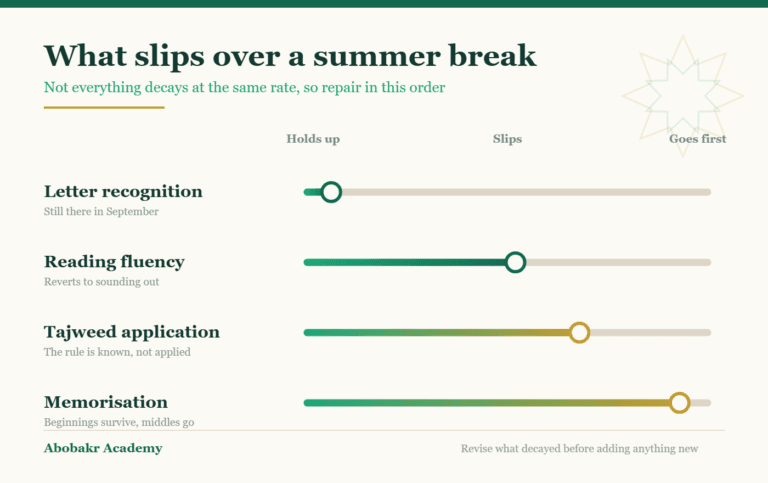
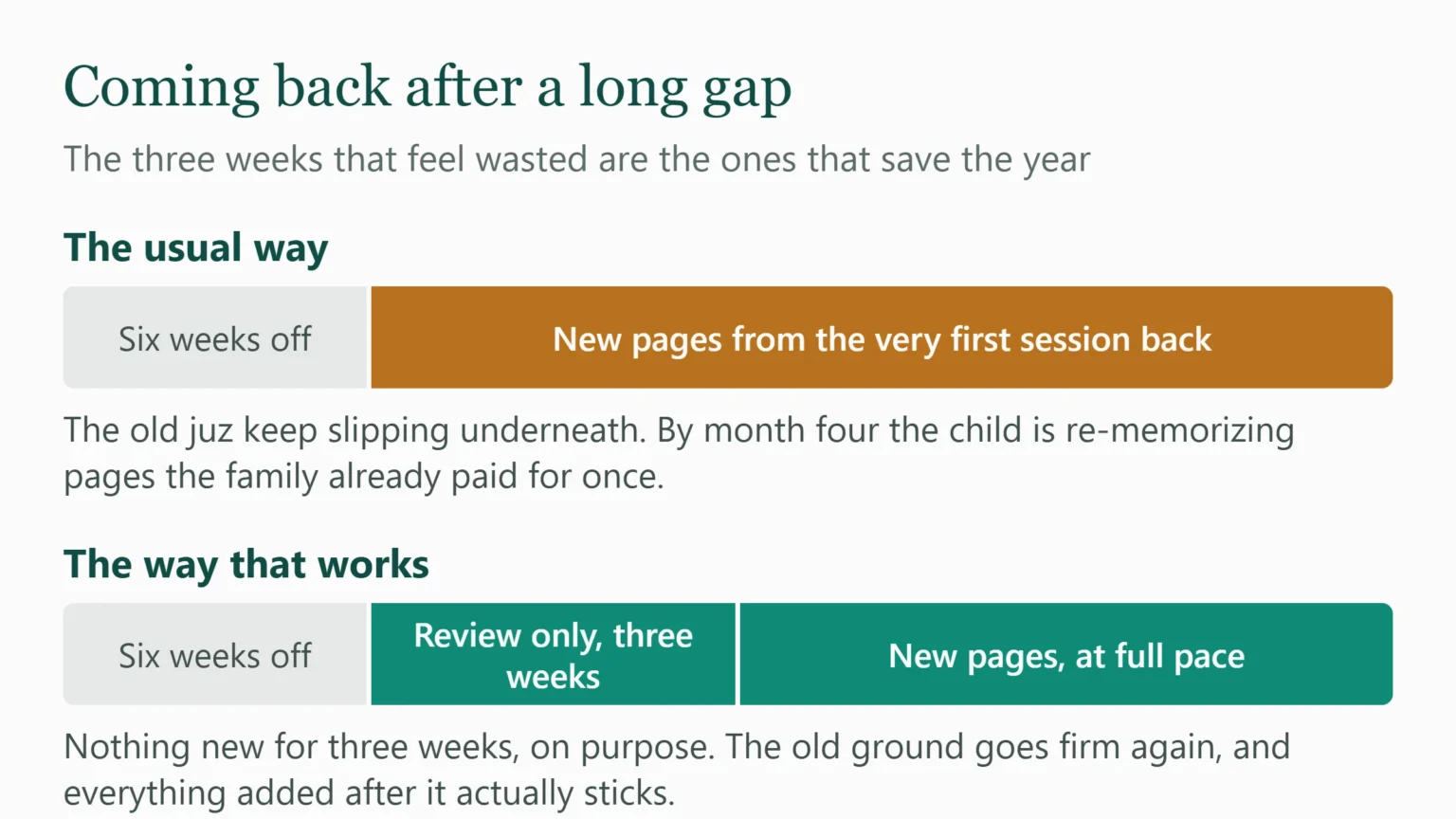
Six weeks off does not delete what was memorized, but it does loosen it, and the instinct to jump straight back into new pages is the single most common way families lose a year. What actually works is three weeks of review and no new material at all. Nothing new. Just holding the old ground until it is firm again.
Those three weeks feel like lost time. They are not. They are the cheapest weeks in the whole project, because the alternative is adding new pages on top of a foundation that is already slipping, which is how a child ends up at juz fourteen with juz three gone.
If your child comes back from a long break and the teacher starts new material in the first session, ask why.
Should the goal be the whole Quran at all?
This deserves a straight answer, and the straight answer is: not necessarily, and pretending otherwise does families real harm.
Juz Amma is thirty-seven surahs. It is the bulk of what a Muslim recites in salah across an entire lifetime. A child who finishes it properly, holds it, and can recite it cold at fifteen has something complete and permanent. A child pushed toward the full 604 pages who quits at juz thirteen, discouraged, has something that will keep slipping and a memory of failing at it.
The second outcome is more common than anyone admits. Setting Juz Amma as a real finish line, celebrating it as one, and then deciding together whether to continue is not lowering the bar. It is putting the bar somewhere a child can actually clear, which is what makes the next one possible.
Allah says of the Quran that He made it easy to remember. That is a promise about the text, not a promise that any given schedule fits any given family. The ease is there. Finding the pace that lets a particular child meet it is the work.
A tracker you can keep on the fridge
You do not need software for this. Four columns on a sheet of paper, filled in once a week, will tell you more in three months than any dashboard.
| Week | New pages this week | Juz reviewed | Cold test: which juz, pass or fail |
|---|---|---|---|
| 1 | |||
| 2 | |||
| 3 | |||
| 4 |
The third and fourth columns are the ones that matter. Anyone can fill in the second. If a month goes by where column three is thin and column four is failing, the pace is wrong regardless of how good column two looks, and it is worth saying so out loud to whoever is teaching.
One year, a child’s pace, and becoming a hafiz
How long does it take to memorize the Quran for a complete beginner?
Six to nine years is realistic from no Arabic reading at all, at half an hour most days. The first six months of that are not memorization at all, they are learning to read fluently enough that memorizing is possible, and skipping them is what produces the child who recites beautifully and cannot find their place on the page.
Can you memorize the Quran in one year?
Yes, and it takes five or six hours a day, six days a week, with a teacher listening daily, which puts one year at the fast end of a one-to-two-year range. It is achievable for a full-time student and it is not achievable alongside school or a job. If a one-year timeline is quoted to someone doing thirty minutes an evening, the number is not the problem, the honesty is.
How long does it take a child to memorize the Quran?
A child who starts around seven, keeps half a page a day through term time, and slows over the summers usually finishes somewhere between thirteen and sixteen years old. Starting earlier does not reliably finish earlier, because a five-year-old memorizes quickly and reviews poorly, and review is what sets the timeline.
How long does it take to become a hafiz?
Becoming a hafiz means holding the whole Quran, not having once memorized it, and that distinction adds one to two years to every estimate on this page. Most programmes count completion at the last new page. The honest count is a year later, when the child can still recite juz one cold.
How difficult is it to memorize the Quran?
The memorizing is not the hard part and never was. Holding it is. Almost everyone who begins can memorize a page; the people who finish are the ones whose review schedule was protected when the household got busy, which is a question about family logistics far more than about talent.
How long does it take to memorize Juz Amma?
About a year at twenty minutes a day, four or five days a week, for a child who can already read Arabic fluently. It is the most useful year of memorization available, and it is a perfectly good place to stop and take stock.
Does memorizing faster mean forgetting faster?
Not by itself, but fast programmes usually cut review to make room for new pages, and that is what causes the forgetting. Speed is not the enemy. Speed bought by shrinking the review block is.
Starting hifz, and the sources behind these numbers
If you have read this far you have probably already worked out which row of that table your household is in. That is most of the decision. The rest is finding a teacher who will build the plan around that row rather than around a brochure, and who will hand you a way of checking their work.
For a child that usually means one-to-one rather than a group, because the review conversation has to happen every single session and it cannot happen in a class of twelve. How the lessons are structured for younger students is worth reading before you commit to a schedule.
Our Quran teachers plan hifz around the week a family actually has, not the one a syllabus assumes, and they will tell you plainly when a target is unrealistic. If you would like someone listening while your child works through the four tests above, tell us a little about where they are and we will set up a trial session.
Sources cited above: Quran 54:17 on Quran.com, Sahih al-Bukhari 5033 on Sunnah.com.