

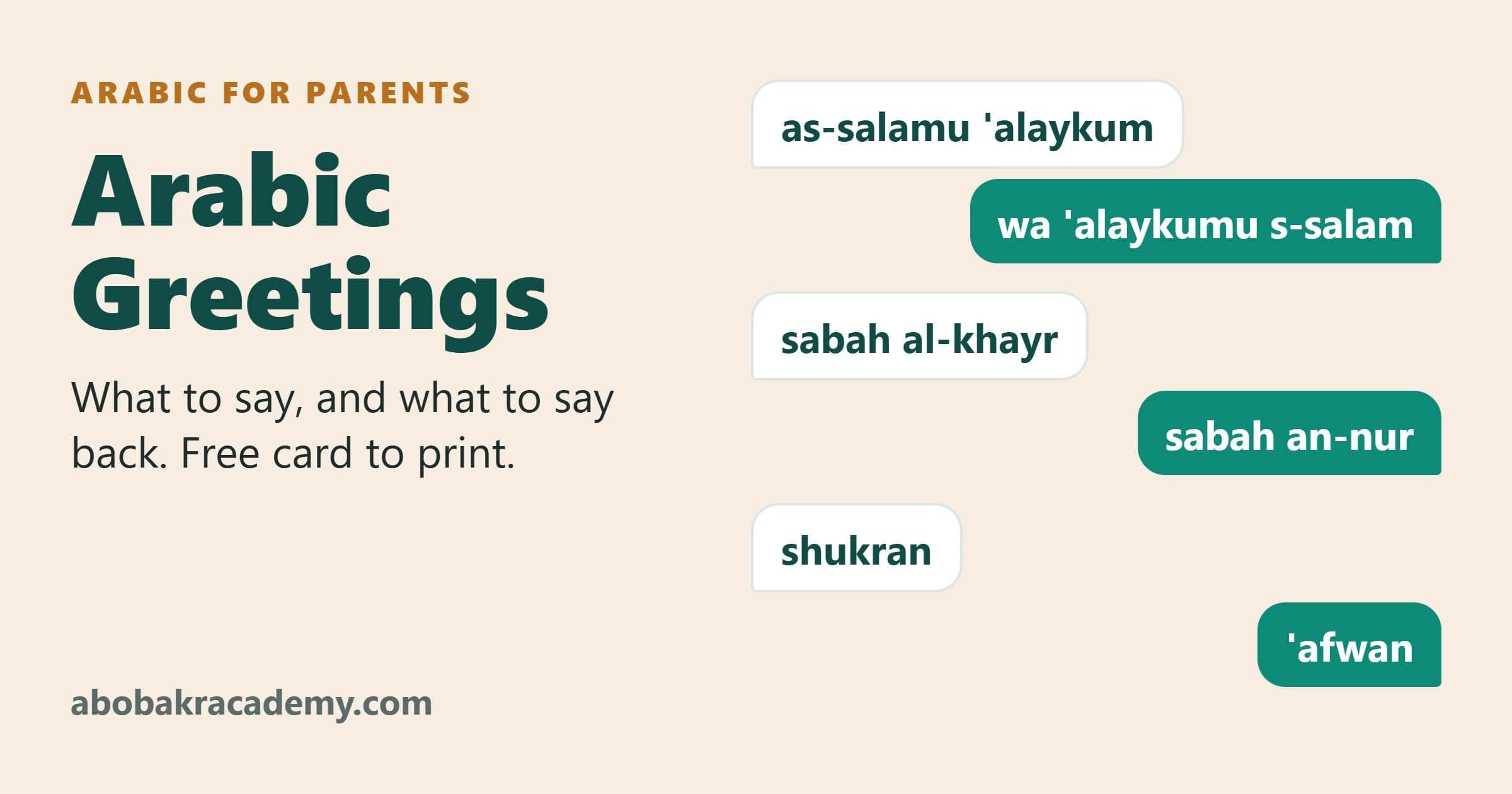
The most common ways to say hello in Arabic are السَّلَامُ عَلَيْكُمْ (as-salamu ‘alaykum), which means “peace be upon you”, مَرْحَبًا (marhaban) and أَهْلًا (ahlan). Each greeting in Arabic has an expected reply, and knowing the reply matters as much as knowing the greeting. The table below gives both, with pronunciation, for every greeting a family is likely to need.
Eid morning, outside the masjid. An auntie your children have never met bends down, beams at your eight year old and says something long and warm in Arabic. He knows it’s a greeting. He knows he’s supposed to answer. He looks at you, you look at the auntie, and the moment passes with a mumbled “hi”.
Nobody minded. But he did, and so did you. This page is built so that doesn’t happen again, and it assumes nobody at home speaks Arabic. It’s arranged the way a day runs, from the first greeting in the morning to the last one at night.
Free, no email needed. One page.
| English | Arabic | Pronunciation | What to say back |
|---|---|---|---|
| Peace be upon you | السَّلَامُ عَلَيْكُمْ | as-salamu ‘alaykum | وَعَلَيْكُمُ السَّلَامُ wa ‘alaykumu s-salam |
| Hello | مَرْحَبًا | marhaban | مَرْحَبًا or أَهْلًا marhaban, or ahlan |
| Hi | أَهْلًا | ahlan | أَهْلًا ahlan |
| Welcome | أَهْلًا وَسَهْلًا | ahlan wa sahlan | أَهْلًا بِكَ / بِكِ ahlan bik (to a man or boy) / biki (to a woman or girl) |
| Good morning | صَبَاحُ الْخَيْرِ | sabah al-khayr | صَبَاحُ النُّورِ sabah an-nur |
| Good evening | مَسَاءُ الْخَيْرِ | masa’ al-khayr | مَسَاءُ النُّورِ masa’ an-nur |
| How are you? | كَيْفَ حَالُكَ؟ | kayfa haluk? | بِخَيْرٍ، الْحَمْدُ لِلَّهِ bi-khayr, alhamdu lillah |
| Thank you | شُكْرًا | shukran | عَفْوًا ‘afwan |
| May Allah reward you with good | جَزَاكَ اللَّهُ خَيْرًا | jazak allahu khayran | وَإِيَّاكُمْ wa iyyakum |
| Goodbye | مَعَ السَّلَامَةِ | ma’a s-salama | فِي أَمَانِ اللَّهِ fi amani llah |
| Good night | تُصْبِحُ عَلَى خَيْرٍ | tusbih ‘ala khayr | وَأَنْتَ مِنْ أَهْلِهِ wa anta min ahlih |
| Eid blessings | عِيدٌ مُبَارَكٌ | ‘id mubarak | تَقَبَّلَ اللَّهُ مِنَّا وَمِنْكُمْ taqabbal allahu minna wa minkum |
A note on the pronunciation column. The apostrophe in ‘alaykum and ‘afwan marks the letter ‘ayn, a tightening at the back of the throat. Kh is the sound in Scottish “loch”, and the h in marhaban and haluk is a breathy h, as if you were fogging a mirror. Close enough is fine to begin with. People will understand your child long before the sounds are perfect.
What is the Islamic greeting, and what does it mean?
As-salamu ‘alaykum means “peace be upon you”. It’s the greeting Muslims use with each other everywhere, whatever language they speak at home, and for a Muslim child in London, Toronto or Sydney it’s by far the most useful Arabic greeting to own. ‘Alaykum is the plural form, and it’s normal to use it even to one person.
The reply turns the phrase around: wa ‘alaykumu s-salam, “and upon you be peace”. Children often reply with the same words they heard, which is the single most common mistake, and an easy one to hear even if you don’t speak Arabic. Listen for whether the answer starts with wa. If it does, it’s a reply.
Why do some people say a longer version?
The greeting has a short form and two longer ones, and the Prophet (peace be upon him) counted them differently. In a hadith graded sahih, a man greeted him with “peace be upon you” and he said “ten”; a second added “and Allah’s mercy” and he said “twenty”; a third added “and His blessings” and he said “thirty” (Sunan Abi Dawud 5195).
| Length | Arabic | Pronunciation | Reply |
|---|---|---|---|
| Short | السَّلَامُ عَلَيْكُمْ | as-salamu ‘alaykum | wa ‘alaykumu s-salam |
| Middle | السَّلَامُ عَلَيْكُمْ وَرَحْمَةُ اللَّهِ | as-salamu ‘alaykum wa rahmatullah | wa ‘alaykumu s-salam wa rahmatullah |
| Full | السَّلَامُ عَلَيْكُمْ وَرَحْمَةُ اللَّهِ وَبَرَكَاتُهُ | as-salamu ‘alaykum wa rahmatullahi wa barakatuh | wa ‘alaykumu s-salam wa rahmatullahi wa barakatuh |
The Quran tells believers that when they are greeted, they should respond with a better greeting or at least the same one (Surah an-Nisa 4:86). In practice that gives a child a simple rule: answer with at least as many words as you were given, and one step more if you can. Teach the short reply first. Add a step once it comes out without thinking.
Who should say salam first?
There’s a short hadith that settles most playground questions. “The young should greet the old, the passer by should greet the sitting one, and the small group should greet the large group” (Sahih al-Bukhari 6231). So at the masjid door, the auntie shouldn’t have had to go first. Your son should have.
That’s worth telling a child directly, because it turns a shy moment into a job with a clear owner. It also connects to why the greeting matters at all: in another hadith, spreading the salam is named as the thing that builds love between people (Sahih Muslim 54a).
How do you say hello in Arabic without the religious greeting?
Marhaban is the everyday “hello”, used in shops, on the phone and in textbooks. Ahlan is closer to “hi”. Ahlan wa sahlan means “welcome”, and it’s what a host says when you walk through the door. In Lebanon and Syria people often answer marhaban with marhabtayn, “two hellos”, which children tend to love.
Here’s the trade-off, stated plainly. For a Muslim family outside the Arab world, marhaban is less useful than it looks. Your child will use as-salamu ‘alaykum every week at the masjid and weekend school, and marhaban mostly in an Arabic class. If you only have time for one, teach the salam and its reply.
What do you say in the morning and evening?
Sabah al-khayr is “morning of goodness”, and the reply is sabah an-nur, “morning of light”. The evening pair works the same way: masa’ al-khayr, answered with masa’ an-nur. Arabic likes a reply that goes one better than the greeting, and these two pairs are the clearest example of it.
These are easy to build into a routine. Say sabah al-khayr at breakfast every day for a week and wait for sabah an-nur before the cereal comes out. By Friday it’s automatic, and you didn’t need to know any Arabic to run it, only to know which answer you were waiting for.
How do you ask “how are you?” in Arabic?
This is the first greeting where Arabic cares who you’re talking to. The question changes slightly for a man or boy and for a woman or girl, and the reply asks it back the same way.
| English | Arabic | Pronunciation | When to use it |
|---|---|---|---|
| How are you? | كَيْفَ حَالُكَ؟ | kayfa haluk? | To a man or boy |
| How are you? | كَيْفَ حَالُكِ؟ | kayfa haluki? | To a woman or girl |
| How are you all? | كَيْفَ حَالُكُمْ؟ | kayfa halukum? | To a group, or politely to an elder |
| I’m well, praise be to Allah | أَنَا بِخَيْرٍ، الْحَمْدُ لِلَّهِ | ana bi-khayr, alhamdu lillah | The standard answer |
| And you? | وَأَنْتَ؟ / وَأَنْتِ؟ | wa anta? / wa anti? | To a man or boy / to a woman or girl |
Most Arabic speakers answer “how are you” with alhamdu lillah whatever kind of day they’re having, and a child who learns that one phrase can answer the question anywhere. Don’t worry too much about getting the masculine and feminine endings right at first. An auntie who hears kayfa haluk from a six year old will smile, not correct.
You’ll also hear this question in dialect. Egyptians say izzayak (to a man) and izzayik (to a woman), and many Gulf speakers say shlonak. If your family’s friends are from one particular country, it’s worth learning their version too. The forms above are understood everywhere.
How do you say thank you, and what comes back?
Shukran is thank you, and ‘afwan, “you’re welcome”, comes back. Among Muslims you’ll hear a second pair just as often: jazak allahu khayran, “may Allah reward you with good”, answered with wa iyyakum, “and you too”.
Strictly, jazaka is to a man, jazaki to a woman and jazakum to a group, and the reply shifts to wa iyyaka, wa iyyaki or wa iyyakum to match. Wa iyyakum is a safe answer to anyone. A closely related one is barak allahu fik, “may Allah bless you”, answered with wa fik. If your children already say the daily duas on our printable dua cards, these phrases sit very naturally beside them.
How do you introduce yourself in Arabic?
Three short lines cover most first meetings.
- مَا اسْمُكَ؟ ma smuk? is “what’s your name?” (to a girl, ma smuki?)
- اِسْمِي … ismi … is “my name is …”
- تَشَرَّفْنَا tasharrafna is “nice to meet you”, literally “we are honoured”
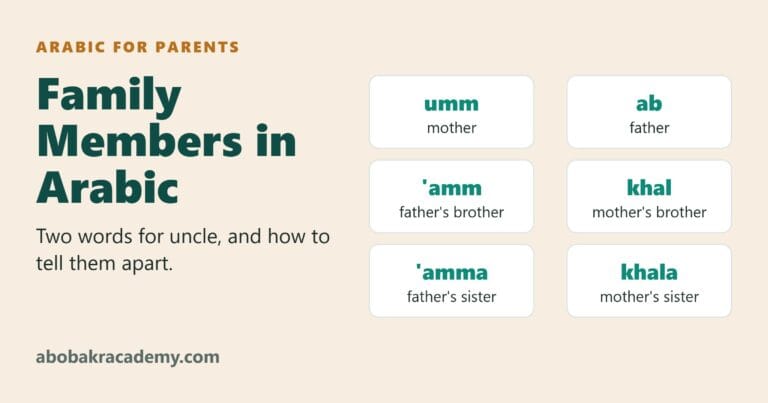
Have your child practise them as a pair with a sibling or a toy. One asks, one answers, then swap. It takes two minutes, and it gives a shy child something to say after the salam, which is usually where the conversation dies. Our guide to family members in Arabic covers the next thing they’ll need: who everyone in the room is.
How do you say goodbye and good night in Arabic?
Ma’a s-salama means “with peace”, and it’s the everyday goodbye. You can answer with the same words or with fi amani llah, “in Allah’s protection”. Ila l-liqa’ is “until we meet again”, closer to “see you”.
At bedtime the phrase is tusbih ‘ala khayr, “may you wake to goodness”, said to a boy. To a girl it becomes tusbihina ‘ala khayr. The reply is lovely: wa anta min ahlih (to a boy) or wa anti min ahlih (to a girl), “and may you be one of its people”. Put it at the end of the bedtime routine, right after the sleep dua in our guide to daily duas for kids, and it becomes the last Arabic your child hears every day.
What do you say at Eid and in Ramadan?
‘Id mubarak, “blessed Eid”, is the greeting almost every Muslim knows. Many families answer it, or add to it, with taqabbal allahu minna wa minkum, “may Allah accept it from us and from you”. In Ramadan you’ll hear ramadan karim or ramadan mubarak. People in Egypt and the Levant often answer ramadan karim with allahu akram, “Allah is more generous”.
If you only prepare one thing before Eid, prepare the reply. That’s what would have saved the moment outside the masjid.
Which Arabic greeting should a child learn first?
Start with the salam and its reply, then add one pair a week. A sensible order is: the salam, shukran and ‘afwan, sabah al-khayr and its reply, “how are you” with alhamdu lillah, goodbye, good night, and the Eid greeting a few weeks before Eid. That’s about two months of one small habit, and by the end your child has a complete day of Arabic.
You can check progress without speaking a word of Arabic. Say the greeting and listen for one thing only: does the answer match the right-hand column of the card at the top of this page? If it does, move on. If it doesn’t, stay on that pair another week. Greetings are one of the few parts of Arabic a parent can teach entirely alone, and we’d rather tell you that than sell you lessons for it.
Common questions
What is the most common way to say hello in Arabic?
Among Muslims, as-salamu ‘alaykum, “peace be upon you”, used in every country and every language community. In everyday secular settings, marhaban and ahlan are the usual hellos.
What is the reply to as-salamu alaykum?
The reply is wa ‘alaykumu s-salam, “and upon you be peace”. If the greeting was longer, the reply should be at least as long, for example wa ‘alaykumu s-salam wa rahmatullahi wa barakatuh.
How do you say hi in Arabic?
The closest word to a casual “hi” is ahlan. You’ll also hear marhaba, and in many countries simply hala among friends.
Does a child need to change greetings for boys and girls?
Only for some of them. As-salamu ‘alaykum, marhaban, shukran and ‘id mubarak stay the same for everyone. “How are you”, “good night” and jazak allahu khayran change their ending depending on who you’re speaking to.
Is Arabic greeting the same in every country?
The salam, marhaban, shukran and ma’a s-salama are understood everywhere. Questions like “how are you” vary by dialect, so a child who learns the standard forms here will be understood in any Arab country, even if friends from Egypt or the Gulf say it their own way.
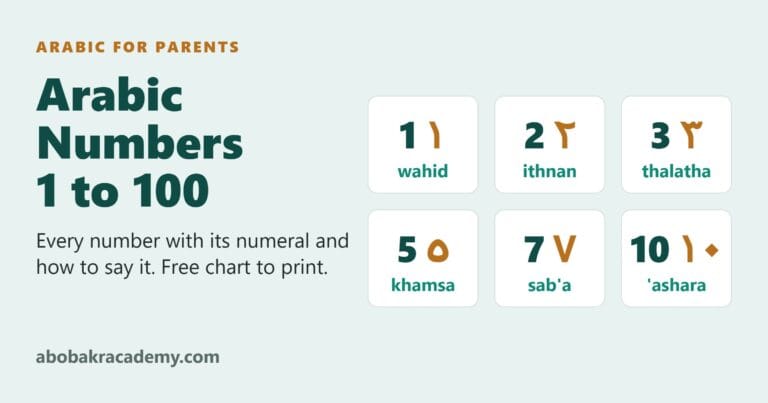
Print the greetings card and put it by the front door. When your child is ready for more than greetings, our chart of Arabic numbers from 1 to 100 is the next easy win. And if you’d like a teacher to take Arabic further than you can at home, you can book a free trial lesson, or see what our Islamic Studies classes cover alongside it.