Colours are one of the first things a young child learns to name, because they are everywhere: on the toy box, in the fruit bowl, on the sky outside the window. That makes them an easy second word set in Arabic, right after the animals.
This page has thirteen colours in Arabic, with the vowel marks, a way to say each one and a picture card for every colour. It also covers the part most lists leave out. In Arabic a colour changes its shape to match the word it describes, so red is one word for a pen and another for an apple, and the table gives you both. At the end are the colours named in the Quran, with each word as it stands in the verse, and a free printable with flashcards and a colouring worksheet, with no sign-up.
Colour in Arabic is لَوْن (lawn), and colours is أَلْوَان (alwaan). Six to start with: red أَحْمَر (ahmar), yellow أَصْفَر (asfar), green أَخْضَر (akhdar), blue أَزْرَق (azraq), white أَبْيَض (abyad) and black أَسْوَد (aswad).
Colors in Arabic with pictures
Here are all thirteen on one chart. Each colour has a picture of something that colour, so a child who cannot read yet can still find the word they want.
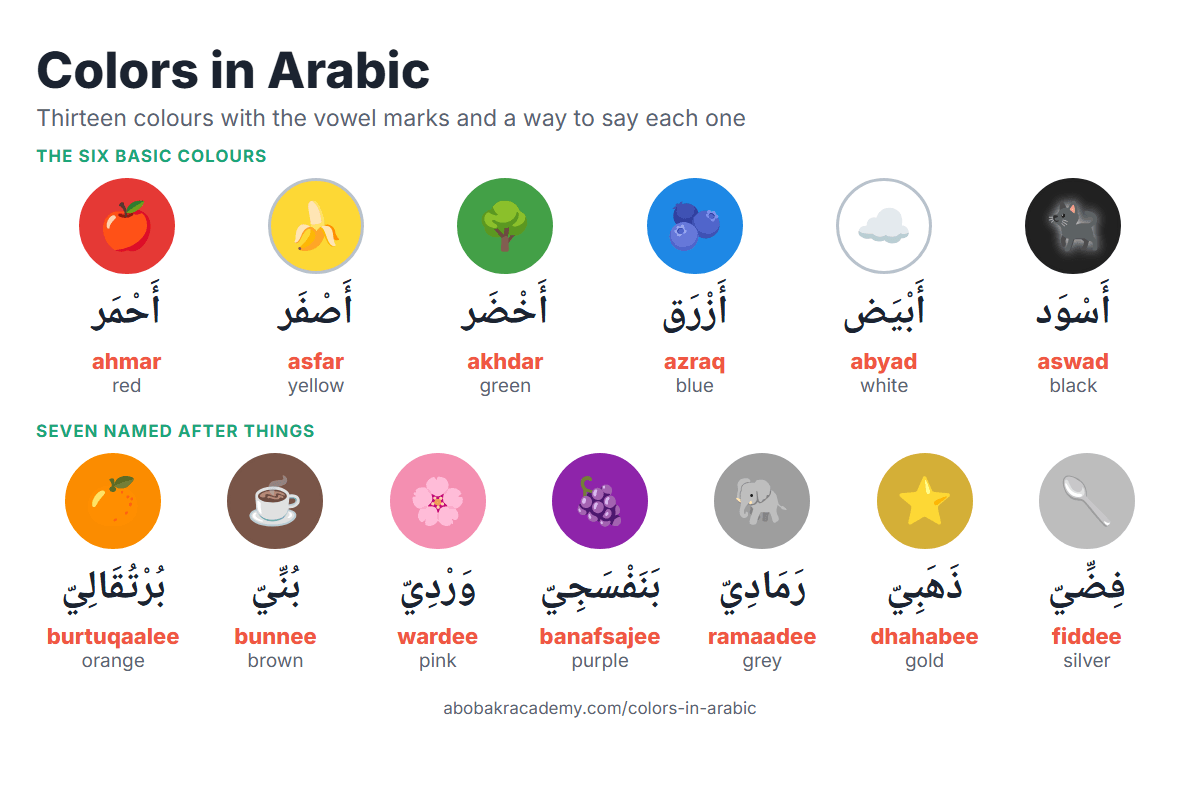
The thirteen colours in Arabic
The first Arabic column is the form you will find in a dictionary. Use it with most words. The last column is the form for words that are feminine in Arabic, such as apple, car and sky, which is explained in the next section. Tap the play button beside any word to hear it said.
| Arabic | Say it | Colour | With a feminine word |
|---|---|---|---|
| أَحْمَر | ahmar | red, like an apple | حَمْرَاء (hamraa’) |
| أَصْفَر | asfar | yellow, like a banana | صَفْرَاء (safraa’) |
| أَخْضَر | akhdar | green, like a tree | خَضْرَاء (khadraa’) |
| أَزْرَق | azraq | blue, like blueberries | زَرْقَاء (zarqaa’) |
| أَبْيَض | abyad | white, like a cloud | بَيْضَاء (baydaa’) |
| أَسْوَد | aswad | black, like a cat | سَوْدَاء (sawdaa’) |
| بُرْتُقَالِيّ | burtuqaalee | orange, like an orange | بُرْتُقَالِيَّة (burtuqaaleeyah) |
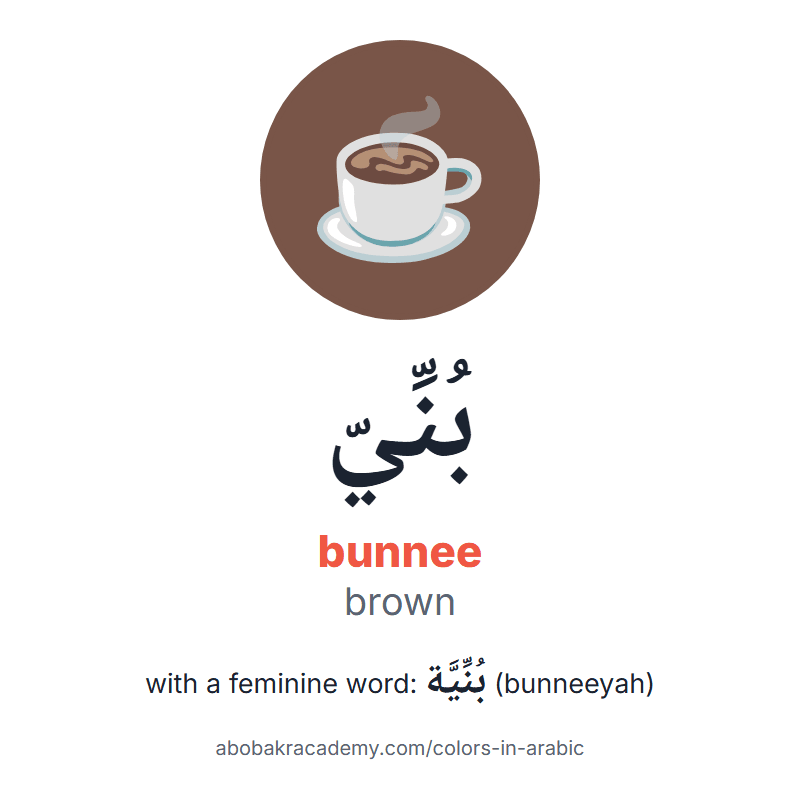
| بُنِّيّ | bunnee | brown, like coffee | بُنِّيَّة (bunneeyah) |
| وَرْدِيّ | wardee | pink, like a flower | وَرْدِيَّة (wardeeyah) |
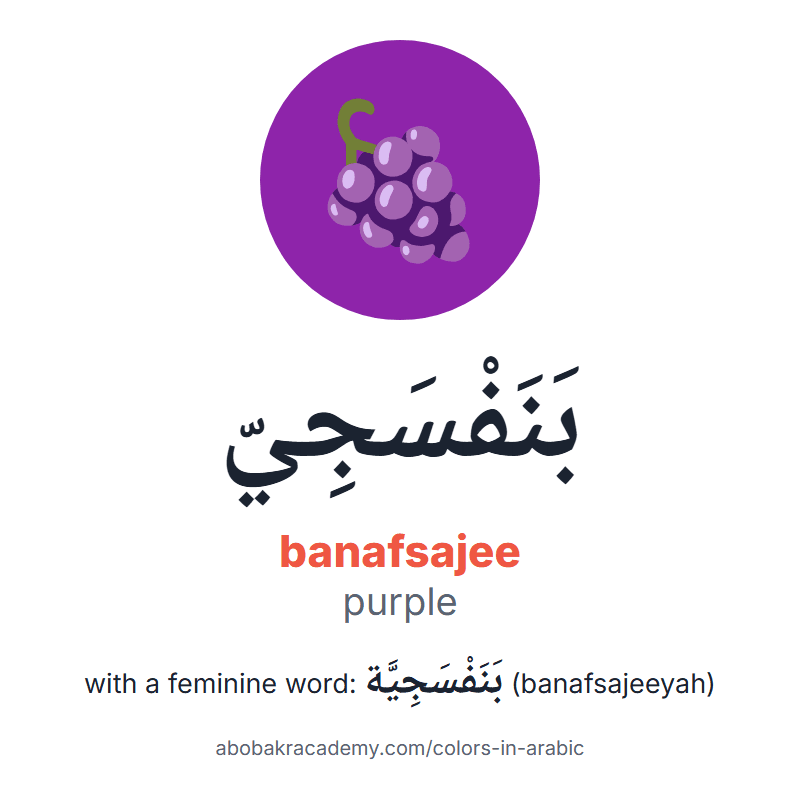
| بَنَفْسَجِيّ | banafsajee | purple, like grapes | بَنَفْسَجِيَّة (banafsajeeyah) |
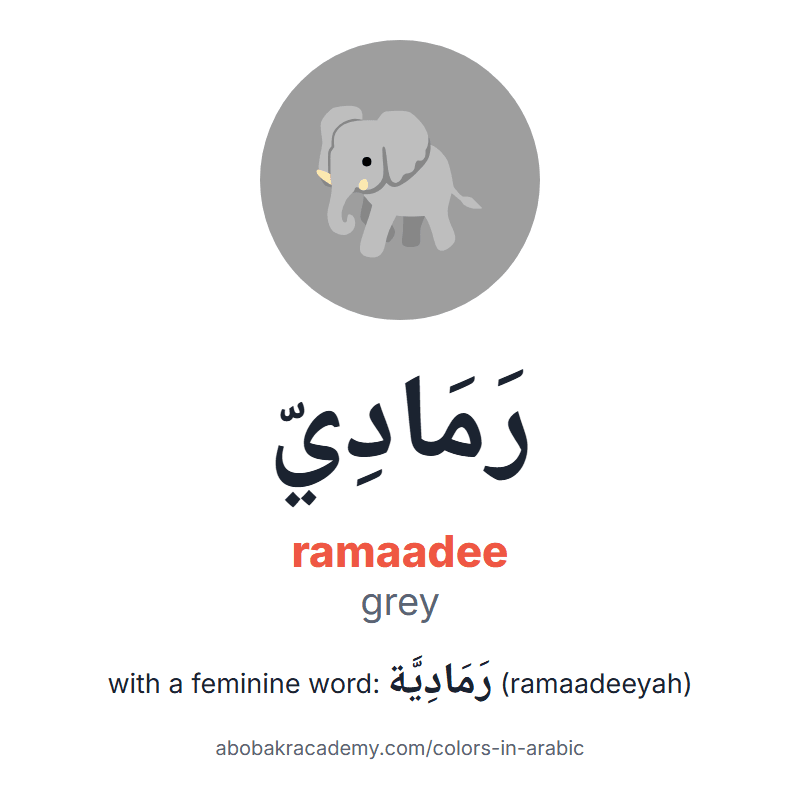
| رَمَادِيّ | ramaadee | grey, like an elephant | رَمَادِيَّة (ramaadeeyah) |
| ذَهَبِيّ | dhahabee | gold, like a star | ذَهَبِيَّة (dhahabeeyah) |
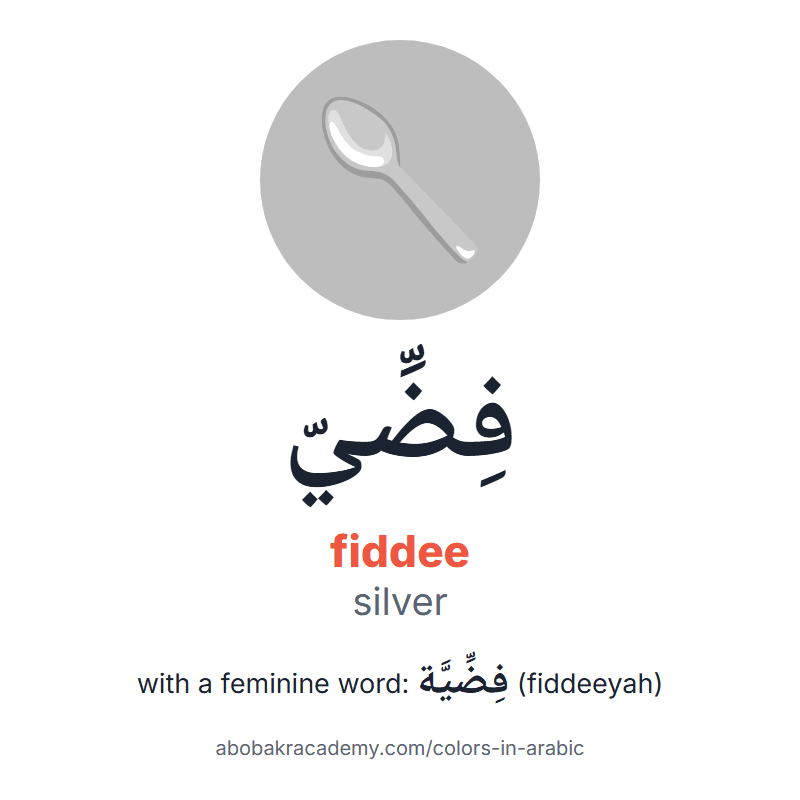
| فِضِّيّ | fiddee | silver, like a spoon | فِضِّيَّة (fiddeeyah) |
The “say it” spelling doubles long vowels (aa, ee, oo) so a child holds them, and an apostrophe at the end marks a short catch in the throat. A few sounds in these words have no match in English:
- The h in أَحْمَر (ahmar). A breathy h from deep in the throat, like breathing on a pair of glasses to clean them.
- The kh in أَخْضَر (akhdar). The sound at the end of the Scottish “loch”.
- The q in أَزْرَق (azraq). A k made further back, where you swallow.
- The s in أَصْفَر (asfar) and the d in أَبْيَض (abyad). Heavy letters. Say them with the tongue low and the mouth a little rounder than for an English s or d.
- The dh in ذَهَبِيّ (dhahabee). The th in “this”, not the th in “thin”.
If nobody at home reads Arabic, these are the sounds to hear from someone who does, whether that is a teacher, a relative or a recording. Everything else on this page a parent can check from the English.
Why every colour has two forms
Every Arabic noun is either masculine or feminine, and a colour that describes it matches it. You say قَلَم أَحْمَر (qalam ahmar) for a red pen, but تُفَّاحَة حَمْرَاء (tuffaahah hamraa’) for a red apple, because apple is a feminine word. The colour comes after the thing it describes, the opposite of English.
| English | Arabic | Say it | Why this form |
|---|---|---|---|
| a red pen | قَلَم أَحْمَر | qalam ahmar | Pen is masculine |
| a red apple | تُفَّاحَة حَمْرَاء | tuffaahah hamraa’ | Apple is feminine |
| a blue book | كِتَاب أَزْرَق | kitaab azraq | Book is masculine |
| a blue sky | سَمَاء زَرْقَاء | samaa’ zarqaa’ | Sky is feminine |
| a brown cat | قِطَّة بُنِّيَّة | qittah bunneeyah | Cat is feminine |
There are two patterns, and once a child has heard both they can guess the rest:
- The six basic colours change shape. أَحْمَر (ahmar) becomes حَمْرَاء (hamraa’), أَصْفَر (asfar) becomes صَفْرَاء (safraa’), and the same happens to green, blue, white and black.
- The other seven just add -ah. بُنِّيّ (bunnee) becomes بُنِّيَّة (bunneeyah), وَرْدِيّ (wardee) becomes وَرْدِيَّة (wardeeyah).
The six basic colours also have a plural, used for a group of things: حُمْر (humr), صُفْر (sufr), خُضْر (khudr), زُرْق (zurq), بِيض (beed) and سُود (sood). Children rarely need these in conversation, but they are forms you will meet in the Quran, as the section below shows.
Seven colours named after things
The seven colours that add -ah are all named after something that colour. The -ee ending turns the thing into a colour, a little like “coffee-coloured” in English:
- Orange, بُرْتُقَالِيّ (burtuqaalee), from بُرْتُقَال (burtuqaal), orange (the fruit)
- Brown, بُنِّيّ (bunnee), from بُنّ (bunn), coffee beans
- Pink, وَرْدِيّ (wardee), from وَرْد (ward), roses
- Purple, بَنَفْسَجِيّ (banafsajee), from بَنَفْسَج (banafsaj), violets (the flower)
- Grey, رَمَادِيّ (ramaadee), from رَمَاد (ramaad), ash
- Gold, ذَهَبِيّ (dhahabee), from ذَهَب (dhahab), gold (the metal)
- Silver, فِضِّيّ (fiddee), from فِضَّة (fiddah), silver (the metal)
This is a good one to tell a child who likes knowing why. Once they know that وَرْد (ward) means roses, they will not forget that pink is وَرْدِيّ (wardee).
Thirteen colour picture cards
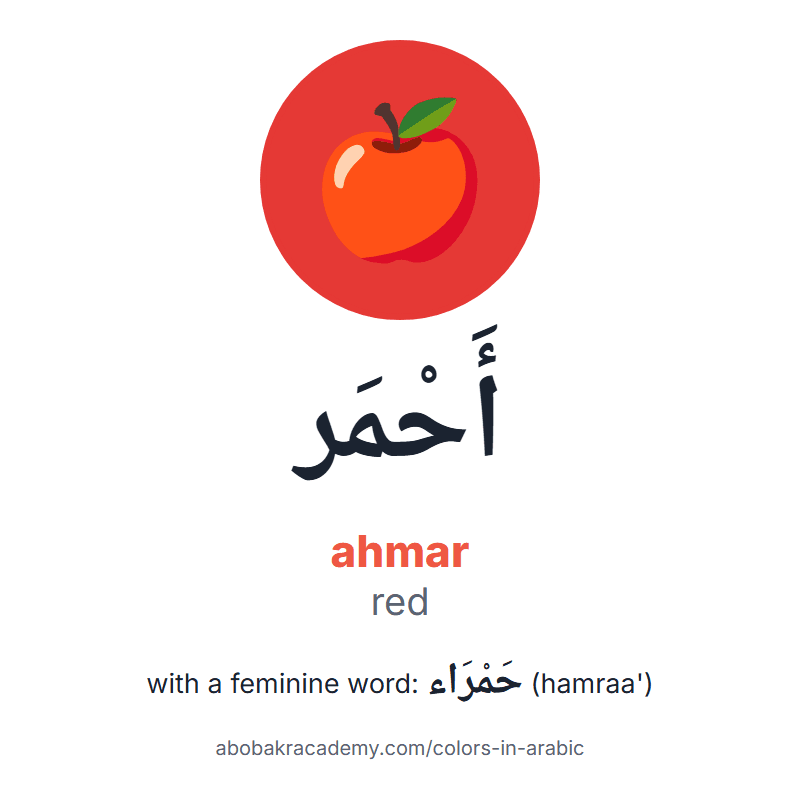
Every colour also has a card of its own. Print one a day, or open them on a tablet and let your child say each colour before they see the English.
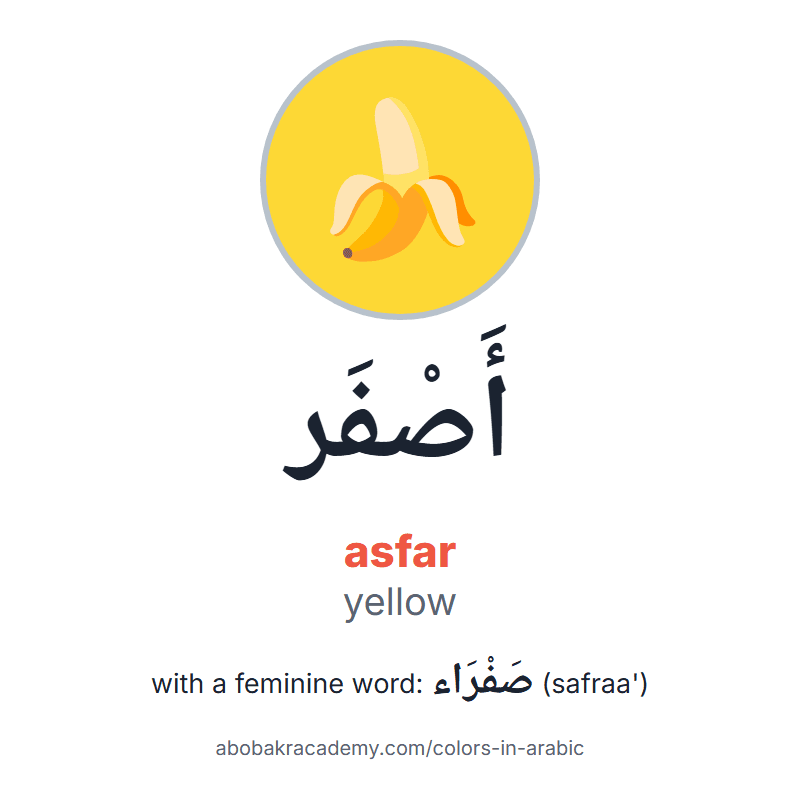
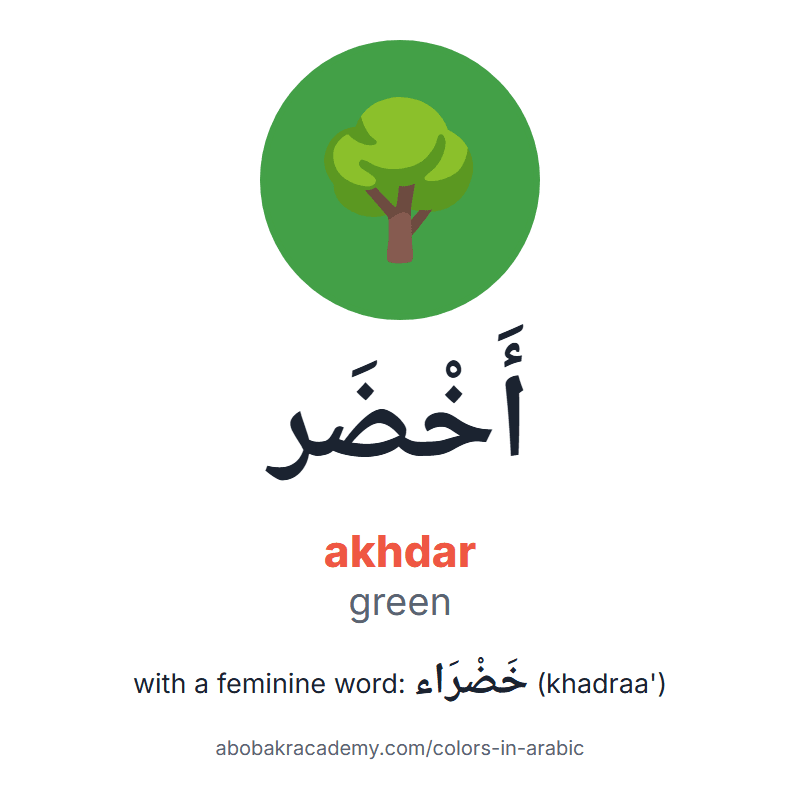


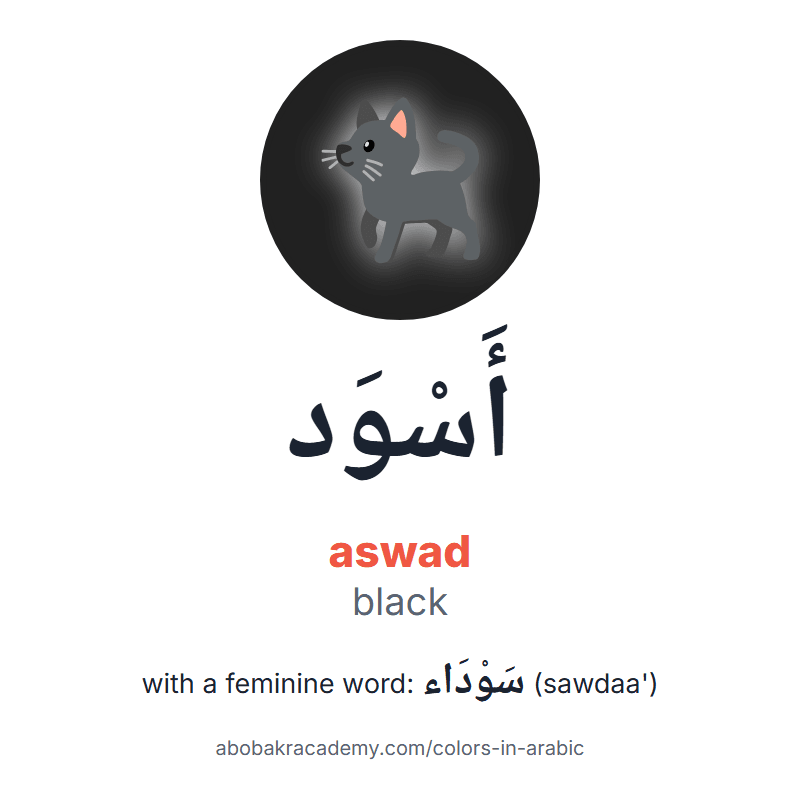
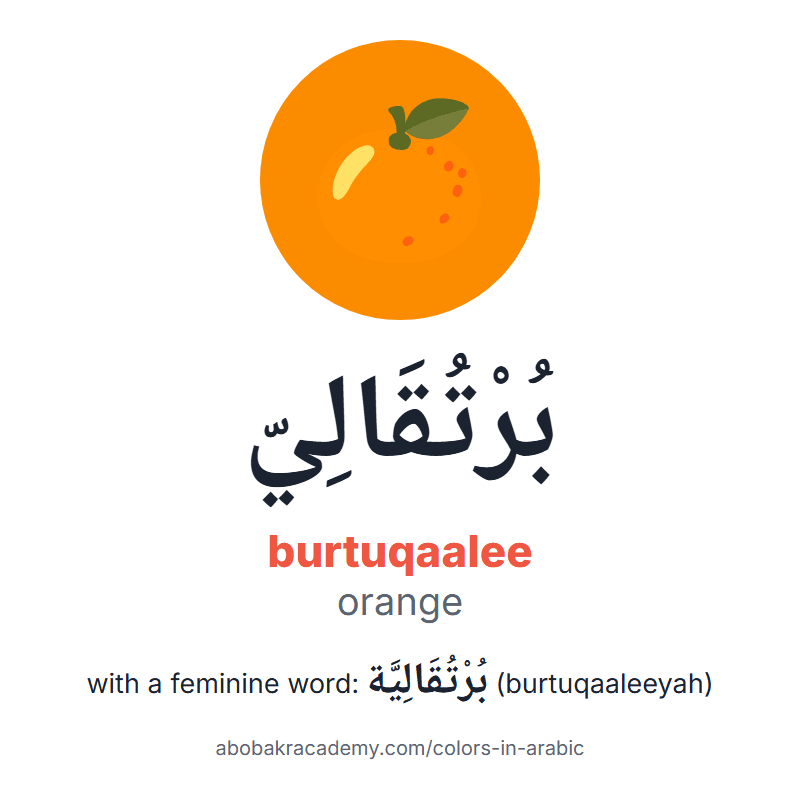


Colours in the Quran
Six of the colours on this page are named in the Quran: white, black, red, yellow, green and blue. The table shows where the first five appear, with each word copied from its verse. Look at the forms: the yellow cow in Surah Al-Baqarah is صَفْرَاءُ (safraa’), the feminine, because cow is a feminine word, and the streaks in the mountains are بِيضٌ (beed) and حُمْرٌ (humr), the plurals. The grammar in the section above is the grammar of the Quran.
| Colour | Word in the Quran | Form | Where | What happens |
|---|---|---|---|---|
| White Black | الْأَبْيَضُ الْأَسْوَدِ | masculine masculine | Al-Baqarah 2:187 | In Ramadan, eating and drinking are allowed until the white thread of dawn can be told apart from the black thread of night. |
| Yellow | صَفْرَاءُ | feminine | Al-Baqarah 2:69 | Musa’s people asked what colour the cow should be. The answer was a yellow cow, bright in colour, pleasing to look at. Cow is a feminine word, so the colour is the feminine safraa. |
| White | بَيْضَاءَ | feminine | Taha 20:22 | Musa was told to put his hand under his arm, and it came out white, without any illness, as a sign from Allah. |
| Green | خُضْرٍ | plural | Yusuf 12:43 | The king dreamed of seven green ears of grain and seven dry ones, and Yusuf explained what the dream meant. |
| Green | خُضْرًا | plural | Al-Kahf 18:31 | The people of Paradise will wear green garments of fine silk. |
| Green | الْأَخْضَرِ | masculine | Ya-Sin 36:80 | Allah made fire for people out of the green tree. |
| White Red Black | بِيضٌ حُمْرٌ سُودٌ | plural plural plural | Fatir 35:27 | The mountains have streaks of white and red in many shades, and some that are deep black. |
The word for colours itself appears too. Honey is described as a drink “of many colours” (أَلْوَانُهُ, 16:69), and the different languages and colours of people are called one of the signs of Allah (30:22). Blue appears in a verse about the Day of Judgement (20:102), which is why it is not in the table for children. Orange, pink, purple and grey are not named in the Quran by the words on this page.
How to teach colours when you do not read Arabic
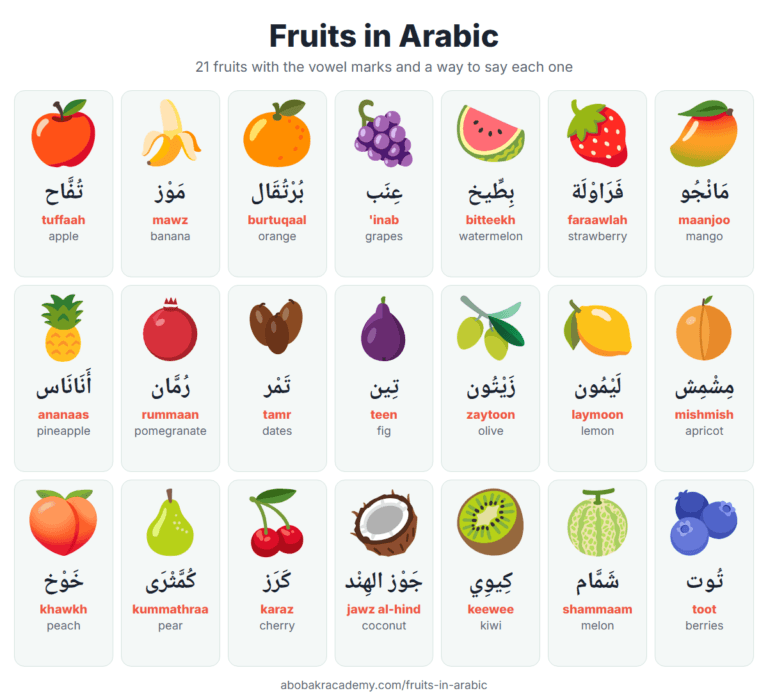
You do not need to read the Arabic to run any of these. Each one works from the picture and the “say it” spelling, and each takes five to ten minutes. Start with two or three colours, say red, blue and yellow, and add the next only when those come out without a pause. Fruit is good practice for colours, because every fruit has one: fruits in Arabic has 21 of them with a play button for each.
- Colour of the day. Put one card on the fridge in the morning. Every time your child spots that colour during the day, they say its Arabic name. By bedtime they have said it twenty times without a lesson.
- Colour hunt. Say a colour in Arabic and give your child ten seconds to touch something that colour. Then swap, and let them call the colour for you.
- Sort the fruit bowl. Line up fruit or toys and name each one’s colour in Arabic: a banana is asfar, an orange is burtuqaalee. Sorting makes them look long enough for the word to stay.
- Pen or apple? For an older child, the two-form game: hold up a pen and ask for its colour, then an apple of the same colour. Ahmar for the pen, hamraa’ for the apple. The table above has the answers, so you can check them yourself.
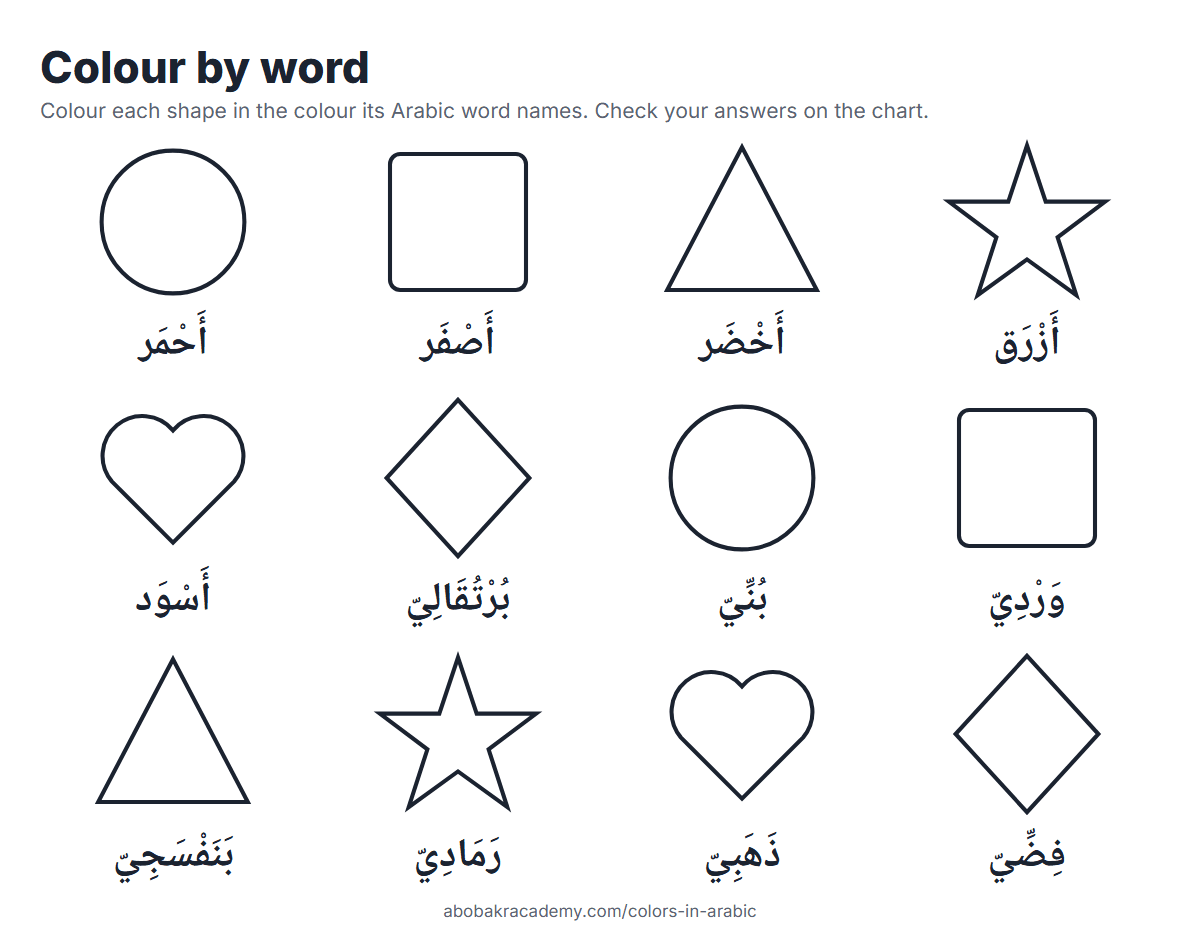
- Colour by word. The worksheet in the printable has shapes labelled only with an Arabic colour word. Your child colours each one in, then checks their own answers against the chart.
For the bigger picture, our guide on teaching your child Arabic when you do not speak it sets out what a parent can do alone and the one part that needs someone listening.
Free printable: colors in Arabic flashcards and worksheet (PDF)
Download the colours in Arabic chart, flashcards and worksheet (free PDF). Page one is the chart of all thirteen colours. Pages two and three are flashcards to cut out, with the colour, the Arabic, the “say it” spelling and the English on each card. Page four is a colour-by-word worksheet, and page five has both forms of every colour and the colours of the Quran with their verses. It is sized for A4 and prints on US Letter if you choose “fit to page”. There is no sign-up.
Common questions about colours in Arabic
What are the colours in Arabic?
The six basic colours are red أَحْمَر (ahmar), yellow أَصْفَر (asfar), green أَخْضَر (akhdar), blue أَزْرَق (azraq), white أَبْيَض (abyad) and black أَسْوَد (aswad). The next seven are orange بُرْتُقَالِيّ (burtuqaalee), brown بُنِّيّ (bunnee), pink وَرْدِيّ (wardee), purple بَنَفْسَجِيّ (banafsajee), grey رَمَادِيّ (ramaadee), gold ذَهَبِيّ (dhahabee) and silver فِضِّيّ (fiddee).
How do you say colours in Arabic?
Colour is لَوْن (lawn) and colours is أَلْوَان (alwaan).
How do you say pink in Arabic?
وَرْدِيّ (wardee), from وَرْد (ward), roses. With a feminine word it becomes وَرْدِيَّة (wardeeyah).
Why does a colour change in Arabic?
Because it matches the word it describes. A red pen is قَلَم أَحْمَر (qalam ahmar), but a red apple is تُفَّاحَة حَمْرَاء (tuffaahah hamraa’), because apple is feminine in Arabic. The six basic colours change shape, and the others add -ah.
Which colours are mentioned in the Quran?
Six of the colours on this page: white, black, red, yellow, green and blue. The yellow cow of Surah Al-Baqarah (2:69) and the white and black threads at dawn in Ramadan (2:187) are the two most children will know.
Animals, numbers, family and the alphabet in Arabic
Colours sit well beside the other first word sets. Animals in Arabic has forty picture cards in the same style, and the days of the week in Arabic, Arabic numbers from 1 to 100 and family members in Arabic all use the same “say it” spelling. If your child is still learning the letters, start with the Arabic alphabet chart, and more free sheets are on our free printables page. When you would like a teacher to take the sounds on, our online Arabic lessons for kids start from where your child is. For a set your child can point to on themselves, body parts in Arabic has a card for every part and a play button beside every word.