

The Arabic alphabet has 28 letters, and every one of them can be anchored to a single everyday word: alif to أَسَد (asad), lion, and baa to بَاب (baab), door. The table below gives all 28 in order, with each letter’s name, the sound it makes described in plain English, one example word in Arabic script, and what that word means.
It is written for the parent doing the teaching rather than for the child. Most families we work with have nobody at home who reads Arabic, so every row carries a transliteration and nothing here assumes you can already sound out the script.
One thing worth saying before the table. A list of 28 letters is not hard to memorize and it is also not much use on its own. A child who can chant the alphabet start to finish still stalls at the first real word, because chanting is recall and reading is recognition. Attaching one concrete word to each letter fixes that, and it is the reason the columns below are arranged the way they are: the letter, then the sound, then a word the letter actually lives inside.
The 28 Arabic letters, with a word for each
The order below is the standard alphabetical order, the one used in dictionaries and in every classroom. Read down the Sound column first and ignore the script entirely if that is where you are starting.
| Letter | Name | Sound in English | Example word | What it means |
|---|---|---|---|---|
| ا | alif | long a, as in father | أَسَد (asad) | lion |
| ب | baa | b, as in book | بَاب (baab) | door |
| ت | taa | t, as in table | تِين (teen) | figs |
| ث | thaa | th, as in think | ثَوْب (thawb) | garment |
| ج | jeem | j, as in jam | جَمَل (jamal) | camel |
| ح | haa | a breathy h from low in the throat | حُوت (hoot) | whale |
| خ | khaa | kh, as in the Scottish loch | خُبْز (khubz) | bread |
| د | daal | d, as in door | دَار (daar) | house |
| ذ | dhaal | th, as in this | ذَهَب (dhahab) | gold |
| ر | raa | a light tapped r, as in Spanish | رُمَّان (rummaan) | pomegranate |
| ز | zayn | z, as in zoo | زَيْت (zayt) | oil |
| س | seen | s, as in sun | سَمَك (samak) | fish |
| ش | sheen | sh, as in shoe | شَمْس (shams) | sun |
| ص | saad | a heavy s, mouth wide and full | صَلاة (salaah) | prayer |
| ض | daad | a heavy d, tongue pressed flat | ضَيْف (dayf) | guest |
| ط | taa (heavy) | a heavy t, fuller than taa | طَيْر (tayr) | bird |
| ظ | dhaa (heavy) | a heavy version of th in this | ظُهْر (dhuhr) | noon |
| ع | ayn | from deep in the throat, no English equal | عَيْن (ayn) | eye |
| غ | ghayn | close to a gargled French r | غَنَم (ghanam) | sheep |
| ف | faa | f, as in fish | فِيل (feel) | elephant |
| ق | qaaf | a k made further back in the mouth | قَلَم (qalam) | pen |
| ك | kaaf | k, as in kite | كِتَاب (kitaab) | book |
| ل | laam | l, as in leaf | لَبَن (laban) | milk |
| م | meem | m, as in moon | مَاء (maa) | water |
| ن | noon | n, as in night | نَجْم (najm) | star |
| ه | haa (light) | h, as in house | هِلَال (hilaal) | crescent moon |
| و | waaw | w, or a long oo | وَرْد (ward) | roses |
| ي | yaa | y, or a long ee | يَد (yad) | hand |
Three notes on that table, because they are the questions it always produces.
Alif, waaw and yaa do double duty. Each is a letter in its own right and each also spells a long vowel, which is why waaw is both the w in ward and the oo in hoot. Nothing is wrong with your reading when the same shape sounds different in two words.
Short vowels are not in the list at all. The small marks above and below the letters, the fatha, kasra and damma, are what turn a string of consonants into a pronounceable word, and they are a separate lesson that comes immediately after this one.
And the letter names vary in spelling wherever you look. Baa, ba and bāʾ are the same letter, and so are haa and hā. Pick one set of spellings and stay with it, because switching is what confuses a beginner rather than the variation itself.
The letter on the chart is not the letter in the word
This is the single thing that derails more beginners than any other, and it usually arrives in week three. Arabic letters change shape depending on where they sit in a word, so most letters have four forms: standing alone, at the start, in the middle, and at the end. The kaaf your child learned as ك appears as كـ at the front of kitaab and as ـك at the end of a word.
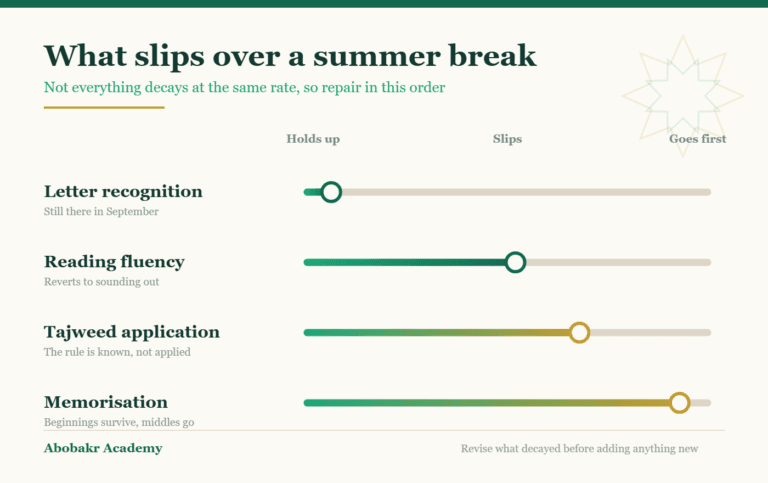
Twenty eight letters therefore produce well over a hundred shapes on the page. That sounds worse than it is, because the forms are related and most children absorb them by pattern rather than by memorization. But it does mean a plain 28 letter list will stop working, and a child who was reading confidently will suddenly appear to have forgotten everything.
The fix is to teach from a chart that shows every position from the start rather than one that shows the isolated letters. Ours does that, and it is a free printable Arabic alphabet chart with no email required, in colour and in black and white for cheaper printing.
Four pairs that sound identical to an English ear
Arabic separates sounds that English treats as one. To a parent who grew up speaking English these pairs are genuinely indistinguishable at first, which matters because a child copies what the parent says, including the wrong version.
| Pair | Names | What actually differs |
|---|---|---|
| ك / ق | kaaf / qaaf | qaaf is made further back, against the soft palate |
| ه / ح | haa / haa (heavy) | the light one is a sigh, the heavy one comes from the throat |
| س / ص | seen / saad | saad is fuller and rounder, with the tongue lowered |
| د / ض | daal / daad | daad presses the side of the tongue against the molars |
Getting these wrong is normal and it is also fixable, but not from a chart. If you want the longer version with the specific errors to listen for, we wrote it up in a separate piece on the Arabic letters children say wrong most often.
The order worth teaching them in
Alphabetical order is the right order for a reference table and the wrong order for a first month. Alif, baa, taa, thaa puts two of the harder sounds in the first four lessons. Teaching by shape family instead means a child gets four letters for the price of one, because ba, ta, tha and ya share a body and differ only in dots.
| Week | Letters | Why these together |
|---|---|---|
| One | ب ت ث ن ي | one body, dots only; immediate wins |
| Two | ج ح خ د ذ ر ز | two more families, each a pair or triple |
| Three | س ش ص ض ط ظ | the heavy letters, taught in contrast |
| Four | ا ع غ ف ق ك ل م ه و | the remainder, most of them straightforward |
If you want that expanded into dated days with what to do when a week goes badly, the free 90 day Arabic plan covers the first term rather than the first month.
Fifteen words to build once the letters are in
Reading real words is what makes the alphabet stick, and the words below are chosen because they are short, they use common letters, and a child already knows the objects. Teach the word, not the spelling.
| Group | Word | Say it | Meaning |
|---|---|---|---|
| Home | بَيْت | bayt | house |
| Home | بَاب | baab | door |
| Home | سَرِير | sareer | bed |
| Home | كِتَاب | kitaab | book |
| Food | مَاء | maa | water |
| Food | خُبْز | khubz | bread |
| Food | تُفَّاح | tuffaah | apple |
| Food | لَبَن | laban | milk |
| Animals | قِطّ | qitt | cat |
| Animals | سَمَك | samak | fish |
| Animals | طَيْر | tayr | bird |
| Outside | شَمْس | shams | sun |
| Outside | قَمَر | qamar | moon |
| Outside | وَرْد | ward | roses |
| Outside | نَجْم | najm | star |
How long the alphabet actually takes
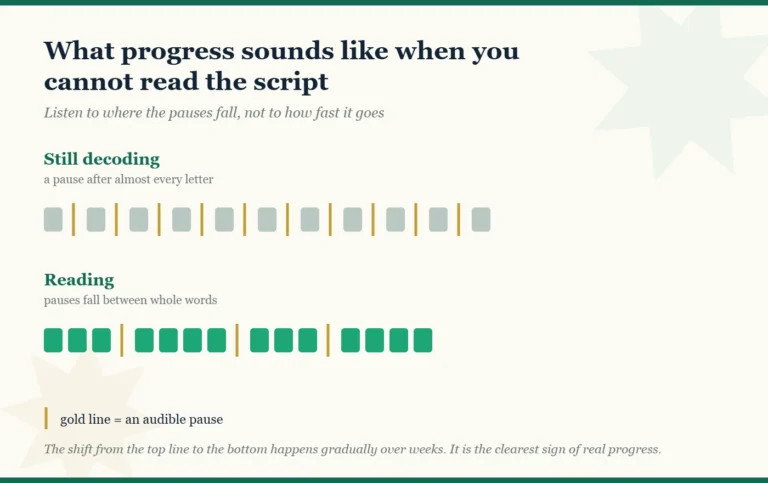
Ten to fifteen minutes a day, five days a week, gets most children aged six and up through recognition of all 28 letters in about four to six weeks. Adding the four positional forms takes roughly as long again. Reading short vowelled words without hesitating is a term, not a month.
Anyone promising the alphabet in a weekend is describing recognition of isolated shapes, which is the part that does not transfer. You can verify this yourself: cover the chart, write kitaab, and see whether the child reads it or recites.
A useful weekly test that needs no Arabic from you. Point at any four letters on the chart in random order and ask for the sound, not the name. Random order removes the chant, and sound rather than name is what reading requires.
If the whole thing feels like more than you can carry alone, that is the normal starting position rather than a failure, and we wrote about teaching Arabic at home when you do not speak it for exactly that case.
Frequently asked questions
What are the 28 Arabic letters?
In order, they are alif, baa, taa, thaa, jeem, haa, khaa, daal, dhaal, raa, zayn, seen, sheen, saad, daad, taa, dhaa, ayn, ghayn, faa, qaaf, kaaf, laam, meem, noon, haa, waaw and yaa. The table above gives each one in script with an example word.
Is the Quran written in the same alphabet?
Yes. The same 28 letters, and this is why learning the alphabet is the first step in reading the Quran as well as in speaking Arabic. What the Quran adds is a set of recitation rules governing length, nasal sounds and pauses, which is Tajweed and comes later.
Does the alphabet have 28 letters or 29?
Twenty eight is the standard count. You will sometimes see 29, which happens when hamza is counted as a letter in its own right rather than as a mark that sits on alif, waaw or yaa. Both counts describe the same writing system.
Should a child learn to write the letters at the same time as reading them?
Writing helps recognition, so yes, but keep it light. Tracing a letter three times is worth more than a page of it, and a child who is copying shapes neatly while unable to sound them out has learned handwriting rather than reading.
Do I need to know Arabic to teach this?
No, and most of the parents we work with do not. What you need is the transliteration column, a chart with all four letter positions on it, and someone who can hear your child read aloud once a week.
Print the chart and start tonight. The alphabet chart is free and ungated, in colour and black and white, and it sits alongside the rest of our free printables for Arabic and Quran.
If you would rather someone else hears the letters and corrects them, you can book a free trial class and see how your child reads with a tutor listening.