Arabic is written joined up, like English handwriting. A letter changes shape depending on whether it starts a word, sits inside it, ends it, or stands alone. There are 28 letters and four positions, so a learner meets far more than 28 shapes. A chart that shows only the isolated letter has taught the one shape that letter almost never has in real writing.
That last point is what costs families months. Most alphabet posters, flashcards and apps show the isolated form: ب, ج, س. But open a Qur’an and the isolated form barely appears. Inside words those same letters look like بـ, ـجـ, ـسـ. A child who has learned the poster can recite the alphabet perfectly and still not read a single word.
What are the initial, medial and final forms of Arabic letters?
Arabic letters take four forms: initial (beginning of a word), medial (middle), final (end) and isolated (standing alone). All 28 letters have these four positions, but they connect differently. Twenty-two letters join to the letter after them, and six never do. Those 6 create visible gaps inside a single word, which is the most common reason beginners mis-read where one word ends and the next begins.
One letter, four forms, in words you already know
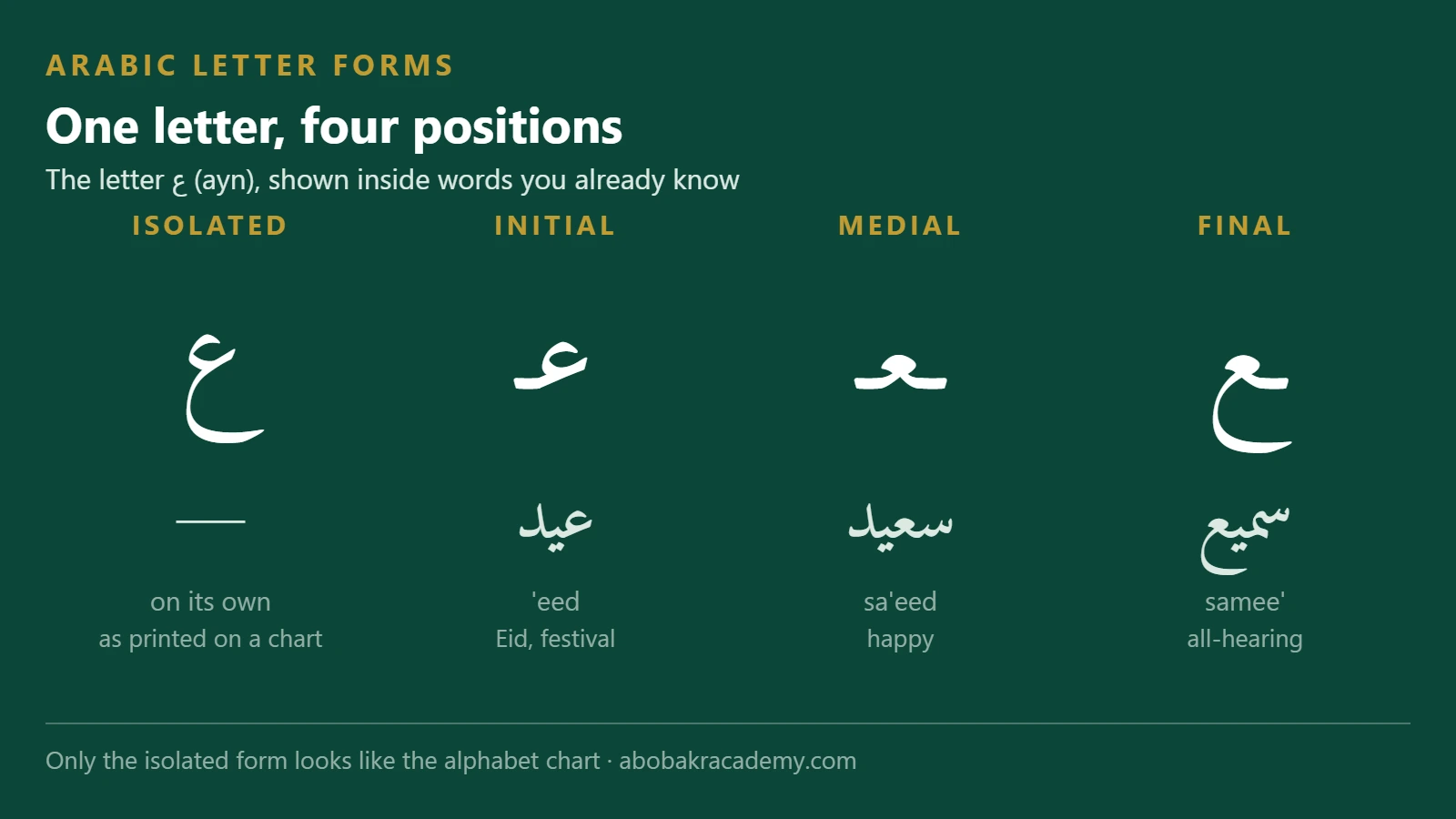
A chart of isolated letters teaches the one form that appears least often in real writing. It is easier to see the rule in a single letter followed through a word. Here is ع (ayn), one of the letters that changes most, in three words a Muslim family will already recognise.
| Position | Shape | Example word | Transliteration | Meaning |
|---|---|---|---|---|
| Isolated | ع | none | ayn | the letter standing alone, as on a chart |
| Initial | عـ | عيد | ʿīd | Eid, festival |
| Medial | ـعـ | سعيد | saʿīd | happy |
| Final | ـع | سميع | samīʿ | all-hearing |
The same letter, four appearances, and only the isolated one looks like the chart. This is why a child who scores full marks on an alphabet app can still stall on the first line of a real page: the app tested the form that appears least.
What to do with this. Take one letter a week rather than the whole alphabet. Find it in three words your child already says out loud. عيد and سعيد are a greeting they hear every year. Then ask them to point at it in each one. You do not need to read the word to check the answer. You only need to know which letter you asked for.
The six letters that never connect forward
This is the rule almost nothing teaches, and it explains more beginner confusion than any other single fact. Six letters join to the letter before them, but never to the letter after them:
These six have a formal name, and it is worth knowing because it explains the behaviour rather than just listing it. The Unicode Standard classifies every Arabic letter by its joining type: these six are right-joining, meaning they join towards the letter before them and never towards the letter after. The other twenty-two are dual-joining, which is why they have four shapes and these six have two.
| Letter | Name | Isolated | Final form |
|---|---|---|---|
| ا | alif | ا | ـا |
| د | dāl | د | ـد |
| ذ | dhāl | ذ | ـذ |
| ر | rā’ | ر | ـر |
| ز | zāy | ز | ـز |
| و | wāw | و | ـو |
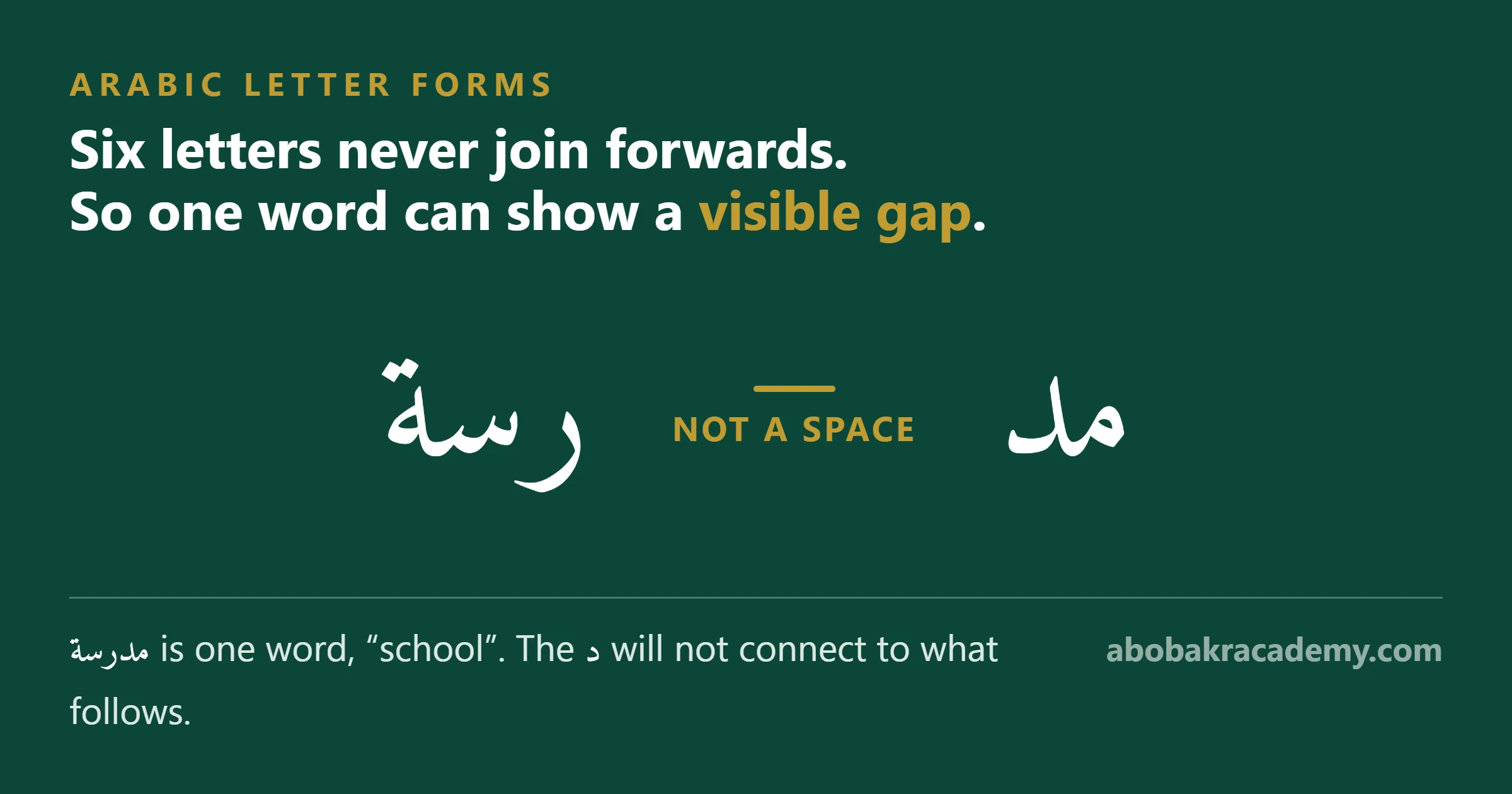
Because these six refuse to join forwards, a word can contain a visible gap and still be one word. Take مدرسة (madrasa, school). The د in the middle will not connect to what follows, so the word splits visually into مد and رسة. A reader who does not know this rule sees two words.
If you do not read Arabic yourself, this is the single most useful thing you can know, because it is the mistake you will watch your child make and be unable to explain. The gap is not a space. The word has not ended.
All 28 Arabic letters in their four forms
This is the reference table. The last column is the one most charts leave out: whether the letter joins to whatever comes after it. Six do not, and those six are the reason a word can break in half on the page.
| Name | Isolated | Initial | Medial | Final | Joins forward? |
|---|---|---|---|---|---|
| alif | ا | ا | ـا | ـا | no |
| ba | ب | بـ | ـبـ | ـب | yes |
| ta | ت | تـ | ـتـ | ـت | yes |
| tha | ث | ثـ | ـثـ | ـث | yes |
| jim | ج | جـ | ـجـ | ـج | yes |
| ha | ح | حـ | ـحـ | ـح | yes |
| kha | خ | خـ | ـخـ | ـخ | yes |
| dal | د | د | ـد | ـد | no |
| dhal | ذ | ذ | ـذ | ـذ | no |
| ra | ر | ر | ـر | ـر | no |
| zay | ز | ز | ـز | ـز | no |
| sin | س | سـ | ـسـ | ـس | yes |
| shin | ش | شـ | ـشـ | ـش | yes |
| sad | ص | صـ | ـصـ | ـص | yes |
| dad | ض | ضـ | ـضـ | ـض | yes |
| ta (emphatic) | ط | طـ | ـطـ | ـط | yes |
| za (emphatic) | ظ | ظـ | ـظـ | ـظ | yes |
| ayn | ع | عـ | ـعـ | ـع | yes |
| ghayn | غ | غـ | ـغـ | ـغ | yes |
| fa | ف | فـ | ـفـ | ـف | yes |
| qaf | ق | قـ | ـقـ | ـق | yes |
| kaf | ك | كـ | ـكـ | ـك | yes |
| lam | ل | لـ | ـلـ | ـل | yes |
| mim | م | مـ | ـمـ | ـم | yes |
| nun | ن | نـ | ـنـ | ـن | yes |
| ha | ه | هـ | ـهـ | ـه | yes |
| waw | و | و | ـو | ـو | no |
| ya | ي | يـ | ـيـ | ـي | yes |
Read it a row at a time rather than all at once. In the six rows marked no, the initial column repeats the isolated shape and the medial column repeats the final one. That is not a gap in the table. It is the rule itself: those letters have two shapes, not four.
The letters whose shapes change the most
Not all 28 letters are equally hard. Most change only slightly. They lose their tail, gain a connecting stroke, and stay recognisable. A handful change so much that a learner has to memorise them as separate shapes.
| Letter | Isolated | Initial | Medial | Final | Why it is hard |
|---|---|---|---|---|---|
| hā’ | ه | هـ | ـهـ | ـه | Four shapes with almost nothing in common |
| ‘ayn | ع | عـ | ـعـ | ـع | The medial form looks nothing like the isolated one |
| ghayn | غ | غـ | ـغـ | ـغ | As ‘ayn, plus the dot to track |
| kāf | ك | كـ | ـكـ | ـك | The initial form loses its distinctive hook |
| mīm | م | مـ | ـمـ | ـم | The circle moves and the tail appears only at the end |
| yā’ | ي | يـ | ـيـ | ـي | The two dots are easy to lose at reading speed |
Spend your practice time here. Drilling all 28 letters equally wastes most of it, because roughly two thirds change predictably and need one exposure rather than twenty.
How to practise this at home if you do not read Arabic
You do not need to read Arabic to check this work. You need to know what to look for. Our guide to teaching your child Arabic when you do not speak it is built on the same idea.
- Ask for the position, not the letter. Point at a letter inside a word and ask “is that the beginning, middle or end shape?” A child who can answer that is reading. A child who can only name the isolated letter is reciting.
- Use a word, never a single letter. A letter shown alone teaches the one form that appears least.
- Watch for the gap mistake. When your child stops mid-word at one of the six non-connectors, that is the moment to say: the word has not finished.
- Cover and check. Hide everything except one letter and ask which word it came from. If the shape only makes sense in context, that is the point. Arabic letters are not islands.
Two free printables here are built around exactly this. The Arabic alphabet flashcards carry all four positional forms on every card rather than the isolated shape alone, and the Arabic alphabet chart is the wall reference to read them against. Shapes you can check alone. Sounds need someone listening, and that is the part our online Arabic lessons for kids cover.
Where this sits in learning to read. Positional forms come after letter recognition and before fluent reading, and they are usually the step that gets skipped. If your child is still naming letters in isolation, that work belongs in the Noorani Qaida sequence first. If you are the one starting rather than teaching, learning to read as an adult covers the same ground without the framing for children, and the beginner route sets out the order the stages arrive in.
Joining letters: what trips children up
Do all 28 Arabic letters have four forms?
All 28 have initial, medial, final and isolated positions. But for the six non-connecting letters the initial and medial forms are not used in the ordinary way, because nothing attaches after them. In practice those six show two shapes rather than four.
Which Arabic letters cannot be joined?
Alif ا, dāl د, dhāl ذ, rā’ ر, zāy ز and wāw و. They join to the letter before them, never to the letter after.
Why does my child read the gaps as spaces?
Because nothing has told them the six-letter rule. It is a two-minute fix and it usually removes a large share of reading errors immediately.
Should we learn the isolated forms first?
Learn them together. Isolated-first is the standard approach, and it is why so many children can recite the alphabet and not read. The isolated shape is the least useful of the four.
If you would like someone to check your child’s reading rather than guessing at it, you can book a free trial lesson.