
Arabic at Home: A Free 90-Day Reading Plan You Can Print
One A4 page that lays out the first three months of teaching a child to read Arabic, in the order the stages actually have to come, with a tick box and a date line for each one and the three checks a parent who does not read Arabic can run to see whether it is working. Free to download and free to print. No email address, no sign-up, nothing to fill in first.
What is on the sheet
The plan splits twelve weeks into four stages. The order is not a preference. Each stage assumes the one before it has actually landed, and the commonest way a home attempt falls apart is skipping the second stage because it looks dull.
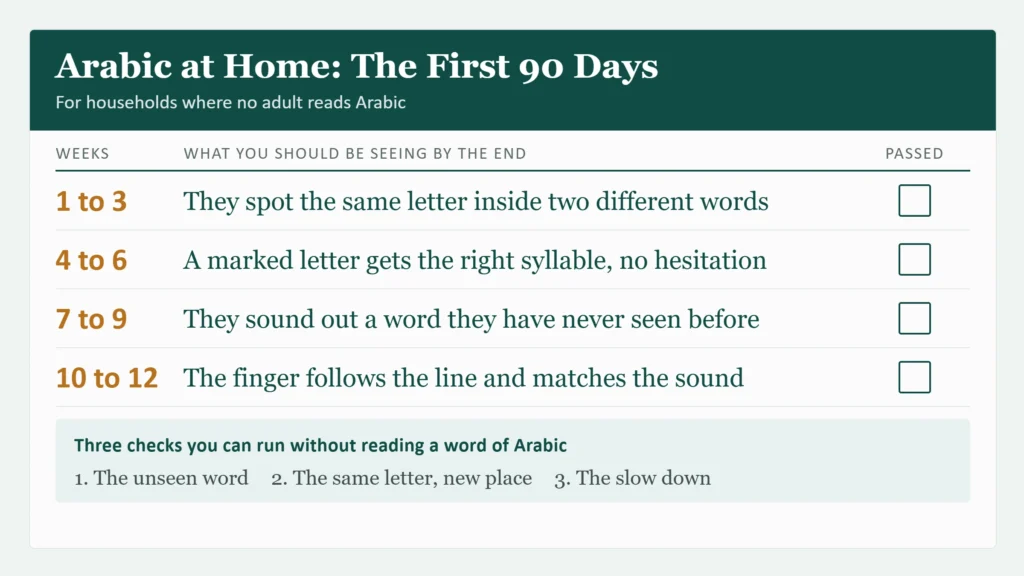
| Weeks | What the child works on | What you should see by the end |
|---|---|---|
| 1 to 3 | Letter names and sounds, with the joined forms taught from day one rather than saved for later. Four or five letters at a time. | They point to the same letter in two different words and say it is the same letter. |
| 4 to 6 | The short vowel marks. Every letter now carries three sounds instead of one, which roughly triples the work. | Given a marked letter, they produce the right syllable without hesitating. Slow is fine. Guessing is not. |
| 7 to 9 | Joining letters into two and three letter combinations, then into real words. No meaning attached yet, on purpose. | They sound out a three letter word they have never seen before. |
| 10 to 12 | First real text. A short surah they already know by ear works best, because the ear catches what the eye misses. | Their finger follows the line and the finger matches the sound. |
The right-hand column is the part worth printing. Weeks passing is not evidence of anything, and a child can sit through six weeks of vowel marks without one of them landing.
How to use it
Stick it somewhere it will be seen. A fridge, the inside of a cupboard door, the wall above wherever lessons happen. It is one page for that reason.
Tick a stage when your child passes the check in the right-hand column, not when you reach the end of the weeks. Those are two different days, and the gap between them tells you more than either date on its own. A child who reached the end of stage two in week six and passed its check in week nine is not behind. A child who reached the end and never passed it has a specific gap, and you now know which one.
If a stage takes half again as long as the sheet says, that is ordinary. If it takes three times as long, something in the stage below it never finished, and going back is faster than pushing on.
The three checks along the bottom
All three work without any Arabic at all, and each takes under a minute.
- The unseen word. Ask your child to read a short word you pick, not one they pick, from anywhere on the page. A child who is decoding will go slowly and usually get there. A child who has memorized the lesson will either freeze or produce something fluent and wrong.
- The same letter in a new place. Point at a letter in the middle of a word, then find what looks to you like a different shape further down and ask whether it is the same letter. You are testing whether all four written forms have landed.
- The slow down. Ask for the same line at half speed. Speed hides guessing, and children work out early that reading fast makes adults nod. Halved, guessing becomes audible even to an ear that knows no Arabic, because it sounds smoother than decoding does.
The longer version of each, and why the second stage is where most home attempts stop, is in our guide on teaching Arabic to your children when you do not speak it.
What the sheet cannot do for you
Everything above works without Arabic. Pronunciation does not.
Arabic has sounds English does not have, and several of them come in pairs that English flattens into one letter. There is a light s and a heavy s, a light d and a heavy d, a light t and a heavy t. Three separate sounds get written as h or kh in transliteration and are made in three different places in the throat. None of that is visible on a page, and none of it is audible as an error to someone who has not been taught to hear it.
So a child can work through all four stages, tick every box honestly, and still be saying half the letters wrong, with nobody in the house able to tell. That is not a failure of the plan. It is the one part of the job that needs an ear, and it is the reason the sheet names it rather than pretending otherwise.
Print it, copy it, host it yourself
Teachers, weekend schools and homeschool groups are welcome to print this for a class, put it in a parent pack, or host the PDF on their own site. A link back is appreciated and not required. If you want it in a different format for a newsletter or a handout, email [email protected] and we will send it over.
It sits alongside our other free printables: a printable Arabic alphabet chart for the first stage, and a short surahs tracker for the stage after this plan finishes.
Questions
Do I need to give an email address?
No. The link above is the file. There is no form, no list and no follow-up.
Does it print in black and white?
There is a version made for it, linked above. The colour sheet prints perfectly well at home, but its headings come out as solid grey bands on a mono printer, which is a waste of toner across thirty copies. The black and white version is the same sheet with none of that.
What age is this for?
Roughly five or six upwards, if the child is already reading in their first language. Younger than that and the letters can start, but the vowel-mark stage will take considerably longer than the sheet says.
Is this Quran reading or spoken Arabic?
Reading. The plan takes a child from letters to following a line of real text, which is the skill Quran reading is built on. It does not teach anyone to hold a conversation, and the two projects are further apart than most parents expect.
Can I do this without a teacher?
The first three stages, yes, and plenty of families do. The pronunciation problem above is the honest limit, and it is usually why parents who got to week ten alone start looking for someone to listen.
My child already knows the letters. Where do we start?
Run the second check on the sheet before you decide. Knowing the letters in isolation and knowing them inside words are different skills, and a child who only recognises a letter at the start of a word has not finished stage one. Closing that gap takes a fortnight rather than three weeks, and skipping it costs you stage three.
If you would like someone listening to the pronunciation while you handle the rest, our Arabic lessons for children are one to one, and a free trial lesson is fifteen to thirty minutes with no commitment attached.
The plan is stage two of six. The other free sheets cover the letters before it and the Qaida after it.