Arabic has two sets of names for the twelve months, and Muslim families need a third. Egypt and the Gulf say the European names with an Arabic accent: yanayir is January. Iraq and the Levant use older names, so January there is kanun ath-thani. The Islamic calendar has its own twelve, Muharram to Dhu al-Hijjah. All three are below, each name with a button to hear it.
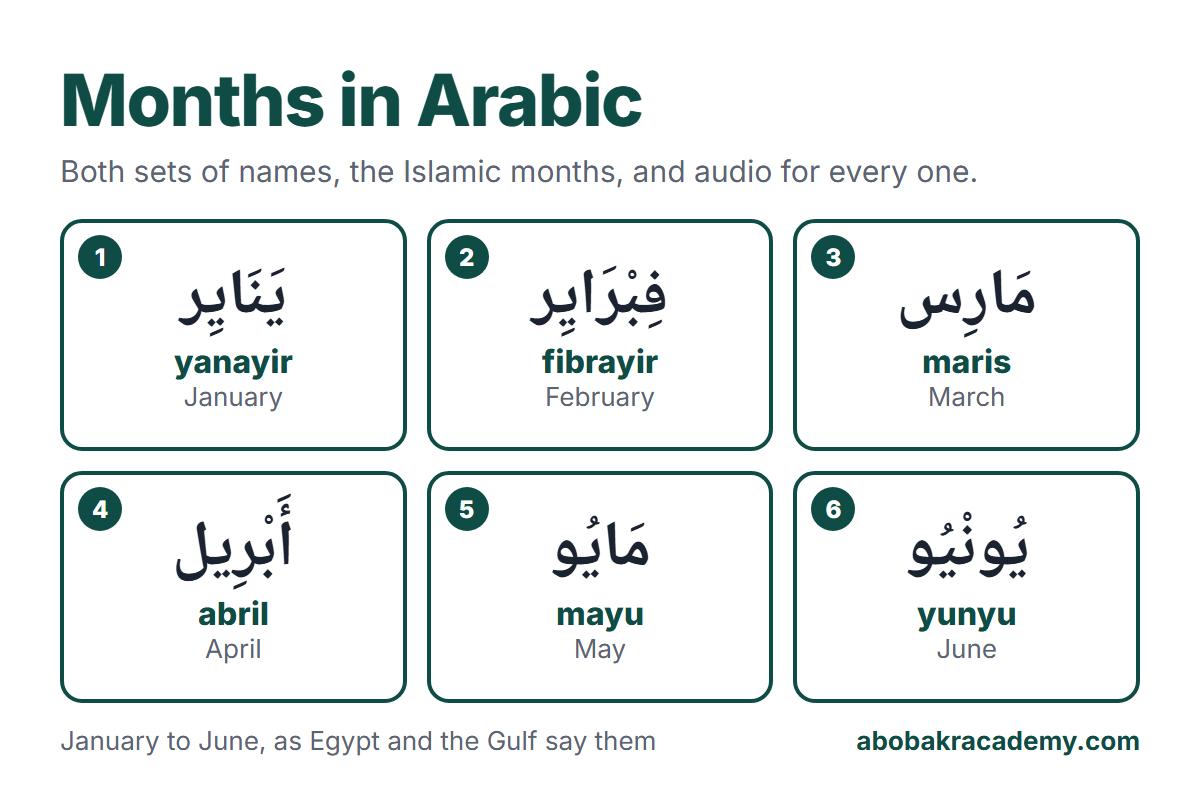
Month in Arabic is شَهْر (shahr). The twelve months: January يَنَايِر (yanayir), February فِبْرَايِر (fibrayir), March مَارِس (maris), April أَبْرِيل (abril), May مَايُو (mayu), June يُونْيُو (yunyu), July يُولْيُو (yulyu), August أَغُسْطُس (aghustus), September سِبْتَمْبِر (sibtambir), October أُكْتُوبَر (uktubar), November نُوفِمْبِر (nufimbir), December دِيسَمْبِر (disambir). In Syria, Lebanon and Iraq, January is كَانُون الثَّانِي (kanun ath-thani) and February شُبَاط (shubat). The Islamic months run from مُحَرَّم (Muharram) to ذُو الحِجَّة (Dhu al-Hijjah).
All twelve on one chart
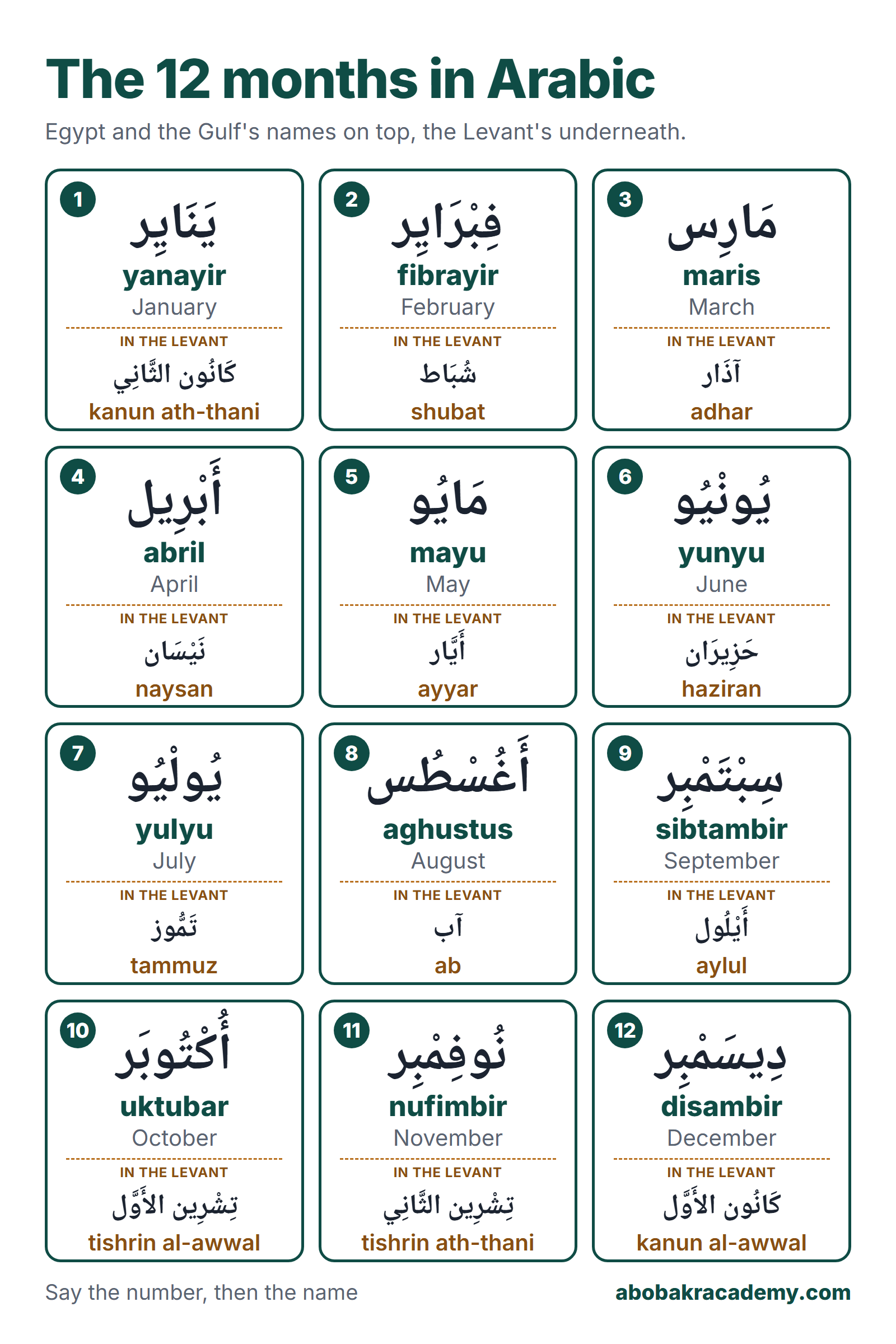
Each card has the textbook name on top and the Levant’s name underneath. Put it where your child eats breakfast and say the month together on the first day of each one.
The months of the year in Arabic
These are the names in most textbooks and on the news from Cairo to Dubai. They came into Arabic from the European names, so a child who already knows January in English is halfway to يَنَايِر. Tap the green button beside a name to hear it.
| # | Arabic | English, and how to say it |
|---|---|---|
| 1 | يَنَايِر | January (yanayir) |
| 2 | فِبْرَايِر | February (fibrayir) |
| 3 | مَارِس | March (maris) |
| 4 | أَبْرِيل | April (abril) |
| 5 | مَايُو | May (mayu) |
| 6 | يُونْيُو | June (yunyu) |
| 7 | يُولْيُو | July (yulyu) |
| 8 | أَغُسْطُس | August (aghustus) |
| 9 | سِبْتَمْبِر | September (sibtambir) |
| 10 | أُكْتُوبَر | October (uktubar) |
| 11 | نُوفِمْبِر | November (nufimbir) |
| 12 | دِيسَمْبِر | December (disambir) |
Two of them are easy to mix up when you first hear them: yunyu (June) and yulyu (July) differ only in their middle letter, an n in June and an l in July. Say the English month straight after the Arabic one for the first few weeks and the pair sorts itself out.
The Levantine names: Kanun, Shubat, Adhar
In Syria, Lebanon, Jordan, Palestine and Iraq the same months carry names that are much older than Arabic. They come from the calendar of ancient Mesopotamia, which is why some sound like Hebrew month names: Nisan, Iyar, Tammuz and Av are on the Jewish calendar too. A family from that part of the world will use these names at home, and a child who hears them from a grandparent should learn them first.
| # | Arabic | English, and how to say it |
|---|---|---|
| 1 | كَانُون الثَّانِي | January (kanun ath-thani) |
| 2 | شُبَاط | February (shubat) |
| 3 | آذَار | March (adhar) |
| 4 | نَيْسَان | April (naysan) |
| 5 | أَيَّار | May (ayyar) |
| 6 | حَزِيرَان | June (haziran) |
| 7 | تَمُّوز | July (tammuz) |
| 8 | آب | August (ab) |
| 9 | أَيْلُول | September (aylul) |
| 10 | تِشْرِين الأَوَّل | October (tishrin al-awwal) |
| 11 | تِشْرِين الثَّانِي | November (tishrin ath-thani) |
| 12 | كَانُون الأَوَّل | December (kanun al-awwal) |
Two pairs share a name. Kanun is December and January, so the first is kanun al-awwal (the first Kanun) and the second is kanun ath-thani (the second). Tishrin works the same way for October and November. Teach a pair together and the numbering makes the order plain.
North Africa has its own set again. Algeria and Tunisia use names taken from French, so January there is janfi, Morocco has its own forms of the European names, and in daily speech across the region people often just say the month’s number. If your family is from the Maghreb, ask the grandparents which names they use and teach those. Wikipedia’s table of the regional names sets every country’s set side by side.
Which set should a child learn first?
For a family where nobody at home speaks Arabic, start with the textbook names. They are the ones in children’s books and apps, they sound close to the English, and teachers usually begin with them. Add the Islamic months once the first set is easy, because those are the months a Muslim child will hear about in the masjid and see on a Ramadan timetable. Leave the Levantine names until later unless your family uses them.
The Islamic months in Arabic
The Hijri calendar follows the moon. Each month begins when the new crescent is seen, so it lasts 29 or 30 days, and the Islamic year is about eleven days shorter than the Gregorian one. That is why Ramadan comes earlier every year. These names are the same in every Muslim country.
| # | Arabic | Month, and how to say it |
|---|---|---|
| 1 | مُحَرَّم | Muharram (muharram) |
| 2 | صَفَر | Safar (safar) |
| 3 | رَبِيع الأَوَّل | Rabi’ al-Awwal (rabi’ al-awwal) |
| 4 | رَبِيع الآخِر | Rabi’ al-Akhir (rabi’ al-akhir) |
| 5 | جُمَادَى الأُولَى | Jumada al-Ula (jumada al-ula) |
| 6 | جُمَادَى الآخِرَة | Jumada al-Akhira (jumada al-akhira) |
| 7 | رَجَب | Rajab (rajab) |
| 8 | شَعْبَان | Sha’ban (sha’ban) |
| 9 | رَمَضَان | Ramadan (ramadan) |
| 10 | شَوَّال | Shawwal (shawwal) |
| 11 | ذُو القَعْدَة | Dhu al-Qa’dah (dhu l-qa’da) |
| 12 | ذُو الحِجَّة | Dhu al-Hijjah (dhu l-hijja) |
For what happens in each of these months, the four sacred months and why the calendar starts from the Hijrah, our Islamic months for kids page goes through all twelve with a printable chart of its own.
Which Islamic month is it in 2026?
Here is the first day of each Islamic month that starts in 2026, by the Umm al-Qura calendar Saudi Arabia uses. Many mosques in the US, UK, Canada and Australia wait for the moon to be sighted locally, so your masjid’s date can be a day later.
| Islamic month | Begins |
|---|---|
| Sha’ban 1447 | 20 January 2026 |
| Ramadan 1447 | 18 February 2026 |
| Shawwal 1447 | 20 March 2026 |
| Dhu al-Qa’dah 1447 | 18 April 2026 |
| Dhu al-Hijjah 1447 | 18 May 2026 |
| Muharram 1448 | 16 June 2026 |
| Safar 1448 | 15 July 2026 |
| Rabi’ al-Awwal 1448 | 14 August 2026 |
| Rabi’ al-Akhir 1448 | 12 September 2026 |
| Jumada al-Ula 1448 | 12 October 2026 |
| Jumada al-Akhira 1448 | 11 November 2026 |
| Rajab 1448 | 10 December 2026 |
How many months are in the Quran?
The Quran gives the number. In Surah At-Tawbah, Allah says the months are twelve and four of them are sacred:
إِنَّ عِدَّةَ الشُّهُورِ عِندَ اللَّهِ اثْنَا عَشَرَ شَهْرًا فِي كِتَابِ اللَّهِ يَوْمَ خَلَقَ السَّمَاوَاتِ وَالْأَرْضَ مِنْهَا أَرْبَعَةٌ حُرُمٌ
Indeed, the number of months with Allāh is twelve [lunar] months in the register of Allāh [from] the day He created the heavens and the earth; of these, four are sacred. (Quran 9:36, Sahih International. The button plays the whole verse, recited by Mahmoud Khalil al-Husary.)
The word for months in the verse is الشُّهُورِ (ash-shuhur), the same plural taught in the table further down. The verse does not list the four sacred months by name; the Prophet ﷺ did, in a hadith in Sahih al-Bukhari (3197): Dhu al-Qa’dah, Dhu al-Hijjah and Muharram, which come one after another, and Rajab. Dhu al-Hijjah is also the month of the pilgrimage, and our Hajj step by step guide follows it day by day, from the 8th of the month.
Only one month is named in the Quran itself, and that is Ramadan:
شَهْرُ رَمَضَانَ الَّذِي أُنزِلَ فِيهِ الْقُرْآنُ
The month of Ramaḍān [is that] in which was revealed the Qur’ān, (Quran 2:185, Sahih International. The button plays the whole verse, recited by Mahmoud Khalil al-Husary.)
We checked the other month names against the whole Quran. Rajab, Sha’ban, Shawwal, Rabi’ and Jumada do not appear. The word محرم does, three times, but each time it means forbidden or sacred, as in the sacred house of 14:37, never the month.
Saying the month in Arabic
Month is شَهْر (shahr). Arabic has two plurals for it: أَشْهُر (ashhur) for three to ten months and شُهُور (shuhur) for more than ten, which is why the verse above, counting twelve, says ash-shuhur. With these and the names, a child can answer the question every Arabic teacher asks in the first weeks.
| Arabic | English, and how to say it | |
|---|---|---|
| 1 | شَهْر | Month (shahr) |
| 2 | أَشْهُر | Months (3 to 10) (ashhur) |
| 3 | شُهُور | Months (11 and more) (shuhur) |
| 4 | سَنَة | Year (sana) |
| 5 | هٰذَا الشَّهْر | This month (hadha sh-shahr) |
| 6 | الشَّهْرُ القَادِم | Next month (ash-shahru l-qadim) |
| 7 | الشَّهْرُ المَاضِي | Last month (ash-shahru l-madi) |
| 8 | فِي رَمَضَان | In Ramadan (fi ramadan) |
| 9 | فِي أَيِّ شَهْرٍ نَحْنُ؟ | What month are we in? (fi ayyi shahrin nahnu?) |
The month always comes after the word for “in”: fi maris is “in March”, fi ramadan is “in Ramadan”. For the day of the month you need the numbers, and our Arabic numbers 1 to 100 page has every one of them with audio.
How to teach the months when you do not speak Arabic
You do not need to speak Arabic to teach twelve words. You need a routine short enough to keep.
- Say the month on its first day. Press play on that month’s button at breakfast and say it after the voice. Twelve times a year is enough for the name of the current month to stick.
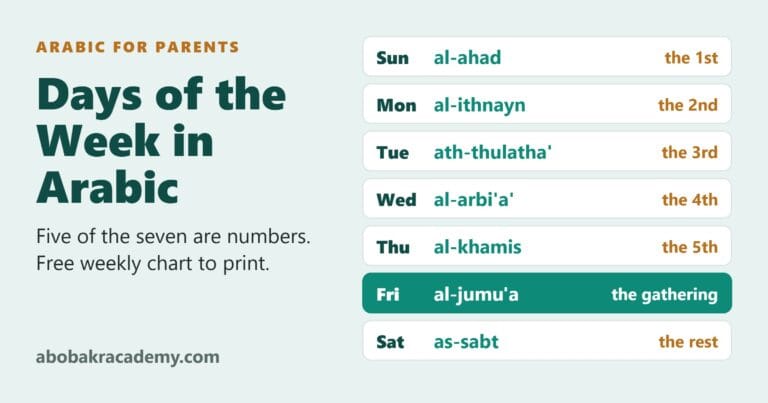
- Add it to the date. If your child already says the day in Arabic from our days of the week page, add the month after it: al-ithnayn, uktubar.
- Look for the new moon. At the end of each Islamic month, go out after sunset and look for the crescent. When you find it, say the new month’s name. Children remember the month they went looking for.
- Count down to Ramadan. From Rajab, say how many months are left: Rajab, then Sha’ban, then Ramadan. It teaches the order of the last three and gives the wait a shape.
- Print the chart and point. A child who cannot read yet can still point to the card for their birthday month and the month of Eid.
If you would rather a teacher took over, our online Arabic classes for kids are taught in English to children from homes where nobody reads Arabic, and the first lesson is free.
Free printable months chart PDF
Two A4 pages, no sign-up. The first has all twelve months under both sets of names, how to say each, and lines for writing this month’s name. The second has the twelve Islamic months and the words for month, year, this month, next month and last month. It prints clearly in black and white.
Questions about the Arabic and Islamic months
How do you say months in Arabic?
Month is شَهْر (shahr). For three to ten months Arabic says أَشْهُر (ashhur), and for eleven or more شُهُور (shuhur). Year is سَنَة (sana).
What are the 12 Islamic months?
Muharram, Safar, Rabi’ al-Awwal, Rabi’ al-Akhir, Jumada al-Ula, Jumada al-Akhira, Rajab, Sha’ban, Ramadan, Shawwal, Dhu al-Qa’dah and Dhu al-Hijjah. The four sacred months are Dhu al-Qa’dah, Dhu al-Hijjah, Muharram and Rajab.
What is the Arabic month?
It can mean two things. The Arabic word for a month is shahr. And people often say “the Arabic month” for the month of the Islamic calendar, which follows the moon and runs alongside the Gregorian month. On 12 October 2026, for example, Jumada al-Ula 1448 began.
What are the names of the months in the Arabic calendar for 2026?
The Gregorian months are the same twelve in Arabic, yanayir to disambir. On the Islamic calendar, 2026 runs from Rajab 1447 to Rajab 1448: it began on 12 Rajab 1447, Ramadan 1447 started on 18 February, Muharram 1448 on 16 June, and the year ends on 22 Rajab 1448, by the Umm al-Qura calendar.
Why does Arabic have two names for each month?
Because the Arab world took its month names from two places. Egypt and the Gulf borrowed the European names. Iraq and the Levant kept the old Mesopotamian ones, in use there before Arabic arrived. Both are correct, and an Arabic speaker from either region will understand both.
What is January in Arabic?
January is يَنَايِر (yanayir) in Egypt and the Gulf, and كَانُون الثَّانِي (kanun ath-thani) in Syria, Lebanon, Jordan and Iraq. The first month of the Islamic year is Muharram, which does not line up with January because the Islamic year follows the moon.
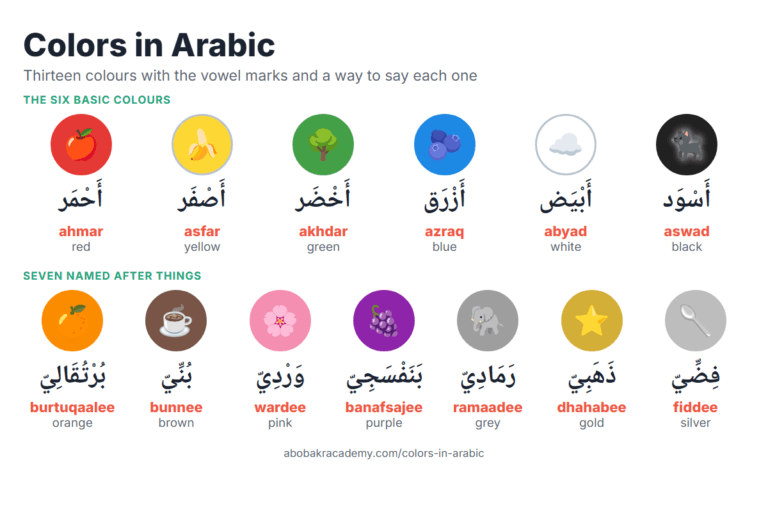
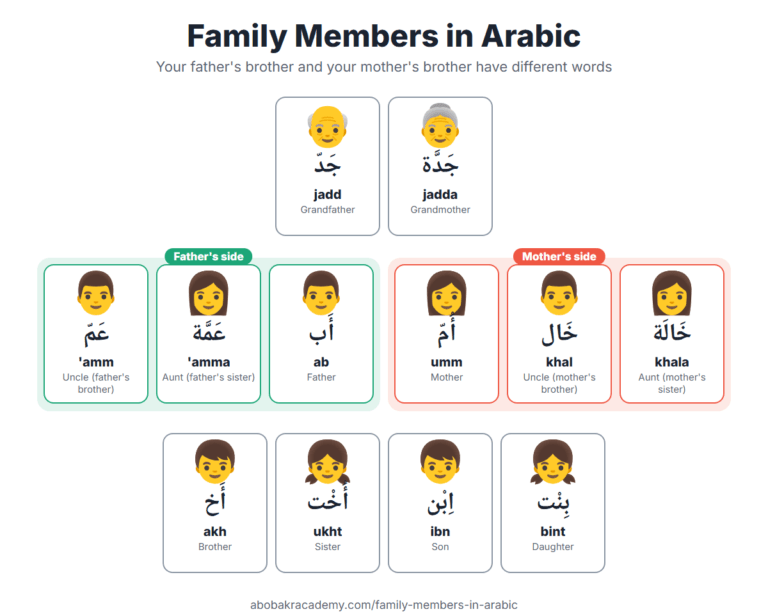
More first words in Arabic
The months go well with the days of the week in Arabic and numbers 1 to 100. For the Islamic year in more depth, see the Islamic months for kids, and for everyday words, Arabic greetings and colours in Arabic. All of them sit under our guide to teaching Arabic to kids when you don’t speak it.