

The core family members in Arabic are أَب (ab, father), أُمّ (umm, mother), أَخ (akh, brother), أُخْت (ukht, sister), جَدّ (jadd, grandfather) and جَدَّة (jadda, grandmother). Arabic is more precise than English about everyone else: there’s no single word for “uncle” or “aunt”, because it matters which parent they’re related to.
A family wedding, and your son is being introduced to half the room. “This is your ‘ammu. And this is your khalo.” Two uncles, two different words, and he looks at you to find out why. You’re not sure either. Your own parents always said “uncle”.
This page sorts that out, and it’s written for a household where nobody reads Arabic. The first two tables give the words with pronunciation in its own column. After that come the bits English speakers get wrong, a short note on the family words that turn up in the Quran, and a family tree sheet your child can fill in.
What are the words for immediate family in Arabic?
| English | Arabic | Pronunciation | “My …” |
|---|---|---|---|
| Father | أَب | ab | أَبِي abi |
| Mother | أُمّ | umm | أُمِّي ummi |
| Parents | وَالِدَان | walidan | وَالِدَايَ walidaya |
| Brother | أَخ | akh | أَخِي akhi |
| Sister | أُخْت | ukht | أُخْتِي ukhti |
| Son | اِبْن | ibn | اِبْنِي ibni |
| Daughter | بِنْت | bint | بِنْتِي binti |
| Husband | زَوْج | zawj | زَوْجِي zawji |
| Wife | زَوْجَة | zawja | زَوْجَتِي zawjati |
| Family | عَائِلَة | ‘a’ila | عَائِلَتِي ‘a’ilati |
At home, most Arabic-speaking children say baba and mama, exactly as they sound. The words in the table are the standard ones a teacher will use, and the ones your child will meet in books.
Look at the last column. “My” in Arabic is a small -i on the end of the word: akh, akhi. When a word ends in the soft -a sound, as zawja and ‘a’ila do, a t appears before the -i: zawjati, ‘a’ilati. That one pattern covers almost every family word on this page, so it’s worth pointing out to your child early.
Why are there two words for uncle in Arabic?
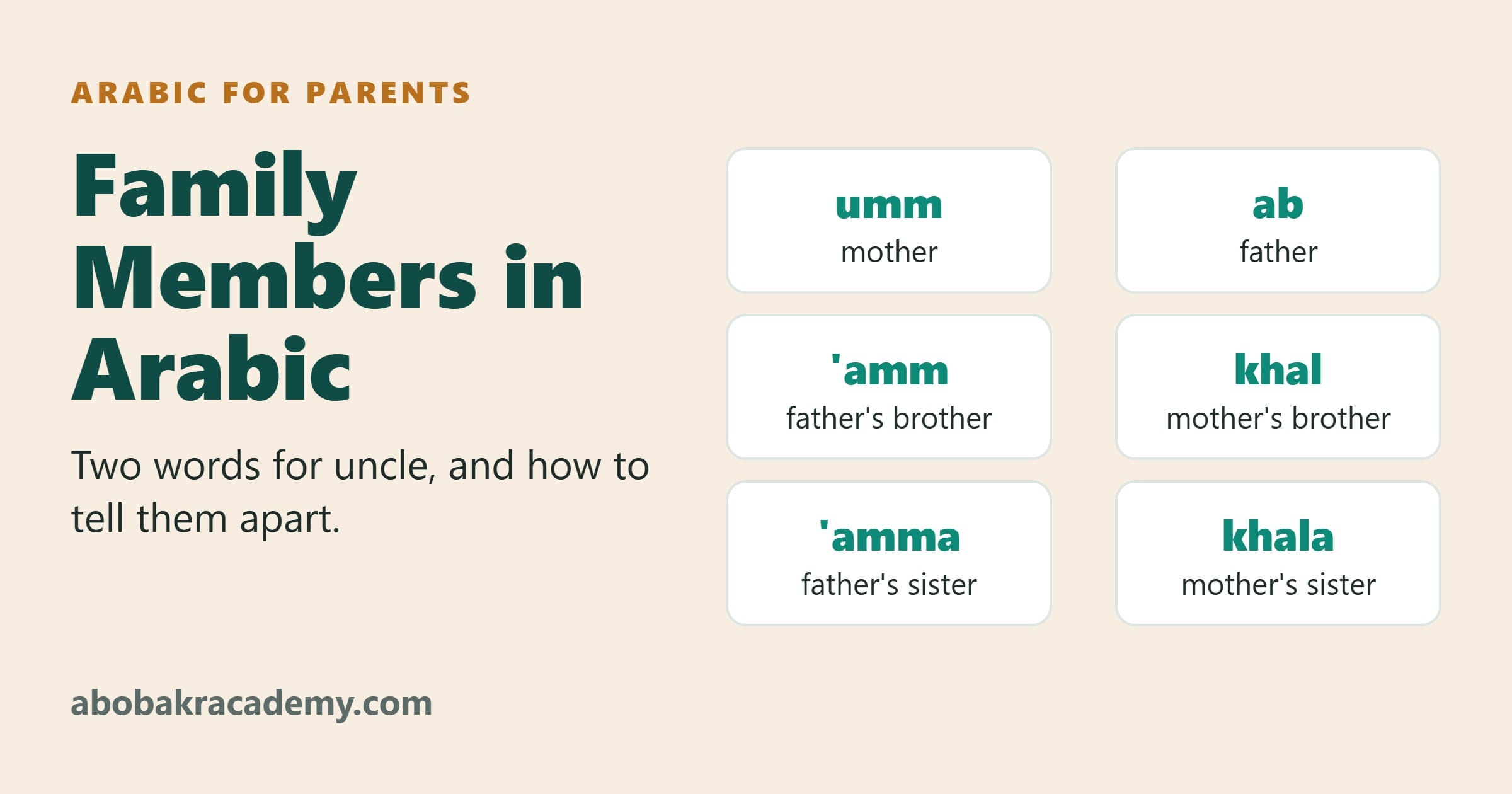
Because Arabic separates your father’s side from your mother’s side, and English doesn’t. Your father’s brother is your ‘amm. Your mother’s brother is your khal. The aunts follow the same split: ‘amma on your father’s side, khala on your mother’s.
| English | Arabic | Pronunciation | Whose side |
|---|---|---|---|
| Uncle | عَمّ | ‘amm | Father’s brother |
| Aunt | عَمَّة | ‘amma | Father’s sister |
| Uncle | خَال | khal | Mother’s brother |
| Aunt | خَالَة | khala | Mother’s sister |
| Grandfather | جَدّ | jadd | Either side |
| Grandmother | جَدَّة | jadda | Either side |
| Grandson | حَفِيد | hafid | Either side |
| Granddaughter | حَفِيدَة | hafida | Either side |
| Cousin (boy) | اِبْنُ العَمّ | ibn al-‘amm | Son of father’s brother; swap in ‘amma, khal or khala for the others |
| Cousin (girl) | بِنْتُ الخَالَة | bint al-khala | Daughter of mother’s sister; the same swap works |
Cousins are where this pays off. English has one word for eight different relationships. Arabic says exactly which one you mean: ibn al-‘amm is the son of your father’s brother, bint al-khal is the daughter of your mother’s brother, and so on. It’s a mouthful at first, and children usually love it once they see it drawn as a tree.
In everyday speech you’ll hear them softened into affectionate forms: ‘ammu or ‘ammo, khalo, khalto. Grandparents usually get family nicknames too. In Egypt and the Levant, teta and gedo or jiddo are the ones most children use.
Why does my child call a stranger “uncle”?
Because Arabic does too. ‘Ammu and khalto are used politely for older adults who aren’t related at all: the man who runs the shop, the woman at the masjid who always has sweets. It’s the same instinct as “Uncle” and “Auntie” in many South Asian and African families, and it’s worth telling a child directly so they aren’t confused when a friend’s father is suddenly “‘ammu“.
Among Muslims, akhi and ukhti, “my brother” and “my sister”, stretch the same way. You’ll hear them at the masjid between people who met five minutes ago. Children pick this up quickly, and it’s a nice way to show them that the family words carry a meaning beyond the house.
What does “Abu” or “Umm” in front of a name mean?
Abu means “father of” and Umm means “mother of”. A man whose eldest son is Ahmad may be called Abu Ahmad, and his wife Umm Ahmad. This kind of name is called a kunya, and it’s a warm, respectful way to address someone.
Your child already knows some. Abu Bakr, the first caliph, is the best-known example, and it’s the reason ab changes to abu: Arabic uses that longer form when “father” is joined to the next word. Ibn, “son of”, works the same way in names, and bint, “daughter of”, does the same for girls.
Which family words appear in the Quran?
Many of them, and the best known for children is a dua for parents. The Quran tells believers to be humble with their parents out of mercy and to pray: “My Lord! Be merciful to them as they raised me when I was young” (Surah al-Isra 17:24).
رَبِّ ارْحَمْهُمَا كَمَا رَبَّيَانِي صَغِيرًا
Rabbi-rhamhuma kama rabbayani saghira. It’s a short line, it’s about the very people a child is learning to name, and it’s a good one to add to the ones in our guide to daily duas for kids. Say it together after you’ve practised the family words, and the vocabulary has somewhere to live.
How do you teach family words to a child who hears no Arabic at home?
Use your real family. Children learn khala in a day when it’s attached to a real aunt with a real face, and forget it in a week when it’s a cartoon on a worksheet. Print the sheet below, fill in the names of your own relatives in English, and let your child point and say the Arabic word.
You can check the answer without knowing any Arabic. The sheet tells you which word goes with which person, so all you’re listening for is whether the word matches the row. The one mistake almost every child makes is using ‘amm for every uncle. When that happens, ask one question: is he Baba’s brother or Mama’s? The answer tells them which word to use, and that question is the whole lesson.
A word on what not to worry about. Your child doesn’t need to learn every cousin combination to get value from this. Parents, siblings, grandparents and the four uncles and aunts cover nearly every conversation they’ll have with Arabic-speaking relatives, and the rest can wait until they ask.
A family tree sheet to print
Free, no email needed. One page.
| Who | Arabic | Pronunciation | Their name |
|---|---|---|---|
| My father | أَبِي | abi | |
| My mother | أُمِّي | ummi | |
| My brother | أَخِي | akhi | |
| My sister | أُخْتِي | ukhti | |
| My grandfather | جَدِّي | jaddi | |
| My grandmother | جَدَّتِي | jaddati | |
| My father’s brother | عَمِّي | ‘ammi | |
| My father’s sister | عَمَّتِي | ‘ammati | |
| My mother’s brother | خَالِي | khali | |
| My mother’s sister | خَالَتِي | khalati |
Common questions
What is the Arabic word for mother?
Mother is umm, أُمّ, and “my mother” is ummi. At home most children say mama.
What is the difference between ‘amm and khal?
‘Amm is your father’s brother and khal is your mother’s brother. Aunts split the same way: ‘amma on your father’s side, khala on your mother’s.
How do you say cousin in Arabic?
There’s no single word. Arabic says “son of” or “daughter of” plus the uncle or aunt: ibn al-‘amm, bint al-khala, and so on, which tells you exactly which side of the family the cousin comes from.
What does akhi mean?
Akhi means “my brother”. Among Muslims it’s also used warmly for any fellow Muslim man, and ukhti, “my sister”, for a woman.
What do Arab children call their grandparents?
The standard words are jadd and jadda, but at home most families use nicknames. Teta for grandmother and gedo or jiddo for grandfather are common in Egypt and the Levant.
Print the sheet and fill it in at the next family visit. The Arabic greetings guide gives your child something to say once they’ve named everyone, and if you’d like a teacher to build on it, you can book a free trial lesson and see how our lessons work first. For a daily habit to go with the sheet, try asking the day each morning with our days of the week chart.