

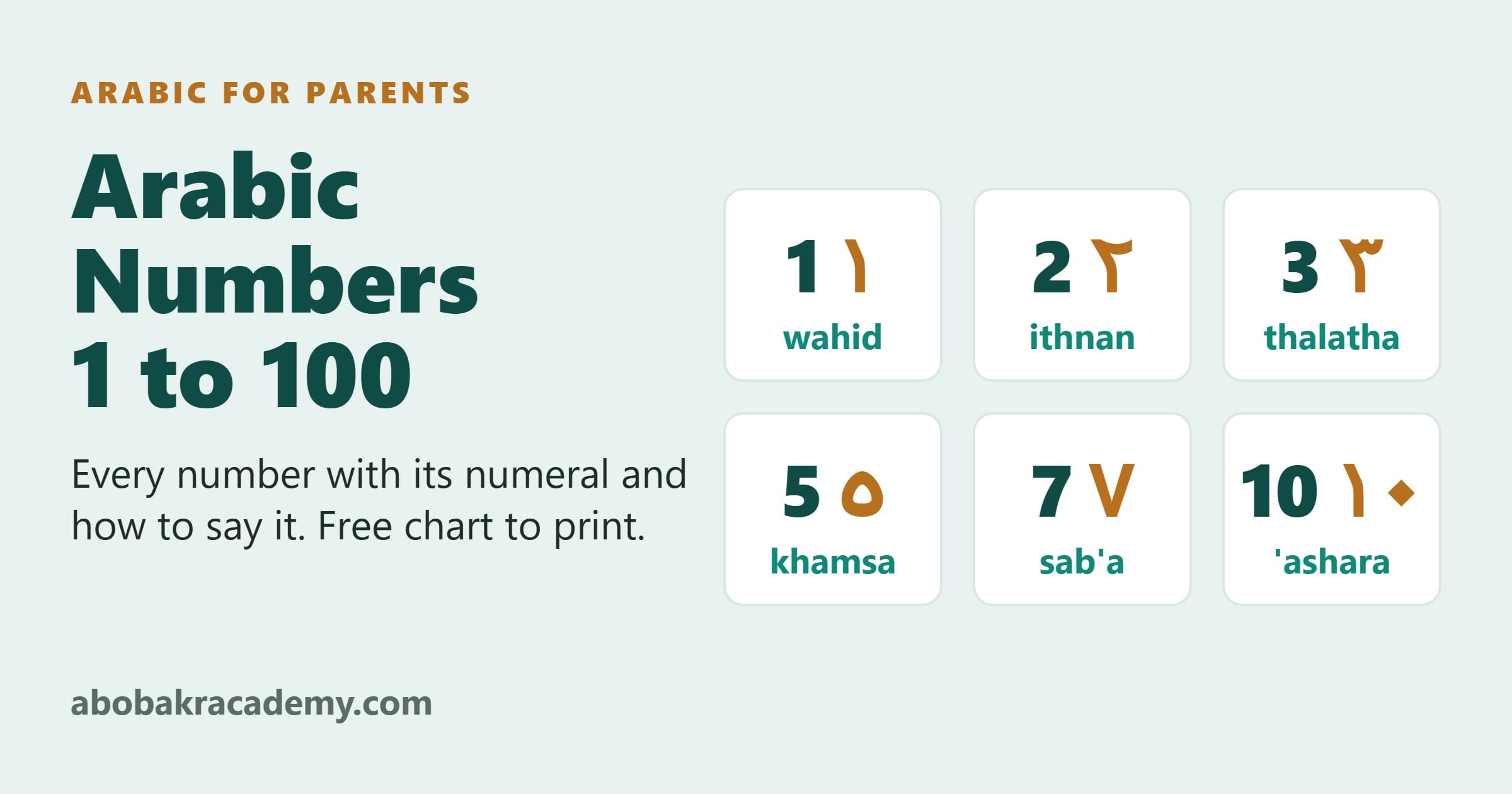
Arabic numbers from 1 to 10 are وَاحِد (wahid), اِثْنَان (ithnan), ثَلَاثَة (thalatha), أَرْبَعَة (arba’a), خَمْسَة (khamsa), سِتَّة (sitta), سَبْعَة (sab’a), ثَمَانِيَة (thamaniya), تِسْعَة (tis’a) and عَشَرَة (‘ashara). Every number up to 99 is built from those ten words plus eight tens, and the full 1 to 100 chart is below, with the Arabic numeral, the word in Arabic script and the pronunciation in separate columns.
Picture the kitchen table on a Saturday morning. Your son is lining up grapes, and his weekend-school teacher has asked him to count to twenty in Arabic by next week. You never learned. The sheet he brought home has the numbers in Arabic script only, and you can’t tell which squiggle is five.
This page is for you, not for him. Nobody at home needs to read Arabic to use it. Every row has an English pronunciation, and the sections after the chart explain the three things that confuse English speakers most: the numerals that look nothing like ours, the order Arabic says two-digit numbers in, and why “three” seems to change its ending.
How do you count from 1 to 10 in Arabic?
Start here and stay here for a week. These ten words carry everything that follows, and a child who owns them can build 11 to 99 by rule rather than by memory.
| English | Numeral | Arabic | Pronunciation | Say it like |
|---|---|---|---|---|
| 0 | ٠ | صِفْر | sifr | SIFR (one beat; it gave English the word “cipher”) |
| 1 | ١ | وَاحِد | wahid | WAA-hid, with a breathy h |
| 2 | ٢ | اِثْنَان | ithnan | ith-NAAN, “th” as in thin |
| 3 | ٣ | ثَلَاثَة | thalatha | tha-LAA-tha |
| 4 | ٤ | أَرْبَعَة | arba’a | AR-ba-a, with a catch in the throat before the last a |
| 5 | ٥ | خَمْسَة | khamsa | KHAM-sa, “kh” as in Scottish loch |
| 6 | ٦ | سِتَّة | sitta | SIT-ta, hold the double t |
| 7 | ٧ | سَبْعَة | sab’a | SAB-a, same throat catch as four |
| 8 | ٨ | ثَمَانِيَة | thamaniya | tha-MAA-ni-ya |
| 9 | ٩ | تِسْعَة | tis’a | TIS-a |
| 10 | ١٠ | عَشَرَة | ‘ashara | ‘A-sha-ra |
The apostrophe in arba’a, sab’a and ‘ashara stands for the letter ‘ayn, a squeeze at the back of the throat that English doesn’t have. Don’t let it stall you. A child who says “arba-a” with a small pause is understood everywhere, and the sound can be polished later by someone who hears it live.
One quick test you can run tonight without any Arabic: hold up fingers in random order and have your child call the number. If they have to count up from wahid to reach seven, they know the song but not the numbers. Keep going until the answer comes before the counting does.
What do Arabic numerals look like, and why are they different from ours?
The digits most of the world uses, 0 to 9, are called Arabic numerals in English, because Europe borrowed them through Arabic texts. Across much of the Arab world, though, printed Arabic uses a different set, usually called Eastern Arabic or Arabic-Indic numerals. That’s the set on your child’s worksheet, on a Middle Eastern price tag, and around every ayah in most printed copies of the Quran.
| English | Western | Eastern Arabic | Pronunciation | How to remember it |
|---|---|---|---|---|
| zero | 0 | ٠ | sifr | A small dot, not a circle |
| one | 1 | ١ | wahid | A single upright stroke, like ours |
| two | 2 | ٢ | ithnan | A stroke with one hook at the top |
| three | 3 | ٣ | thalatha | A stroke with two hooks: one more than two |
| four | 4 | ٤ | arba’a | Looks like a backwards 3 |
| five | 5 | ٥ | khamsa | A round shape. This is the one people read as zero |
| six | 6 | ٦ | sitta | A stroke with a short tail at the top left |
| seven | 7 | ٧ | sab’a | A V shape, opening upwards |
| eight | 8 | ٨ | thamaniya | The same V upside down |
| nine | 9 | ٩ | tis’a | Almost the same as ours |
The trap that catches almost every beginner is the pair at the top of the list. In Eastern Arabic, zero is a dot and five is the round one. So ٥٠ is fifty, not “zero-dot”, and a parent glancing at a page number reads it wrong for the first few weeks. Seven and eight are the other pair worth drilling, because they are the same shape turned over.
If your family reads Urdu or Persian: those languages use a slightly different set of the same digits. In Urdu, 4, 6 and 7 are drawn differently, and in Persian the differences fall on 4, 5 and 6. A grandparent who learned numbers in Urdu may write a four your child’s Arabic teacher doesn’t recognise, and both of them are right.
There’s one more surprise, and it’s a pleasant one. Arabic is written right to left, but multi-digit numbers are not reversed. The number 25 is written ٢٥, with the two on the left, exactly as in English. Only the words around it run the other way.
How do you say 11 to 19 in Arabic?
The teens are the only part of the chart that needs to be memorised as a block. Each one is two words, a unit and ‘ashar, joined without the little “and”. Eleven and twelve are irregular: ahada ‘ashar and ithna ‘ashar. From thirteen on, you take the number from the first table, add a short “-ta” sound, and put ‘ashar after it: thalathata ‘ashar, arba’ata ‘ashar, and so on up to tis’ata ‘ashar.
If your child stumbles here, that’s normal. The teens are where most children stop progressing on their own, and where a week of daily two-minute practice does more than an hour on a Sunday.
How do you say 20, 30 and the other tens?
The tens are the units with -un on the end. Three is thalatha, thirty is thalathun. Four is arba’a, forty is arba’un. The only one that doesn’t follow the pattern cleanly is twenty, ‘ishrun, which comes from the word for ten rather than the word for two.
In everyday speech, and in most children’s songs, you’ll hear these ending in -een instead: ‘ishreen, thalatheen, arba’een. That isn’t a mistake. It’s the form Arabic uses in most sentences, and it’s what nearly every spoken dialect uses all the time. Your child can learn either first. What matters is that the teacher and the worksheet agree.
Why does Arabic say “one and twenty” instead of twenty-one?
From 21 to 99, Arabic puts the unit first, then wa (and), then the ten. Twenty-one is wahid wa-‘ishrun, literally “one and twenty”. Forty-seven is sab’a wa-arba’un, “seven and forty”. If that sounds odd, older English did the same thing, which is why a nursery rhyme can still have “four and twenty blackbirds”.
This is the single rule that opens up the whole chart. Once your child has the ten units and the eight tens, there are no new words between 21 and 99. Say a number in English, reverse the two halves, put wa in the middle, and you have the Arabic.
Here is a game that uses exactly that. Roll two dice. The first die is the unit and the second is the ten. A four and a three is arba’a wa-thalathun, thirty-four. Your child says it in Arabic, you check it against the chart below, and nobody at the table needs to know any Arabic for the check to work.
The full chart: Arabic numbers 1 to 100
Free, no email needed. Prints on two pages.
| Number | Numeral | Arabic | Pronunciation |
|---|---|---|---|
| 1 | ١ | وَاحِد | wahid |
| 2 | ٢ | اِثْنَان | ithnan |
| 3 | ٣ | ثَلَاثَة | thalatha |
| 4 | ٤ | أَرْبَعَة | arba’a |
| 5 | ٥ | خَمْسَة | khamsa |
| 6 | ٦ | سِتَّة | sitta |
| 7 | ٧ | سَبْعَة | sab’a |
| 8 | ٨ | ثَمَانِيَة | thamaniya |
| 9 | ٩ | تِسْعَة | tis’a |
| 10 | ١٠ | عَشَرَة | ‘ashara |
| 11 | ١١ | أَحَدَ عَشَرَ | ahada ‘ashar |
| 12 | ١٢ | اِثْنَا عَشَرَ | ithna ‘ashar |
| 13 | ١٣ | ثَلَاثَةَ عَشَرَ | thalathata ‘ashar |
| 14 | ١٤ | أَرْبَعَةَ عَشَرَ | arba’ata ‘ashar |
| 15 | ١٥ | خَمْسَةَ عَشَرَ | khamsata ‘ashar |
| 16 | ١٦ | سِتَّةَ عَشَرَ | sittata ‘ashar |
| 17 | ١٧ | سَبْعَةَ عَشَرَ | sab’ata ‘ashar |
| 18 | ١٨ | ثَمَانِيَةَ عَشَرَ | thamaniyata ‘ashar |
| 19 | ١٩ | تِسْعَةَ عَشَرَ | tis’ata ‘ashar |
| 20 | ٢٠ | عِشْرُون | ‘ishrun |
| 21 | ٢١ | وَاحِد وَعِشْرُون | wahid wa-‘ishrun |
| 22 | ٢٢ | اِثْنَان وَعِشْرُون | ithnan wa-‘ishrun |
| 23 | ٢٣ | ثَلَاثَة وَعِشْرُون | thalatha wa-‘ishrun |
| 24 | ٢٤ | أَرْبَعَة وَعِشْرُون | arba’a wa-‘ishrun |
| 25 | ٢٥ | خَمْسَة وَعِشْرُون | khamsa wa-‘ishrun |
| 26 | ٢٦ | سِتَّة وَعِشْرُون | sitta wa-‘ishrun |
| 27 | ٢٧ | سَبْعَة وَعِشْرُون | sab’a wa-‘ishrun |
| 28 | ٢٨ | ثَمَانِيَة وَعِشْرُون | thamaniya wa-‘ishrun |
| 29 | ٢٩ | تِسْعَة وَعِشْرُون | tis’a wa-‘ishrun |
| 30 | ٣٠ | ثَلَاثُون | thalathun |
| 31 | ٣١ | وَاحِد وَثَلَاثُون | wahid wa-thalathun |
| 32 | ٣٢ | اِثْنَان وَثَلَاثُون | ithnan wa-thalathun |
| 33 | ٣٣ | ثَلَاثَة وَثَلَاثُون | thalatha wa-thalathun |
| 34 | ٣٤ | أَرْبَعَة وَثَلَاثُون | arba’a wa-thalathun |
| 35 | ٣٥ | خَمْسَة وَثَلَاثُون | khamsa wa-thalathun |
| 36 | ٣٦ | سِتَّة وَثَلَاثُون | sitta wa-thalathun |
| 37 | ٣٧ | سَبْعَة وَثَلَاثُون | sab’a wa-thalathun |
| 38 | ٣٨ | ثَمَانِيَة وَثَلَاثُون | thamaniya wa-thalathun |
| 39 | ٣٩ | تِسْعَة وَثَلَاثُون | tis’a wa-thalathun |
| 40 | ٤٠ | أَرْبَعُون | arba’un |
| 41 | ٤١ | وَاحِد وَأَرْبَعُون | wahid wa-arba’un |
| 42 | ٤٢ | اِثْنَان وَأَرْبَعُون | ithnan wa-arba’un |
| 43 | ٤٣ | ثَلَاثَة وَأَرْبَعُون | thalatha wa-arba’un |
| 44 | ٤٤ | أَرْبَعَة وَأَرْبَعُون | arba’a wa-arba’un |
| 45 | ٤٥ | خَمْسَة وَأَرْبَعُون | khamsa wa-arba’un |
| 46 | ٤٦ | سِتَّة وَأَرْبَعُون | sitta wa-arba’un |
| 47 | ٤٧ | سَبْعَة وَأَرْبَعُون | sab’a wa-arba’un |
| 48 | ٤٨ | ثَمَانِيَة وَأَرْبَعُون | thamaniya wa-arba’un |
| 49 | ٤٩ | تِسْعَة وَأَرْبَعُون | tis’a wa-arba’un |
| 50 | ٥٠ | خَمْسُون | khamsun |
| 51 | ٥١ | وَاحِد وَخَمْسُون | wahid wa-khamsun |
| 52 | ٥٢ | اِثْنَان وَخَمْسُون | ithnan wa-khamsun |
| 53 | ٥٣ | ثَلَاثَة وَخَمْسُون | thalatha wa-khamsun |
| 54 | ٥٤ | أَرْبَعَة وَخَمْسُون | arba’a wa-khamsun |
| 55 | ٥٥ | خَمْسَة وَخَمْسُون | khamsa wa-khamsun |
| 56 | ٥٦ | سِتَّة وَخَمْسُون | sitta wa-khamsun |
| 57 | ٥٧ | سَبْعَة وَخَمْسُون | sab’a wa-khamsun |
| 58 | ٥٨ | ثَمَانِيَة وَخَمْسُون | thamaniya wa-khamsun |
| 59 | ٥٩ | تِسْعَة وَخَمْسُون | tis’a wa-khamsun |
| 60 | ٦٠ | سِتُّون | sittun |
| 61 | ٦١ | وَاحِد وَسِتُّون | wahid wa-sittun |
| 62 | ٦٢ | اِثْنَان وَسِتُّون | ithnan wa-sittun |
| 63 | ٦٣ | ثَلَاثَة وَسِتُّون | thalatha wa-sittun |
| 64 | ٦٤ | أَرْبَعَة وَسِتُّون | arba’a wa-sittun |
| 65 | ٦٥ | خَمْسَة وَسِتُّون | khamsa wa-sittun |
| 66 | ٦٦ | سِتَّة وَسِتُّون | sitta wa-sittun |
| 67 | ٦٧ | سَبْعَة وَسِتُّون | sab’a wa-sittun |
| 68 | ٦٨ | ثَمَانِيَة وَسِتُّون | thamaniya wa-sittun |
| 69 | ٦٩ | تِسْعَة وَسِتُّون | tis’a wa-sittun |
| 70 | ٧٠ | سَبْعُون | sab’un |
| 71 | ٧١ | وَاحِد وَسَبْعُون | wahid wa-sab’un |
| 72 | ٧٢ | اِثْنَان وَسَبْعُون | ithnan wa-sab’un |
| 73 | ٧٣ | ثَلَاثَة وَسَبْعُون | thalatha wa-sab’un |
| 74 | ٧٤ | أَرْبَعَة وَسَبْعُون | arba’a wa-sab’un |
| 75 | ٧٥ | خَمْسَة وَسَبْعُون | khamsa wa-sab’un |
| 76 | ٧٦ | سِتَّة وَسَبْعُون | sitta wa-sab’un |
| 77 | ٧٧ | سَبْعَة وَسَبْعُون | sab’a wa-sab’un |
| 78 | ٧٨ | ثَمَانِيَة وَسَبْعُون | thamaniya wa-sab’un |
| 79 | ٧٩ | تِسْعَة وَسَبْعُون | tis’a wa-sab’un |
| 80 | ٨٠ | ثَمَانُون | thamanun |
| 81 | ٨١ | وَاحِد وَثَمَانُون | wahid wa-thamanun |
| 82 | ٨٢ | اِثْنَان وَثَمَانُون | ithnan wa-thamanun |
| 83 | ٨٣ | ثَلَاثَة وَثَمَانُون | thalatha wa-thamanun |
| 84 | ٨٤ | أَرْبَعَة وَثَمَانُون | arba’a wa-thamanun |
| 85 | ٨٥ | خَمْسَة وَثَمَانُون | khamsa wa-thamanun |
| 86 | ٨٦ | سِتَّة وَثَمَانُون | sitta wa-thamanun |
| 87 | ٨٧ | سَبْعَة وَثَمَانُون | sab’a wa-thamanun |
| 88 | ٨٨ | ثَمَانِيَة وَثَمَانُون | thamaniya wa-thamanun |
| 89 | ٨٩ | تِسْعَة وَثَمَانُون | tis’a wa-thamanun |
| 90 | ٩٠ | تِسْعُون | tis’un |
| 91 | ٩١ | وَاحِد وَتِسْعُون | wahid wa-tis’un |
| 92 | ٩٢ | اِثْنَان وَتِسْعُون | ithnan wa-tis’un |
| 93 | ٩٣ | ثَلَاثَة وَتِسْعُون | thalatha wa-tis’un |
| 94 | ٩٤ | أَرْبَعَة وَتِسْعُون | arba’a wa-tis’un |
| 95 | ٩٥ | خَمْسَة وَتِسْعُون | khamsa wa-tis’un |
| 96 | ٩٦ | سِتَّة وَتِسْعُون | sitta wa-tis’un |
| 97 | ٩٧ | سَبْعَة وَتِسْعُون | sab’a wa-tis’un |
| 98 | ٩٨ | ثَمَانِيَة وَتِسْعُون | thamaniya wa-tis’un |
| 99 | ٩٩ | تِسْعَة وَتِسْعُون | tis’a wa-tis’un |
| 100 | ١٠٠ | مِئَة | mi’a |
The chart uses the formal endings throughout so it matches a textbook. If your child’s teacher says ‘ishreen where the chart says ‘ishrun, both are correct, as explained above.
What comes after 100?
Most weekend-school worksheets stop at a hundred, but page numbers and years don’t, so the next handful are worth having.
| English | Numeral | Arabic | Pronunciation | Pattern |
|---|---|---|---|---|
| 100 | ١٠٠ | مِئَة | mi’a | Also spelled مائة, same word |
| 101 | ١٠١ | مِئَة وَوَاحِد | mi’a wa-wahid | Hundreds come first, then “and” |
| 125 | ١٢٥ | مِئَة وَخَمْسَة وَعِشْرُون | mi’a wa-khamsa wa-‘ishrun | Hundred, then “five and twenty” |
| 200 | ٢٠٠ | مِئَتَان | mi’atan | Arabic has a special “pair of” form |
| 300 | ٣٠٠ | ثَلَاثُمِئَة | thalathu mi’a | Unit plus mi’a, often written as one word |
| 500 | ٥٠٠ | خَمْسُمِئَة | khamsu mi’a | Same pattern |
| 1,000 | ١٠٠٠ | أَلْف | alf | A new word |
| 2,000 | ٢٠٠٠ | أَلْفَان | alfan | The “pair of” form again |
Notice that once you pass a hundred, the order flips back to what English speakers expect: the biggest part comes first. Only the last two digits keep the “one and twenty” order.
Why does “three” sometimes lose its ending?
This is the part to understand rather than drill. When Arabic counts actual things, the numbers 3 to 10 do something that looks backwards: with a masculine noun they keep their -a ending, and with a feminine noun they drop it. So three pens is ثَلَاثَةُ أَقْلَام (thalathatu aqlam), but three girls is ثَلَاثُ بَنَات (thalathu banat).
There’s more to it. After 3 to 10 the thing counted goes into the plural, while from 11 to 99 it goes back to the singular, so “thirty students” is literally “thirty student”. A child learning to count doesn’t need any of this yet. It matters when your child starts reading sentences, and it’s the kind of thing a tutor explains in five minutes with the child’s own examples. If a worksheet shows thalath without the ending, now you know why, and you don’t need to correct it.
Where will your child see Arabic numbers in the Quran?
Open most printed copies of the Quran and you’ll find a small ornamented circle at the end of every verse with a number inside it. Those numbers are Eastern Arabic numerals. It is the most practical reason for a Muslim child to learn them: it’s how you find your place.
Try it together. Ayat al-Kursi is the 255th ayah of Surah al-Baqarah, so ask your child to find the marker reading ٢٥٥ (you can check the verse on quran.com). Or turn to Surah al-Ikhlas, surah number ١١٢, and have them read the four ayah markers aloud in Arabic. A child working through our list of short surahs to memorize can say the surah’s number in Arabic each time they start one, which is two skills practised in one breath.
The same markers sit beside the stopping signs covered in our guide to the small signs above the Quran text, so a child who can read both knows exactly where they are on the page and where to pause.
How long does it take a child to learn Arabic numbers?
It depends far more on how often you practise than on age, so we won’t give you a number of weeks. What we can say is where the time goes. The first ten come quickly. The teens take longest, because they are the only block that has to be memorised. And the jump from 20 to 99 is usually fast, because it’s one rule rather than eighty new words.
The honest trade-off: an app will drill numbers perfectly well, and for this particular skill it may be all your child needs. Where a teacher earns their place is the pronunciation. An app can’t hear that your daughter is saying “arba” with no ‘ayn, and she will keep saying it that way for years if nobody does.
Common questions
Are Arabic numerals the same as the numbers we use?
Partly. The digits 0 to 9 used in English are called Arabic numerals and came to Europe through Arabic. But printed Arabic today usually uses a different set, the Eastern Arabic numerals shown above, where zero is a dot and five is round.
Do you read Arabic numbers right to left?
No. Arabic words run right to left, but a multi-digit number is written with its largest place on the left, just as in English. The number 47 is written ٤٧.
How do you say 21 in Arabic?
Twenty-one is wahid wa-‘ishrun, literally “one and twenty”. Every number from 21 to 99 puts the unit first, then wa, then the ten.
Is Egyptian Arabic counting different?
A little. In Egyptian Arabic the “th” sound usually becomes “t”, so three is talata and two is itnen, and the tens end in -een. The pattern and the order are the same, so a child who learns one can follow the other.
Should my child learn Arabic numbers before the alphabet?
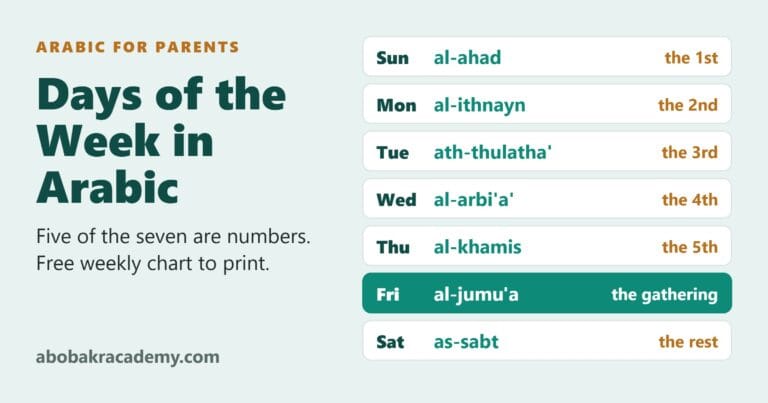
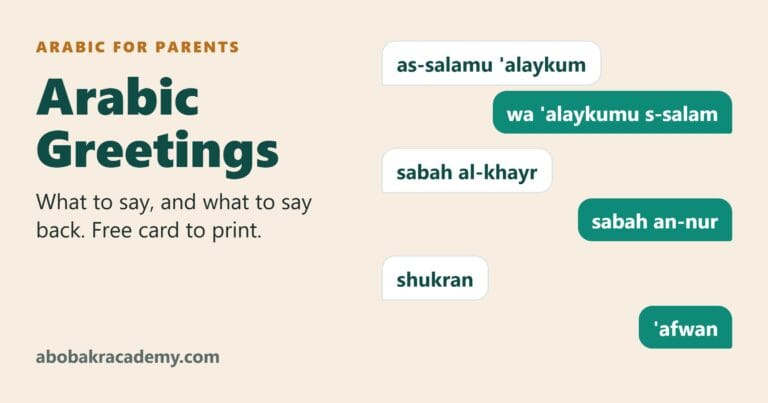
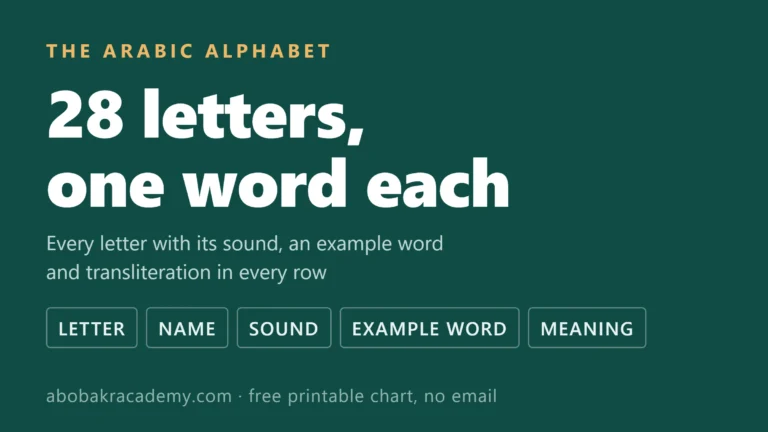
They can be learned side by side. Numbers are a good early win because the chart is short and progress is easy to see, and our free Arabic alphabet chart covers the letters when you’re ready for them. Once counting is solid, everyday Arabic greetings are the natural next step, and the first five numbers turn up again in the days of the week in Arabic.
Print the chart above and stick it where the counting happens. If you’d like a tutor to listen to your child count and fix the sounds an app can’t hear, you can book a free trial lesson, and we’ll tell you straight if the chart on the fridge is all they need for now. Here’s how lessons work if you want to see that first.