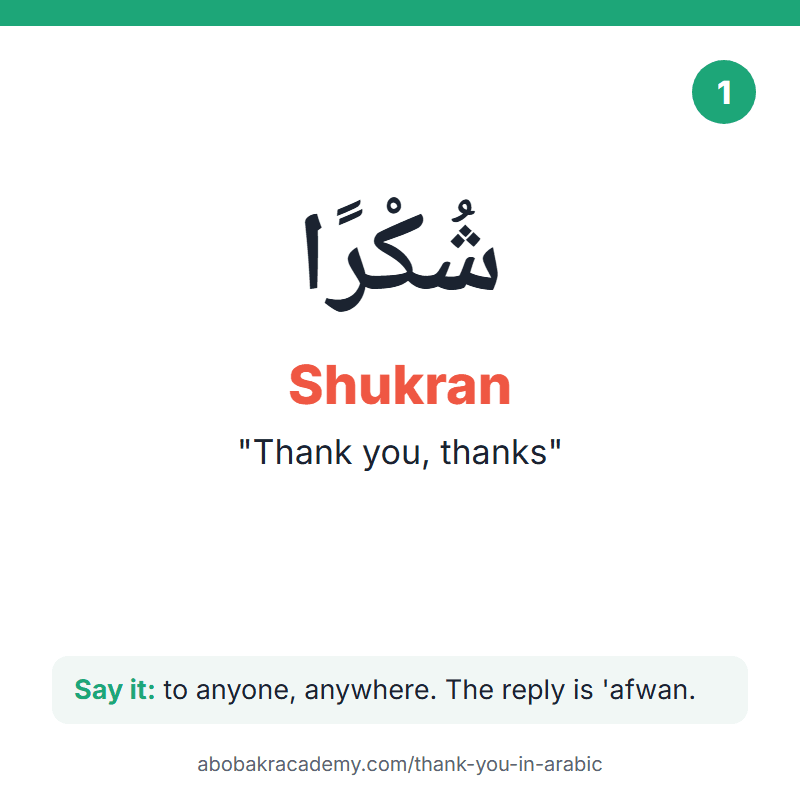
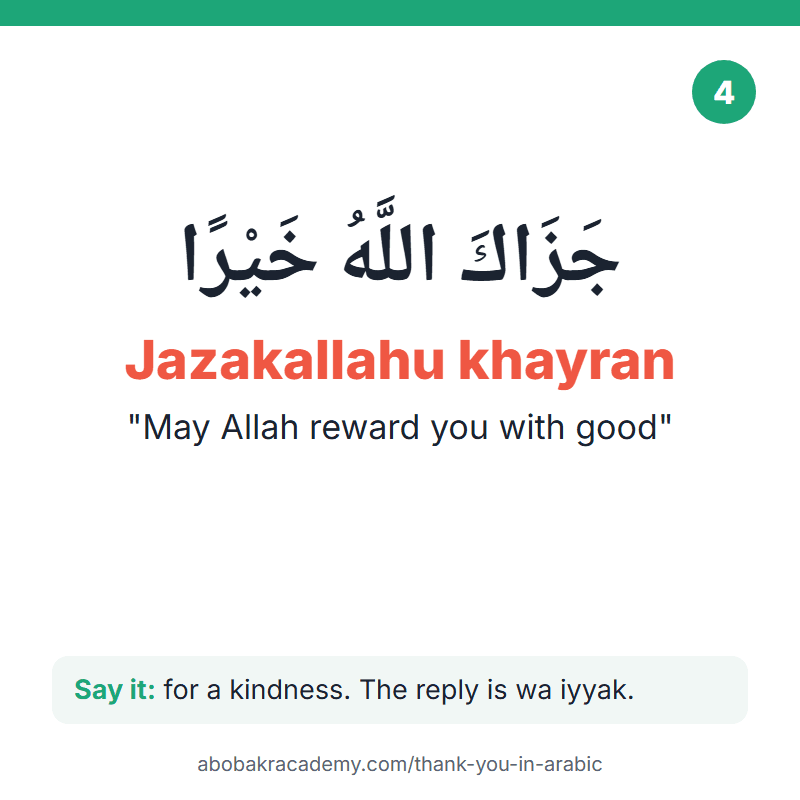
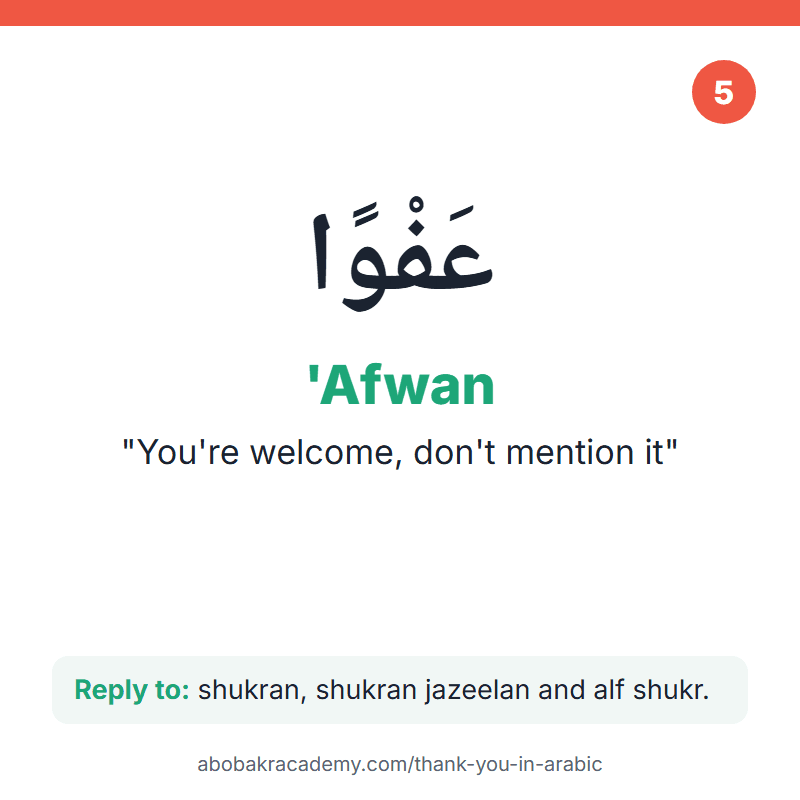
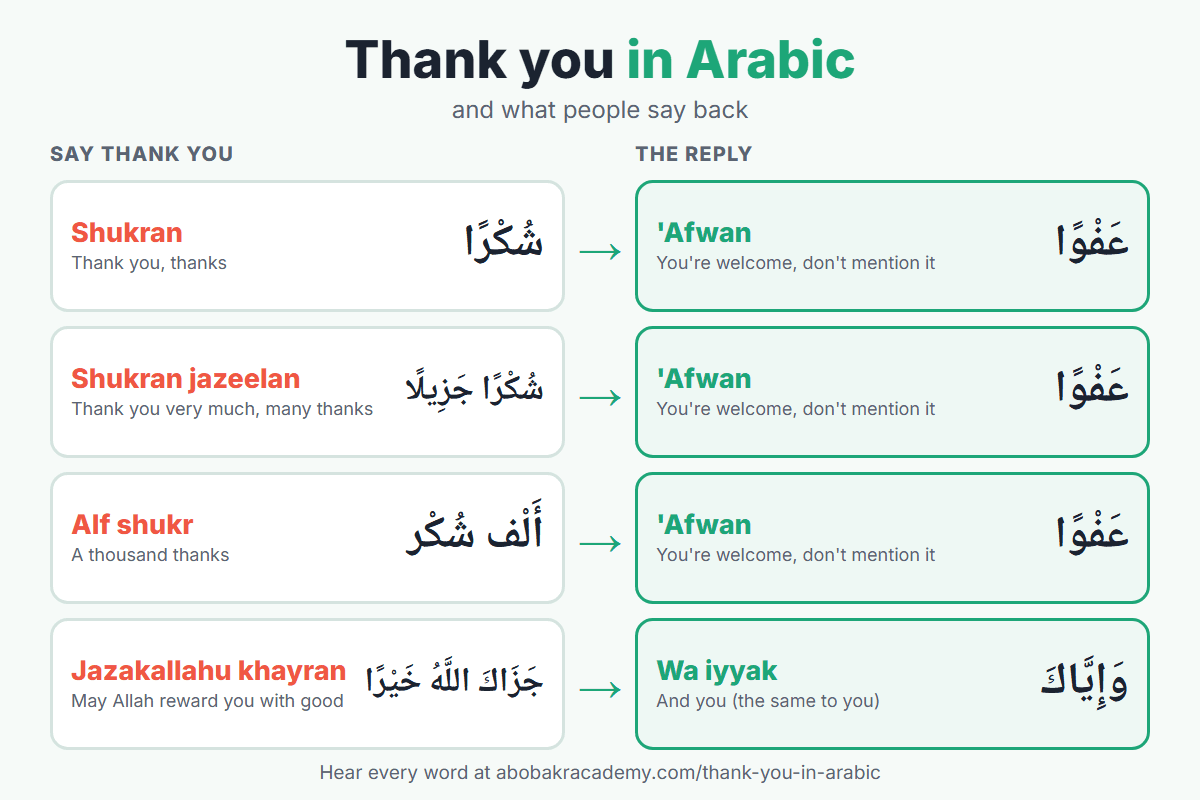
Thank you in Arabic is shukran (شُكْرًا), said shook-ran. It works anywhere and with anyone, and the reply is ‘afwan (عَفْوًا), “you’re welcome”. To say thank you very much, say shukran jazeelan. Muslims also thank each other with jazakallahu khayran, “may Allah reward you with good”, and the reply to that is wa iyyak, “and you”.
Below are the 6 ways to say thank you you will hear most, the replies to each, which words change for a girl or a group, the dialect forms, and free thank-you cards and a printable with no sign-up. Every way to say thank you and every reply written in Arabic has a button to hear it.
How to say thank you in Arabic
Tap the button beside the Arabic to hear it said slowly. The last column is what people say back.
| Say | Arabic | Meaning | When | Reply |
|---|---|---|---|---|
| Shukran | شُكْرًا | Thank you, thanks. | Anywhere, to anyone: a shop, a friend, a teacher, your mother passing the bread. | ‘Afwan |
| Shukran jazeelan | شُكْرًا جَزِيلًا | Thank you very much, many thanks. | When someone has gone out of their way for you. | ‘Afwan |
| Alf shukr | أَلْف شُكْر | A thousand thanks. | Warm and everyday, between family and friends, the way English says thanks a million. | ‘Afwan |
| Jazakallahu khayran | جَزَاكَ اللَّهُ خَيْرًا | May Allah reward you with good. | The thank-you of Muslims everywhere, in any language: for a kindness, a gift, a lift, help with homework. | Wa iyyak |
| Mashkoor to a woman: mashkoora | مَشْكُور | Literally "thanked": you are thanked, much obliged. | Heard in the Gulf and the Levant, often to someone who has done a job for you. | Al-‘afw |
| Mamnoon a woman says: mamnoona | مَمْنُون | Grateful, obliged: I owe you one. | Said by the person giving thanks: a man says mamnoon, a woman mamnoona. | ‘Afwan |
If you learn one, learn shukran: every Arabic speaker understands it, in every country. Shukran jazeelan is the same thanks with more weight, for when someone has gone out of their way. Mashkoor and mamnoon are what you will hear in the street in the Gulf, the Levant and Egypt rather than in a classroom, and both change for a woman: you say mashkoora to a woman you are thanking, and a woman thanking you says mamnoona.
How to reply to shukran
The everyday reply is ‘afwan. These are the replies you will hear, starting with the one to learn first.
| Reply | Arabic | Meaning | When |
|---|---|---|---|
| ‘Afwan | عَفْوًا | You’re welcome, don’t mention it. | The everyday reply to shukran. It also means "excuse me" or "pardon?", so you will hear it when someone did not catch what you said. |
| Al-‘afw | الْعَفْو | You’re welcome (literally "the pardon": no need to thank me). | A little more formal than ‘afwan, and common in the Gulf. |
| Wa iyyak | وَإِيَّاكَ | And you (the same to you). | The usual reply to jazakallahu khayran: may Allah reward you too. Wa iyyaki to a woman or girl, wa iyyakum to more than one. A fuller reply is wa antum fa jazakumullahu khayran, "and you, may Allah reward you with good". Neither reply comes from a hadith; both are common, and any kind reply is fine. |
| La shukra ‘ala wajib | (spoken form) | No thanks are needed for a duty: it was the least I could do. | A polite, slightly formal reply, often from someone helping a guest or an older person. |
| Ahlan wa sahlan | (spoken form) | You’re most welcome (it is also the Arabic welcome to a guest). | A warm reply, especially when you have hosted someone. |
What do Muslims say after thank you?
Many Muslims, in Arabic and in English, say jazakallahu khayran instead of thank you, or right after it: “Thank you, jazakallahu khayran.” It is a du’a: you ask Allah to reward the person with good, which is more than you could give them yourself.
جَزَاكَ اللَّهُ خَيْرًا
The Prophet ﷺ said that whoever is done a kindness and says jazakallahu khayran to the one who did it has praised them in full (Jami` at-Tirmidhi 2035, graded hasan by Darussalam). Our Islamic phrases page has it beside the other phrases a Muslim child hears every day.
Why thanking people matters in Islam
Thanking people is part of thanking Allah. The Prophet ﷺ said:
لاَ يَشْكُرُ اللَّهَ مَنْ لاَ يَشْكُرُ النَّاسَ
“He who does not thank the people is not thankful to Allah.” (Sunan Abi Dawud 4811, graded sahih by Al-Albani)
And Allah says in the Quran: لَئِن شَكَرْتُمْ لَأَزِيدَنَّكُمْ, “If you are grateful, I will surely increase you” (Ibrahim 14:7).
Shakartum, “you are grateful”, and shukran share one root, sh-k-r. Each time a child says shukran, they are using the word the Quran uses for gratitude.
Thank you to a boy, a girl or a group
Shukran never changes. You say it the same way to anyone. A few of the other phrases do change:
| Phrase | To a man or boy | To a woman or girl | To a group | Note |
|---|---|---|---|---|
| Shukran | shukran | shukran | shukran | Never changes |
| Jazakallahu khayran | jazakallahu khayran | jazakillahu khayran | jazakumullahu khayran | Jazaka, jazaki, jazakum |
| Wa iyyak | wa iyyak | wa iyyaki وَإِيَّاكِ | wa iyyakum | The reply to jazakallahu khayran |
| Mashkoor | mashkoor | mashkoora مَشْكُورَة | mashkooreen | Said to the person you thank |
Many people say jazakallahu khayran and wa iyyak to everyone, and that is understood. The forms above are what careful speakers use.
Thank you in Arabic dialects
Shukran is understood everywhere. In daily speech you will also hear these, which change from country to country. They are spoken forms, so they are given here as you hear them rather than in Arabic script.
- Teslam to a man and teslami to a woman, "may you be kept safe", all over the Levant and the Gulf.
- Ya’teek al-‘afya, "may God give you strength", in the Levant, said to someone who is working.
- Kattar khayrak, "may your good increase", in the Levant.
- Mersi, from the French merci, in Egypt, Lebanon and North Africa.
Thank-you cards to print
Six cards: four ways to say thank you and the two replies children need first. Each has the Arabic, how to say it and what it means. They are in the printable too, so you can cut them out and stick shukran on the fridge this week.



Free printable: thank you in Arabic (PDF)
Download the thank you in Arabic printable (PDF, 3 pages). No email and no sign-up. It has:
- a chart of the four ways to say thank you with the reply to each;
- the six cards, to cut out;
- a table of every phrase on this page, the replies and the forms for a girl or a group.
Teaching children to say thank you when nobody at home reads Arabic
This site is built for families where nobody at home reads Arabic, and these words need none: they are learnt by ear. Pick one moment that happens every day, such as passing food at dinner, and make shukran and ‘afwan the rule there. Play the button once so everyone hears it, then say it every time. After a week the children will be saying it to you.
Once shukran is easy, add jazakallahu khayran for bigger kindnesses: a gift, a grandparent’s visit, help with homework. Children like that it has a reply, and wa iyyak is easy to say. When your child is ready to read the Arabic itself, our teachers start from the letters and explain everything in English. See Arabic lessons for kids; the first lesson is free. If you want to start on reading at home first, the Arabic alphabet with words gives a word a child knows for every letter.
Shukran, habibi and the replies: what people ask
Can I say shukran?
Yes. Shukran is the ordinary Arabic word for thank you, and Arabic speakers of every faith use it. Anyone may say it, and it is always polite. You do not need to change it for a man, a woman or a group.
What does shukran mean?
Shukran means “thank you” or “thanks”. It comes from shukr, gratitude, from the same root the Quran uses for being grateful to Allah.
How do I reply to shukran?
Say ‘afwan, “you’re welcome”. Al-‘afw is a little more formal, and la shukra ‘ala wajib means “no thanks are needed for a duty”.
What is the reply to “shukran habibi”?
Shukran habibi means “thanks, my dear” (habibi to a man or boy, habibti to a woman or girl). The reply is the same as to shukran: ‘afwan, or ‘afwan habibi back.
How do you reply to jazakallahu khayran?
Say wa iyyak, “and you”, or the fuller wa antum fa jazakumullahu khayran, “and you, may Allah reward you with good”. Neither reply comes from a hadith, so any kind reply is fine.
How do you spell shukran?
Shukran is the usual English spelling. You will also see shokran and shukraan. They are all the same word, شُكْرًا.
More words and phrases to learn together
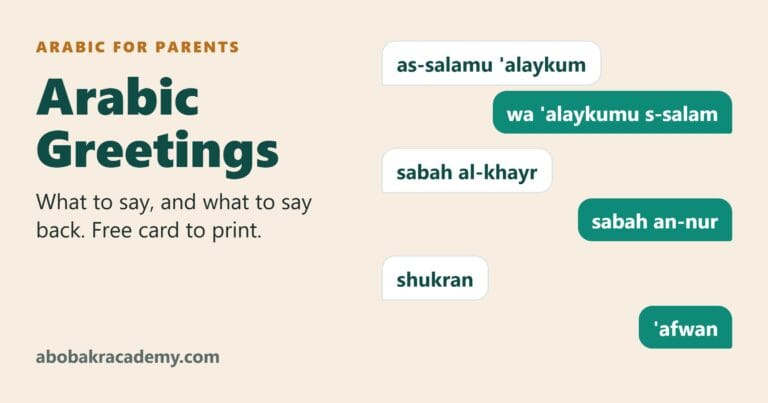
- Arabic greetings: the salam, good morning, good night and the reply to each.
- Islamic phrases: bismillah, in sha Allah, masha Allah and the rest, with when to say each.
- Daily duas for kids: the du’as a child learns first, from waking up to going to sleep.
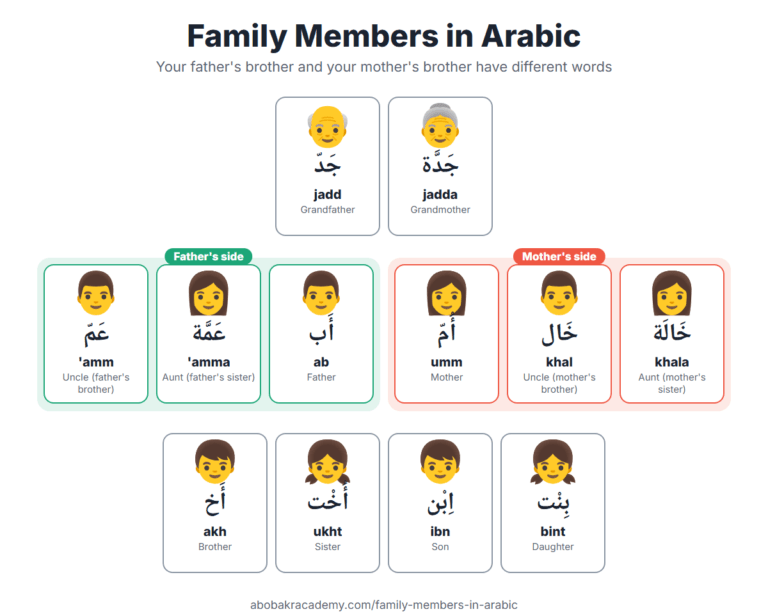
- Family members in Arabic: who to thank at home, in Arabic.
- Free printables: more charts and worksheets for Muslim children.