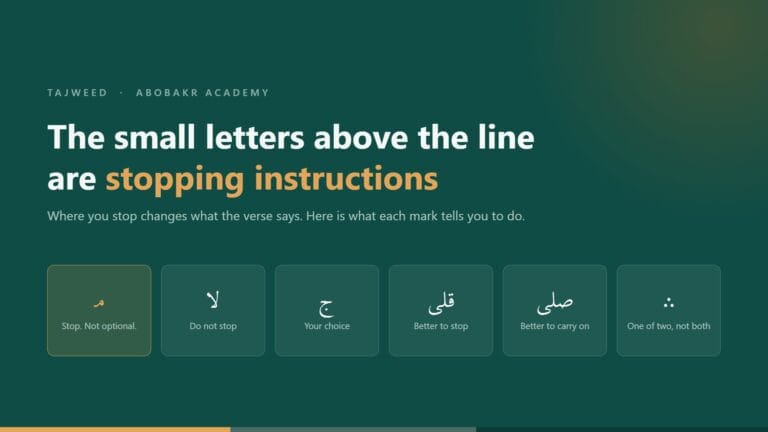
Reading the Quran with tajweed means saying every letter from its proper place, with its proper qualities, and applying the rules for how letters meet: the nasal ghunnah, the lengths of madd, the four rules of noon sakinah, the bounce of qalqalah, and where to stop.
The way in is the same for nearly everyone. Learn the letters and short vowels first. Then read from a colour-coded tajweed mushaf, where each colour marks a rule (the Tajweed Mushaf on Quran.com is free). Listen to a slow reciter and copy him line by line, and recite to a teacher who can stop you at the word. One verse below shows seven rules in colour, with a recording to follow along.
Most people who struggle with tajweed do not have a knowledge problem. They can name the rules of nun sakinah, spot a madd, explain what ikhfa means when asked. Then they open the mushaf, begin reciting, and almost none of it makes it onto the page. The sun and moon letters are the clearest case of it: a reader can name all 28 and still say al-shams the moment a real page is in front of them.
That gap is normal, and another article on the rules will not close it. Practice closes it: a way of working through real pages until the rules happen without you having to think about them.
Knowing the rules and reading with them are two different skills
Naming a rule is a fact you can produce when asked. Applying it is closer to a motor habit, and it has to happen while you are also decoding unfamiliar letter shapes, tracking where the sentence ends, managing your breath, and holding some attention on the meaning.
Under that much simultaneous load, the newest and least automatic skill drops first. For a student six months into tajweed, that skill is tajweed. It is why a learner can score full marks on a written rules test and then recite a page with flat, ruleless pronunciation ten minutes later.
So when recitation falls apart, learning more rules rarely helps. What helps is applying the few you know to far more text, far more slowly, out loud, in front of someone who will stop you.
Start slower than feels natural
Classical recitation recognises three speeds. Tahqiq is deliberate and unhurried, the pace used for teaching and correction. Tadwir sits in the middle. Hadr is quick, and it belongs to reciters who have already made the rules automatic.
Nearly every beginner reaches for hadr. It is the speed they hear in the recordings on their phone, so it becomes the target without anyone deciding it should be. At that pace there is no room to choose anything. A madd needs a length decision. An ikhfa needs a decision. If the word has left your mouth before you register it, knowing the rule changes nothing.
Reciting at tahqiq feels absurdly slow at first, close to one word at a time. That slowness gives you the half second you need to remember a rule and apply it. The speed comes back by itself once the rules no longer need thinking about.
A practice loop for one page of the mushaf
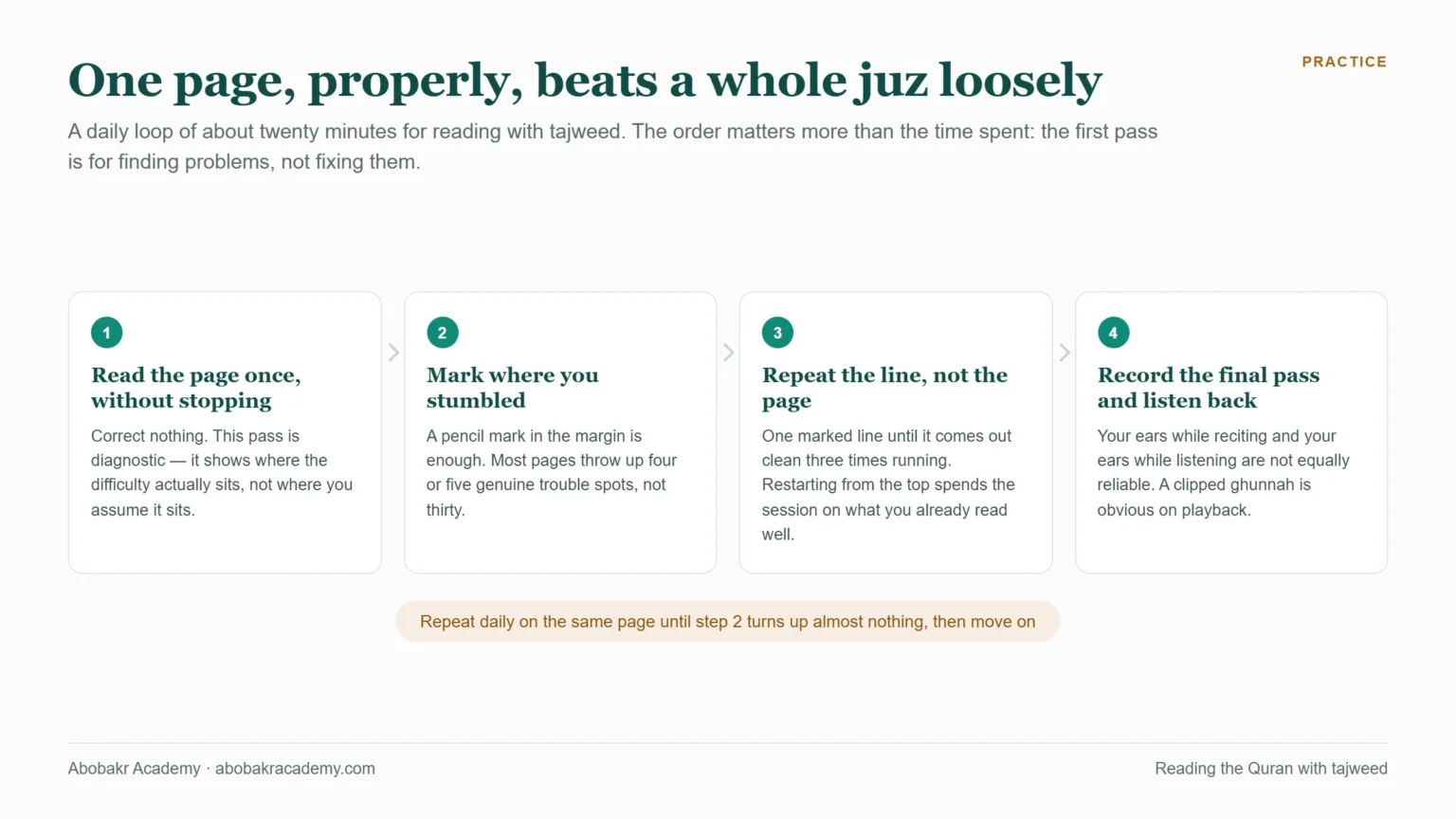
Working loosely through a whole juz achieves less than working through a single page properly. The loop below takes roughly twenty minutes and is meant to repeat daily.
Read the page once without stopping
Correct nothing on this pass. You are finding out where the trouble is, and it is often not where you expected.
Mark the places you stumbled
A light pencil mark in the margin works, or a note of the ayah numbers on your phone. Most pages throw up four or five genuine trouble spots, not thirty.
Repeat the line, not the page
Take one marked line and recite it until it comes out clean three times in a row, then move to the next. Restarting the full page from the top after every mistake spends most of the session on the parts you were already reading well.
Record the final pass and listen back
Your ears while reciting and your ears while listening are not equally reliable. A clipped ghunnah or a shortened madd is obvious in playback and nearly invisible in the moment. A voice memo on your phone is enough.
Colour-coded mushafs help until they stop helping
A mushaf that shades ikhfa in one colour and idgham in another is a reasonable scaffold early on. It shortens the distance between seeing a letter and knowing what to do with it. Two good ones cost nothing: the Tajweed Mushaf view on Quran.com and the Tajweed mushaf on QuranFlash, which turns pages like a printed copy.
The catch shows up after a few months, when some students stop applying rules and start reading colours. They have learned the colours rather than the rules, and it shows the moment they pick up a plain mushaf, open an app without shading, or stand in salah reciting from memory.
To check, take a page you have drilled in a colour-coded mushaf, leave it a week, then recite the same page from a plain one. What you still get right, you have learned.
One verse, seven rules, heard
This is what a colour-coded mushaf is showing you, on one verse. Al-Fajr 89:23 packs seven tajweed rules into nine words. The colours are Quran.com’s own tajweed markup, and the recording is Sheikh Mahmoud Khalil al-Husary’s teaching recitation (al-Mu’allim), read slowly so a learner can repeat it. Play it once while watching the colours, then once with your eyes on the list.
وَجِاْىٓءَ يَوْمَئِذِۭ بِجَهَنَّمَۚ يَوْمَئِذٍ يَتَذَكَّرُ ٱلْإِنسَـٰنُ وَأَنَّىٰ لَهُ ٱلذِّكْرَىٰ
And brought [within view], that Day, is Hell, that Day, man will remember, but how [i.e., what good] to him will be the remembrance? (Al-Fajr 89:23)
- Obligatory madd ىٓ: A long vowel before a hamza in the same word, stretched to four or five counts.
- Iqlab ذِۭ ب: The tanween before b turns into a meem sound, lips closed, with a two-count hum.
- Ghunnah نّ: A doubled noon or meem, hummed through the nose for two counts.
- Idgham with ghunnah ذٍ ي: The noon sound of the tanween is not said; it merges into the next letter with a two-count hum.
- Ikhfa نس: The noon is hidden: the tongue does not settle on it, and a two-count hum carries into the next letter.
- Natural madd ـٰ: A plain long vowel, two counts.
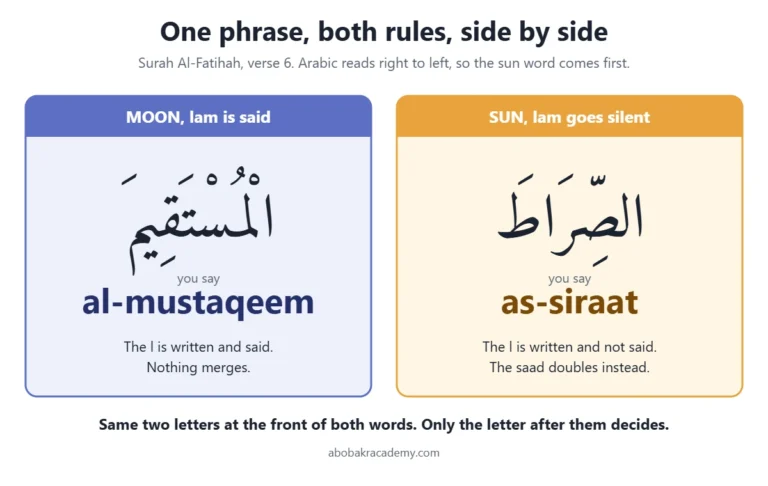
- Sun-letter lam ل: The l of al- is written but not said; the next letter is doubled instead.
Letters in light grey are written but not pronounced. You do not need to memorise the colours. What the exercise trains is noticing, before a word leaves your mouth, that a rule applies there.
What breaks first when you speed up
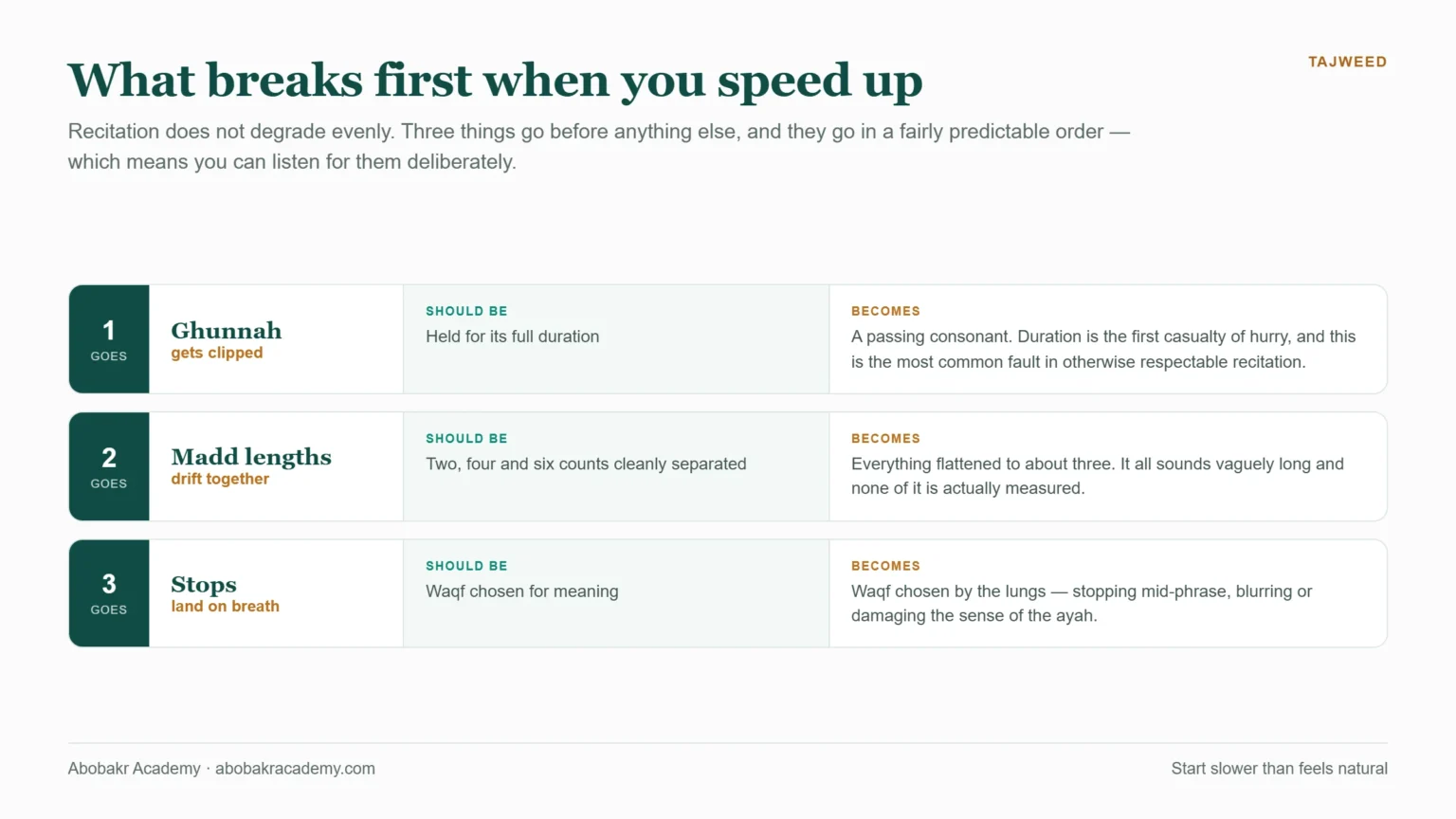
When you speed up, three things usually go first, in roughly this order.
Ghunnah gets clipped
The nasal sound has a length, and length is the first thing to go when you hurry. A ghunnah that should be held turns into a passing consonant. It is the most common fault in otherwise respectable recitation.
Madd lengths drift toward each other
A student who can cleanly separate a two-count madd from a four or six-count one at slow speed will often flatten all of them to about three counts once moving. Everything sounds vaguely long and nothing is counted.
Stops land wherever the breath runs out
Waqf is a meaning decision. At speed it turns into a breathing decision, and the reciter ends up stopping mid-phrase in places that blur or damage the sense of the ayah. The small marks printed above the line are there to prevent this, and it is worth learning what each one asks you to do before speed becomes the goal.
None of these three appear on a written test, which is part of why they persist for years in students who have covered the tajweed rules themselves thoroughly.
How correction works in a live lesson
Recorded courses teach rules well. They cannot hear you. Correction is the step that needs another person, and it is why tajweed has always been passed on face to face rather than from a book alone.
In a one-to-one lesson at Abobakr Academy the tutor stops you at the word rather than waiting for the end of the ayah, because by then the error has been rehearsed four more times. You repeat the word, then the phrase around it, then the full line. Our tutors are Ijazah certified, many of them trained at Al-Azhar, which in practice means they were corrected this same way by their own teachers, in a chain that runs back to the Prophet, peace be upon him.
A trial session runs about thirty minutes. That is long enough for a tutor to hear where your recitation currently sits and tell you which two or three faults are worth attacking first, which is more useful than a general assessment.
Reciting with tajweed inside salah
Prayer applies a different pressure. You are reciting from memory, standing, often tired, sometimes leading others, with no page in front of you and nobody to correct you.
The workable rule is to recite in salah only what you have already practised aloud and had corrected. A short surah you can execute cleanly is worth more than a long one delivered at speed with flattened madds. Students who grow their prayer repertoire in that order keep the quality. Students who add length first usually lose it and do not notice.
How long before it stops feeling deliberate
It depends far less on total hours than on how often you recite aloud to someone who will interrupt you. A student reciting twenty minutes a day with two corrected lessons each week usually reaches the point where the common rules fire on their own within a few months. A student covering identical material silently can spend a year and never arrive there. How many months each stage takes, from the alphabet to rules that need no thought, is laid out in how long it takes to learn Tajweed.
If progress stalls, get corrected more often before you change anything else.
Rules, teachers, colour-coded mushafs and speed
What does Quran with tajweed mean?
Reading the Quran the way it was taught by the Prophet, peace be upon him: each letter from its proper place with its proper qualities, with the rules for joining, lengthening, nasalising and stopping applied. The word tajweed comes from a root meaning to make something good.
Is it necessary to read the Quran with tajweed?
Scholars of recitation separate two kinds of mistake. A clear mistake that changes a letter or a vowel, and can change the meaning, must be avoided by anyone reciting. The finer points, such as exact madd lengths, belong to reading well. A learner who is still stumbling is not sinning: the Prophet said that the one who recites with difficulty has two rewards (Sahih Muslim 798).
What are the 7 rules of tajweed?
There is no fixed list of seven. Most courses teach the same groups in roughly this order: the places of the letters (makharij), noon sakinah and tanween, meem sakinah, ghunnah, qalqalah, madd, and stopping (waqf). The heavy and light letters and the two lams come alongside. Our Tajweed rules guide takes them in that order.
Do I need to finish learning the rules before I start reciting with them?
No, and waiting tends to backfire. Apply each rule to real text as soon as you meet it. Someone who knows six rules and uses all six reads better than someone who knows thirty and uses none.
Can I learn to read with tajweed without a teacher?
The rules, yes. Accurate application is much harder alone, because the mistakes you cannot hear in yourself are exactly the ones that survive. Most self-taught readers plateau on articulation points and madd timing, and both are quick to fix once somebody points them out.
Is a colour-coded mushaf worth buying?
Early on it earns its place. Plan to move off it. Treat it as training wheels with a removal date rather than a permanent reading tool, and test yourself on a plain mushaf every few weeks.
Why does my recitation get worse when I try to read faster?
Speed removes the decision time that rule application needs. Until the rules are automatic, reading faster just means reading worse. Build accuracy at tahqiq and let the pace rise by itself.
How can I tell whether my pronunciation is genuinely correct?
Recording yourself catches timing faults such as clipped ghunnah and uneven madd. Articulation points are harder to self-diagnose, since a letter produced slightly off can sound acceptable to the person making it. That part generally needs a trained ear.
Where should I start if my recitation is already fluent but untidy?
Slow down to tahqiq on material you know well, and pick one rule at a time to police across a full page. Fluent readers rarely need new content. They need one fault removed properly before moving to the next.
If you want a tutor listening while you recite rather than a set of rules to study alone, our online tajweed lessons run one to one, and the first session is spent mostly listening to you read.
If you would rather build the habit before booking anything, the full step-by-step recitation guide covers the same ground at your own pace.